SmarterEd

Aussie Maths & Science Teachers: Save your time with SmarterEd

  • Login
  • Get Help
  • About

Mechanics, EXT2* M1 2018 HSC 13c

An object is projected from the origin with an initial velocity of  `V` at an angle  `theta`  to the horizontal. The equations of motion of the object are

`x(t)` `= Vt cos theta`
`y(t)` `= Vt sin theta - (g t^2)/2.`  (Do NOT prove this.)


  1. Show that when the object is projected at an angle  `theta`, the horizontal range is


         `V^2/g sin 2 theta`  (2 marks)

    --- 6 WORK AREA LINES (style=lined) ---

  2. Show that when the object is projected at an angle  `pi/2 - theta`, the horizontal range is also 


         `V^2/g sin 2 theta`.  (1 mark)

    --- 3 WORK AREA LINES (style=lined) ---

  3. The object is projected with initial velocity `V` to reach a horizontal distance `d`, which is less than the maximum possible horizontal range. There are two angles at which the object can be projected in order to travel that horizontal distance before landing.


    Let these angles be `alpha`  and  `beta`, where  `beta = pi/2 - alpha.`


    Let  `h_alpha`  be the maximum height reached by the object when projected at the angle `alpha` to the horizontal.


    Let  `h_beta`  be the maximum height reached by the object when projected at the angle `beta` to the horizontal.
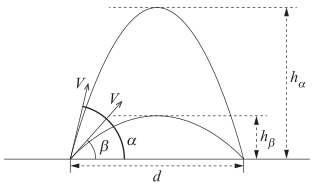


    Show that the average of the two heights, `(h_alpha + h_beta)/2`, depends only on `V` and `g`.  (3 marks)

    --- 9 WORK AREA LINES (style=lined) ---
Show Answers Only
  1. `text(Proof)\ \ text{(See Worked Solutions)}`
  2. `text(Proof)\ \ text{(See Worked Solutions)}`
  3. `text(Proof)\ \ text{(See Worked Solutions)}`
Show Worked Solution

i.    `text(Horizontal range occurs when)\ \ y = 0`

`Vt sin theta – (g t^2)/2` `= 0`
`V sin theta – (g t)/2` `= 0`
`t` `= (2V sin theta)/g`

 
`text(Find)\ \ x\ \ text(when)\ \ t=(2V sin theta)/g :`

`x` `= Vt cos theta`
  `= V((2V sin theta)/g) cos theta`
  `= (V^2 * 2sin theta cos theta)/g`
  `= V^2/g sin 2 theta\ \ \ text(.. as required)`


ii.  `text(Find)\ \ x\ \ text(when)\ \ theta = (pi/2 – theta):`

`x` `= V^2/g sin 2 (pi/2 – theta)`
  `= V^2/g underbrace {sin (pi – 2 theta)}_{text(Using)\ \ sin (pi-theta) = sin theta}`
  `= V^2/g sin 2 theta\ \ \ text(.. as required)`


iii.  `text(Highest point → half way through the flight.)`

`=> h_alpha\ \ text(occurs when)\ \ t=(V sin alpha)/g\ \ text{(by symmetry)}`
  

`:. h_alpha` `= V((V sin alpha)/g) sin alpha – g/2 ((V sin alpha)/g)^2`
  `= (V^2 sin^2 alpha)/g – g/2 ((V^2 sin^2 alpha)/g^2)`
  `= (V^2 sin^2 alpha)/g – (V^2 sin^2 alpha)/(2g)`
  `= (V^2 sin^2 alpha)/(2g)`


`text(Similarly,)\ \ h_beta = (V^2 sin^2 beta)/(2g)`

♦ Mean mark 44%.
 

`:. (h_alpha + h_beta)/2` `= 1/2 ((V^2 sin^2 alpha)/(2g) + (V^2 sin^2 beta)/(2g))`
  `= V^2/(4g) (sin^2 alpha + underbrace{sin^2 beta}_{text(Using)\ \ beta= pi/2 -alpha})`
  `= V^2/(4g) (sin^2 alpha + sin^2(pi/2 – alpha)) `
  `= V^2/(4g) (sin^2 alpha + cos^2 alpha)`
  `= V^2/(4g)`

 
`:. text(The average height depends only on)\ V\ text(or)\ g.`

Filed Under: Projectile Motion, Projectile Motion EXT1 Tagged With: Band 3, Band 4, Band 5, smc-1062-10-Range/Time of Flight, smc-1062-20-Max Height

Mechanics, EXT2* M1 2017 HSC 13c

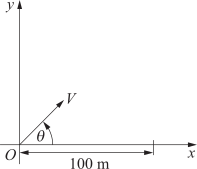
A golfer hits a golf ball with initial speed `V\ text(ms)^(−1)` at an angle `theta` to the horizontal. The golf ball is hit from one side of a lake and must have a horizontal range of 100 m or more to avoid landing in the lake.


Neglecting the effects of air resistance, the equations describing the motion of the ball are

`x = Vt costheta`

`y = Vt sintheta - 1/2 g t^2`,

where `t` is the time in seconds after the ball is hit and `g` is the acceleration due to gravity in `text(ms)^(−2)`. Do NOT prove these equations.

  1. Show that the horizontal range of the golf ball is
     
         `(V^2sin 2theta)/g` metres.  (2 marks)

    --- 5 WORK AREA LINES (style=lined) ---

  2. Show that if  `V^2 < 100 g`  then the horizontal range of the ball is less than 100 m.  (1 mark)

    --- 2 WORK AREA LINES (style=lined) ---

It is now given that  `V^2 = 200 g`  and that the horizontal range of the ball is 100 m or more.

  1. Show that  `pi/12 <= theta <= (5pi)/12`.  (2 marks)

    --- 4 WORK AREA LINES (style=lined) ---

  2. Find the greatest height the ball can achieve.  (2 marks)

    --- 6 WORK AREA LINES (style=lined) ---

Show Answers Only
  1. `text(See Worked Solution)`
  2. `text(See Worked Solution)`
  3. `text(See Worked Solution)`
  4. `25(2 – sqrt 3)\ text(metres)`
Show Worked Solution

i.   `text(Find)\ \ t\ \ text(when)\ \ y = 0:`

`1/2 g t^2` `= Vtsintheta`
`1/2 g t` `= Vsintheta`
`t` `= (2Vsintheta)/g`


`text(Horizontal range)\ (x)\ text(when)\ \ t = (2Vsintheta)/g :`

`x` `= V · (2Vsintheta)/g costheta`
  `= (V^2 2sintheta costheta)/g`
  `= (V^2sin2theta)/g\ … text(as required)`


ii.   `text(If)\ \ V^2 < 100 g`

♦ Mean mark 44%.
`x` `< (100 g sin2theta)/g`
`x` `< 100 sin2theta`


`text(S)text(ince)\ −1 <= 2theta <= 1,`

`x < 100\ text(metres)`


iii.   `V^2 = 200g,\ \ x >= 100`

`(200 g · sin2theta)/g` `>= 100`
`sin2theta` `>= 1/2`

`:. pi/6 <= 2theta <= (5pi)/6`

`:. pi/12 <= theta <= (5pi)/12\ …\ text(as required)`


iv.   `text(Max height occurs when)`

♦♦ Mean mark 35%.
`t` `= 1/2 xx text(time of flight)`
  `= (Vsintheta)/g`

 
`text(Find)\ \ y\ \ text(when)\ \ t = (Vsintheta)/g`

`y` `= V · (Vsintheta)/g · sintheta – 1/2 g ((Vsintheta)/g)^2`
  `= (V^2 sin^2theta)/g – 1/2 · (V^2 sin^2 theta)/g`
  `= (V^2 sin^2theta)/(2g)`


`text(Max height when)\ theta = (5pi)/12\ (text(steepest angle)), V^2 = 200 g\ (text(given))`

`y_text(max)` `= (200 g · sin^2 ((5pi)/12))/(2g)`
  `= 100 sin^2 ((5pi)/12)`
  `= 50(1 – cos((5pi)/6))`
  `= 50(1 + sqrt3/2)`
  `= 25(2 + sqrt 3)\ text(metres)`

Filed Under: Projectile Motion, Projectile Motion EXT1 Tagged With: Band 4, Band 5, Band 6, smc-1062-10-Range/Time of Flight, smc-1062-20-Max Height, smc-1062-40-Initial Angle/Speed

Mechanics, EXT2* M1 2016 HSC 13b

The trajectory of a projectile fired with speed  `u\ text(ms)^-1`  at an angle  `theta`  to the horizontal is represented by the parametric equations

`x = utcostheta`   and   `y = utsintheta - 5t^2`,

where `t` is the time in seconds.

  1. Prove that the greatest height reached by the projectile is  `(u^2 sin^2 theta)/20`.  (2 marks)

    --- 5 WORK AREA LINES (style=lined) ---

A ball is thrown from a point `20\ text(m)` above the horizontal ground. It is thrown with speed `30\ text(ms)^-1` at an angle of `30^@` to the horizontal. At its highest point the ball hits a wall, as shown in the diagram.
 

     ext1-2016-hsc-q13
 

  1. Show that the ball hits the wall at a height of `125/4\ text(m)` above the ground.  (2 marks)

    --- 4 WORK AREA LINES (style=lined) ---

The ball then rebounds horizontally from the wall with speed `10\ text(ms)^-1`. You may assume that the acceleration due to gravity is `10\ text(ms)^-2`.

  1. How long does it take the ball to reach the ground after it rebounds from the wall?  (2 marks)

    --- 6 WORK AREA LINES (style=lined) ---

  2. How far from the wall is the ball when it hits the ground?  (1 mark)

    --- 2 WORK AREA LINES (style=lined) ---

Show Answers Only
  1. `text(Proof)\ \ text{(See Worked Solutions)}`
  2. `text(Proof)\ \ text{(See Worked Solutions)}`
  3. `2.5\ text(seconds)`
  4. `25\ text(m)`
Show Worked Solution
i.    `y` `= u t sin theta – 5t^2`
  `y prime` `= u sin theta – 10t`


`text(Maximum height when)\ \ y prime = 0`

`10 t` `= u sin theta`
`t` `= (u sin theta)/10`


`:.\ text(Maximum height)`

`= u ((u sin theta)/10) · sin theta – 5 ((u sin theta)/10)^2`

`= (u^2 sin^2 theta)/10 – (u^2 sin^2 theta)/20`

`= (u^2 sin^2 theta)/20\ text(… as required)`


ii.   `text{Using part (i)},`

`text(Height that ball hits wall)`

`= (30^2 · (sin 30)^2)/20 + 20`

`= (30^2 · (1/2)^2)/20 + 20`

`= 11 1/4 + 20`

`= 125/4\ text(m … as required)`


♦♦ Mean mark part (iii) 35%.
iii.   ext1-hsc-2016-13bi
`y ″` `= -10`
`y prime` `= -10 t`
`y` `= 125/4 – 5t^2`


`text(Ball hits ground when)\ \ y = 0,`

MARKER’S COMMENT: Many students struggled to solve: `5t^2=125/4`.
`5t^2` `= 125/4`
`t^2` `= 25/4`
`:. t` `= 5/2,\ \ t > 0`


`:.\ text(It takes the ball 2.5 seconds to hit the ground.)`


iv.   `text(Distance from wall)`

♦ Mean mark 43%.

`= 2.5 xx 10`

`= 25\ text(m)`

Filed Under: Projectile Motion, Projectile Motion EXT1 Tagged With: Band 3, Band 4, Band 5, smc-1062-10-Range/Time of Flight, smc-1062-20-Max Height, smc-1062-95-Hit Wall

Mechanics, EXT2* M1 2005 6b

An experimental rocket is at a height of  5000 m, ascending with a velocity of  ` 200 sqrt 2\ text(m s)^-1`  at an angle of  45°  to the horizontal, when its engine stops.


After this time, the equations of motion of the rocket are:

`x = 200t`

`y = -4.9t^2 + 200t + 5000,`

where `t` is measured in seconds after the engine stops. (Do NOT show this.)

  1. What is the maximum height the rocket will reach, and when will it reach this height?  (2 marks)

    --- 6 WORK AREA LINES (style=lined) ---

  2. The pilot can only operate the ejection seat when the rocket is descending at an angle between 45° and 60° to the horizontal. What are the earliest and latest times that the pilot can operate the ejection seat?  (3 marks)

    --- 10 WORK AREA LINES (style=lined) ---

  3. For the parachute to open safely, the pilot must eject when the speed of the rocket is no more than  `350\ text(m s)^-1`. What is the latest time at which the pilot can eject safely?  (2 marks)

    --- 8 WORK AREA LINES (style=lined) ---

Show Answers Only
  1. `7041\ text(metres)`


    `20.4\ text(seconds.)`

  2. `40.8\ text(seconds)\ ;\ 55.8\ text(seconds)`
  3. `49.7\ text(seconds)`
Show Worked Solution

i.


`y = -4.9t^2 + 200t + 5000`

`dot y = -9.8t + 200`

`text(Max height occurs when)\ \ dot y = 0`

`9.8t` `= 200`
`t` `= 20.408…`
  `= 20.4\ text{seconds  (to 1 d.p.)}`


`text(When)\ t = 20.408…`

`y` `= -4.9 (20.408…)^2 + 200 (20.408…) + 5000`
  `= 7040.816…`
  `= 7041\ text{m  (to nearest metre)}`


`:.\ text(The rocket will reach a maximum height of)`

`text(7041 metres when)\ \ t = 20.4\ text(seconds.)`


ii.  `text(The rocket is descending at 45° at point)\ A\ text(on the graph.)`

`text(The symmetry of the parabolic motion means that)\ \ A`

`text(occurs when)\ \ t = 2 xx text(time to reach max height, or)`

`40.8\ text(seconds.)`


`text(Point)\ B\ text(occurs when the rocket is descending at 60°)`

`text(to the horizontal.)`


`text(At)\ \ B,`


`-tan 60° = (dot y)/(dot x)`

`text{(The gradient of the projectile becomes}`

`text{negative after reaching its max height.)}`

`dot y = -9.8t + 200`

`dot x = d/(dt) (200t) = 200`

`:.\ – sqrt 3` `= (-9.8t + 200)/200`
`-200 sqrt 3` `= -9.8t + 200`
`9.8t` `= 200 + 200 sqrt 3`
`t` `= (200 + 200 sqrt 3)/9.8`
  `= (546.410…)/9.8`
  `= 55.756…`
  `= 55.8\ text{seconds  (nearest second)}`


`:.\ text(The pilot can operate the ejection seat)`

`text(between)\ \ t = 40.8 and t = 55.8\ text(seconds.)`


iii.

`v^2 = (dot x)^2 + (dot y)^2`

`text(When)\ \ v = 350`

`350^2` `= 200^2 + (-9.8t + 200)^2`
`122\ 500` `= 40\ 000 + (-9.8t + 200)^2`
`(-9.8t + 200)^2` `= 82\ 500`
`-9.8t + 200` `= +- sqrt (82\ 500)`
`9.8t` `= 200 +- sqrt (82\ 500)`
`t` `= (200 +- sqrt (82\ 500))/9.8`
  `= 49.717…\ \ \ (t > 0)`
  `= 49.7\ text{seconds  (to 1 d.p.)}`


`:.\ text(The latest time the pilot can eject safely)`

`text(is when)\ \ t = 49.7\ text(seconds.)`

Filed Under: Projectile Motion, Projectile Motion EXT1 Tagged With: Band 4, Band 5, Band 6, page-break-before-solution, smc-1062-20-Max Height, smc-1062-50-Angle of Trajectory/Impact

Mechanics, EXT2* M1 2012 HSC 14b

A firework is fired from `O`, on level ground, with velocity `70` metres per second at an angle of inclination  `theta`. The equations of motion of the firework are

 `x = 70t cos theta\ \ \ \ `and`\ \ \ y = 70t sin theta\ – 4.9t^2`. (Do NOT prove this.) 

The firework explodes when it reaches its maximum height.
 

2012 14b
 

  1. Show that the firework explodes at a height of  `250 sin^2 theta`  metres.   (2 marks)

    --- 6 WORK AREA LINES (style=lined) ---

  2. Show that the firework explodes at a horizontal distance of  `250 sin 2 theta`  metres from  `O`.    (1 mark)

    --- 4 WORK AREA LINES (style=lined) ---

  3. For best viewing, the firework must explode at a horizontal distance between 125 m and 180 m from `O`, and at least 150 m above the ground.


    For what values of  `theta`  will this occur?   (3 mark)

    --- 8 WORK AREA LINES (style=lined) ---

Show Answers Only
  1. `text(Proof)\ \ text{(See Worked Solutions)}`
  2. `text(Proof)\ \ text{(See Worked Solutions)}`
  3. `66.97^@… <= theta <= 75^@\ text(for best viewing)`
Show Worked Solution

i.   `text(Show max height is)\ 250 sin^2 theta\ text(metres)`

`text(Firework explodes at max height)`

`text(Find)\ \ t\ \ text(when)\ dot y = 0`

`y = 70t sin theta\ – 4.9t^2`

`dot y = 70 sin theta\ – 9.8t`
 

`text(When)\ \ dot y = 0`

`70 sin theta\ – 9.8t` `= 0`
`9.8t` `=70 sin theta`
`t` `= 70/9.8 sin theta`


`:.\ y_max` `= 70 * 70/9.8 sin theta * sin theta\ – 4.9 * (70^2)/(9.8^2) sin^2 theta`
  `= 500 sin^2 theta\ – 250 sin^2 theta`
  `= 250 sin^2 theta\ text(metres)\ \ \ \ \ text(… as required)`


ii.  `x = 70t cos theta`

`text(At)\ \ t = 70/9.8 sin theta`

`x` `= 70 * 70/9.8 sin theta cos theta`
  `= 250 * 2 sin theta cos theta`
  `= 250 sin 2 theta\ text(metres)\ \ \ \ \ text(… as required)`


iii.  `text(Best viewing when)`

♦♦ Mean mark 28%
MARKER’S COMMENT: Many students ignored the findings in earlier parts and tried unsuccessfully to solve inequalities that still contained `t`.

`125 <= x <= 180\ \ text(and)\ \ y >= 150`

`text(S)text(ince)\ x = 250 sin 2 theta`

`125` `<= 250 sin 2 theta <= 180`
`1/2` `<= sin 2 theta <= 18/25`


`text(In the 1st quadrant)`

`30^@ <= 2 theta <= 46.054…^@`

`15^@ <= theta <= 23.0^@`

`text(In the 2nd quadrant)`

`133.94…^@` `<= 2 theta <= 150^@`
`67.0^@` `<= theta <= 75^@`

 
`text{Using part (i)}`

`text(When)\ theta = 23.0^@`

`y_(max)` `= 250 xx sin^2 23.0^@`
  `~~ 38 < 150text(m)`

 
`=> text(“Highest” max height for)\ \ 15°<=theta<=23.0\ \ text(does not satisfy.)`

 
`text(When)\ theta = 67.0…^@`

`y_text(max)` `= 250 xx sin^2 67.0^@`
  `~~ 212 > 150 text(m)`


`=> text(“Lowest” max height for)\ \ 67°<=theta<=75°\ \ text(satisfies.)`

`:.\ 67.0^@ <= theta <= 75^@\ text( for best viewing)`.

Filed Under: Projectile Motion, Projectile Motion EXT1 Tagged With: Band 4, Band 5, smc-1062-10-Range/Time of Flight, smc-1062-20-Max Height, smc-1062-40-Initial Angle/Speed

Mechanics, EXT2* M1 2013 HSC 13c

Points `A` and `B` are located `d` metres apart on a horizontal plane. A projectile is fired from `A` towards `B` with initial velocity `u` m/s at angle `alpha` to the horizontal.

At the same time, another projectile is fired from `B` towards `A` with initial velocity `w` m/s at angle `beta` to the horizontal, as shown on the diagram.

The projectiles collide when they both reach their maximum height.
 

2013 13c
 

The equations of motion of a projectile fired from the origin with initial velocity  `V` m/s at angle  `theta`  to the horizontal are

`x=Vtcostheta`   and   `y=Vtsintheta-g/2 t^2`.        (DO NOT prove this.)

  1. How long does the projectile fired from  `A`  take to reach its maximum height?  (2 marks)

    --- 5 WORK AREA LINES (style=lined) ---

  2. Show that  `usinalpha=w sin beta`.    (1 mark)

    --- 3 WORK AREA LINES (style=lined) ---

  3. Show that  `d=(uw)/(g)sin(alpha+beta)`.    (2 marks)

    --- 8 WORK AREA LINES (style=lined) ---

Show Answers Only
  1. `(u)/(g) sin alpha\ \ text(seconds)`
  2. `text{Proof  (See Worked Solutions)}`
  3. `text{Proof  (See Worked Solutions)}`
Show Worked Solution

i.   `y=Vtsintheta-g/2 t^2`

`text(Projectile)\ A\   => V=u,\ \ theta=alpha`

`y` `=ut sinalpha- (g)/2 t^2`
`doty` `=u sinalpha- g t`


`text(Max height when)\  doty=0`

`0` `=usinalpha-g t`
`g t` `=usinalpha`
`t` `=(u)/(g)sinalpha`

 
`:.\ text(Projectile from)\ A\ text(reaches max height at)`

 `t=(u)/(g)sin alpha\ \ text(seconds)`


ii.  `text(Show that)\ \ usin alpha=wsin beta`

IMPORTANT: Part (i) in this example leads students to a very quick solution. Always look to previous parts for clues to direct your strategy.

`text(Projectile)\ B\ =>V=w,\ \ theta=beta`

`y` `=wt sin beta- (g)/2 t^2`
`doty` `=wsin beta-g t`


`text(Max height when)\ \ doty=0`

`t=(w)/(g) sin beta`

`text{Projectiles collide at max heights}`

`text(S)text(ince they were fired at the same time)`

`(u)/(g) sin alpha` `=(w)/(g) sin beta`
`:.\ usin alpha` `=wsin beta\ \ text(… as required)`


iii  `text(Show)\ \ d=(uw)/(g) sin (alpha+beta) :`

`text(Find)\ x text(-values for each projectile at max height)`

`text(Projectile)\ A`

`x_1` `=utcos alpha`
  `=u((u)/(g) sin alpha)cos alpha`
  `=(u^2)/(g) sin alpha cos alpha`


`text(Projectile)\ B`

♦ Mean mark 39%
IMPORTANT: Students should direct their calculations by reverse engineering the required result. `sin(alpha+beta)` in the proof means that  `sin alpha cos beta+“ cos alpha sin beta`  will appear in the working calculations.
`x_2` `=wt cos beta`
  `=w((w)/(g) sin beta)cos beta`
  `=(w^2)/(g) sin beta cos beta`
`d` `=x_1+x_2`
  `=(u^2)/(g) sin alpha cos alpha+(w^2)/(g) sin beta cos beta`
  `=(u)/(g)(u sin alpha)cos alpha+(w)/(g) (w sin beta) cos beta`
  `=(u)/(g)(w sin beta) cos alpha+(w)/(g) (usin alpha)cos beta\ \ text{(part (ii))}`
  `=(uw)/(g) (sin alpha cos beta+cos alpha sin beta)`
  `=(uw)/(g) sin (alpha+beta)\ \ text(… as required)`


Filed Under: Projectile Motion, Projectile Motion EXT1 Tagged With: Band 4, Band 5, Band 6, smc-1062-20-Max Height, smc-1062-90-Projectiles Collide

Copyright © 2014–2025 SmarterEd.com.au · Log in