A table tennis club consists of 6 males and 5 females.
How many committees of 4 players can be chosen that contain no more than 2 females?
- 250
- 265
- 305
- 330
Aussie Maths & Science Teachers: Save your time with SmarterEd
A table tennis club consists of 6 males and 5 females.
How many committees of 4 players can be chosen that contain no more than 2 females?
\(\Rightarrow B\)
\(\text{Combinations (0 females)}={ }^6 C_4=15\)
\(\text{Combinations (1 female)}={ }^5 C_1 \times{ }^6 C_3=100\)
\(\text{Combinations (2 females)}={ }^5 C_2 \times{ }^6 C_2=150\)
\(\text{Total combinations }=15+100+150=265\)
\(\Rightarrow B\)
The diagram shows triangle `A B C` with points chosen on each of the sides. On side `A B`, 3 points are chosen. On side `A C`, 4 points are chosen. On side `B C`, 5 points are chosen.
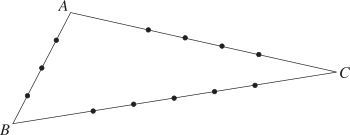
How many triangles can be formed using the chosen points as vertices?
`C`
`text{1 point taken from each side:}`
`text{Triangles} = 3 xx 4xx5=60`
`text{2 points taken from one side:}`
| `text{Triangles}` | `=((3),(2))((9),(1))+((4),(2))((8),(1))+((5),(2))((7),(1))` | |
| `=145` |
`:.\ text{Total triangles} =60+145=205`
`=>C`
A committee containing 5 men and 3 women is to be formed from a group of 10 men and 8 women.
In how many different ways can the committee be formed? (1 mark)
`14\ 112`
`text(Different combinations)`
`= \ ^10C_5 · \ ^8C_3`
`= 14\ 112`
Out of 10 contestants, six are to be selected for the final round of a competition. Four of those six will be placed 1st, 2nd, 3rd and 4th.
In how many ways can this process be carried out?
`C`
| `text(Combinations)` | `= \ ^10 C_6 xx \ ^6P_4` |
| `= \ ^10 C_6 xx 6 xx 5 xx 4 xx 3` | |
| `= (10!)/(6!4!) xx (6!)/(2!)` | |
| `= (10!)/(4!2!)` |
`=>C`
Three squares are chosen at random from the 3 × 3 grid below, and a cross is placed in each chosen square.
What is the probability that all three crosses lie in the same row, column or diagonal?
A. `1/28`
B. `2/21`
C. `1/3`
D. `8/9`
`B`
| `P` | `= text(favourable events)/text(total possible events)` |
| `= (3 + 3 + 2)/(\ ^9C_3)` | |
| `= 2/21` |
`=>B`
A team of 11 students is to be formed from a group of 18 students. Among the 18 students are 3 students who are left-handed.
What is the number of possible teams containing at least 1 student who is left-handed?
`B`
`text(Teams with at least 1 left-hander)`
`=\ ^18C_11 -\ ^15C_11`
`= 30\ 459`
`=> B`
A bag contains 12 red marbles and 12 yellow marbles. Six marbles are selected at random without replacement.
--- 4 WORK AREA LINES (style=lined) ---
i. `\ ^12C_3= text(# Ways of selecting 3 R or Y from 12.)`
`\ ^24C_6=text(# Ways of selecting 6 from 24.)`
| `P text{(exactly 3R)}` | `=(\ ^12C_3 xx \ ^12C_3)/(\ ^24C_6)` |
| `=(220 xx 220)/(134\ 596)` | |
| `=0.36\ \ text{(to 2 d.p.)}` |
ii. `text(Solution 1)`
| `text(S)text(ince)\ \ P text{(> 3 Red)` | `=Ptext{(< 3 Red)}` |
| `P text{(> 3 Red)` | `=1/2[1-Ptext{(exactly 3R)}]` |
| `=1/2(1-0.36)` | |
| `=0.32` |
`text(Solution 2)`
| `P (> 3R)` | `=P (4R) + P (5R) + P (6R)` |
| `=(\ ^12C_4 \ ^12C_2 + \ ^12C_5 \ ^12C_1 + \ ^12C_6 xx \ ^12C_0)/(\ ^24C_6)` | |
| `=(43\ 098)/(134\ 596)` | |
| `=0.32\ \ text{(to 2 d.p.)}` |
Katie is one of ten members of a social club. Each week one member is selected at random to win a prize.
--- 2 WORK AREA LINES (style=lined) ---
--- 5 WORK AREA LINES (style=lined) ---
--- 8 WORK AREA LINES (style=lined) ---
i. `Ptext{(wins at least 1 prize)}`
`= 1 − Ptext{(wins no prize)}`
`= 1 − (9/10)^7`
`= 0.5217…`
`= 0.52\ \ \ text{(2 d.p.)}`
ii. `text(In 1st 20 weeks,)`
`Ptext{(winning exactly 1 prize)}`
`=\ ^(20)C_1 · (1/10) · (9/10)^19`
`= 0.2701…`
`Ptext{(winning exactly 2 prizes)}`
`=\ ^(20)C_2 · (1/10)^2 · (9/10)^18`
`= 0.2851…`
`:.\ text(Katie has a greater chance of winning)`
`text(exactly 2 prizes.)`
iii. `Ptext{(winning exactly 3 prizes)}`
`=\ ^nC_3 · (1/10)^3 · (9/10)^(n − 3)`
`Ptext{(winning exactly 2 prizes)}`
`=\ ^nC_2 · (1/10)^2 · (9/10)^(n − 2)`
`text(If greater chance of winning exactly 3 than exactly 2:)`
| `\ ^nC_3 · (1/10)^3 · (9/10)^(n − 3)` | `>\ ^nC_2 · (1/10)^2 · (9/10)^(n − 2)` |
| `(n!)/(3!(n − 3)) · 1/10` | `> (n!)/(2!(n − 2)!) · 9/10` |
| `(2!(n − 2)!)/(3!(n − 3)!)` | `> 9` |
| `(n − 2)/3` | `> 9` |
| `n − 2` | `> 27` |
| `n` | `> 29` |
`:.\ text(Katie must participate for 30 weeks.)`
A four-person team is to be chosen at random from nine women and seven men.
--- 2 WORK AREA LINES (style=lined) ---
i. `text(# Team combinations)`
`=\ ^(16)C_4`
`= (16!)/((16 − 4)!\ 4!)`
`= 1820`
ii. `text{P(4 women)}`
`= (\ ^9C_4)/1820`
`= 126/1820`
`= 9/130`
Sophie has five coloured blocks: one red, one blue, one green, one yellow and one white. She stacks two, three, four or five blocks on top of one another to form a vertical tower.
--- 1 WORK AREA LINES (style=lined) ---
--- 2 WORK AREA LINES (style=lined) ---
| i. `text(Towers)` | `= \ ^5P_3` |
| `= 60` |
ii. `text(Number of different towers)`
`= \ ^5P_2 + \ ^5P_3 + \ ^5P_4 + \ ^5P_5`
`= 20 + 60 + 120 + 120`
`= 320`
Two players `A` and `B` play a series of games against each other to get a prize. In any game, either of the players is equally likely to win.
To begin with, the first player who wins a total of 5 games gets the prize.
--- 3 WORK AREA LINES (style=lined) ---
By considering the probability that `A` gets the prize, prove that
--- 8 WORK AREA LINES (style=lined) ---
i. `text(To win exactly 7 games, player)\ A`
`text(must win the 7th game.)`
`:.P(A\ text{wins in 7 games)}`
`=\ ^6C_4 · (1/2)^4(1/2)^2 xx 1/2`
`=\ ^6C_4(1/2)^7`
ii. `Ptext{(wins in at most 7 games)}`
`=Ptext{(wins in 5, 6 or 7 games)}`
`=\ ^4C_4(1/2)^4 xx 1/2 +\ ^5C_4(1/2)^4(1/2) xx 1/2 +\ ^6C_4(1/2)^7`
`=\ ^4C_4(1/2)^5 +\ ^5C_4(1/2)^6 +\ ^6C_4(1/2)^7`
iii. `text(Prove that)`
`\ ^nC_n · 2^n +\ ^(n + 1)C_n · 2^(n − 1) + … +\ ^(2n)C_n = 2^(2n)`
`P(A\ text(wins in)\ (n + 1)\ text{games)}`
`=\ ^nC_n(1/2)^(n + 1) +\ ^(n + 1)C_n(1/2)^(n + 2) + … +\ ^(2n)C_n(1/2)^(2n + 1)`
`text{One player must have won after (2n + 1) games are played.}`
`text(S)text(ince each player has an equal chance,)`
`\ ^nC_n(1/2)^(n + 1) +\ ^(n + 1)C_n(1/2)^(n + 2) + … +\ ^(2n)C_n(1/2)^(2n + 1) = 1/2`
`text(Multiply both sides by)\ 2^(2n + 1)`
`\ ^nC_n2^(-(n + 1)) · 2^(2n + 1) +\ ^(n + 1)C_n · 2^(-(n + 2)) · 2^(2n + 1) + …`
`… +\ ^(2n)C_n · 2^(-(2n + 1)) · 2^(2n + 1) = 2^(-1) · 2^(2n + 1)`
`:. \ ^nC_n · 2^n +\ ^(n + 1)C_n · 2^(n − 1) + … +\ ^(2n)C_n = 2^(2n)`
A rowing team consists of 8 rowers and a coxswain.
The rowers are selected from 12 students in Year 10.
The coxswain is selected from 4 students in Year 9.
In how many ways could the team be selected?
`C`
| `\ ^(12)C_8` | `=\ text(Combinations of rowers)` |
| `\ ^4C_1` | `=\ text(Combinations of coxswains)` |
`:.\ text(Number of ways to select team)`
`=\ ^12C_8 xx\ ^4C_1`
`=> C`
Alex’s playlist consists of 40 different songs that can be arranged in any order.
--- 1 WORK AREA LINES (style=lined) ---
--- 2 WORK AREA LINES (style=lined) ---
| i. | `#\ text(Arrangements) = 40!` |
| ii. | `#\ text(Arrangements)` | `= 3! xx 37!` |
| `= 6 xx 37!` |
In how many ways can a committee of 3 men and 4 women be selected from a group of 8 men and 10 women? (1 mark)
--- 2 WORK AREA LINES (style=lined) ---
`11\ 760`
| `text(# Combinations)` | `=\ ^8C_3 xx\ ^10C_4` |
| `= (8!)/(5!3!) xx (10!)/(6!4!)` | |
| `= 56 xx 210` | |
| `= 11\ 760` |