SmarterEd

Aussie Maths & Science Teachers: Save your time with SmarterEd

  • Login
  • Get Help
  • About

Vectors, EXT1 V1 2025 HSC 14b

Points \(A\) and \(B\) lie vertically above the origin. Point \(A\) is higher than point \(B\) such that  \(\dfrac{OA}{O B}=k\), where  \(k>1\).

A particle is projected horizontally from point \(A\) with velocity \(U\ \text{ms}^{-1}\). After \(T\) seconds, another particle is projected horizontally from point \(B\) with velocity \(V\ \text{ms}^{-1}\). The two particles land on the ground in the same place.
 

Show that the ratio \(\dfrac{V}{U}\) depends only on \(k\).   (4 marks)

--- 12 WORK AREA LINES (style=lined) ---
Show Answers Only

\(\text{See Worked Solutions.}\)

Show Worked Solution

\(\text{Let} \ \ OB=h \ \Rightarrow \ OA=k \times OB=k h\)

\({\underset{\sim}{a}}_A=\displaystyle \binom{0}{-g}, \quad {\underset{\sim}{v}}_A=\displaystyle \binom{U}{-g t_1}, \quad {\underset{\sim}{r}}_A=\displaystyle \binom{U t_1}{k h-\frac{1}{2} g t_1^2}\)

 
\(\text{Time of flight for} \ B\left(t_2\right) \neq \text{Time of flight for} \ A\left(t_1\right)\)

\({\underset{\sim}{a}}_B=\displaystyle \binom{0}{-g}, \quad {\underset{\sim}{v}}_B=\displaystyle\binom{V}{-g t_2}, \quad {\underset{\sim}{r}}_B=\displaystyle\binom{V t_2}{h-\frac{1}{2} g t_2^2}\)
 

\(\text{Time of flight for} \ A\left(t_1\right)\) :

\(kh-\dfrac{1}{2} g t_1^2=0 \ \Rightarrow \  t_1^2=\dfrac{2kh}{g} \ \Rightarrow \ t_1=\sqrt{\dfrac{2 kh}{g}}\)

\(\text{Range of} \ A=Ut_1=U \sqrt{\dfrac{2 k h}{g}}\)

 
\(\text{Time of flight for}\ B\left(t_2\right):\)

\(h-\dfrac{1}{2} g t_2^2=0 \ \Rightarrow \ t_2^2=\dfrac{2 h}{g}\ \Rightarrow \  t_2=\sqrt{\dfrac{2 h}{g}}\)

\(\text{Range of} \ B=Vt_2=V \sqrt{\dfrac{2h}{g}}\)

\(\text{Equating ranges:}\)

\(V \sqrt{\dfrac{2h}{g}}\) \(=U \sqrt{\dfrac{2 kh}{g}}\)  
\(\dfrac{V}{U}\) \(=\sqrt{\dfrac{2 kh}{g}} \times \sqrt{\dfrac{g}{2 h}}=\sqrt{k}\)  

 
\(\therefore \dfrac{V}{U} \ \text{ratio depends only on} \ k.\)

Filed Under: Vectors and Projectile Motion (Ext1) Tagged With: Band 5, smc-1087-10-Range, smc-1087-30-Time of Flight

Vectors, EXT1 V1 2022 HSC 14c

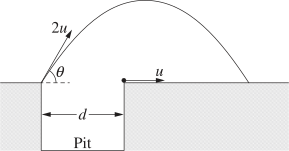
A video game designer wants to include an obstacle in the game they are developing. The player will reach one side of a pit and must shoot a projectile to hit a target on the other side of the pit in order to be able to cross. However, the instant the player shoots, the target begins to move away from the player at a constant speed that is half the initial speed of the projectile shot by the player, as shown in the diagram below.

The initial distance between the player and the target is `d`, the initial speed of the projectile is `2 u` and it is launched at an angle of `theta` to the horizontal. The acceleration due to gravity is `g`. The launch angle is the ONLY parameter that the player can change.


Taking the position of the player when the projectile is launched as the origin, the positions of the projectile and target at time `t` after the projectile is launched are as follows.

`vecr_(P)` `=((2utcostheta),(2utsintheta-g/2t^2))` `text{Projectile}`
     
`vecr_(T)` `=((d+ut),(0))` `text{Target          (Do NOT prove these)}`

 
Show that, for the player to have a chance of hitting the target, `d` must be less than 37% of the maximum possible range of the projectile (to 2 significant figures).  (4 marks)

--- 10 WORK AREA LINES (style=lined) ---

Show Answers Only

`text{Proof (See Worked Solutions)}`

Show Worked Solution

`text{Projectile’s motion:}`

`x_P=2utcostheta, \ \ y_P=2utsintheta-g/2t^2`

`text{Time of flight}\ \ =>\ \ text{Find}\ \ t\ \ text{when}\ \ y=0:`

`2utsintheta-g/2t^2` `=0`  
`t(2usintheta-g/2 t)` `=0`  
`g/2 t` `=2u sin theta`  
`t` `=(4usintheta)/g`  


`text{Range of projectile}\ (R):`

`R` `=2u((4usintheta)/g) costheta`  
  `=(8u^2sinthetacostheta)/g`  
  `=(4u^2sin(2theta))/g`  

 
`=>R_max=(4u^2)/g \ \ (text{when}\ \ theta=45°):`

`text{Projectile will hit target when}\ \ x_P=x_T\ \ text{at}\ \ t=(4usintheta)/g:`

`(4u^2sin(2theta))/g` `=d+u*(4usintheta)/g`  
`d` `=(4u^2sin(2theta))/g-u*(4usintheta)/g`  
  `=(4u^2)/g\ (sin(2theta)-sintheta)`  
  `=R_max*(sin(2theta)-sintheta)`  

 
`d_max\ \ text{occurs when}\ \ (sin(2theta)-sin theta)\ \ text{is MAX}`

`f(theta)` `=sin(2theta)-sintheta`  
`f^(′)(theta)` `=2cos(2theta)-costheta`  
`f^(′′)(theta)` `=-4sin(2theta)+sin theta`  

 
`text{Find SP’s when}\ \ f^(′)(theta)=0:`

`2cos2theta-costheta` `=0`  
`2(2cos^2theta-1)-costheta` `=0`  
`4cos^2theta-costheta-2` `=0`  


`costheta` `=(1+-sqrt(1-4xx4xx-2))/(2xx4)`  
  `=(1+-sqrt33)/8`  
`theta` `=32°32′, \ 126°23′`  

 
`f^(′′)(32°32′)~~-3.1<0`

`=>\ text{MAX at}\ \ theta=32°32′`
 

`:.d_max` `=R_max xx (sin65°04′-sin32°32′)`  
  `=(0.369)R_max<0.37R_max`  

♦♦ Mean mark 33%.

Filed Under: Vectors and Projectile Motion (Ext1) Tagged With: Band 5, smc-1087-10-Range, smc-1087-30-Time of Flight, smc-1087-85-Collision

Vectors, EXT1 V1 SM-Bank 30

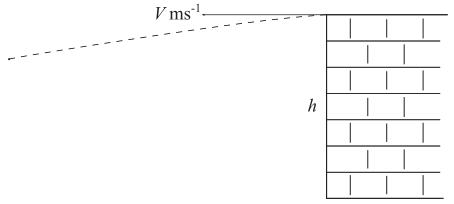
A canon ball is fired from a castle wall across a horizontal plane at `V` ms−1.

Its position vector  `t` seconds after it is fired from its origin is given by  `underset~s(t) = V tunderset~i - 1/2g t^2 underset~j`.

  1. If the projectile hits the ground at a distance 8 times the height at which it was fired, show that it initial velocity is given by
     
          `V = 4sqrt(2hg)`  (2 marks)

    --- 5 WORK AREA LINES (style=lined) ---

  2. Show that the total distance the canon ball travels can be expressed as
     
          `int_0^sqrt((2h)/g) sqrt(g(32h + g t^2))\ dt` 
    (2 marks)

    --- 5 WORK AREA LINES (style=lined) ---

Show Answers Only
  1. `text(See Worked Solutions)`
  2. `text(See Worked Solutions)`
Show Worked Solution

i.   `text(Time of flight  ⇒  find)\ t\ text(when)\ \ y = −h`

`−1/2g t^2` `= −h`
`t^2` `= (2h)/g`
`t` `= sqrt((2h)/g),\ \ t > 0`


`text(S)text(ince the canon ball impacts when)\ \ x = 8h:`

`Vt` `= 8h`
`Vsqrt((2h)/g)` `= 8h`
`V` `= (8sqrt(hg))/sqrt2`
  `= 4sqrt(2hg)`


ii.   `underset~v = 4sqrt(2hg) underset~i – g t underset~j`

`|underset~v|` `= sqrt((4sqrt(2hg))^2 + (−g t)^2)`
  `= sqrt(16 xx 2hg  + g^2 t^2)`
  `=sqrt(g(32h + g t^2)`


`text(Distance)` `= int_0^sqrt((2h)/g) |underset~v|\ dt`
  `= int_0^sqrt((2h)/g) sqrt(g(32h + g t^2))\ dt`

Filed Under: Vectors and Projectile Motion (Ext1) Tagged With: Band 5, Band 6, smc-1087-10-Range, smc-1087-30-Time of Flight, smc-1087-80-Total Distance

Vectors, EXT1 V1 2019 SPEC2-N 4

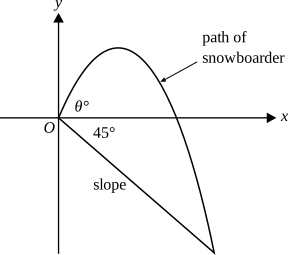
A snowboarder at the Winter Olympics leaves a ski jump at an angle of `theta` degrees to the horizontal, rises up in the air, performs various tricks and then lands at a distance down a straight slope that makes an angle of 45° to the horizontal, as shown below.

Let the origin `O` of a cartesian coordinate system be at the point where the snowboarder leaves the jump, with a unit vector in the positive `x` direction being represented by  `underset~i`  and a unit vector in the positive `y` direction being represented by  `underset~j`. Distances are measured in metres and time is measured in seconds.

The position vector of the snowboarder  `t`  seconds after leaving the jump is given by

`underset~r (t) = (6t-0.01t^3) underset~i + (6 sqrt3 t-4.9t^2 + 0.01t^3) underset~j , \ t ≥ 0`


  1. Find the angle  `theta °`.    (2 marks)

    --- 5 WORK AREA LINES (style=lined) ---

  2. Find the speed, in metres per second, of the snowboarder when she leaves the jump at `O`.    (1 mark)

    --- 2 WORK AREA LINES (style=lined) ---

  3. Find the maximum height above `O` reached by the snow boarder. Give your answer in metres, correct to one decimal place.    (2 marks)

    --- 4 WORK AREA LINES (style=lined) ---

  4. Show that the time spent in the air by the snowboarder is  `(60(sqrt3 + 1))/(49)`  seconds.    (3 marks)

    --- 6 WORK AREA LINES (style=lined) ---

Show Answers Only
  1. `60°`
  2. `12 \ text(ms)^-1`
  3. `5.5 \ text(m)`
  4. `text(See Worked Solutions)`
Show Worked Solution

a.   `v(t) = (6-0.03t^2)underset~i + (6 sqrt3-9.8t + 0.03t^2) underset~j`

`text(When) \ t =0,`

`v(t) = 6underset~i + 6 sqrt3 underset~j`

`tan theta = (6 sqrt3)/(6) = sqrt3`

`:. \ theta` `= tan^-1 sqrt3= 60°`


b.    `text(Speed)` `= |v(0)|`
    `= sqrt(6^2 + (6 sqrt3)^2)`
    `= 12 \ text(ms)^-1`

 
c.   `text(Max height when) \ underset~j \ text(component of) \ v(t) = 0`

`text(Solve): \ \ 6 sqrt3-9.8t + 0.03t^2 = 0`

`=> t =  1.064 \ text(seconds)`

`text(Max height)` `= 6 sqrt3 (1.064)-4.9(1.064)^2 + 0.01(1.064)^3`  
  `~~5.5\ text(m)`  

 
d.   `text(Time of Flight  ⇒  Solve for)\ \ t\ \ text(when)\ \ y=-x:`

`6 sqrt 3 t-4.9t^2 + 0.01 t^3` `= -(6t-0.01t^3)`
`(6 + 6 sqrt3)t-4.9 t^2` `= 0`
`t(6 + 6 sqrt3-4.9 t)` `= 0`
`4.9 t` `= 6 + 6 sqrt3`
`t` `= (6 + 6 sqrt3)/(4.9)`
  `= (60(sqrt3 + 1))/(49)\ text(seconds)`

Filed Under: Vectors and Projectile Motion (Ext1) Tagged With: Band 4, Band 5, Band 6, smc-1087-20-Maximum Height, smc-1087-30-Time of Flight, smc-1087-40-Initial Angle

Vectors, EXT1 V1 SM-Bank 6

A cricketer hits a ball at time  `t = 0`  seconds from an origin `O` at ground level across a level playing field.

The position vector  `underset ~s(t)`, from `O`, of the ball after `t` seconds is given by
 
  `qquad underset ~s(t) = 15t underset ~i + (15 sqrt 3 t - 4.9t^2)underset ~j`,
 
where,  `underset ~i`  is a unit vector in the forward direction, `underset ~j`  is a unit vector vertically up and displacement components are measured in metres.

  1. Find the initial velocity of the ball and the initial angle, in degrees, of its trajectory to the horizontal.  (2 marks)

    --- 5 WORK AREA LINES (style=lined) ---

  2. Find the maximum height reached by the ball, giving your answer in metres, correct to two decimal places.  (2 marks)

    --- 4 WORK AREA LINES (style=lined) ---

  3. Find the time of flight of the ball. Give your answer in seconds, correct to three decimal places.  (1 mark)

    --- 2 WORK AREA LINES (style=lined) ---

  4. Find the range of the ball in metres, correct to one decimal place.  (1 mark)

    --- 2 WORK AREA LINES (style=lined) ---

  5. A fielder, more than 40 m from `O`, catches the ball at a height of 2 m above the ground.


    How far horizontally from `O` is the fielder when the ball is caught? Give your answer in metres, correct to one decimal place.  (2 marks)

    --- 5 WORK AREA LINES (style=lined) ---

Show Answers Only
  1. `underset ~v (0) = 15 underset ~i + 15 sqrt 3 underset ~j`


    `theta = pi/3 = 60^@`

  2. `34.44\ text(m)`
  3. `5.302\ text(s)`
  4. `79.5\ text(m)`
  5. `78.4\ text(m)`
Show Worked Solution

a.   `underset ~v (t) = underset ~ dot s (t) = 15 underset ~i + (15 sqrt 3 – 9.8t)underset ~j`

`text(Initial velocity occurs when)\ \ t=0:`

`:. underset ~v (0) = 15 underset ~i + 15 sqrt 3 underset ~j`
 

`text(Let)\ \ theta = text(Initial trajectory,)`

`tan theta` `=(15sqrt3)/15`  
  `=sqrt3`  
`:. theta` `=pi/3\ \ text(or)\ \ 60^@`  


b.  `text(Max height)\ =>underset~j\ \ text(component of)\ \ underset ~v=0.`

`15 sqrt 3 – 9.8t` `=0`
`t` `=(15 sqrt 3)/9.8`
  `=2.651…`

 
`text(Find max height when)\ \ t = 2.651…`

`:.\ text(Max height)` `= 15 sqrt 3 xx 2.651 – 4.9 xx (2.651)^2`
  `~~ 34.44\ text(m)`


c.   `text(Ball travels in symmetrical parabolic path.)`

`:.\ text(Total time of flight)`

`= 2 xx (15 sqrt 3)/9.8`

`= (15 sqrt 3)/4.9`

`~~ 5.302\ text(s)`
 

d.  `text(Range)\ =>underset~i\ \ text(component of)\ \ underset~s(t)\ \ text(when)\ \ t= (15 sqrt 3)/4.9`

`:.\ text(Range)` `= 15 xx (15 sqrt 3)/4.9`
  `= (225 sqrt 3)/4.9`
  `~~ 79.5\ text(m)`


e.
   `text(Find)\ t\ text(when height of ball = 2 m:)`

`15 sqrt 3 t – 4.9t^2` `=2`  
`4.9t^2 – 15 sqrt 3 t + 2` `=0`  


  `t=(15 sqrt 3 +- sqrt ((15 sqrt 3)^2 – 4 xx 4.9 xx2))/(2 xx 4.9)`  
     

`t ~~ 0.078131\ \ text(or)\ \ t ~~ 5.22406`

 
`text(When)\ \ t=0.0781,`

`x= 15 xx 0.0781 = 1.17\ text(m)\ \ text{(no solution →}\ x<40 text{)}`
 

 `text(When)\ \ t=5.2241,`

`x=15 xx 5.2241 = 78.4\ text(m)`
 

`:.\ text(Ball is caught 78.4 m horizontally from)\ O.`

Filed Under: Vectors and Projectile Motion (Ext1) Tagged With: Band 3, Band 4, Band 5, smc-1087-10-Range, smc-1087-20-Maximum Height, smc-1087-30-Time of Flight, smc-1087-40-Initial Angle

Copyright © 2014–2025 SmarterEd.com.au · Log in