SmarterEd

Aussie Maths & Science Teachers: Save your time with SmarterEd

  • Login
  • Get Help
  • About

Statistics, STD1 S3 2022 HSC 23

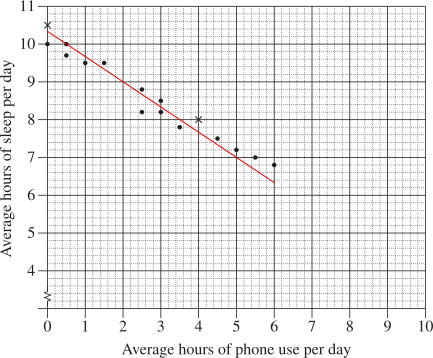
A teacher surveyed the students in her Year 8 class to investigate the relationship between the average number of hours of phone use per day and the average number of hours of sleep per day.

The results are shown on the scatterplot below.
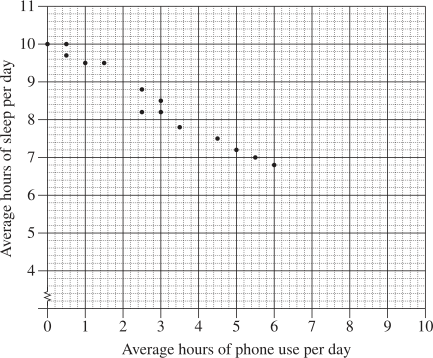
 

  1. The data for two new students, Alinta and Birrani, are shown in the table below. Plot their results on the scatterplot.  (2 marks)

\begin{array} {|l|c|c|}
\hline
  & \textit{Average hours of} & \textit{Average hours of} \\ & \textit{phone use per day} & \textit{sleep per day} \\
\hline
\rule{0pt}{2.5ex} \text{Alinta} \rule[-1ex]{0pt}{0pt} & 4 & 8 \\
\hline
\rule{0pt}{2.5ex} \text{Birrani} \rule[-1ex]{0pt}{0pt} & 0 & 10.5 \\
\hline
\end{array}

  1. By first fitting the line of best fit by eye on the scatterplot, estimate the average number of hours of sleep per day for a student who uses the phone for an average of 2 hours per day.  (2 marks)

    --- 2 WORK AREA LINES (style=lined) ---

Show Answers Only
  1.  
  2. 9 hours (see LOBF in diagram above)
Show Worked Solution

a.     \(\text{New data points are marks with a × on the diagram below.}\)
 

b.   \(\text{9 hours (see LOBF in diagram above)}\)
Filed Under: Bivariate Data, S3 Further Statistical Analysis (Y12) Tagged With: Band 4, num-title-ct-coreb, num-title-qs-hsc, smc-1113-10-Line of Best Fit, smc-1113-20-Scatterplot from Table, smc-5022-10-Line of best fit graphs, smc-5022-20-Scatterplot from table

Statistics, STD1 S3 2021 HSC 18

People are placed into groups to complete a puzzle. There are 9 different groups.

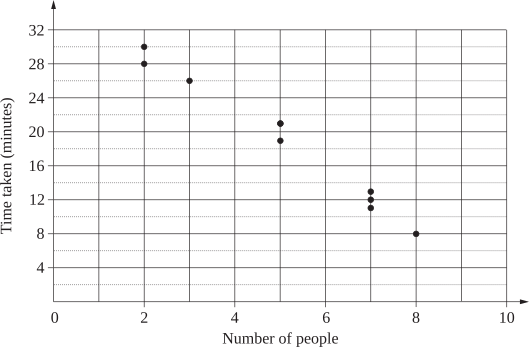
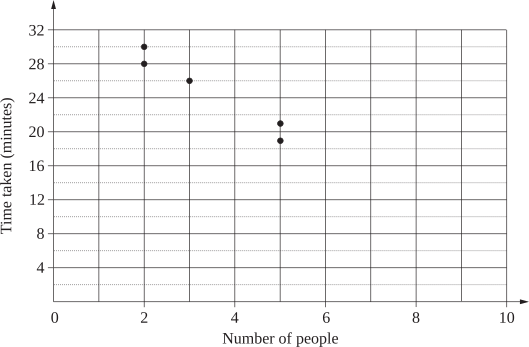
The table shows the number of people in each group and the amount of time, in minutes, for each group to complete the puzzle.

\begin{array} {|l|c|c|c|c|c|c|c|c|c|}
\hline
\rule{0pt}{2.5ex} \textit{Number of people} \rule[-1ex]{0pt}{0pt} & 2 & 2 & 3 & 5 & 5 & 7 & 7 & 7 & 8 \\
\hline
\rule{0pt}{2.5ex} \textit{Time taken (min)} \rule[-1ex]{0pt}{0pt} & 28 & 30 & 26 & 19 & 21 & 12 & 13 & 11 & 8 \\
\hline
\end{array}

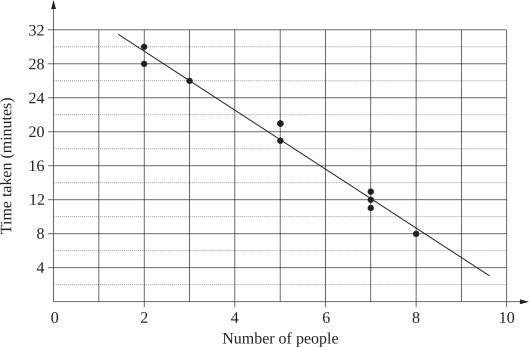
  1. Complete the scatterplot by adding the last four points from the table.  (2 marks)
     
       
  2. Add a line of best fit by eye to the graph in part (a).  (1 mark)
  3. The graph in part (a) shows the association between the time to complete the puzzle and the number of people in the group.
  4. Identify the form (linear or non-linear), the direction and the strength of the association.  (3 marks)

    --- 3 WORK AREA LINES (style=lined) ---

  5. Calculate the mean of the time taken to complete the puzzle for the three groups of size 7 observed in the dataset.  (1 mark)

    --- 1 WORK AREA LINES (style=lined) ---

Show Answers Only
  1.  
       
  2.  
       
  3. `text(The association is linear, negative and strong.)`
  4. `12\ text(minutes)`
Show Worked Solution

a.

b.


c.    `text(Form: linear)`

♦ Mean mark (c) 50%.

`text{Direction: negative}`

`text{Strength: strong}`
 

d. `text{Mean time (7 people)}` `= (12 + 13 + 11)/3`
    `= 12\ text(minutes)`

Filed Under: S3 Further Statistical Analysis (Y12) Tagged With: Band 3, Band 4, Band 5, smc-1113-10-Line of Best Fit, smc-1113-20-Scatterplot from Table, smc-1113-30-Correlation

Statistics, STD1 S3 2020 HSC 4 MC

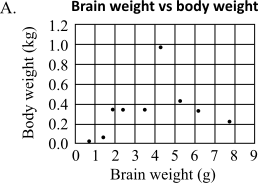
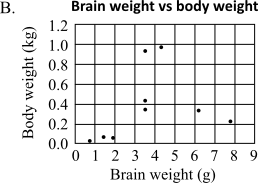
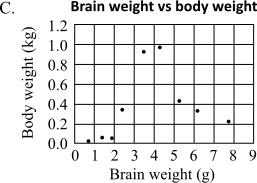
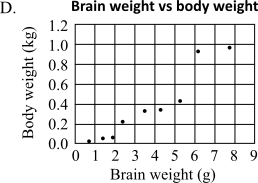
The table shows the average brain weight (in grams) and average body weight (in kilograms) of nine different mammals.

\begin{array} {|l|c|c|c|c|c|c|c|c|}
\hline
\rule{0pt}{2.5ex} \textit{Brain weight (g)} \rule[-1ex]{0pt}{0pt} & 0.7 & 0.4 & 1.9 & 2.4 & 3.5 & 4.3 & 5.3 & 6.2 & 7.8 \\
\hline
\rule{0pt}{2.5ex} \textit{Body weight (kg)} \rule[-1ex]{0pt}{0pt} & 0.02 &0.06 & 0.05 & 0.34 & 0.93 & 0.97 & 0.43 & 0.33 & 0.22 \\
\hline
\end{array}

Which of the following is the correct scatterplot for this dataset?


Show Answers Only

`C`

Show Worked Solution

`text{Consider data point} \ (1.9, 0.05)`

`→ \ text{Eliminate} \ A \ text{(too high)}`

`→ \ text{Eliminate} \ D \ text{(should be below 2nd data point)}`
 

`text{Consider data point} \ (2.4, 0.34)`

`→ \ text{Eliminate} \ B \ text{(not on graph)}` 

`=> \ C`

Filed Under: Bivariate Data, S3 Further Statistical Analysis (Y12) Tagged With: Band 4, num-title-ct-coreb, num-title-qs-hsc, smc-1113-20-Scatterplot from Table, smc-5022-20-Scatterplot from table

Statistics, STD2 S4 2015 HSC 28e

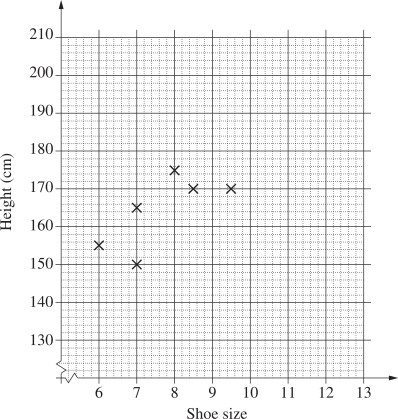
The shoe size and height of ten students were recorded.

\begin{array} {|l|c|c|}
\hline \rule{0pt}{2.5ex} \text{Shoe size} \rule[-1ex]{0pt}{0pt} & \text{6} & \text{7} & \text{7} & \text{8} & \text{8.5} & \text{9.5} & \text{10} & \text{11} & \text{12} & \text{12} \\
\hline \rule{0pt}{2.5ex} \text{Height} \rule[-1ex]{0pt}{0pt} & \text{155} & \text{150} & \text{165} & \text{175} & \text{170} & \text{170} & \text{190} & \text{185} & \text{200} & \text{195} \\
\hline
\end{array}

  1. Complete the scatter plot AND draw a line of fit by eye.  (2 marks)
     
     
  2. Use the line of fit to estimate the height difference between a student who wears a size 7.5 shoe and one who wears a size 9 shoe.  (1 mark)

    --- 1 WORK AREA LINES (style=lined) ---

  3. A student calculated the correlation coefficient to be 1 for this set of data. Explain why this cannot be correct.  (1 mark)

    --- 2 WORK AREA LINES (style=lined) ---

Show Answers Only
  1. `text(See Worked Solutions.)`
  2. `13\ text{cm  (or close given LOBF drawn)}
  3. `text(A correlation co-efficient of 1 would)`
    `text(mean that all data points occur on the)`
    `text(line of best fit which clearly isn’t the case.)`
Show Worked Solution

i.    
      2UG 2015 28e Answer

ii.   `text{Shoe size 7½ gives a height estimate of 162 cm (see graph)}`

`text{Shoe size 9 gives a height estimate of 175 cm (see graph)}`

`:.\ text(Height difference)` `= 175-162`
  `= 13\ text{cm  (or close given LOBF drawn)}`


iii.   `text(A correlation co-efficient of 1 would mean)`

♦ Mean mark (c) 39%.

`text(that all data points occur on the line of best)`

`text(fit which clearly isn’t the case.)`

Filed Under: Bivariate Data Analysis (Y12), Correlation / Body Measurements, S3 Further Statistical Analysis (Y12), S4 Bivariate Data Analysis (Y12) Tagged With: Band 4, Band 5, common-content, smc-1001-10-Line of Best Fit, smc-1001-30-Correlation, smc-1113-10-Line of Best Fit, smc-1113-20-Scatterplot from Table, smc-1113-30-Correlation, smc-785-10-Line of Best Fit, smc-785-30-Correlation

Copyright © 2014–2025 SmarterEd.com.au · Log in