The graph shows the salvage value of a car over 5 years.
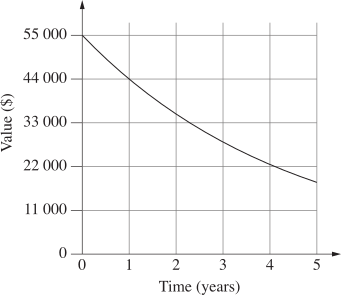
The salvage values are based on the declining-balance method.
By what amount will the car’s value depreciate during the 10th year? (4 marks)
--- 12 WORK AREA LINES (style=lined) ---
Aussie Maths & Science Teachers: Save your time with SmarterEd
The graph shows the salvage value of a car over 5 years.
The salvage values are based on the declining-balance method.
By what amount will the car’s value depreciate during the 10th year? (4 marks)
--- 12 WORK AREA LINES (style=lined) ---
The graph shows the decreasing value of an asset.
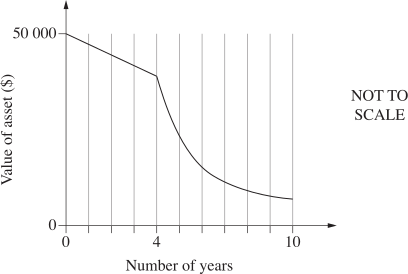
For the first 4 years, the value of the asset depreciated by $1500 per year, using a straight-line method of depreciation.
After the end of the 4th year, the method of depreciation changed to the declining-balance method at the rate of 35% per annum.
What is the total depreciation at the end of 10 years? (4 marks)
--- 10 WORK AREA LINES (style=lined) ---
A car is purchased for $15 000. The graph shows the value of the car, `$V`, at time `t` years since it was purchased, using the declining-balance method of depreciation.
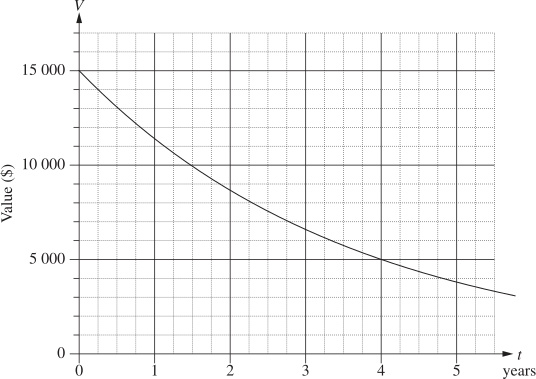
When using the straight-line method of depreciation, the value of the car depreciates at a rate of $2500 per year.
By first completing the table, plot on the grid above the value of the car for the first three years based on the straight-line method of depreciation. (2 marks)

--- 1 WORK AREA LINES (style=lined) ---
a.

b.
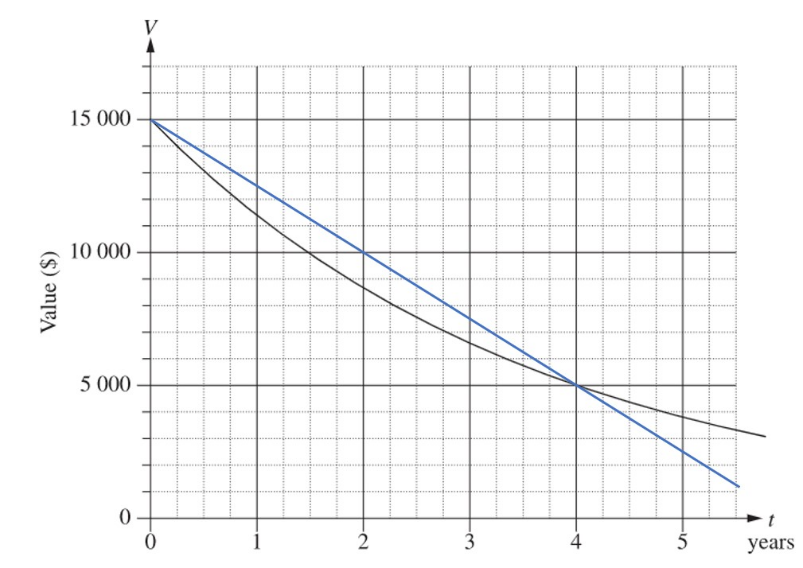
Values are equal when graphs intersect
→ after 4 years
a.
b.
Values are equal when graphs intersect
→ after 4 years
A piece of machinery, initially worth $56 000, depreciates at 8% per annum.
Which graph best shows the salvage value of this piece of machinery over time?


Kai purchased a new car for $30 000. It depreciated in value by $2000 per year for the first three years.
After the end of the third year, Kai changed the method of depreciation to the declining balance method at the rate of 25% per annum.
--- 1 WORK AREA LINES (style=lined) ---
--- 4 WORK AREA LINES (style=lined) ---
Use the horizontal axis to represent time and the vertical axis to represent the value of the car. (3 marks)
--- 8 WORK AREA LINES (style=lined) ---
i. `text(Using)\ \ S = V_0 – Dn`
| `S` | `= 30\ 000 – (2000 xx 3)` |
| `= $24\ 000` |
ii. `text(Using)\ \ S = V_0(1 – r)^n`
| `text(where)\ V_0` | `= 24\ 000` |
| `r` | `= 0.25` |
| `n` | `= 4` |
| `S` | `= 24\ 000(1 – 0.25)^4` |
| `= $7593.75` |
`:.\ text(The value of the car after 7 years is $7593.75)`
| iii. |
|
A car bought for $50 000 is depreciated using the declining balance method.
Which graph best represents the salvage value of the car over time?


The value of a car is depreciated using the declining balance method.
Which graph best illustrates the value of the car over time?


Norman and Pat each bought the same type of tractor for $60 000 at the same time. The value of their tractors depreciated over time.
The salvage value `S`, in dollars, of each tractor, is its depreciated value after `n` years.
Norman drew a graph to represent the salvage value of his tractor.

--- 2 WORK AREA LINES (style=lined) ---
--- 2 WORK AREA LINES (style=lined) ---
--- 3 WORK AREA LINES (style=lined) ---
--- 4 WORK AREA LINES (style=lined) ---
Pat used the declining balance formula for calculating the salvage value of her tractor. The depreciation rate that she used was 20% per annum.
--- 4 WORK AREA LINES (style=lined) ---
--- 2 WORK AREA LINES (style=lined) ---
A machine was bought for $25 000.
Which graph best represents the salvage value of the machine over 10 years using the declining balance method of depreciation?
| (A) |  |
(B) | 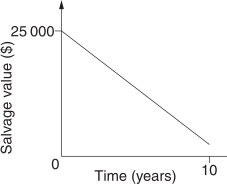 |
|
| (C) | 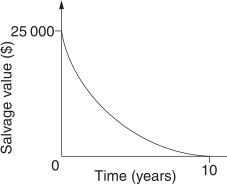 |
(D) | 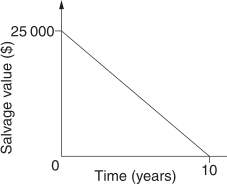 |
