SmarterEd

Aussie Maths & Science Teachers: Save your time with SmarterEd

  • Login
  • Get Help
  • About

Functions, SPEC2 2023 VCAA 2 MC

The graph of  \(y=\dfrac{x^3}{a x^2+b x+c}\)  has asymptotes given by  \(y=2 x+1\)  and  \(x=1\). The values of \(a, b\) and \(c\) are, respectively

  1. \(2,-4,2\)
  2. \( \dfrac{1}{2},-\dfrac{1}{4},-\dfrac{1}{4} \)
  3. \( \dfrac{1}{2}, \dfrac{1}{4},-\dfrac{3}{4} \)
  4. \( \dfrac{1}{2},-\dfrac{1}{4},-\dfrac{3}{4} \)
  5. \(2,-4,-8\)
Show Answers Only

\(B\)

Show Worked Solution

\(\text{Using partial fractions (by calc):}\)

\(\text{Remainder}\ =  \dfrac{x}{a}-\dfrac{b}{a^2} =  2x+1\)

\(a=\dfrac{1}{2},\ \ b=-\dfrac{1}{4} \)

\(x=1\ \ \text{is a solution of}\ \ ax^2+bx+c=0\)

\(c=-\dfrac{1}{4} \)

\(\Rightarrow B\)

Filed Under: Partial Fractions, Quotient and Other Functions (SM) Tagged With: Band 4, smc-1154-10-Quotient functions/Asymptotes, smc-1154-20-Partial fractions

Calculus, SPEC2 2021 VCAA 1

Let  `f(x) = ((2x-3)(x + 5))/((x-1)(x + 2))`.

  1. Express `f(x)` in the form  `A + (Bx + C)/((x-1)(x + 2))`, where `A`, `B` an `C` are real constants.   (1 mark)

    --- 2 WORK AREA LINES (style=lined) ---

  2. State the equation of the asymptotes of the graph of `f`.   (2 marks)

    --- 4 WORK AREA LINES (style=lined) ---

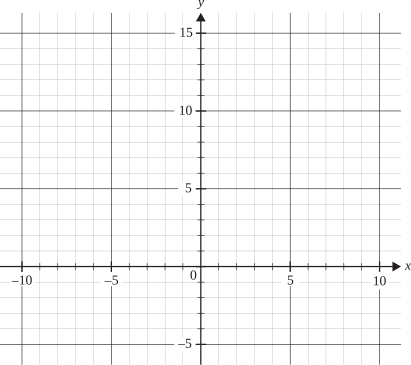
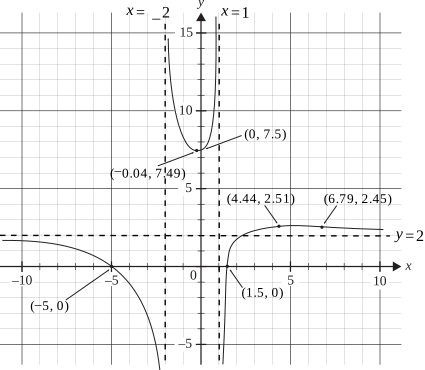
  3. Sketch the graph of `f` on the set of axes below. Label the asymptotes with their equations, and label the maximum turning point and the point of inflection with their coordinates, correct to two decimal places. Label the intercepts with the coordinate axes.   (3 marks)

    --- 0 WORK AREA LINES (style=lined) ---


  4. Let  `g_k(x) = ((2x-3)(x + 5))/((x-k)(x + 2))`, where `k` is a real constant.
  5.  i. For what values of `k` will the graph of `g_k`, have two asymptotes?   (2 marks)

    --- 4 WORK AREA LINES (style=lined) ---

  6. ii. Given that the graph of `g_k` has more than two asymptotes, for what values of `k` will the graph of `g_k` have no stationary points?   (2 marks)

    --- 5 WORK AREA LINES (style=lined) ---

Show Answers Only
  1. `f(x) = 2 + (5x-11)/((x-1)(x + 2))`
  2. `text(Horizontal asymptote:)\ y = 2`

  3.  
  4.  i. `k = 3/2 => g_k(x) = 2 + 6/(x + 2)`
  5. ii. `k , -5\ \ text(or)\ \ k > 3/2`
Show Worked Solution

a.   `text{By CAS  (prop Frac}\ f(x)):`

`f(x) = 2 + (5x-11)/((x-1)(x + 2))`
 

b.   `text(Vertical asymptotes:)\ x = 1, x = –2`

`text(As)\ \ x -> ∞, y -> 2`

`text(Horizontal asymptote:)\ y = 2`

♦ Mean mark part (c) 48%.

 
c.


d.i.   `text(Two asymptotes only when:)`

♦♦ Mean mark part (d)(i) 24%.

`k = -2 \ => \ g_k(x) = 2-(23 + x)/((x + 2)^2)`

`k = -5 \ => \ g_k(x) = 2-7/(x + 2)`

`k = 3/2 \ => \ g_k(x) = 2 + 6/(x + 2)`


d.ii.   `text(By CAS, solve)\ \ d/(dx)(g_k(x)) = 0\ \ text(for)\ \ x:`

♦♦♦ Mean mark part (d)(ii) 16%.

`x = (-4k + 15 ± sqrt(-21(2k^2 + 7k-15)))/(2k + 3)`
 

`text(No solutions occur when:)`

`k = -3/2\ \ text(or)`

`2k^2 + 7k-15 < 0`

`=> k < -5\ \ text(or)\ \ k > 3/2`

Filed Under: Partial Fractions, Quotient and Other Functions (SM), Tangents and Curve Sketching Tagged With: Band 4, Band 5, Band 6, smc-1154-20-Partial fractions, smc-1154-50-Sketch graph, smc-1182-35-Sketch curve, smc-1182-40-Other 1st/2nd deriv problems

Algebra, SPEC2 2020 VCAA 7 MC

For non-zero constants `a` and `b`, where  `b < 0`, the expression  `1/(ax(x^2 + b))`  in partial fraction form with linear denominators, where  `A, B`  and  `C`  are real constants, is

  1. `A/(ax) + (Bx + C)/(x^2 + b)`
  2. `A/(ax) + B/(x + sqrtb) + C/(x - sqrtb)`
  3. `A/x + B/(ax + sqrt|b|) + C/(ax - sqrt|b|)`
  4. `A/x + B/(x + sqrt|b|) + C/(x - sqrt|b|)`
  5. `A/(ax) + B/((x + sqrtb)^2) + C/(x + sqrtb)`
Show Answers Only

`D`

Show Worked Solution

♦♦♦ Mean mark 26%.
MARKER’S COMMENT: Option A results from not considering `b<0`.
`1/(ax(x^2 + b))` `= 1/a (A_1/x + B_1/(x + sqrt|b|) + C_1/(x – sqrt|b|))`
  `= A/x + B/(x + sqrt|b|) + C/(x – sqrt|b|)`

 
`=>D`


Filed Under: Partial Fractions, Quotient and Other Functions (SM) Tagged With: Band 6, smc-1154-20-Partial fractions

Algebra, SPEC1 VCE SM-Bank 7

Given that  `(16x - 43)/((x - 3)^2 (x + 2))`  can be written as

 
`(16x - 43)/((x - 3)^2 (x + 2)) = a/(x - 3)^2 + b/(x - 3) + c/(x + 2)`,

  
where  `a, b` and `c in RR`, find  `a, b and c.`  (3 marks)

    1.  
Show Answers Only

`a = 1, b = 3, c = -3`


Show Worked Solution

`(16x – 43)/((x – 3)^2 (x + 2)) = a/(x – 3)^2 + b/(x – 3) + c/(x + 2)`

`16x – 43 = a (x + 2) + b (x – 3) (x + 2) + c (x – 3)^2`
 

`text(When)\ \ x = 3,\ \ 5a =5\ \ =>a=1`

`text(When)\ \ x=-2,\ \ 25c=-75\ \ =>c=-3`

`text(When)\ \ x=0`

`-43` `= 2(1) – 6b + (-3)(-3)^2`
`6b` `= 18`
`b` `=3`

 
`:.a=1, b=3, c=-3`

Filed Under: Partial Fractions, Quotient and Other Functions (SM) Tagged With: Band 3, smc-1154-20-Partial fractions

Algebra, SPEC1 VCE SM-Bank 4

Find  `A, B`  and  `C in RR`, such that

`1/(x(x^2 + 2)) = A/x + (Bx + C)/(x^2 + 2).`   (2 marks)

Show Answers Only

`A = 1/2,\ \ \ B = -1/2,\ \ \ C = 0`

Show Worked Solution
`1/(x(x^2 + 2))` `= A/x + (Bx + C)/(x^2 + 2)`
`1` `= A (x^2 + 2) + (Bx + C) x`
`1` `= (A+B)x^2 + Cx + 2A`


`2A = 1,\ \ =>A=1/2`

`C=0`

`A + B = 0,\ \ =>B=-1/2`

`:.A = 1/2,\ \ \ \ B = -1/2,\ \ \ \ C = 0`

Filed Under: Partial Fractions, Quotient and Other Functions (SM) Tagged With: Band 3, smc-1154-20-Partial fractions

Algebra, SPEC1 VCE SM-Bank 1

Find numbers  `A, B` and `C in RR`, such that

`(x^2 + 8x + 11)/((x -3)(x^2 + 2)) = A/(x - 3) + (Bx + C)/(x^2 + 2).`  (2 marks)

Show Answers Only

`A = 4,\ B = -3,\ C = -1`

Show Worked Solution

`(x^2 + 8x + 11)/((x -3)(x^2 + 2)) = A/(x – 3) + (Bx + C)/(x^2 + 2)`

`x^2 + 8x + 11` `=A(x^2 + 2)+(Bx+C)(x-3)`
  `=(A+B)x^2+(C-3B)x+(2A-3C)`


`A+B=1\ \ \ => B=1-A`

`C-3B=8\ \ \ =>C=11-3A`

`2A-3C=11 \ \ \ =>2A-33+9A=11\ \ \ =>A=4`

`B=1-4=-3`

`C=11-12=-1`

 `:.A=4, B=-3, C=-1`

Filed Under: Partial Fractions, Quotient and Other Functions (SM) Tagged With: Band 3, smc-1154-20-Partial fractions

Algebra, SPEC2-NHT 2017 VCAA 5 MC

Given that `A, B, C` and `D` are non-zero rational numbers, the expression  `(3x + 1)/(x(x - 2)^2)`  can be represented in partial fraction form as

A.   `A/x + B/((x - 2))`

B.   `A/x + B/(x - 2)^2`

C.   `A/x + B/((x - 2)) + C/(x - 2)^2`

D.   `A/x + B/x^2 + C/((x - 2))`

E.   `A/x + (Bx)/((x - 2)) + (Cx + D)/(x - 2)^2`

Show Answers Only

`C`

Show Worked Solution

`(3x + 1)/(x(x – 2)^2) = A/x + B/(x – 2) + C/(x – 2)^2`

 
`=>   C`

Filed Under: Partial Fractions, Quotient and Other Functions (SM) Tagged With: Band 3, smc-1154-20-Partial fractions

Algebra, SPEC2 2018 VCAA 3 MC

Which one of the following, where `A, B, C` and `D` are non-zero real numbers, is the partial fraction form for the expression

      `(2x^2 + 3x + 1)/{(2x + 1)^3 (x^2 - 1)}?`

A.  `A/(2x + 1) + B/(x - 1) + C/(x + 1)`

B.  `A/(2x + 1) + B/(2x - 1)^2 + C/(2x + 1)^3 + (Dx)/(x^2 - 1)`

C. `A/(2x + 1) + (Bx + C)/(x^2 - 1)`

D.  `A/(2x + 1) + B/(2x + 1)^2 + C/(x - 1)`

E.  `A/(2x + 1) + (Bx + C)/(2x + 1)^2 + D/(x - 1)` 

Show Answers Only

`D`

Show Worked Solution

`(2x^2 + 3x + 1)/{(2x + 1)^3 (x^2 – 1)}`

♦ Mean mark 46%.

`= ((2x^2 + 2x) + (x + 1))/((2x + 1)^3 (x – 1) (x + 1))`

`= (2x(x + 1) + (x + 1))/((2x + 1)^3 (x – 1) (x + 1))`

`= ((2x + 1)(x + 1))/((2x + 1)^3 (x – 1) (x + 1))`

`= 1/((2x + 1)^2(x – 1))`

`= A/(2x + 1) + B/(2x + 1)^2 + C/(x – 1)`

 
`=>  D`

Filed Under: Partial Fractions, Quotient and Other Functions (SM) Tagged With: Band 5, smc-1154-20-Partial fractions

Copyright © 2014–2025 SmarterEd.com.au · Log in