SmarterEd

Aussie Maths & Science Teachers: Save your time with SmarterEd

  • Login
  • Get Help
  • About

Calculus, SPEC2 2024 VCAA 12 MC

The position, \(x\) metres, of a particle moving in a straight line from a fixed origin \(O\) at time, \(t\) seconds, is given by  \(x=e^{(k-1) t}\),  where  \(k>1\).

The acceleration of the particle, in m s\(^{-2}\), when  \(x=k+1\)  is

  1. \(k^2-1\)
  2. \(\left(k^2-1\right)(k+1)\)
  3. \(\left(k^2-1\right)(k-1)\)
  4. \((k-1)^2\)
Show Answers Only

\(C\)

Show Worked Solution

\(x=e^{(k-1)t}\)

\(v=\dfrac{dx}{dt}=(k-1) e^{(k-1)t}\)

\(a=\dfrac{dv}{dt}=(k-1)^2 e^{(k-1)t}\)

\(\text{When}\ \ x=k+1:\)

\(a=(k-1)^2 \cdot e^{(k-1)t}=(k-1)^2 x=(k-1)^2(k+1)=(k^2-1)(k-1)\)

\(\Rightarrow C\)

♦ Mean mark 50%.

Filed Under: Motion (SM) Tagged With: Band 5, smc-1159-10-Motion as f(t)

Calculus, SPEC2 2023 VCAA 13 MC

A tourist in a hot air balloon, which is rising vertically at 2.5 m s\(^{-1}\), accidentally drops a phone over the side when the phone is 80 metres above the ground.

Assuming air resistance is negligible, how long in seconds, correct to two decimal places, does it take for the phone to hit the ground?

  1. 2.86
  2. 2.98
  3. 3.79
  4. 4.04
  5. 4.30
Show Answers Only

\(E\)

Show Worked Solution

\(\text{Take upward velocity as positive.}\)

\(u=2.5\ \text{ms}^{-1}, \ a=-9.8\ \text{ms}^{-2} \)

\(\text{Using}\ \ s=ut+\dfrac{1}{2}at^2,\)

\(\text{Find}\ t\ \text{when}\ \ s=-80\ \text{(by calc):} \)

\(-80=2.5t-4.9t^2\ \ \Rightarrow \ \ t=4.30\ \text{s}\)

\(\Rightarrow E\)

Filed Under: Motion (SM) Tagged With: Band 4, smc-1159-10-Motion as f(t), smc-1159-50-Projectiles

Calculus, SPEC2 2020 VCAA 3 MC

A train is travelling from Station A to Station B. The train starts from rest at Station A and travels with constant acceleration for 30 seconds until it reaches a velocity of 10 ms−1. It then travels at this velocity for 200 seconds. The train then slows down, with constant acceleration, and stops at Station B having travelled for 260 seconds in total. Let `v` ms−1 be the velocity of the train at time `t` seconds. The velocity `v` as a function of `t` is given by

  1. `v(t) = {(1/3 t, ),(10, ),(1/3 (260 - t), ):}{:(0 <= t <= 30),(30 < t <= 230),(230 < t <= 260):}`
  2. `v(t) = {(1/3 t, ),(10, ),(1/3 (230 - t), ):}{:(0 <= t <= 30),(30 < t <= 230),(230 < t <= 260):}`
  3. `v(t) = {(3t, ),(10, ),(3 (230 - t), ):}{:(0 <= t <= 30),(30 < t <= 230),(230 < t <= 260):}`
  4. `v(t) = {(3t, ),(10, ),(3 (260 - t), ):}{:(0 <= t <= 30),(30 < t <= 230),(230 < t <= 260):}`
  5. `v(t) = {(1/3 t, ),(10, ),(1/3 (230 - t), ):}{:(0 <= t <= 30),(30 < t <= 200),(200 < t <= 230):}`
Show Answers Only

`A`

Show Worked Solution

`text(When)\ \ t = 30, v(t) = 10\ \ => \ text(Eliminate C and D)`

`v(t) = 10\ \ text(for)\ \ 30 <= t <= 230\ \ =>\ text(Eliminate E)`
 

`text(When)\ \ 230 <= t <= 260:`

`(v – 0)/(t – 260)` `= (10 – 0)/(230 – 260)`
`v` `= 1/3(260 – t)`

`=>A`

Filed Under: Motion (SM) Tagged With: Band 4, smc-1159-10-Motion as f(t)

Calculus, SPEC2 2012 VCAA 5

At her favourite fun park, Katherine’s first activity is to slide down a 10 m long straight slide. She starts from rest at the top and accelerates at a constant rate, until she reaches the end of the slide with a velocity of `6\ text(ms)^(-1)`.

  1. How long, in seconds, does it take Katherine to travel down the slide?   (1 mark)

    --- 3 WORK AREA LINES (style=lined) ---

When at the top of the slide, which is 6 m above the ground, Katherine throws a chocolate vertically upwards. The chocolate travels up and then descends past the top of the slide to land on the ground below. Assume that the chocolate is subject only to gravitational acceleration and that air resistance is negligible.

  1. If the initial speed of the chocolate is 10 m/s, how long, correct to the nearest tenth of a second, does it take the chocolate to reach the ground?   (2 marks)

    --- 4 WORK AREA LINES (style=lined) ---

  2. Assume that it takes Katherine four seconds to run from the end of the slide to where the chocolate lands.


    At what velocity would the chocolate need to be propelled upwards, if Katherine were to immediately slide down the slide and run to reach the chocolate just as it hits the ground?


    Give your answer in `text(ms)^(-1)`, correct to one decimal place.   (2 marks)

    --- 4 WORK AREA LINES (style=lined) ---

Katherine’s next activity is to ride a mini speedboat. To stop at the correct boat dock, she needs to stop the engine and allow the boat to be slowed by air and water resistance.

At time `t` seconds after the engine has been stopped, the acceleration of the boat, `a\ text(ms)^(-2)`, is related to its velocity, `v\ text(ms)^(-1)`, by

`a = -1/10 sqrt(196-v^2)`.

Katherine stops the engine when the speedboat is travelling at `7\ text(m/s)`.

  1. i.  Find an expression for `v` in terms of `t`.   (3 marks)

    --- 6 WORK AREA LINES (style=lined) ---

  2. ii. Find the time it takes the speedboat to come to rest.Give your answer in seconds in terms of `pi`.   (2 marks)

    --- 4 WORK AREA LINES (style=lined) ---

  3. iii. Find the distance it takes the speedboat to come to rest, from when the engine is stopped.Give your answer in metres, correct to one decimal place.   (3 marks)

    --- 5 WORK AREA LINES (style=lined) ---

Show Answers Only
  1. `10/3\ text(s)`
  2. `2.5\ text(s)`
  3. `35.1\ text(m s)^(−1)`
  4. i.  `v = 14 sin(pi/6-t/10)`
  5. ii. `(5 pi)/3`
  6. iii. `18.8`
Show Worked Solution

a.   `u = 0, quad v = 6, quad s = 10`

COMMENT: Exact form required. 3.3 seconds was marked incorrect!

`text(Solve for)\ \ t:\ \ \ ((u + v)/2)t` `= s`
`((0 + 6)/2)t` `= 10`
`t` `= 10/3\ text(s)`


b.   `u = 10, quad a = -9.8, quad s = -6`

COMMENT: Many students showed a “lack of understanding” of displacement here.

`text(Solve for)\ \ t:`

`s` `= ut + 1/2 at^2`
`-6` `= 10t-4.9 t^2`
`:. t` `~~2.5\ text(s)\ \ \ text{(by CAS)}`

♦♦ Mean mark 27%.

c.   `text(Time of chocolate in air)`

`= 10/3 + 4`

`=22/3`
 

`text(Solve for)\ \ u:`

`-6` `= 22/3 u -4.9(22/3)^2`
`:. u` `~~35.1\ text(m s)^(−1)\ \ \ text{(by CAS)}`


d.i.    `(dv)/(dt)` `= -1/10 sqrt(196-v^2)`
  `(dt)/(dv)` `= (-10)/sqrt(196-v^2)`
  `t` `= int(-10)/sqrt(196-v^2)\ dv`
  `-t/10` `= int 1/sqrt(14^2-v^2) dv`
  `-t/10` `= sin^(-1)(v/14) + c`

 
`text(When)\ \ t = 0, v = 7`

`=> c=-sin^(-1)(1/2) = -pi/6`
 

`-t/10` `=sin^(-1)(v/14)-pi/6`  
`sin^(-1) (v/14)` `= pi/6-t/10`  
`:. v` `=14sin(pi/6-t/10)`  


d.ii.  `text(Find)\ \ t\ \ text(when)\ \ v=0:`

  `-t/10` `=sin^(-1)(0)-pi/6`
  `t` `= -10 sin^(-1)(0) + (10 pi)/6`
    `= (5 pi)/3\ text(s)`


d.iii.   `v = 14sin(pi/6-t/10)`

`(dx)/(dt)` `=14sin(pi/6-t/10)`
`x` `= int_0^((5pi)/3)14sin(pi/6-t/10)\ dt`
  `~~ 18.8\ text(m)\ \ \ text{(by CAS)}`

Filed Under: Motion (SM) Tagged With: Band 4, Band 5, smc-1159-10-Motion as f(t), smc-1159-30-a=f(v), smc-1159-50-Projectiles

Calculus, SPEC2 2012 VCAA 3

A car accelerates from rest. Its speed after `T` seconds is `V\ text(ms)^(−1)`, where

`V = 17 tan^(−1)((pi T)/6), T >= 0`

  1. Write down the limiting speed of the car as  `T -> oo`.   (1 mark)

    --- 1 WORK AREA LINES (style=lined) ---

  2. Calculate, correct to the nearest `0.1\ text(ms)^(−2)`, the acceleration of the car when  `T = 10`.   (1 mark)

    --- 2 WORK AREA LINES (style=lined) ---

  3. Calculate, correct to the nearest second, the time it takes for the car to accelerate from rest to `25\ text(ms)^(−1)`.   (2 marks)

    --- 4 WORK AREA LINES (style=lined) ---

After accelerating to `25\text(ms)^(−1)`, the car stays at this speed for 120 seconds and then begins to decelerate while braking. The speed of the car  `t`  seconds after the brakes are first applied is `v\ text(ms)^(−1)` where

`(dv)/(dt) =-1/100 (145-2t),`

until the car comes to rest.

  1. i.  Find `v` in terms of `t`.   (2 marks)

    --- 3 WORK AREA LINES (style=lined) ---

  2. ii. Find the time, in seconds, taken for the car to come to rest while braking.   (2 marks)

    --- 3 WORK AREA LINES (style=lined) ---

  3. i.  Write down the expressions for the distance travelled by the car during each of the three stages of its motion.   (2 marks)

    --- 4 WORK AREA LINES (style=lined) ---

  4. ii. Find the total distance travelled from when the car starts to accelerate to when it comes to rest.


        Give your answer in metres correct to the nearest metre.   (1 mark)

    --- 3 WORK AREA LINES (style=lined) ---

Show Answers Only
  1. `(17 pi)/2`
  2. `0.3`
  3. `19\ text(s)`
  4. i.  `V = t^2/100-(145 t)/100 + 25`
  5. ii. `t_1 = 20\ text(s)`
  6. i.  `d_1 = int_0^19 17 tan^(-1) ((pi T)/6)\ dT`


        `d_2 = 25 xx 120`


        `d_3 = int_0^20 -1/100 [145 t-t^2] + 25\ dt`

  7. ii. `3637\ text(m)`
Show Worked Solution

a.   `text(As)\ \ T->oo,\ \ tan^(-1)((piT)/6)->pi/2`

  `:.underset (T->oo) (limV)` `= (17 pi)/2`


b.  `(dV)/(dt)= (102 pi)/(36 + pi^2 T^2),\ \ \ text{(by CAS)}`
 

`text(When)\ \ T=10:`

`(dV)/(dt)` `= (102 pi)/(36 + 100 pi^2)`
  `~~ 0.3`

 
c.
   `text(Find)\ \ T\ \ text(when)\ \ V=25:`

  `17 tan^(-1) ((pi T)/6)` `=25 `
  `T` `= 18.995\ \ \ text{(by CAS)}`
    `~~ 19\ text(seconds)`


d.i.    `v` `= -1/100 int_0^t 145-2t\ dt`
  `v` `= -1/100 [145 t-t^2] + c`

 
`text(When)\ \ t=0, \ v=25:`

`=> c=25`

`:. v= -1/100 [145 t-t^2] + 25`
 

d.ii.  `text(Find)\ \ t\ \ text(when)\ \ v=0:`

`-1/100[145t-t^2] + 25=0`

`:. t=20\ text(seconds)\ \ \ text{(by CAS)}`


e.i.   `text(Stage 1: car travels from rest to 25 m/s)`

`d_1 = int_0^19 17 tan^(-1) ((pi T)/6)\ dT`
  

`text(Stage 2: car travels at 25 m/s for 120 seconds)`

`d_2` `= 25 xx 120`
  `= 3000`

 
`text(Stage 3: car decelerates for 20 seconds`

`d_3 = int_0^20 -1/100 [145 t-t^2] + 25\ dt`


e.ii.    `d_1` `~~ 400.131`
  `d_2` `= 3000`
  `d_3` `= 236.6`


`text(Total distance)` `= d_1 + d_2 + d_3`
  `~~ 3637\ text(m)`

Filed Under: Motion (SM) Tagged With: Band 3, Band 4, Band 5, smc-1159-10-Motion as f(t)

Calculus, SPEC2 2013 VCAA 19 MC

A tourist in a hot air balloon, which is rising at 2 m/s, accidentally drops a camera over the side and it falls 100 m to the ground.

Neglecting the effect of air resistance on the camera, the time taken for the camera to hit the ground, correct to the nearest tenth of a second, is

A.   4.3 s

B.   4.5 s

C.   4.7 s

D.   4.9 s

E.   5.0 s

Show Answers Only

`C`

Show Worked Solution

`u = 2, s = −100, a = -9.8`

`s` `= ut + 1/2at^2`
`-100` `= 2t – 4.9t^2`
`0` `= 4.9t^2 – 2t – 100`

 
`text(Solve:)\ \ 4.9t^2 – 2t – 100=0\ \ text(for)\ \ t`

`t~~4.7\ \ text(sec)`

`=> C`

Filed Under: Motion (SM) Tagged With: Band 4, smc-1159-10-Motion as f(t), smc-1159-50-Projectiles

Calculus, SPEC2 2015 VCAA 20 MC

An object is moving in a straight line, initially at `5\ text(ms)^(–1)`. Sixteen seconds later, it is moving at `11\ text(ms)^(–1)` in the opposite direction to its initial velocity.

Assuming that the acceleration of the object is constant, after 16 seconds the distance, in metres, of the object from its starting point is

A.   24

B.   48

C.   73

D.   96

E.   128

Show Answers Only

`B`

Show Worked Solution

`u = 5, v = −11, t = 16`

`v=u+at`

`-11=5+a xx 16\ \ =>\ \ a=-1`

`s` `= ut+1/2 at^2`
  `= 5xx16 – 1 xx 16^2`
  `=-48`

 
`:.\ text(Object is 48 metres from strating point.)`

`=> B`

Filed Under: Motion (SM) Tagged With: Band 4, smc-1159-10-Motion as f(t)

Calculus, SPEC2 2017 VCAA 2

A helicopter is hovering at a constant height above a fixed location. A skydiver falls from rest for two seconds from the helicopter. The skydiver is subject only to gravitational acceleration and air resistance is negligible for the first two seconds. Let downward displacement be positive.

  1. Find the distance, in metres, fallen in the first two seconds.   (2 marks)

    --- 4 WORK AREA LINES (style=lined) ---

  2. Show that the speed of the skydiver after two seconds is 19.6 ms–1.   (1 mark)

    --- 2 WORK AREA LINES (style=lined) ---

After two seconds, air resistance is significant and the acceleration of the skydiver is given by  `a = g -0.01v^2`.

  1. Find the limiting (terminal) velocity, in ms–1, that the skydiver would reach.   (1 mark)

    --- 3 WORK AREA LINES (style=lined) ---

  2. i.  Write down an expression involving a definite integral that gives the time taken for the skydiver to reach a speed of 30 ms–1.   (2 marks)

    --- 4 WORK AREA LINES (style=lined) ---

  3. ii. Hence, find the time, in seconds, taken to reach a speed of 30 ms–1, correct to the nearest tenth of a second.   (1 mark)

    --- 2 WORK AREA LINES (style=lined) ---

  4. Write down an expression involving a definite integral that gives the distance through which the skydiver falls to reach a speed of 30 ms–1. Find this distance, giving your answer in metres, correct to the nearest metre.   (3 marks)

    --- 6 WORK AREA LINES (style=lined) ---

Show Answers Only
  1. `19.6\ text(m)`
  2. `text(See Worked Solutions)`
  3. `v_t = 10sqrtg\ text(ms)^(−1)\ \ text(downwards)`
  4.  i.  `t(30) = int_19.6^30 100/(100g-v^2)dv + 2`
  5. ii. `5.8\ text(s)`
  6. `120\ text(m)`
Show Worked Solution

a.   `u = 0, \ t = 2, \ a = g = 9.8`

`x` `= ut + 1/2 at^2`
  `=0 xx 2 + 1/2 xx 9.8 xx 2^2`
  `= 19.6\ text(m)`


b.    `v` `= u+ at`
  `v(2)` `= 9.8 xx 2`
    `= 19.6\ text(ms)^(−1)\ \ \ text{(downward → positive)}`


c.   `text(Terminal velocity), v_t, text(occurs when)\ \ a = 0,`

♦ Mean mark 48%.

`g -0.01v_t^2` `=0`
`v_t^2` `= 100 xx 9.8`
`:. v_t` `= 14 sqrt5\ text(ms)^(−1)\ \ \ (v_t > 0\ \ text{as}\ \ v_t\ \ text{is downwards})`


d.i.    `(dv)/(dt)` `= g-0.01v^2`
  `(dt)/(dv)` `= 1/(g-0.01v^2)`
    `= 100/(100g-v^2)`
  `t` `= int 100/(100g-v^2)`

 
`text(Time taken until)\ \ v=19.6\ \ text(is 2 seconds.)`

♦ Mean mark part (d)(i) 39%.

 
`:.\ text(Time taken until)\ \ v=30`

`=int_19.6^30 100/(100g-v^2)\ dv + 2`


d.ii.   `5.8\ text(seconds)\ \ \ text{(by CAS)}`

♦♦ Mean mark part (d)(ii) 25%.


e.    `v *(dv)/(dx)` `= g-0.01 v^2`
  `(dv)/(dx)` `= g/v-(v^2)/(100v)`
    `= (100g-v^2)/(100v)`
  `(dx)/(dv)` `= (100v)/(100g-v^2)`
  `x` `= int (100v)/(100g-v^2)\ dv`

 
`text(Distance fallen in 1st 2 seconds)\ = 19.6\ text(m)`

♦♦ Mean mark part (e) 29%.

 
`:.\ text(Total distance fallen until)\ \ v=30`

`= int_19.6^30 (100v)/(100g-v^2)\ dv + 19.6`

`~~ 120\ text(m)`

Filed Under: Motion (SM) Tagged With: Band 2, Band 5, smc-1159-10-Motion as f(t), smc-1159-30-a=f(v), smc-1159-60-Terminal velocity

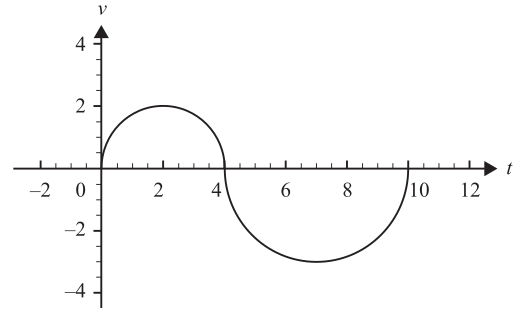
Calculus, SPEC2-NHT 2018 VCAA 17 MC

An object travels in a straight line relative to an origin `O`.

At time `t` seconds its velocity, `v` metres per second, is given by
 

`v(t) = {(sqrt(4 - (t - 2)^2), text(,) quad 0 <= t <= 4), (-sqrt(9 - (t - 7)^2), text(,) quad 4 < t <= 10):}`
 

The graph of  `v(t)`  is shown below.

The object will be back at its initial position when `t` is closest to

A.   4.0

B.   6.5

C.   6.7

D.   6.9

E.   7.0

Show Answers Only

`C`

Show Worked Solution

`text(Solve for)\ k:`

`int_0^4 sqrt(4 – (t – 2)^2)\ dt= int_4^k sqrt(9 -(t – 7)^2)\ dt`

 
`k~~ 6.7`

`=>  C`

Filed Under: Motion (SM) Tagged With: Band 4, smc-1159-10-Motion as f(t), smc-1159-40-Graphs

Copyright © 2014–2025 SmarterEd.com.au · Log in