SmarterEd

Aussie Maths & Science Teachers: Save your time with SmarterEd

  • Login
  • Get Help
  • About

Mechanics, SPEC2 2020 VCAA 5

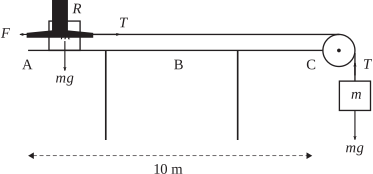
Two objects, each of mass `m` kilograms, are connected by a light inextensible strings that passes over a smooth pulley, as shown below. The object on the platform is initially at point A and, when it is released, it moves towards point C. The distance from point A to point C is 10 m. The platform has a rough surface and, when it moves along the platform, the object experiences a horizontal force opposing the motion of magnitude `F_1` newtons in the section AB and a horizontal force opposing the motion of magnitude `F_2` newtons when it moves in the section BC.
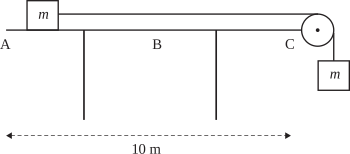
 

  1. On the diagram above, mark all forces that act on each object once the object on the platform has been released and the system is in motion.  (2 marks)

The force `F_1` is given by  `F_1 = kmg, \ k ∈ R^+`.

  1.  i. Show that an expression for the acceleration, in `text(ms)^(−2)`, of the object on the platform, in terms of `k`, as it moves from point A to point B is given by  `(g(1 - k))/2`.  (2 marks)
  2. ii. The system will only be in motion for certain values of `k`.
  3.     Find these values of `k`.  (1 mark)

Point B is midway between points A and C.

  1. Find, in terms of `k`, the time taken, is seconds, for the object on the platform to reach point B.  (2 marks)
  2. Express, in terms of `k`, the speed `v_B`, in `text(ms)^(−1)`, of the object on the platform when it reaches point B.  (2 marks)
  3. When the object on the platform is at point B, the string breaks. The velocity of the object at point B is  `v_B = 2.5\ text(ms)^(−1)`. The force that opposes motion from point B to point C is  `F_2 = 0.075 mg + 0.4 mv^2`, where `v` is the velocity of the object when it is a distance of `x` metres from point B. The object on the platform comes to rest before point C.
  4. Find the object's distance from point C when it comes to rest. Give your answer in metres, correct to two decimal places.  (4 marks)
Show Answers Only
  1.  
  2.  i. `text(See Worked Solutions)`
  3. ii. `k ∈ (0, 1), k ∈ R^+`
  4. `2sqrt(5/(g(1 – k)))`
  5. `v_text(B) = sqrt(5g(1 – k))`
  6. `3.15\ text(m)`
Show Worked Solution
a.   


b. i.   `text(Horizontally:)`

`ma = T – F_1 = T – kmg\ …\ (1)`

`text(Vertically:)`

`ma = mg – T\ …\ (2)`
 

`text(Add)\ \ (1) + (2) :`

`2ma = mg – kmg`

`:. a` `= (g – kg)/2`
  `= (g(1 – k))/2`
♦ Mean mark (b)(ii) 45%.


b. ii.   `text(System in motion when)\ a > 0`

`(g(1 – k))/2 > 0`

`:. k ∈ (0, 1), \ k ∈ R^+`


c.   `text(AB) = 5\ (text(given)), u = 0\ (text(given))`

`text(Find)\ t\ text(when)\ s = 5:`

`s = ut + 1/2at^2`

`5 = 0 + 1/2 · (g(1 – k))/2 · t^2`

`t^2` `= 20/(g(1 – k))`
`t` `= sqrt(20/(g(1 – k)))`
  `= 2sqrt(5/(g(1 – k)))`


d.   `text(At B,)\ s = 5`

`v_text(B)^2` `= u^2 + 2as`
  `= 0 + 2 · (g(1 – k))/2 · 5`
  `= 5g(1 – k)`

 
`:. v_text(B) = sqrt(5g(1 – k))`


e.   `text(Acceleration is against the direction of motion.)`

♦♦ Mean mark (e) 35%.
`a` `= −F/m`
  `= −0.075g – 0.4v^2`
  `= −0.4(0.1875g + v^2)`


`d/(dx)(1/2 v^2)` `= −0.4(0.1875g + v^2)`
`d/(dx)(v^2)` `= −0.8(0.1875g + v^2)`
`(dx)/(d(v^2))` `= −1.25(1/(0.1875g + v^2))`
`:. x` `= −1.25 int_(2.5^2)^0 1/(0.1875 + v^2)\ dv^2`
  `= 1.85\ text(m)`


`:.\ text(Distance from C)` `= 5 – 1.85`
  `= 3.15\ text(m)`

Filed Under: Pulleys, Planes and Equilibrium (SM) Tagged With: Band 4, Band 5, smc-1175-30-Connected particles

Mechanics, SPEC2-NHT 2019 VCAA 5

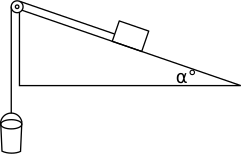
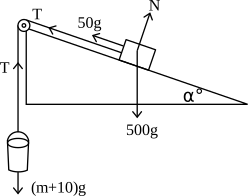
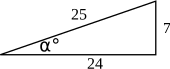
A pallet of bricks weighing 500 kg sits on a rough plane inclined at an angle of  `α°` to the horizontal, where  `tan(α°) = (7)/(24)`. The pallet is connected by a light inextensible cable that passes over a smooth pulley to a hanging container of mass `m` kilograms in which there is 10 L of water. The pallet of bricks is held in equilibrium by the tension `T` newtons in the cable and a frictional resistance force of 50 `g` newtons acting up and parallel to the plane. Take the weight force exerted by 1 L of water to be `g` newtons.


  1. Label all forces acting on both the pallet of bricks and the hanging container on the diagram above, when the pallet of bricks is in equilibrium as described.   (1 mark)
  2. Show that the value of `m` is 80.  (3 marks)

Suddenly the water is completely emptied from the container and the pallet of bricks begins to slide down the plane. The frictional resistance force of 50 `g` newtons acting up the plane continues to act on the pallet.

  1. Find the distance, in metres, travelled by the pallet after 10 seconds.  (3 marks)
  2. When the pallet reaches a velocity of  `3\ text(ms)^-1`, water is poured back into the container at a constant rate of 2 L per second, which in turn retards the motion of the pallet moving down the plane. Let  `t`  be the time, in seconds, after the container begins to fill. 
  3.   i. Write down, in terms of  `t`, an expression for the total mass of the hanging container and the water it contains after `t` seconds. Give your answer in kilograms.  (1 mark)
  4.  ii. Show that the acceleration of the pallet down the plane is given by  `(text(g)(5 - t))/(t + 290)\ text(ms)^-2`  for  `t ∈[0, 5)`.  (2 marks)
  5. iii. Find  the velocity of the pallet when  `t = 4`. Give your answer in metres per second, correct to one decimal place.  (2 marks)
Show Answers Only
  1.  
    `qquad`
  2. `text(Proof(Show Worked Solution))`
  3. `(25 text(g))/(29)`
  4.   i. `80 + 2t`
     ii. `text(Proof (Show Worked Solution))`
    iii. `3.4\ text(ms)^-1`
Show Worked Solution

a.

 
b.   `text(Resolving vertical forces on container:)`

`T – (m + 10)g = 0 \ …\ (1)`

`text(Resolving forces on plane:)`


`tan α = (7)/(24) \ => \ sin α = (7)/(25)`
 

`text(Solve for m:)`

`(m + 10)g` `= 500 text(g) · (7)/(25) – 50 text(g)`
`m + 10` `= 140 – 50`
`:. \ m` `= 80`


c.   `text(Resolving vertical forces on container:)`

`T – 80 g = 80 a \ …\ (1)`

`text(Resolving forces on plane:)`

`500 g sin α – (T + 50 g) = 500 a`

`90 g – T = 500 a \ …\ (2)`

`text(Add) \ (1) + (2)`

`10 g` `= 580 a`
`a` `= (g)/(58)`
`s` `= ut + (1)/(2) at^2`
  `= 0 + (1)/(2) · (g)/(58) + 10^2`
  `= (25g)/(29)`


d.i.   `m = 80 + 2t`
 

d.ii.   `text(Resolving vertical forces on container:)`

`T – (80+2t)g = (80+2t)a \ …\ (1)`

`text(Resolving forces on plane:)`

`90g – T = 500a \ …\ (2)`

`text(Add)\ (1) + (2)`

`(90 – 80 – 2t)g` `= (500 + 80 + 2t)a`
`(10 – 2t)g` `=(580 + 2t)a`
`a` `= (g(5 – t))/(t + 290) ms^-2`


d.iii.   `(dv)/(dt) = (g(5 – t))/(t + 290)`

`v = int (dv)/(dt)\ dt = 295 log_e ((t + 290)/(290)) – g t + c`

 
`text(When)\ t = 0, v = 3\ \ text{(given)} \ => \ c = 3`

`:. \ v = 295 log_e ((t+290)/(290)) – g t + 3`

`:. \ v(4) = 3.4\ text(ms)^-1`

Filed Under: Pulleys, Planes and Equilibrium (SM) Tagged With: Band 4, Band 5, Band 6, smc-1175-30-Connected particles

Mechanics, SPEC2 2019 VCAA 14 MC

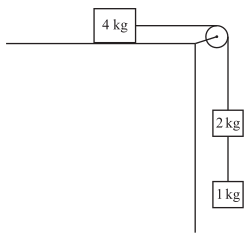
A 4 kg mass is held at rest on a smooth surface. It is connected by a light inextensible string that passes over a smooth pulley to a 2 kg mass, which in turn is connected by the same type of string to a 1 kg mass. This is shown in the diagram below.


When the 4 kg mass is released, the tension in the string connecting the 1 kg and 2 kg masses is `T` newtons. The value of `T` is

  1. `(4g)/7`
  2. `(3g)/7`
  3. `g/7`
  4. `(6g)/7`
  5. `g`
Show Answers Only

`A`

Show Worked Solution

`text(Considering the whole system:)`

`text(Total mass = 7 kg)`

`text(Net Force ↓ =)\ 3g`

`F` `= ma`
`3g` `= 7a`
`:.a` `= (3g)/7`

 
`text(Consider the forces on the 1 kg mass:)`

`g – T` `= a`
`g – T` `= (3g)/7`
`T` `= g – (3g)/7`
  `= (4g)/7`

 
`=>A`

Filed Under: Pulleys, Planes and Equilibrium (SM) Tagged With: Band 4, smc-1175-30-Connected particles

Mechanics, SPEC2 2012 VCAA 20 MC

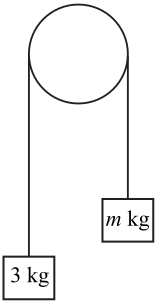
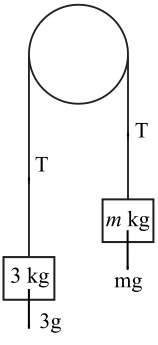
Particles of mass 3 kg and `m` kg are attached to the ends of a light inextensible string that passes over a smooth pulley, as shown.


If the acceleration of the 3 kg mass is  `4.9\ text(m/s)^2`  upwards, then

A.   `m` = 4.5

B.   `m` = 6.0

C.   `m` = 9.0

D.   `m` = 13.5

E.   `m` = 18.0

Show Answers Only

`C`

Show Worked Solution

`sum F` `=\ text(total mass × acceleration)`
`mg – 3g` `= (m + 3) xx 4.9`
`9.8m-3xx9.8` `= 4.9m + 14.7`
`:. m` `= 9`

 
`=> C`

Filed Under: Pulleys, Planes and Equilibrium (SM) Tagged With: Band 5, smc-1175-30-Connected particles

Mechanics, SPEC2 2014 VCAA 20 MC

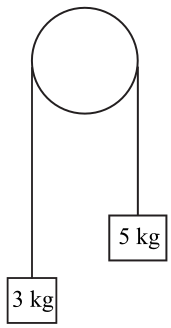
Particles of mass 3 kg and 5 kg are attached to the ends of a light inextensible string that passes over a fixed smooth pulley, as shown above. The system is released from rest.

Assuming the system remains connected, the speed of the 5 kg mass after two seconds is

A.     4.0 m/s

B.     4.9 m/s

C.     9.8 m/s

D.   10.0 m/s

E.   19.6 m/s

Show Answers Only

`B`

Show Worked Solution
`sum F` `= 5g – 3g = 2g`
  `=2 xx 9.8`
  `=19.6\ \ text(N)`
`(5+3)a` `= 19.6`
`a` `=2.45`

  
`u = 0, quad t = 2, quad a = 2.45`

`v` `= u + at`
  `= 0 + 2.45 xx 2`
  `=4.9\ \ text(m/s)`

 
`=> B`

Filed Under: Pulleys, Planes and Equilibrium (SM) Tagged With: Band 4, smc-1175-30-Connected particles

Mechanics, SPEC2 2015 VCAA 19 MC

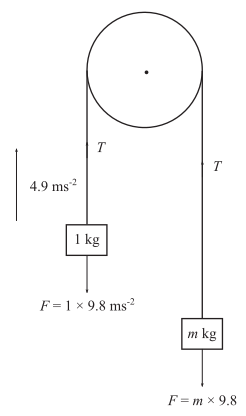
A light inextensible string passes over a smooth pulley, as shown below, with particles of mass 1 kg and `m` kg attached to the ends of the string.
 

SPEC2 2015 VCAA 19 MC

If the acceleration of the 1 kg particle is 4.9 `text(ms)^(-2)` upwards, then `m` is equal to

A.   1

B.   2

C.   3

D.   4

E.   5

Show Answers Only

`C`

Show Worked Solution

`T – (9.8 xx 1) = 4.9 xx 1`

`T=14.7`
 

`m xx 9.8 – T` `=m xx 4.9`
`4.9m` `= 14.7“
`:. m` `= 14.7/4.9`
  `= 3`

`=> C`

Filed Under: Pulleys, Planes and Equilibrium (SM) Tagged With: Band 4, smc-1175-30-Connected particles

Mechanics, SPEC2-NHT 2017 VCAA 5

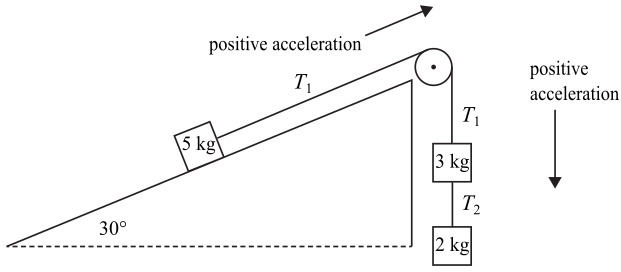
A 5 kg mass is initially held at rest on a smooth plane that is inclined at 30° to the horizontal. The mass is connected by a light inextensible string passing over a smooth pulley to a 3 kg mass, which in turn is connected to a 2 kg mass.

The 5 kg mass is released from rest and allowed to accelerate up the plane.

Take acceleration to be positive in the directions indicated.
 

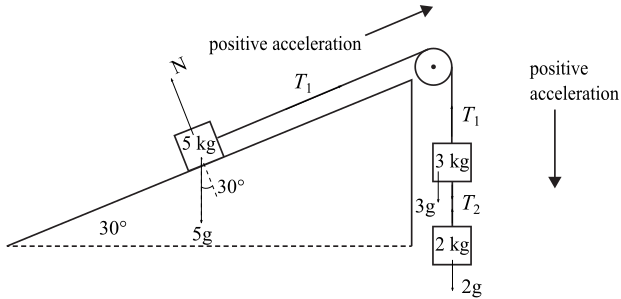
  1. Write down an equation of motion, in the direction of motion, for each mass.   (3 marks)
  2. Show that the acceleration of the 5 kg mass is  `g/4\ text(ms)^(-2)`.  (1 mark)
  3. Find the tensions  `T_1`  and  `T_2`  in the string in terms of  `g`.  (2 marks)
  4. Find the momentum of the 5 kg mass, in kg ms`­^(-1)`, after it has moved 2 m up the plane, giving your answer in terms of `g`.  (2 marks)
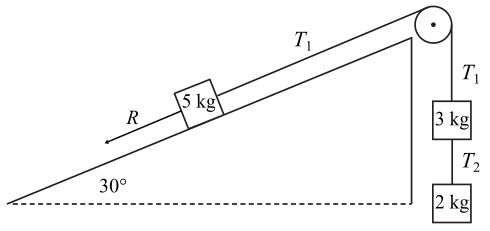
  5. A resistance force  `R`  acting parallel to the inclined plane is added to hold the system in equilibrium, as shown in the diagram below.


    `qquad`


    Find the magnitude of  `R`  in terms of  `g`.  (2 marks)

Show Answers Only
  1. `2a = 2g – T_2`


    `3a = 3g + T_2 – T_1`


    `5a = T_1 – (5g)/2`

  2. `text(Proof)\ text{(See Worked Solutions)}`
  3. `T_1 = (15g)/4`


    `T_2 = (3g)/2`

  4. `p = 5 sqrt g`
  5. `R = (5g)/2`
Show Worked Solution
a.    `2\ text(kg): \ 2a` `= 2g – T_2`
  `3\ text(kg): \ 3a` `= 3g + T_2 – T_1`
  `5\ text(kg): \ 5a` `= T_1 – 5g sin (30^@)`
  `5a` `= T_1 – (5g)/2`


b.   `sum F = 3g + 2g – 5g sin 30^@ = (5 + 3 + 2)a`

`5g – (5g)/2` `= 10a`
`a` `= (5g)/(2 xx 10)`
`:. a` `= g/4\ text(ms)^(-2)`


c.   ` T_1 – (5g)/2` `= 5a`
`:. T_1` `= (5g)/2 + 5(g/4)`
  `= (15g)/4`


`2g – T_2` `= 2a`
`:. T_2` `= 2g – 2(g/4)`
  `= (3g)/2`


d.   `u = 0,\ \ a = g/4,\ \ s = 2`

`text(Find)\ \ v\ \ text(when)\ \ s=2:`

`v^2` `= u^2 + 2as`  
  `=0 + 2 (g/4) xx 2`  
  `=g`  
`v` `=sqrtg\ \ \ (v>0)`  

 
`:. p = 5 sqrt g`


e.   `sum F = 2g + 3g – 5g sin 30^@ – R = 0`

`:. R` `= 2g + 3g – 5g sin 30^@`
  `= 5g – (5g)/2`
  `= (5g)/2`

Filed Under: Pulleys, Planes and Equilibrium (SM) Tagged With: Band 3, Band 4, Band 5, smc-1175-30-Connected particles

Mechanics, SPEC2 2017 VCAA 14 MC

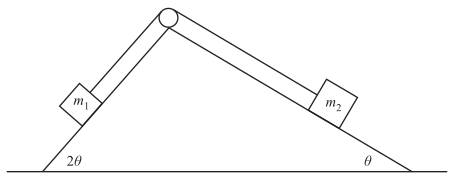
Two particles with mass `m_1` kilograms and `m_2` kilograms are connected by a taut light string that passes over a smooth pulley. The particles sit on smooth inclined planes, as shown in the diagram below.


If the system is in equilibrium, then  `m_1/m_2`  is equal to

  1.  `(sec(theta))/2`
  2.  `2sec(theta)`
  3.  `2cos(theta)`
  4.  `1/2`
  5.  `1`
Show Answers Only

`A`

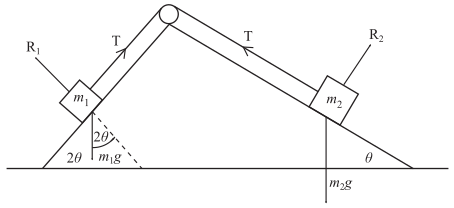
Show Worked Solution

Mean mark 51%.

`∑F` `=m_1gsin(2theta) – m_2gsin(theta) = 0`
   
`m_1gsin(2theta)` `= m_2gsin(theta)`
`m_1/m_2` `= (sin(theta))/(sin(2theta))`
  `= (sin(theta))/(2sin(theta)cos(theta))`
  `= 1/(2 cos(theta))`
  `= 1/2 sec(theta)`

 
`=> A`

Filed Under: Pulleys, Planes and Equilibrium (SM) Tagged With: Band 4, smc-1175-30-Connected particles

Mechanics, SPEC1-NHT 2018 VCAA 1

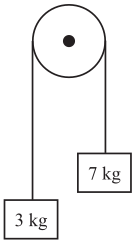
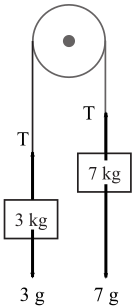
A light inextensible string hangs over a frictionless pulley connecting masses of 3 kg and 7 kg, as shown below.


  1.  Draw all of the forces acting on the two masses on the diagram above. (1 mark)
  2.  Calculate the tension in the string.  (2 marks)
Show Answers Only
  1.  `text(See Worked Solutions)`
  2. `(21g)/5 N`
Show Worked Solution
a.   


b.    `sum F = 7g – 3g = 4g` ` = (7 + 3)a`
  `a = (4g)/10= (2g)/5`  
  `sum F_3 = T – 3g` `= 3a`
  `T – 3g` `= (6g)/5`
  `T` `= 3g + (6g)/5`
    `= (21g)/5\ \ N`

Filed Under: Pulleys, Planes and Equilibrium (SM) Tagged With: Band 4, smc-1175-30-Connected particles

Mechanics, SPEC1 2018 VCAA 1

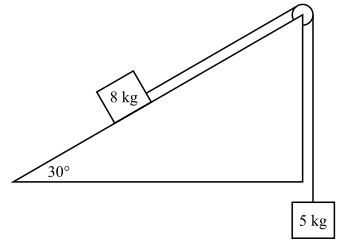
Two objects of masses 5 kg and 8 kg are attached by a light inextensible string that passes over a smooth pulley. The 8 kg mass is on a smooth plane inclined at 30° to the horizontal. The 5 kg mass is hanging vertically, as shown in the diagram below.


  1. On the diagram above, show all forces acting on both masses.  (1 mark)
  2. Find the magnitude, in `text(ms)^(-2)`, and state the direction of the acceleration of the 8 kg mass.  (3 marks)
Show Answers Only
a.  

b.   `a = 9/13\ text(ms)^(-2)\ text(up the incline)`

Show Worked Solution
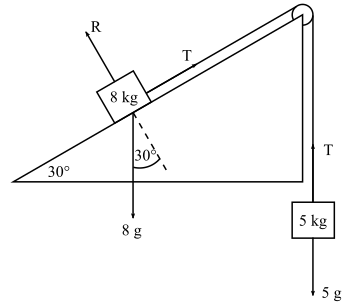
a.  


b.   
`sum F` `= 5 text(g) – 8 text(g)\ sin (30^@) = (5 + 8)a\ \ text{(up slope → +)}`
  `5 text(g) – 4 text(g)` `= 13a`
  `:. a` `= 9/13\ text(ms)^(-2)\ text(up the incline)`

Filed Under: Pulleys, Planes and Equilibrium (SM) Tagged With: Band 4, smc-1175-30-Connected particles

Copyright © 2014–2025 SmarterEd.com.au · Log in