SmarterEd

Aussie Maths & Science Teachers: Save your time with SmarterEd

  • Login
  • Get Help
  • About

Mechanics, SPEC2 2020 VCAA 18 MC

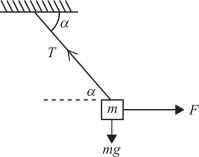
A particle of mass `m` kilogram hangs from a string that is attached to a fixed point. The particle is acted on by a horizontal force of magnitude `F` newtons. The system is in equilibrium when the string makes an angle `alpha` to the horizontal, as shown in the diagram below. The tension in the string has magnitude `T` newtons.
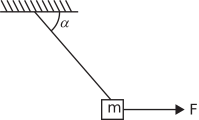


The value of  `tan(alpha)`  is

  1. `(mg)/T`
  2. `T/(mg)`
  3. `T/F`
  4. `F/(mg)`
  5. `(mg)/F`
Show Answers Only

`E`

Show Worked Solution

`text(Resolving forces vertically:)`

`mg = Tsin(alpha)`
 

`text(Resolving forces horizontally:)`

`F = Tcos(alpha)`

`:. tan(alpha) = (mg)/F`

`=>E`
Filed Under: Pulleys, Planes and Equilibrium (SM) Tagged With: Band 4, smc-1175-40-Equilibrium

Mechanics, SPEC2 2019 VCAA 17 MC

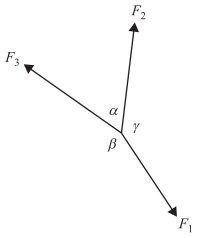
A particle is held in equilibrium by three coplanar forces of magnitudes  `F_1, F_2`  and  `F_3`.

The angles between these forces are  `alpha, beta`  and  `gamma`  as shown in the diagram below.
 

If  `beta = 2alpha`, then  `(F_1)/(F_2)`  is equal to

  1. `1/2 sin(alpha)`
  2. `2sin(alpha)`
  3. `1/2text(cosec)(alpha)`
  4. `1/2cos(alpha)`
  5. `1/2sec(alpha)`
Show Answers Only

`E`

Show Worked Solution

`text(Using Lami’s theorem:)`

`(F_1)/(sin alpha)` `= (F_2)/(sinbeta)`
`(F_1)/(F_2)` `= (sin alpha)/(sin beta)`
  `= (sin alpha)/(sin 2alpha)`
  `= (sin alpha)/(2sin alphacos alpha)`
  `= 1/2 sec alpha`

 
`=>E`

Filed Under: Pulleys, Planes and Equilibrium (SM) Tagged With: Band 4, smc-1175-40-Equilibrium, smc-1175-50-Lami's theorem

Mechanics, SPEC1 2019 VCAA 9

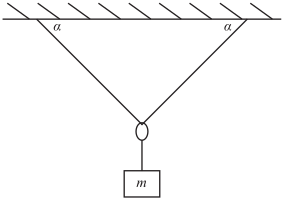
  1. A light inextensible string is connected at each end to a horizontal ceiling. A mass of `m` kilograms hangs in equilibrium from a smooth ring on the string, as shown in the diagram below. The string makes an angle `alpha` with the ceiling.
      
    `qquad qquad`
     
    Express the tension, `T` newtons, in the string in terms of `m`, `g` and `alpha`.  (1 mark)
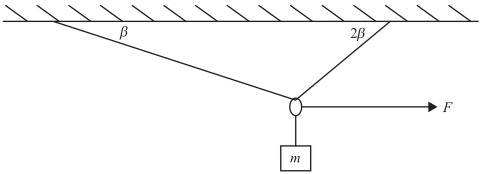
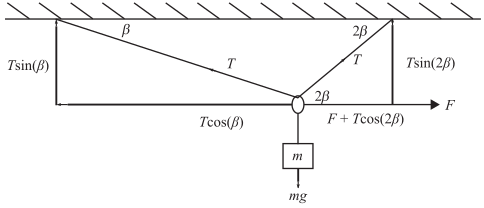
  2. A different light inextensible sting is connected at each end to a horizontal ceiling. A mass of `m` kilograms hangs from a smooth ring on the string. A horizontal force of `F` newtons is applied to the ring. The tension in the sting has a constant magnitude and the system is in equilibrium. At one end the string makes an angle `beta` with the ceiling and at the other end the string makes an angle `2beta` with the ceiling, as shown in the diagram below.


    Show that  `F = mg((1 - cos(beta))/(sin(beta)))`.  (3 marks)
Show Answers Only
  1. `T = (mg)/(2sinalpha)`
  2. `text(See Worked Solutions)`
Show Worked Solution
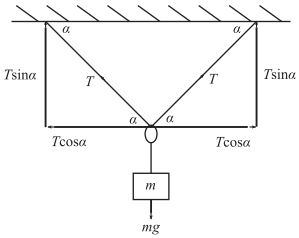
a.   
`2 xx Tsinalpha` `= mg`
`:.T` `= (mg)/(2sinalpha)`


b.   

 
`text(Resolving forces vertically:)`

`Tsin(beta) + Tsin(2beta)` `= mg`
`T` `= (mg)/(sin(beta) + sin(2beta))`

 
`text(Resolving forces horizontally:)`

`F + Tcos(2beta)` `= Tcos(beta)`
`F` `= Tcos(beta) – Tcos(2beta)`
  `= T(cos(beta) – cos(2beta))`
  `= T[cos(beta) – (2cos^2beta – 1)]`
  `= T(−2cos^2(beta) + cos(beta) + 1)`
  `= T(−2cos(beta) – 1)(cos(beta) – 1)`
  `= (mg(1 -cos(beta))(2cosbeta + 1))/(sin(beta) + 2sin(beta)cos(beta))`
  `= (mg(1 – cos(beta))(2cos(beta) + 1))/(sin(beta)(1+2cos(beta)))`
  `= mg((1 – cos(beta))/(sin(beta)))`

Filed Under: Pulleys, Planes and Equilibrium (SM) Tagged With: Band 4, Band 5, smc-1175-40-Equilibrium

Mechanics, SPEC2 2012 VCAA 22 MC

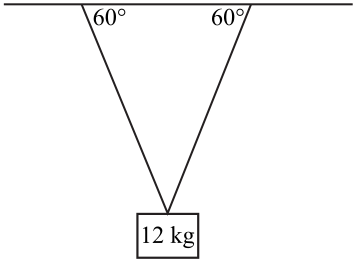
A 12 kg mass is suspended in equilibrium from a horizontal ceiling by two identical light strings. Each string makes an angle of 60° with the ceiling, as shown.


The magnitude, in newtons, of the tension in each string is equal to

A.     `6 g`

B.   `12 g`

C.   `24 g`

D.   `4 sqrt 3 g`

E.   `8 sqrt 3 g`

Show Answers Only

`D`

Show Worked Solution

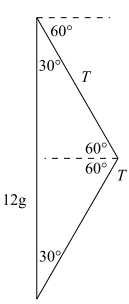
`T/(sin 30^@)` `= (12 g)/(sin 120^@)`
`2T` `= (24 g)/sqrt3`
`T` `= (12 g)/sqrt3`
  `= 4g sqrt 3`

 
`=> D`

Filed Under: Pulleys, Planes and Equilibrium (SM) Tagged With: Band 4, smc-1175-40-Equilibrium

Mechanics, SPEC1 2011 VCAA 7

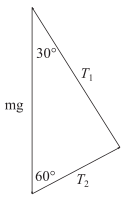
A flowerpot of mass `m` kg is held in equilibrium by two light ropes, both of which are connected to a ceiling. The first rope makes an angle of 30° to the vertical and has tension `T_1` newtons. The second makes an angle of 60° to the vertical and has tension `T_2` newtons.
 

VCAA 2011 spec 7b
 

  1. Show that `T_2 = T_1/sqrt 3.`  (1 mark)
  2. The first rope is strong, but the second rope will break if the tension in it exceeds 98 newtons.


    Find the maximum value of `m` for which the flowerpot will remain in equilibrium.  (3 marks)

Show Answers Only
  1. `text(Proof)\ \ text{(See Worked Solutions)}`
  2. `m = 20\ text(kg)`
Show Worked Solution

a.   `text(Forces in equilibrium:)`

`tan 30^@` `=T_2/T_1`
`T_2` `= T_1 xx tan30^@`
`T_2` `= T_1/sqrt3\ \ text(.. as required)`


b.    `sin30^@` `= (T_2)/(mg)`
  `T_2` `= (mg)/2`
  `98` `=(m_text(max) xx 9.8)/2`
  `m_text(max)` `=(2 xx 98)/9.8`
    `=20\ text(kg)`

Filed Under: Pulleys, Planes and Equilibrium (SM) Tagged With: Band 4, smc-1175-40-Equilibrium

Mechanics, SPEC2 2013 VCAA 16 MC

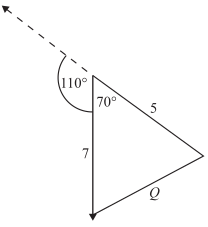
Forces of magnitude 5 N, 7 N and `Q` N act on a particle that is in equilibrium, as shown in the diagram below.
 

SPEC2 2013 VCAA 16 MC
 

The magnitude of `Q`, in newtons, can be found by evaluating

A.   `sqrt(5^2 + 7^2 - 2 xx 5 xx 7 cos(70^@))`

B.   `5^2 + 7^2 - 2 xx 5 xx 7 cos(110^@)`

C.   `sqrt(5^2 + 7^2 - 2 xx 5 xx 7 cos(110^@))`

D.   `5^2 + 7^2 - 2 xx 5 xx 7 cos(70^@)`

E.   `sqrt(5^2 + 7^2 - 2 xx 5 xx 7 cos(20^@))`

Show Answers Only

`A`

Show Worked Solution

`text(Using cosine rule:)`


`Q^2` `= 5^2 + 7^2 – 2(5)(7)cos(70^@)`
`Q` `= sqrt(5^2 + 7^2 – (5)(7)cos(70^@))`

 
`=> A`

Filed Under: Pulleys, Planes and Equilibrium (SM) Tagged With: Band 4, smc-1175-40-Equilibrium

Mechanics, SPEC2 2015 VCAA 16 MC

SPEC2 2015 VCAA 16 MC

The diagram above shows a mass suspended in equilibrium by two light strings that make angles of `60^@` and `30^@` with a ceiling. The tensions in the strings are `T_1` and `T_2`, and the weight force acting on the mass is `underset~W`. The correct statement relating the given forces is

A.   `underset~T_1 + underset~T_2 + underset~W = underset~0`

B.   `underset~T_1 + underset~T_2 - underset~W = underset~0`

C.   `underset~T_1 xx 1/2 + underset~T_2 xx sqrt3/2 = underset~0`

D.   `underset~T_1 xx sqrt3/2 + underset~T_2 xx 1/2 = underset~W`

E.   `underset~T_1 xx 1/2 + underset~T_2 xx sqrt3/2 = underset~W`

Show Answers Only

`A`

Show Worked Solution

`text(S)text(ince equilibrium exists:)`

♦♦♦ Mean mark 26%.

`sumunderset~F = underset~(T_1) + underset~(T_2) + underset~W = underset~0`

 
`=> A`

Filed Under: Pulleys, Planes and Equilibrium (SM) Tagged With: Band 6, smc-1175-40-Equilibrium

Mechanics, SPEC2 2016 VCAA 14 MC

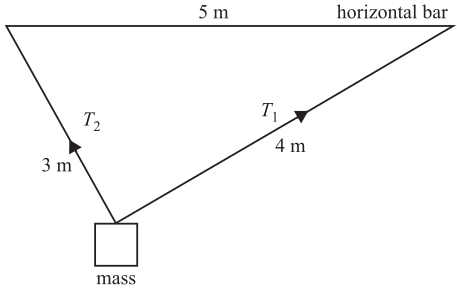
Two light strings of length 4 m and 3 m connect a mass to a horizontal bar, as shown below

The strings are attached to the horizontal bar 5 m apart.


Given the tension in the longer string is  `T_1`  and the tension in the shorter string is  `T_2`,  the ratio of the tensions  `T_1/T_2`  is

A.   `3/5`

B.   `3/4`

C.   `4/5`

D.   `5/4`

E.   `4/3`

Show Answers Only

`B`

Show Worked Solution

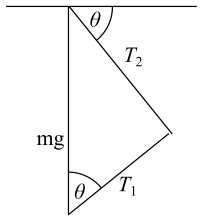
`text{Strings make up 3-4-5 (right-angled) triangle:}`

♦ Mean mark 41%.

`text(Let)\ \ theta =\ text(angle between 3m string and horizontal bar)`

`T_1/T_2` `= cot theta`
  `= 3/4`

  
`=>  B`

Filed Under: Pulleys, Planes and Equilibrium (SM) Tagged With: Band 5, smc-1175-40-Equilibrium

Mechanics, SPEC1 2016 VCAA 1

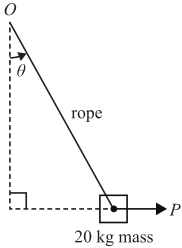
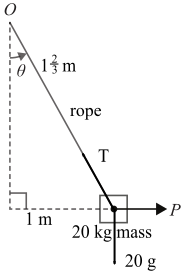
A taut rope of length `1 2/3` m suspends a mass of 20 kg from a fixed point `O`. A horizontal force of `P` newtons displaces the mass by 1 m horizontally so that the taut rope is then at an angle of  `theta`  to the vertical.

  1. Show all the forces acting on the mass on the diagram below.  (1 mark)


  1. Show that  `sin (theta) = 3/5`.  (1 mark)
  2. Find the magnitude of the tension force in the rope in newtons.  (2 marks)
Show Answers Only
  1. `text(See Worked Solutions)`
  2. `text(Proof)\ text{(See Worked Solutions)}`
  3. `T = 245\ text(N)`
Show Worked Solution
a.   


b.    `sin(theta)` `= 1/(1 2/3)`
    `= 1/((5/3)`
    `= 3/5`


c.   

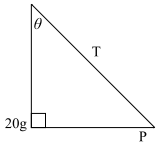
`cos theta = (20g)/T`

`sin theta = 3/5\ \ text{(using part b)}`

`underbrace{(400g^2)/T^2 + 9/25}_(cos^2 theta + sin^2 theta = 1)` `= 1`
`(400g^2)/T^2` `= 16/25`
`(20g)/T` `=4/5`
`T/(20g)` `= 5/4`
`T` `= 25g`
  `=245\ text(N)`

Filed Under: Pulleys, Planes and Equilibrium (SM) Tagged With: Band 2, Band 4, smc-1175-40-Equilibrium

Mechanics, SPEC1 2014 VCAA 8

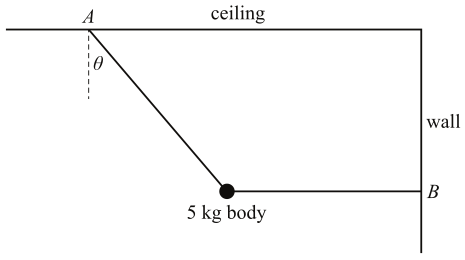
A body of mass 5 kg is held in equilibrium by two light inextensible strings. One string is attached to a ceiling at `A` and the other to a wall at `B`. The string attached to the ceiling is at an angle `theta` to the vertical and has tension `T_1` newtons, and the other string is horizontal and has tension `T_2` newtons. Both strings are made of the same material.

  1. i. Resolve the forces on the body vertically and horizontally, and express `T_1` in terms of  `theta`.  (2 marks)
  2. ii. Express `T_2` in terms of  `theta`.  (1 mark)
  3.  Show that  `tan (theta) < sec (theta)`  for  `0 < theta < pi/2`.  (1 mark)
  4.  The type of string used will break if it is subjected to a tension of more than 98 N.


     Find the maximum allowable value of  `theta`  so that neither string will break.  (3 marks)

Show Answers Only
  1.  i. `T_1 = 5g sec theta`
  2. ii. `T_2 = 5g tan theta`
  3.  `text(Proof)\ text{(See Worked Solutions)}`
  4.  `theta_max = pi/3`
Show Worked Solution
a.i.   

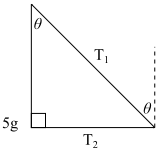
`text(Resolve vertically): \ 5g = T_1 cos theta`

`text(Resolve horizontally): \ T_1 sin theta = T_2`

`:. T_1 = 5g sec theta`


a.ii.    `T_2` `= 5g sec theta sin theta`
    `= 5g tan theta`


b.    `cos theta in (0, 1), \ theta in (0, pi/2)`
  `sin theta in (0, 1), \ theta in (0, pi/2)`

`:. sin theta < 1, \ theta in (0, pi/2)`

♦ Mean mark part (b) 40%.


`text(If)\ sin theta < 1 and cos theta > 0:`

`(sin theta)/(cos theta) < 1/(cos theta)`

`:.  tan theta < sec theta, quad 0 < theta < pi/2`


c.   `tan theta < sec theta \ \ =>\ \  T_2\ text(will be smaller) => \ T_1\ text(will break first)`

♦ Mean mark part (c) 46%.

`5text(g)\ sec theta_max` `= 98`
`sec theta_max` `= 98/(5 xx 9.8)`
`sec theta_max` `= 10/5`
`sec theta_max` `= 2`
`:.  theta_max` `= pi/3`

Filed Under: Pulleys, Planes and Equilibrium (SM) Tagged With: Band 4, Band 5, smc-1175-40-Equilibrium

Mechanics, SPEC2-NHT 2018 VCAA 14 MC

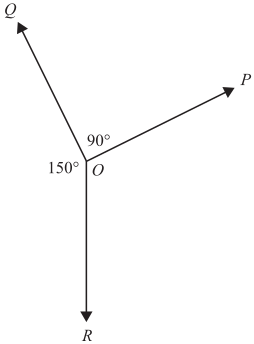
The diagram above shows a particle at `O` in equilibrium in a plane under the action of three forces of magnitudes `P, Q` and `R`.

Which one of the following statements is false?

A.   `R = Q sin (60^@)`

B.   `Q = R sin (60^@)`

C.   `P = R sin(30^@)`

D.   `Q cos (60^@) = P cos (30^@)`

E.   `P cos (60^@) + Q cos (30^@) = R`

Show Answers Only

`A`

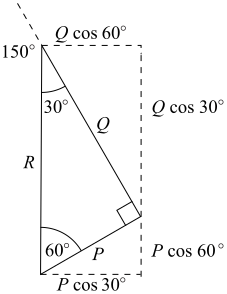
Show Worked Solution


`text(By elimination:)`

`sin 60^@` `= Q/R`
`Q` `= R\ sin 60^@ \ \ text{(B correct)}`
`sin30^@` `= P/R`
`P` `= R\ sin30^@\ \ text{(C correct)}`


`text(Equating horizontal forces:)`

`Q\ cos 60^@ = P\ cos 30^@\ \ text{(D correct)}`


`text(Equating vertical forces:)`

`P\ cos 60^@ + Q\ cos 30^@ = R\ \ text{(E correct)}`

 
`=>  A`

Filed Under: Pulleys, Planes and Equilibrium (SM) Tagged With: Band 4, smc-1175-40-Equilibrium, smc-1175-50-Lami's theorem

Mechanics, SPEC2 2018 VCAA 16 MC

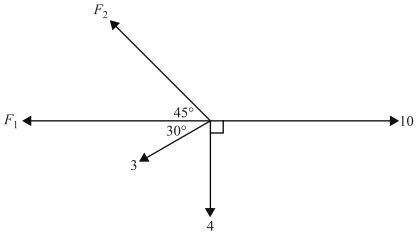
The diagram below shows a mass being acted on by a number of forces whose magnitudes are labelled. All forces are measured in newtons and the system is in equilibrium.
 

The value of `F_2` is

A.   `sqrt 2/2 (8 + 3 sqrt 3)`

B.   `(11 sqrt 2)/2`

C.   `(3 sqrt 2)/2`

D.   `7.78`

E.   `7.0`

Show Answers Only

`B`

Show Worked Solution

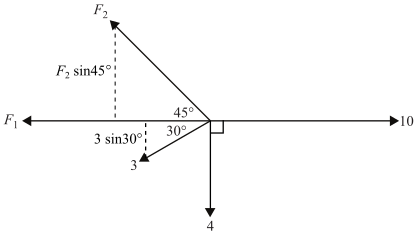
`text(vertical:)\ \ sum F_y = 4 + 3 sin 30^@ +\ ^(−)F_2 sin 45^@ = 0`

`4 + 3/2 – F_2/sqrt 2` `= 0`
`F_2/sqrt 2` `= 4 + 3/2`
`:. F_2` `= sqrt 2 (4 + 3/2)`
  `= (11 sqrt 2)/2`

 
`=>  B`

Filed Under: Pulleys, Planes and Equilibrium (SM) Tagged With: Band 4, smc-1175-40-Equilibrium

Copyright © 2014–2025 SmarterEd.com.au · Log in