The path of a moving particle with position vector
\(\underset{\sim}{r}(t)=\left(5 \cos (t)-4 \cos \left(\dfrac{5 t}{2}\right)\right) \underset{\sim}{i}+\left(5 \sin (t)-4 \sin \left(\dfrac{5 t}{2}\right)\right) \underset{\sim}{j}\)
is shown below for time \(t \geq 0\).
All lengths are in metres and time is measured in seconds.
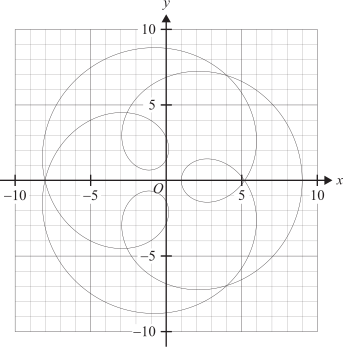
- Write down the coordinates of the particle's starting point. (1 mark)
--- 2 WORK AREA LINES (style=lined) ---
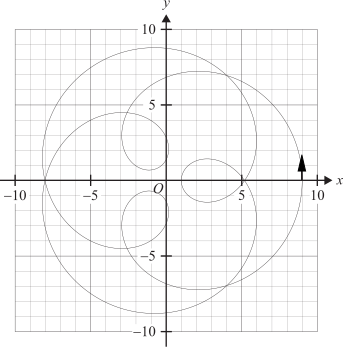
- On the graph above, draw an arrow from the point \((9,0)\) to indicate the direction of motion of the particle. (1 mark)
--- 0 WORK AREA LINES (style=lined) ---
- Find the value of \(t\) for which the particle will first return to its starting point. (1 mark)
--- 2 WORK AREA LINES (style=lined) ---
- Show that the speed of the particle, in m s\(^{-1}\), at time \(t\) can be expressed as \(\sqrt{125-100 \cos \left(\dfrac{3 t}{2}\right)}\). (3 marks)
--- 9 WORK AREA LINES (style=lined) ---
- What is the maximum speed of the particle in m s\(^{-1}\)? (1 mark)
--- 2 WORK AREA LINES (style=lined) ---
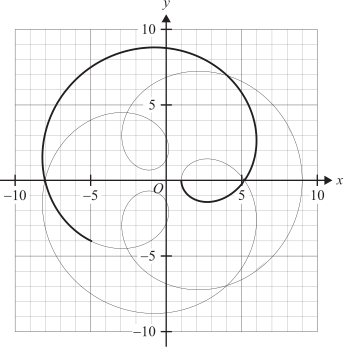
- On the graph above, trace the path of the particle for \(t \in[0, \pi]\). (1 mark)
--- 0 WORK AREA LINES (style=lined) ---
- Find the length of the path traced in part f, giving your answer in metres, correct to one decimal place. (2 marks)
--- 5 WORK AREA LINES (style=lined) ---
a. \(\text{Initial coordinates:}\ (1,0)\)
b.
c. \(t=4 \pi \ \text{seconds}\)
d. \(r(t)=\left(5 \cos (t)-4 \cos \left(\dfrac{5 t}{2}\right)\right)\underset{\sim}{i}+\left(5 \sin (t)-4 \sin \left(\dfrac{5 t}{2}\right)\right)\underset{\sim}{j}\)
\(\dot{r}(t)=\left(-5 \sin (t)+10 \sin \left(\dfrac{5 t}{2}\right)\right) \underset{\sim}{i}+\left(5 \cos (t)-10 \cos \left(\dfrac{5 t}{2}\right)\right) \underset{\sim}{j}\)
\(\text {Speed}=\abs{\dot{r}(t)}:\)
| \(\text{Speed}^2\) | \(=\left(-5 \sin (t)+10 \sin \left(\dfrac{5 t}{2}\right)\right)^2+\left(5 \cos (t)-10 \cos \left(\dfrac{5 t}{2}\right)\right)^2\) |
| \(=25 \sin ^2(t)-100 \sin (t) \sin \left(\dfrac{5 t}{2}\right)+100 \sin ^2\left(\dfrac{5 t}{2}\right)\) | |
| \(\quad +25 \cos ^2(t)-100 \cos (t) \cos \left(\dfrac{5 t}{2}\right)+100 \cos ^2\left(\dfrac{5 t}{2}\right)\) | |
| \(=125-100\left(\sin (t) \sin \left(\dfrac{5 t}{2}\right)-\cos (t) \cos \left(\dfrac{5 t}{2}\right)\right)\) | |
| \(=125-100 \cos \left(\dfrac{5 t}{2}-t\right)\) | |
| \(\text{speed}\) | \(=\sqrt{125-100 \cos \left(\dfrac{3t}{2}\right)}\) |
e. \(\text{Speed}_{\text {max}}=15 \ \text{ms}^{-1}\)
f. \(\text{Path traces curve from}\ (1,0)\ \text{to}\ (-5,-4).\)
g. \(\displaystyle \int_0^\pi \sqrt{125-100 \cos \left(\frac{3 t}{2}\right)} d t=36.6\ \text{(1 d.p.)}\)
a. \(\text{At} \ \ t=0:\)
\(r(t)=(5 \cos 0-4 \cos 0)\underset{\sim}{i} + (5 \sin 0-4 \sin 0) {\underset{\sim}{j}}=\underset{\sim}{i}\)
\(\text{Initial coordinates:}\ (1,0)\)
b.
c. \(\text{Solve for}\ t \ \text{(by CAS):}\)
\(5 \cos (t)-4 \cos \left(\dfrac{5t}{2}\right)=1\)
\(5 \sin (t)-4 \sin \left(\dfrac{5 t}{2}\right)=0\)
\(t=4 \pi \ \text{seconds}\)
d. \(r(t)=\left(5 \cos (t)-4 \cos \left(\dfrac{5 t}{2}\right)\right)\underset{\sim}{i}+\left(5 \sin (t)-4 \sin \left(\dfrac{5 t}{2}\right)\right)\underset{\sim}{j}\)
\(\dot{r}(t)=\left(-5 \sin (t)+10 \sin \left(\dfrac{5 t}{2}\right)\right) \underset{\sim}{i}+\left(5 \cos (t)-10 \cos \left(\dfrac{5 t}{2}\right)\right) \underset{\sim}{j}\)
\(\text {Speed}=\abs{\dot{r}(t)}:\)
| \(\text{Speed}^2\) | \(=\left(-5 \sin (t)+10 \sin \left(\dfrac{5 t}{2}\right)\right)^2+\left(5 \cos (t)-10 \cos \left(\dfrac{5 t}{2}\right)\right)^2\) |
| \(=25 \sin ^2(t)-100 \sin (t) \sin \left(\dfrac{5 t}{2}\right)+100 \sin ^2\left(\dfrac{5 t}{2}\right)\) | |
| \(\quad +25 \cos ^2(t)-100 \cos (t) \cos \left(\dfrac{5 t}{2}\right)+100 \cos ^2\left(\dfrac{5 t}{2}\right)\) | |
| \(=125-100\left(\sin (t) \sin \left(\dfrac{5 t}{2}\right)-\cos (t) \cos \left(\dfrac{5 t}{2}\right)\right)\) | |
| \(=125-100 \cos \left(\dfrac{5 t}{2}-t\right)\) | |
| \(\text{speed}\) | \(=\sqrt{125-100 \cos \left(\dfrac{3t}{2}\right)}\) |
e. \(\text{Speed}_{\text {max }} \ \text {occurs when} \ \ \cos \left(\frac{3 t}{2}\right)=-1\)
\(\text{Speed}_{\text {max}}=\sqrt{125+100}=15 \ \text{ms}^{-1}\)
f. \(\text{At} \ \ t=\pi, \quad r(\pi)=-5\underset{\sim}{i}-4\underset{\sim}{j}\)
\(\text{Path traces curve from}\ (1,0)\ \text{to}\ (-5,-4).\)
g. \(\text{Length of curve (by CAS):}\)
\(\displaystyle \int_0^\pi \sqrt{125-100 \cos \left(\frac{3 t}{2}\right)} d t=36.6\ \text{(1 d.p.)}\)