SmarterEd

Aussie Maths & Science Teachers: Save your time with SmarterEd

  • Login
  • Get Help
  • About

Calculus, SPEC2 2023 VCAA 3

The curve given by  \(y^2=x-1\), where  \(2 \leq x \leq 5\), is rotated about the \(x\)-axis to form a solid of revolution.

  1.  i. Write down the definite integral, in terms of \(x\), for the volume of this solid of revolution.  (1 mark)

    --- 2 WORK AREA LINES (style=lined) ---

  2. ii. Find the volume of the solid of revolution.  (1 mark)

    --- 2 WORK AREA LINES (style=lined) ---

  3.  i. Express the curved surface area of the solid in the form  \(\pi \displaystyle \int_a^b \sqrt{A x-B}\, d x\), where \(a, b, A, B\) are all positive integers.  (2 marks)

    --- 4 WORK AREA LINES (style=lined) ---

  4. ii. Hence or otherwise, find the curved surface area of the solid correct to three decimal places.  (1 mark)

    --- 2 WORK AREA LINES (style=lined) ---

The total surface area of the solid consists of the curved surface area plus the areas of the two circular discs at each end.

The 'efficiency ratio' of a body is defined as its total surface area divided by the enclosed volume.

  1. Find the efficiency ratio of the solid of revolution correct to two decimal places.  (2 marks)

    --- 2 WORK AREA LINES (style=lined) ---

  2. Another solid of revolution is formed by rotating the curve given by  \(y^2=x-1\) about the \(x\)-axis for  \(2 \leq x \leq k\), where \(k \in R\). This solid has a volume of \(24 \pi\).
  3. Find the efficiency ratio for this solid, giving your answer correct to two decimal places.  (3 marks)

    --- 4 WORK AREA LINES (style=lined) ---

Show Answers Only

a.i. \(\displaystyle V=\pi \int y^2 d x=\pi \int_2^5(x-1) dx\)
 

a.ii. \(\text{Evaluating integral (by calc):}\)

\(V=\dfrac{15 \pi}{2}\ \text{u}^3\)
 

b.i.  \(\displaystyle y=\sqrt{x-1} \ \Rightarrow \ \frac{d y}{d x}=\frac{1}{2} \cdot \frac{1}{\sqrt{x-1}} \ \Rightarrow \ \frac{d^2 y}{dx^2}=\frac{1}{4(x-1)}\)

\(\ \ \begin{aligned} \displaystyle \int_2^5 2 \pi \sqrt{x-1} \ \sqrt{1+\frac{1}{4(x-1)}} \ d x & =\int_2^5 2 \pi \sqrt{x-1+\frac{1}{4}}\, d x \\ & =\pi \int_2^5 \sqrt{4 x-3}\, d x\end{aligned}\)

 
b.ii.
\(\text{Evaluate integral in b.i.}\)

\(\text {S.A.}=30.847\ \text{u}^2\)
 

c.    \(y=\sqrt{x-1}\)

\(\text{At}\ \ x=2\ \ \Rightarrow y=1\)

\(\text{At}\ \ x=5\ \ \Rightarrow y=2\)

\begin{aligned}
\text{Total S.A. } &=30.847+\pi(1)^2+\pi(2)^2 \\
&=46.5545\ \text{u}^2 \\
\end{aligned}

\(\text {Efficiency ratio}=\dfrac{46.5545}{\frac{15 \pi}{2}}=1.98\ \text{(2 d.p.)}\)
 

d.   \(V=\displaystyle \pi \int_2^k(x-1) d x=24 \pi\)

\(\text{Solve (by calc):}\)

\(\dfrac{\pi k(k-2)}{2}=24 \pi \ \Rightarrow \ k=8 \)

\(\text {S.A.}=\pi \displaystyle{\int_2^8} \sqrt{4 x-3}\, d x=75.9163 \ldots\)

\(\text{Total S.A.}=75.9163+\pi(1+7)=101.049 \)

\(\text{Efficiency ratio}=\dfrac{101.049}{24 \pi}= 1.34\ \text{(2 d.p.)}\)

Show Worked Solution

a.i. \(\displaystyle V=\pi \int y^2 d x=\pi \int_2^5(x-1) dx\)
 

a.ii. \(\text{Evaluating integral (by calc):}\)

\(V=\dfrac{15 \pi}{2}\ \text{u}^3\)
 

b.i.  \(\displaystyle y=\sqrt{x-1} \ \Rightarrow \ \frac{d y}{d x}=\frac{1}{2} \cdot \frac{1}{\sqrt{x-1}} \ \Rightarrow \ \frac{d^2 y}{dx^2}=\frac{1}{4(x-1)}\)

\(\ \ \begin{aligned} \displaystyle \int_2^5 2 \pi \sqrt{x-1} \ \sqrt{1+\frac{1}{4(x-1)}} \ d x & =\int_2^5 2 \pi \sqrt{x-1+\frac{1}{4}}\, d x \\ & =\pi \int_2^5 \sqrt{4 x-3}\, d x\end{aligned}\)

 
b.ii.
\(\text{Evaluate integral in b.i.}\)

\(\text {S.A.}=30.847\ \text{u}^2\)
 

c.    \(y=\sqrt{x-1}\)

\(\text{At}\ \ x=2\ \ \Rightarrow y=1\)

\(\text{At}\ \ x=5\ \ \Rightarrow y=2\)

\begin{aligned}
\text{Total S.A. } &=30.847+\pi(1)^2+\pi(2)^2 \\
&=46.5545\ \text{u}^2 \\
\end{aligned}

\(\text {Efficiency ratio}=\dfrac{46.5545}{\frac{15 \pi}{2}}=1.98\ \text{(2 d.p.)}\)
 

d.   \(V=\displaystyle \pi \int_2^k(x-1) d x=24 \pi\)

\(\text{Solve (by calc):}\)

\(\dfrac{\pi k(k-2)}{2}=24 \pi \ \Rightarrow \ k=8 \)

\(\text {S.A.}=\pi \displaystyle{\int_2^8} \sqrt{4 x-3}\, d x=75.9163 \ldots\)

\(\text{Total S.A.}=75.9163+\pi(1+7)=101.049 \)

\(\text{Efficiency ratio}=\dfrac{101.049}{24 \pi}= 1.34\ \text{(2 d.p.)}\)

Filed Under: Solids of Revolution Tagged With: Band 3, Band 4, Band 5, smc-1180-30-Square root, smc-1180-50-x-axis rotations, smc-1180-65-Surface area, smc-1180-80-Efficiency ratio

Calculus, SPEC1 2020 VCAA 8

Find the volume of, `V`, of the solid of revolution formed when the graph of  `y = 2sqrt((x^2 + x + 1)/((x + 1)(x^2 + 1)))`  is rotated about the `x`-axis over the interval  `[0, sqrt 3]`. Give your answer in the form  `V = 2pi(log_e(a) + b)`, where  `a, b in R`.  (5 marks)

Show Answers Only

`V = 2pi (log_e(2 sqrt 3 + 2) + pi/3)\ text(u³)`

Show Worked Solution
`V` `= pi int_0^sqrt 3 y^2\ dx`
  `= 4 pi int_0^sqrt 3 (x^2 + x + 1)/((x + 1)(x^2 + 1))\ dx`


`text(Using partial fractions):`

`(x^2 + x + 1)/((x + 1)(x^2 + 1))` `= A/(x + 1) + (Bx + C)/(x^2 + 1)`
`x^2 + x + 1` `= Ax^2 + A + (Bx + C)(x + 1)`
  `=(A+B)x^2 + (B+C)x + A + C`

 
`text(If)\ \ x = – 1,\ 2A = 1 \ => \ A = 1/2`

♦ Mean mark 50%.

`text(Equating coefficients of)\ x^2: A + B = 1 \ => \ B = 1/2`

`text(Equating constants): A + C = 1 \ => \ C = 1/2`

`:. V` `= 2 pi int_0^sqrt 3 1/(x + 1) + x/(x^2 + 1) + 1/(x^2 + 1)\ dx`
  `= 2 pi [log_e |x + 1| + 1/2 log_e |x^2 + 1| + tan^(-1)(x)]_0^sqrt 3`
  `= 2 pi (log_e (sqrt 3 + 1) + 1/2 log_e4 + pi/3)`
  `= 2 pi (log_e (sqrt 3 + 1) + log_e 2 + pi/3)`
  `= 2 pi (log_e (2 sqrt 3 + 2) + pi/3)\ text(u³)`

Filed Under: Solids of Revolution Tagged With: Band 5, smc-1180-30-Square root, smc-1180-50-x-axis rotations

Calculus, SPEC2 2019 VCAA 1

A curve is defined parametrically by  `x = sec(t) + 1, \ y = tan(t)`, where  `t ∈ [0, pi/2)`.

  1. Show that the curve can be represent in cartesian form by the rule  `y = sqrt(x^2-2x)`.   (2 marks)

    --- 5 WORK AREA LINES (style=lined) ---

  2. State the domain and range of the relation given by  `y = sqrt(x^2-2x)`.  (2 marks)

    --- 4 WORK AREA LINES (style=lined) ---

  3.  i. Express  `(dy)/(dx)`  in terms of  `sin(t)`.   (2 marks)

    --- 4 WORK AREA LINES (style=lined) ---

  4. ii. State the limiting value of  `(dy)/(dx)`  as  `t`  approaches  `pi/2`.   (1 mark)

    --- 4 WORK AREA LINES (style=lined) ---

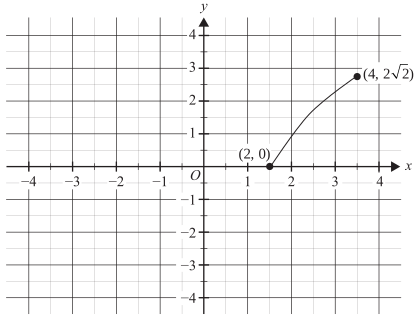
  1. Sketch the curve  `y = sqrt(x^2-2x)`  on the axes below for  `x ∈ [2, 4]`, labelling the endpoints with their coordinates.   (2 marks)

    --- 0 WORK AREA LINES (style=lined) ---


  2. The portion of the curve given by  `y = sqrt(x^2-2x)`  for  `x ∈ [2, 4]`  is rotated about the `y`-axis to form a solid of revolution.
  3. Write down, but do not evaluate, a definite integral in terms of  `t`  that gives the volume of the solid formed.   (2 marks)

    --- 6 WORK AREA LINES (style=lined) ---

Show Answers Only
  1. `text(See Worked Solutions)`
  2. `text(Domain:)\ x ∈ [2, ∞)`


    `text(Range:)\ y ∈ [0, ∞)`

    1. `(dy)/(dx) = ((dy)/(dt))/((dt)/(dx)) = (sec^2(t))/(sin(t)sec^2(t)) = 1/(sin(t))`
    2. `(dy)/(dx) -> 1`
  3.  
  4. ` V = pi int_0^(tan^(−1)(2sqrt2)) (sec(t) + 1)^2sec^2(t)dt`
Show Worked Solution

a.   `x = sec(t) + 1 \ => \ sec(t) = x-1`

`y = tan(t)`

`text(Using)\ \ tan^2(t) + 1 = sec^2(t):`

`y^2 + 1` `= (x-1)^2`
`y^2 + 1` `= x^2-2x + 1`
`y^2` `= x^2-2x`
`y` `= sqrt(x^2-2x), \ y >= 0\ \ text(as)\ \ t ∈ [0, pi/2)`


b.   `text(Sketch:)\ \ x = sec(t) + 1, \ y = tan(t)\ \ text(for)\ \ t ∈ [0, pi/2)`

`text(Domain:)\ \ x ∈ [2, ∞)`

`text(Range:)\ \ y ∈ [0, ∞)`


c.i.   `(dy)/(dt) = sec^2(t), \ (dx)/(dt) = sin(t)sec^2(t)\ \ \ (text(by CAS))`

`(dy)/(dx) = ((dy)/(dt))/((dx)/(dt)) = (sec^2(t))/(sin(t)sec^2(t)) = 1/(sin(t))`


c.ii.   `text(As)\ \ t -> pi/2:`

`(dy)/(dx) -> 1`


d.   


e.   `V = pi int_0^(2sqrt2) x^2\ dy`

`x^2 = (sec(t) + 1)^2`

`(dy)/(dt) = sec^2(t) \ => \ dy = sec^2(t)\ dt`

`text(When)\ y = 0, t = 0`

`text(When)\ y = 2sqrt2, t = tan^(−1)(2sqrt2)`
 

`:. V = pi int_0^(tan^(−1)(2sqrt2)) (sec(t) + 1)^2sec^2(t)\ dt`

Filed Under: Solids of Revolution, Trigonometry (SM) Tagged With: Band 3, Band 4, Band 5, smc-1150-20-Parametric, smc-1180-30-Square root, smc-1180-60-y-axis rotation

Calculus, SPEC1 2019 VCAA 8

Find the volume of the solid of revolution formed when the graph of  `y = sqrt((1 + 2x)/(1 + x^2))`  is rotated about the `x`-axis over the interval  `[0,1]`.  (4 marks)

Show Answers Only

`pi(pi/4 + ln2)\ \ text(u³)`

Show Worked Solution
`V` `= pi int_0^1 (1 + 2x)/(1 + x^2)\ dx`
  `= pi int_0^1 1/(1 + x^2)\ dx + pi int_0^1 (2x)/(1 + x^2)\ dx`
  `= pi [tan^(−1)(x)]_0^1 + pi [ln(1 + x^2)]_0^1`
  `= pi(tan^(−1)1 – tan^(−1)0) + pi(ln2 – ln1)`
  `= pi(pi/4) + pi(ln2)`
  `= pi(pi/4 + ln2)\ \ text(u³)`

Filed Under: Solids of Revolution Tagged With: Band 4, smc-1180-30-Square root, smc-1180-50-x-axis rotations

Calculus, SPEC2 2012 VCAA 12 MC

The volume of the solid of revolution formed by rotating the graph of  `y = sqrt (9-(x-1)^2)`  above the `x`-axis is given by

  1. `4 pi(3)^2`
  2. `pi int_(−3)^3(9-(x-1)^2)dx`
  3. `pi int_(−2)^(4)(sqrt(9-(x-1)^2))dx`
  4. `pi int_(−2)^4(9-(x-1)^2)^2dx`
  5. `pi int_(−4)^2(9-(x-1)^2)dx`
Show Answers Only

`A`

Show Worked Solution

`y = sqrt (9-(x-1)^2)\ \ => text(Semi-circle of circle)`

♦ Mean mark 48%.

`text{with centre (1,0), radius = 3}`
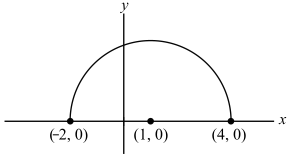
 

`:. V` `= 4/3 pi r^3`
  `= 4/3 pi (3)^3`
  `=4 pi (3)^2`

 
`=> A`

Filed Under: Solids of Revolution Tagged With: Band 5, smc-1180-30-Square root, smc-1180-50-x-axis rotations

Calculus, SPEC2 2018 VCAA 3

Part of the graph of  `y = 1/2 sqrt(4x^2-1)`  is shown below.
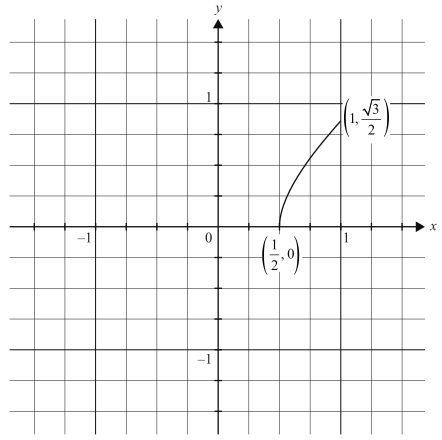


The curve shown is rotated about the `y`-axis to form a volume of revolution that is to model a fountain, where length units are in metres.

  1. Show that the volume, `V` cubic metres, of water in the fountain when it is filled to a depth of `h` metres is given by  `V = pi/4(4/3h^3 + h)`.   (2 marks)

    --- 5 WORK AREA LINES (style=lined) ---

  2. Find the depth `h` when the fountain is filled to half's its volume. Give your answer in metres, correct to two decimal places.   (2 marks)

    --- 5 WORK AREA LINES (style=lined) ---

The fountain is initially empty. A vertical jet of water in the centre fills the fountain at a rate of 0.04 cubic metres per second and, at the same time, water flows out from the bottom of the fountain at a rate of  `0.05 sqrt h`  cubic metres per second when the depth is `h` metres.

  1.  i. Show that  `(dh)/(dt) = (4-5sqrt h)/(25 pi (4h^2 + 1))`.   (2 marks)

    --- 5 WORK AREA LINES (style=lined) ---

  2. ii. Find the rate, in metres per second, correct to four decimal places, at which the depth is increasing when the depth is 0.25 m.   (1 mark)

    --- 2 WORK AREA LINES (style=lined) ---

  3. Express the time taken for the depth to reach 0.25 m as a definite integral and evaluate this integral correct to the nearest tenth of a second.   (2 marks)

    --- 4 WORK AREA LINES (style=lined) ---

  4. After 25 seconds the depth has risen to 0.4 m.
    Using Euler's method with a step size of five seconds, find an estimate of the depth 30 seconds after the fountain began to fill. Give your answer in metres, correct to two decimal places.   (2 marks)

    --- 4 WORK AREA LINES (style=lined) ---

  5. How far from the top of the fountain does the water level ultimately stabilise? Give your answer in metres, correct to two decimal places.   (2 marks)

    --- 4 WORK AREA LINES (style=lined) ---

Show Answers Only
  1. `text(Proof)\ \ text{(See Worked Solutions)}`
  2. `h~~ 0.59\ text(m)`
    1. `text(Proof)\ \ text{(See Worked Solutions)}`
    2. `0.0153\ text(ms)^(-1)`
  1. `9.8\ text(seconds)`
  2. `0.43\ text(m)`
  3. `0.23\ text(m)`
Show Worked Solution

a.   `V= pi int_0^h x^2\ dy`

`y` `=1/2 sqrt(4x^2-1)`
`2y` `=sqrt(4x^2-1)`
`4y^2` `= 4x^2-1`
`4x^2` `= 4y^2 + 1`
`x^2` `= y^2 + 1/4`


`:. V` `= pi int_0^h y^2 + 1/4\ dy`
  `= pi[y^3/3 + y/4]_0^h`
  `= pi(h^3/3 + h/4-0)`
  `= pi(1/4((4h^3)/3 + h))`
  `= pi/4((4h^3)/3 + h)\ \ …\ text(as required)`


b.    `V_text(max)` `= pi/4 (4/3 xx (sqrt 3/2)^3 + sqrt 3/2)`
    `= pi/4 (sqrt 3/2 + sqrt 3/2)`
    `= (pi sqrt 3)/4`


`1/2 V_text(max)` `= (pi sqrt 3)/8`
`(pi sqrt 3)/8` `= pi/4 (4/3 h^3 + h)`
`sqrt 3/2` `= 4/3 h^3 + h`
`:. h` `~~0.59\ text(m)`


c.i.   `((dV)/(dt))_text(in)` `= 0.04`
  `((dV)/(dt))_text(out)` `= 0.05 sqrt h`
  `(dV)/(dt)` `= 0.04-0.05 sqrt h`
    `= (4-5 sqrt h)/100`
     
  `(dV)/(dh)` `= pi/4(4h^2 + 1)`
  `:. (dh)/(dt)` `= (dh)/(dV) ⋅ (dV)/(dt)`
    `= 4/(pi(4h^2 + 1)) xx (4-5 sqrt h)/100`
    `= (4-5 sqrt h)/(25 pi (4h^2 + 1))`


c.ii.   `(dh)/(dt)|_(h = 0.25)` `= (4-5 sqrt(0.25))/(25 pi (4(0.25)^2 + 1))`
    `~~ 0.0153\ text(ms)^(-1)`


d.   `(dt)/(dh) = (25 pi (4h^2 + 1))/(4-5 sqrt h)`

`:. t(0.25)` `= int_0^0.25 (25 pi (4h^2 + 1))/(4-5 sqrt h)\ dh`
  `~~9.8\ text(seconds)`


e.   `text(When)\ \ t=25,\ \ h=0.4\ \ text{(given)}`

♦♦ Mean mark part (e) 30%.

`:. h(30)` `~~ h(25) + 5 xx (dh)/(dt)|_(h = 0.4)`
  `~~ 0.4 + 5 xx ((4-5 sqrt 0.4)/(25 pi (4(0.4)^2 + 1)))`
  `~~ 0.43\ text(m)`


f.    `(dV)/(dt) = 0`

♦♦ Mean mark part (f) 32%.

`0.04-0.05 sqrt h` `= 0`
`0.04` `= 0.05 sqrt h“
`sqrt h` `= 4/5`
`h` `= 16/25`


`d` `= h_max-16/25`
  `= sqrt 3/2-16/25`
  `~~ 0.23\ text(m)`

Filed Under: Related Rates of Change, Solids of Revolution Tagged With: Band 2, Band 3, Band 4, Band 5, smc-1180-30-Square root, smc-1180-60-y-axis rotation, smc-1185-10-Volume

Copyright © 2014–2025 SmarterEd.com.au · Log in