SmarterEd

Aussie Maths & Science Teachers: Save your time with SmarterEd

  • Login
  • Get Help
  • About

Calculus, SPEC2 2024 VCAA 1

Consider the function \(f\) with rule  \(f(x)=\dfrac{x^4-x^2+1}{1-x^2}\).

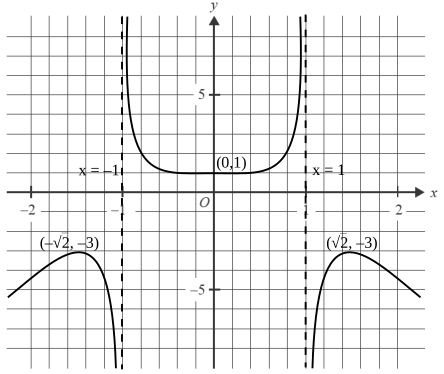
  1. Sketch the graph of  \(y=f(x)\)  on the set of axes below. Label the vertical asymptotes with their equations and label the stationary points with their coordinates.   (3 marks)


--- 3 WORK AREA LINES (style=lined) ---

  1. The region bounded by the graph of  \(y=f(x)\)  and the lines  \(y=1\)  and  \(y=6\)  is rotated about the \(y\)-axis to form a solid of revolution.
    1. Write down a definite integral involving only the variable \(y\), that when evaluated, will give the volume of the solid.   (2 marks)

      --- 3 WORK AREA LINES (style=lined) ---

    2. Find the volume of the solid, correct to one decimal place.   (1 mark)

      --- 2 WORK AREA LINES (style=lined) ---

  1. Now consider the function \(g\) with rule  \(g(x)=\dfrac{x^4+b}{1-x^2}\), where \(b \in R\).  
  2. For what value of \(b\) will the graph of \(g\) have no asymptotes?    (1 mark)

    --- 2 WORK AREA LINES (style=lined) ---

  3. The gradient function of \(g\) is given by  \(g^{\prime}(x)=\dfrac{-2 x\left(\left(x^2-1\right)^2-(b+1)\right)}{\left(1-x^2\right)^2}\).
  4. For what values of \(b\) will the graph of \(g\) have exactly
    1. one stationary point?   (1 mark)

      --- 3 WORK AREA LINES (style=lined) ---

    2. three stationary points?   (1 mark)

      --- 3 WORK AREA LINES (style=lined) ---

    3. five stationary points?   (1 mark)

      --- 3 WORK AREA LINES (style=lined) ---

Show Answers Only

a.   

b.i.   \(V=\pi \displaystyle\int_1^6 \frac{1-y+\sqrt{y^2+2y-3}}{2} \, dy\)

b.ii.  \(V=11.2\ \text{u}^3\)

c.   \(b=-1\)

d.i.   \(b \leqslant-1\)

d.ii.  \(b \geqslant 0\)

d.iii. \(-1<b<0\)

Show Worked Solution

a.   \(\text{Using CAS (set domain, range to match image):}\)

\(1-x^2 \neq 0 \ \Rightarrow \ \text {Vertical asymptotes at}\ \  x= \pm 1\)
 

b.i    \(V\) \(=\pi \displaystyle \int_1^6 x^2 \ dy\)
    \(=\pi \displaystyle\int_1^6 \frac{1-y+\sqrt{y^2+2y-3}}{2} \, dy \ \ \text{(by CAS)}\)

 
b.ii.
  \(V=11.2\ \text{u}^3 \ \text{(1 d.p.)}\)
 

c.    \(g(x)=\dfrac{x^4+b}{1-x^2}=-x^2-1+\dfrac{b+1}{1-x^2} \ \ \text{(by polynomial division)}\)

\(\text{No asymptotes when}\ \ b+1=0\ \ \Rightarrow\ \ b=-1\)
  

d.i. \(\text{Since  \(g^{\prime}(0)=0\)  provides 1 SP, no solutions are required for}\)

\(\dfrac{(x^2-1)^2-(b+1)}{(1+x^2)^2}=0\)

\(b+1<0 \ \Rightarrow \ b<-1\)

\(\text{Consider} \ \ b=-1:\)

\(\dfrac{\left(x^2-1\right)^2-0}{\left(1-x^2\right)^2}=1 \neq 0 \ \text{(no solution)}\)

\(\therefore b \leqslant-1\)

♦♦♦ Mean mark (d.i.) 27%.
♦♦♦ Mean mark (d.ii.) 27%.
♦♦♦ Mean mark (d.iii.) 25%.
 

d.ii.  \(\text{3 SPs:} \ \left(x^2-1\right)^2=b+1 \ \ \text{has two non-zero, real solutions}\)

\(x^2-1\) \(= \pm \sqrt{b+1}\)
\(x\) \(=\pm \sqrt{1 \pm \sqrt{b+1}}\)


 \(\Rightarrow \sqrt{b+1} \geqslant 1 \ \text{for 2 solution}\)

\(\Rightarrow b \geqslant 0\)
 

d.iii  \(\text{5 SPs:} \ \left(x^2-1\right)^2 = b+1 \ \text{has four non-zero real solutions}\)

\(x=\pm\sqrt{1 \pm \sqrt{b+1}} \ \ \text{has 4 solutions if}\)

\(b+1 >\) \(0\) \(\text{and}\)    \(\sqrt{b+1}<1\)
\(b >\) \( -1\)   \(b<0\)

 
\(\therefore -1<b<0\)

Filed Under: Solids of Revolution, Tangents and Curve Sketching Tagged With: Band 4, Band 5, Band 6, smc-1180-40-Other graphs, smc-1180-60-y-axis rotation, smc-1182-35-Sketch curve, smc-1182-40-Other 1st/2nd deriv problems

Calculus, SPEC1 2024 VCAA 5

The curve with equation  \(y=\sqrt{k-\dfrac{1}{x^2}}\),  for  \(1 \leq x \leq \dfrac{k}{2}\)  where  \(k>2\), is rotated about the \(x\)-axis to form a solid of revolution that has volume  \(\dfrac{7 \pi}{2}\) units\(^3\).

Show that \(k\) satisfies the equation  \(k^3-2 k^2-9 k+4=0\).   (3 marks)

--- 8 WORK AREA LINES (style=lined) ---

Show Answers Only

  \(V\) \(=\pi \displaystyle{\int}_1^{\frac{k}{2}}\left(k-\dfrac{1}{x^2}\right) dx\)
  \(\dfrac{7 \pi}{2}\) \(=\pi\left[kx+\dfrac{1}{x}\right]_1^{\frac{k}{2}}\)
  \(7\) \(=2\left[\left(\dfrac{k^2}{2}+\dfrac{2}{k}\right)-(k+1)\right]\)
  \(7\) \(=k^2+\dfrac{4}{k}-2 k-2\)
  \(7k\) \(=k^3+4-2 k^2-2 k\)
  \(0\) \(=k^3-2k^2-9k+4\)

Show Worked Solution

\(y=\sqrt{k-\dfrac{1}{x^2}}\)

  \(V\) \(=\pi \displaystyle{\int}_1^{\frac{k}{2}}\left(k-\dfrac{1}{x^2}\right) dx\)
  \(\dfrac{7 \pi}{2}\) \(=\pi\left[kx+\dfrac{1}{x}\right]_1^{\frac{k}{2}}\)
  \(7\) \(=2\left[\left(\dfrac{k^2}{2}+\dfrac{2}{k}\right)-(k+1)\right]\)
  \(7\) \(=k^2+\dfrac{4}{k}-2 k-2\)
  \(7k\) \(=k^3+4-2 k^2-2 k\)
  \(0\) \(=k^3-2k^2-9k+4\)

Filed Under: Solids of Revolution Tagged With: Band 4, smc-1180-40-Other graphs, smc-1180-50-x-axis rotations

Calculus, SPEC2 2022 VCAA 1

Consider the family of functions \(f\) with rule  \(f(x)=\dfrac{x^2}{x-k}\), where \(k \in R \backslash\{0\}\).

  1. Write down the equations of the two asymptotes of the graph of \(f\) when \(k=1\).   (2 marks)

    --- 3 WORK AREA LINES (style=lined) ---

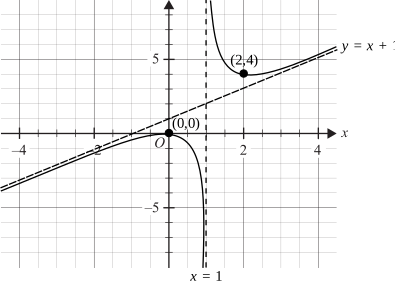
  2. Sketch the graph of  \(y=f(x)\)  for  \(k=1\)  on the set of axes below. Clearly label any turning points with their coordinates and label any asymptotes with their equations.   (3 marks)
     

--- 0 WORK AREA LINES (style=lined) ---
  1.  i. Find, in terms of \(k\), the equations of the asymptotes of the graph of  \(f(x)=\dfrac{x^2}{x-k}\).   (1 mark)

    --- 2 WORK AREA LINES (style=lined) ---

  2. ii. Find the distance between the two turning points of the graph of  \(f(x)=\dfrac{x^2}{x-k}\) in terms of \(k\).   (2 marks)

    --- 4 WORK AREA LINES (style=lined) ---

  3. Now consider the functions \(h\) and \(g\), where  \(h(x)=x+3\)  and  \(g(x)=\abs{\dfrac{x^2}{x-1}}\).
  4. The region bounded by the curves of \(h\) and \(g\) is rotated about the \(x\)-axis.
    1. Write down the definite integral that can be used to find the volume of the resulting solid.   (2 marks)

      --- 5 WORK AREA LINES (style=lined) ---

    2. Hence, find the volume of this solid. Give your answer correct to two decimal places.   (1 mark)

      --- 2 WORK AREA LINES (style=lined) ---

Show Answers Only

a.  \(\text {Asymptotes: } x=1,\  y=x+1\)

b.   
       

c.i.   \(\text {Asymptotes: } x=k,\  y=x+k\)

c.ii.  \(\text {Distance }=2 \sqrt{5}|k|\)

d.i.  \(\displaystyle V=\pi \int_{\frac{-\sqrt{7}-1}{2}}^{\frac{\sqrt{7}-1}{2}}(x+3)^2-\left(\frac{x^2}{x-1}\right)^2 dx\)

d.ii.  \(V=51.42\ \text{u}^3 \)

Show Worked Solution

a.    \(\text {When } k=1 :\)

\(f(x)=\dfrac{x^2}{x-1}=\dfrac{(x+1)(x-1)+1}{(x-1)}=x+1+\dfrac{1}{x-1}\)

\(\text {Asymptotes: } x=1,\  y=x+1\)
 

b.    


c.i. \(f(x)=\dfrac{x^2}{x-k}=\dfrac{(x+k)(x-k)+k^2}{x-k}=x+k+\dfrac{k^2}{x-k}\)

\(\text {Using part a.}\)

\(\text {Asymptotes: } x=k,\  y=x+k\)
 

c.ii.  \(f^{\prime}(x)=1-\left(\dfrac{k}{x-k}\right)^2\)

\(\text {TP’s when } f^{\prime}(x)=0 \text { (by CAS):}\)

\(\Rightarrow(2 k, 4 k),(0,0)\)

\(\text {Distance }\displaystyle=\sqrt{(2 k-0)^2+(4 k-0)^2}=\sqrt{20 k^2}=2 \sqrt{5}|k|\)
 

d.i  \(\text {Solve for intersection of graphs (by CAS):}\)

\(\displaystyle x+3=\left|\frac{x^2}{x-1}\right|\)

\(\displaystyle \Rightarrow x=\frac{3}{2}, x=\frac{-1 \pm \sqrt{7}}{2}\)

\(\displaystyle V=\pi \int_{\frac{-\sqrt{7}-1}{2}}^{\frac{\sqrt{7}-1}{2}}(x+3)^2-\left(\frac{x^2}{x-1}\right)^2 dx\)
 

d.ii. \(V=51.42\ \text{u}^3 \text{ (by CAS) }\)

♦♦ Mean mark (d)(ii) 37%.

Filed Under: Partial Fractions, Quotient and Other Functions (SM), Solids of Revolution Tagged With: Band 3, Band 4, Band 5, smc-1154-10-Quotient functions/Asymptotes, smc-1154-30-Absolute value, smc-1154-50-Sketch graph, smc-1180-40-Other graphs, smc-1180-50-x-axis rotations

Calculus, SPEC1-NHT 2019 VCAA 6

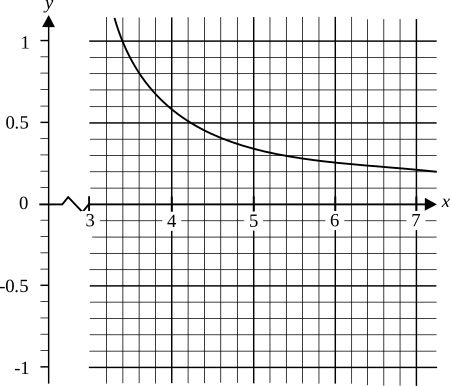
Part of the graph of  `y = (2)/(sqrt(x^2-4x+3))`, where  `x > 3`, is shown below.


Find the volume of the solid of revolution formed when the graph of  `y = (2)/(sqrt(x^2-4x+3))`  from  `x = 4`  to  `x = 6`  is rotated about the `x`-axis. Give your answer in the form  `a log_e(b)`  where `a` and `b` are real numbers.   (5 marks)

Show Answers Only

`pi log_e ((9)/(5))`

Show Worked Solution

`V = pi int_4 ^6 (4)/(x^2 – 4x + 3)\ dx`
 

`text(Using partial fractions:)`

`(4)/(x^2 – 4x + 3) = (a)/((x-3)) + (b)/((x-1))`

`a(x -1) + b(x – 3)= 4`
 

`text(When)\ \ x = 1, \ -2b = 4  => \ b = -2`

`text(When)\ \ x = 3, \ 2a = 4  => \ a = 2`

`:. \ V` `= pi int_4 ^6 (2)/(x-3) – (2)/(x-1)\ dx`
  `= 2 pi [log_e(x-3) -log_e(x-1)]_4 ^6`
  `= 2 pi [log_e 3 – log_e 5 – (log_e 1 – log_e3)]`
  `= 2 pi (2log_e 3 – log_e 5)`
  `= 2pi log_e((9)/(5))`

Filed Under: Solids of Revolution Tagged With: Band 4, smc-1180-40-Other graphs, smc-1180-50-x-axis rotations, smc-1180-70-Partial Fractions

Calculus, SPEC2 2017 VCAA 1

Let  `f:D ->R, \ f(x) = x/(1 + x^3)`, where `D` is the maximal domain of  `f`.

  1.   i. Find the equations of any asymptotes of the graph of  `f`.   (1 mark)

    --- 2 WORK AREA LINES (style=lined) ---

  2.  ii. Find  `f′(x)`  and state the coordinates of any stationary points of the graph of  `f`, correct to two decimal places.  (2 marks)

    --- 4 WORK AREA LINES (style=lined) ---

  3. iii. Find the coordinates of any points of inflection of the graph of  `f`, correct to two decimal places.  (2 marks)

    --- 6 WORK AREA LINES (style=lined) ---

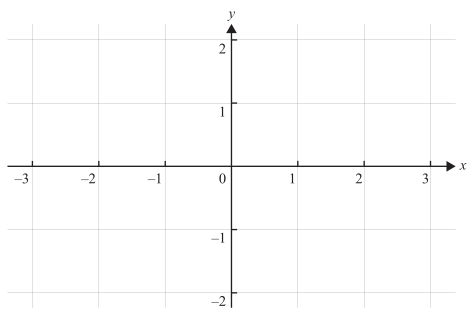
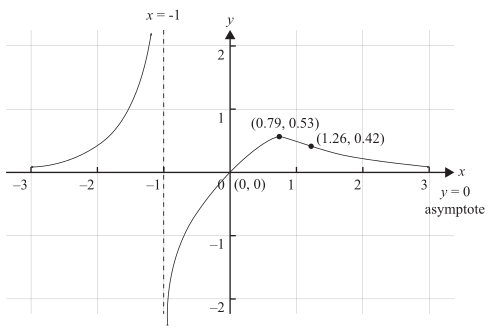
  4. Sketch the graph of  `f(x) = x/(1 + x^3)`  from  `x=–3`  and  `x = 3`  on the axes provided below, marking all stationary points, points of inflection and intercepts with axes, labelling them with their coordinates. Show any asymptotes and label them with their equations.  (3 marks)

    --- 0 WORK AREA LINES (style=lined) ---


  5. The region `S`, bounded by the graph of  `f`, the `x`-axis and the line  `x = 3`, is rotated about the `x`-axis to form a solid of revolution. The line  `x = a`, where  `0 < a < 3`, divides the region `S` into two regions such that, when the two regions are rotated about the `x`-axis, they generate solids of equal volume.
  6. i.  Write down an equation involving definite integrals that can be used to determine `a`.  (2 marks)

    --- 3 WORK AREA LINES (style=lined) ---

  7. ii. Hence, find the value of `a`, correct to two decimal places.  (1 mark)

    --- 1 WORK AREA LINES (style=lined) ---

Show Answers Only

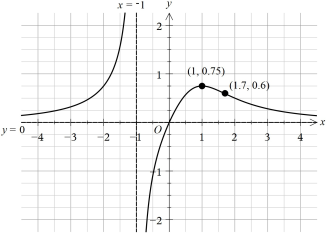
  1. i.  `text(vertical asymptote:)\ \ x = −1“text(horizontal asymptote:)\ \ y = 0`
  2. ii. `text(S.P.)\ \ (0.79, 0.53)`
  3. iii. `text(P.O.I.)\ (1.26, 0.42)`
  4.  
  5. i.  `pi int_a^3 (x^2)/((1 + x^3)^2) dx`
  6. ii. `~~ 0.98`

Show Worked Solution

a.i.   `text(Graphing the function on CAS:`

♦♦ Mean mark 36%.

`text(Vertical asymptote:)\ x = −1`

`text(Horizontal asymptote:)\ \ y = 0`
 

a.ii.   `u = x, \ u′ = 1,\ \ v = 1 + x^3, \ v′ = 3x^2\ \ \ text{(manual or by CAS)}`

`f′(x)` `= (1(1 + x^3)-x(3x^2))/((1 + x^3)^2)`
  `= (1-2x^3)/((1 + x^3)^2)`

 
`text(S.P. when)\ \ f′(x)=0:\ `

`=>  (0.79, 0.53)\ \ \ text{(by CAS)}`


a.iii.  `text(When)\ \ f″(x)=0,\ \ \ text{(by CAS)}`

`=> x = 0, \ x = -1, \ x = 2`

`x != -1`

`text(Check concavity changes:)`

`f″(−1/2) = −1632/343`

`f″(1) = −3/4`

`f″(3) = 675/(10\ 976)`
 

`text(P.O.I. at)\ \ x = sqrt2 ~~ 1.26\ \ text{(concavity changes)}`

`=> f(sqrt2) ~~ 0.42`

`:. text(P.O.I.)\ (1.26, 0.42)`


b.   


c.i.    `V_1` `= pi int_0^a y^2\ dx`
  `V_2` `= pi int_a^3 y^2\ dx`

 
`:.\ text(Equation to solve for)\ a:`

`int_0^a x^2/(1 + x^3)^2\ dx = int_a^3 x^2/(1 + x^3)^2\ dx`


c.ii.  `a=0.98\ \ \ text{(by CAS)}`

Filed Under: Solids of Revolution, Tangents and Curve Sketching Tagged With: Band 3, Band 4, Band 5, smc-1180-40-Other graphs, smc-1180-50-x-axis rotations, smc-1182-35-Sketch curve

Calculus, SPEC1-NHT 2017 VCAA 5

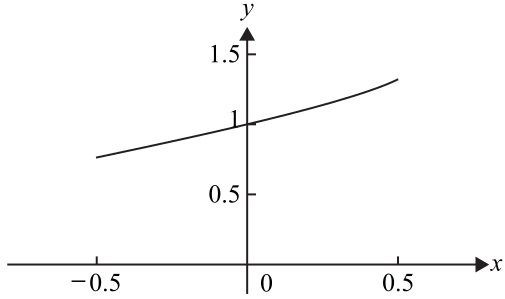
Part of the graph of  `y = (sqrt(x + 1))/(root4(1 - x^2))`  is shown below.


Find the volume generated if the region bounded by the graph of  `y = (sqrt(x + 1))/(root4(1 - x^2))`, the lines  `x = -1/2`  and  `x = 1/2`, and the `x`-axis is rotated about the `x`-axis.  (4 marks)

Show Answers Only

`pi^2/3`

Show Worked Solution
`V` `= pi int_(-1/2)^(1/2) y^2\ dx`
  `= pi int_(-1/2)^(1/2) (x + 1)/sqrt(1 – x^2)\ dx`
  `= pi int_(-1/2)^(1/2) x/sqrt(1 – x^2)\ dx + int_(-1/2)^(1/2) 1/sqrt(1 – x^2)\ dx`

 
`text(Let)\ \ u = 1 – x^2`

`(du)/(dx) = -2x\ \ =>\ \ -1/2\ du = x\ dx`

`text(When)\ \ x=1/2\ \ =>\ \ u=3/4`

`text(When)\ \ x=- 1/2\ \ =>\ \ u=3/4`

`text(Same limit)\ =>\ text(1st integral = 0)`
 

`:. V` `= 0+pi int_(-1/2)^(1/2) 1/sqrt(1 – x^2)\ dx`
  `= pi [sin^(-1) (x)]_(-1/2)^(1/2)`
  `= pi (pi/6 – ((-pi)/6))`
  `= pi (pi/3)`
  `= pi^2/3`

Filed Under: Solids of Revolution Tagged With: Band 4, smc-1180-40-Other graphs, smc-1180-50-x-axis rotations

Calculus, SPEC1 2017 VCAA 10

  1.  Show that  `d/dx(x arccos(x/a)) = arccos(x/a)−x/(sqrt(a^2-x^2))`, where  `a > 0`.   (1 mark)

    --- 3 WORK AREA LINES (style=lined) ---

  2.  State the maximum domain and the range of  `f(x) = sqrt(arccos(x/2))`.   (2 marks)

    --- 2 WORK AREA LINES (style=lined) ---

  3.  Find the volume of the solid of revolution generated when the region bounded by the graph of  `y = f(x)`, and the lines  `x = −2`  and  `y = 0`, is rotated about the `x`-axis.   (4 marks)

    --- 8 WORK AREA LINES (style=lined) ---

Show Answers Only
  1. `text(See Worked Solutions)`
  2. `x ∈ [−2, 2], \ y ∈ [0, sqrtpi]`
  3. `2pi^2`
Show Worked Solution
a.    `u` `= x,` `v` `= cos^(−1)(x/a)`
  `uprime` `= 1,`   `vprime` `= (−1)/sqrt(a^2-x^2)`
`d/(dx)(xcos^(−1)(x/a))` `= uprimev + vprimeu`
  `= cos^(−1)(x/a) + (x(−1))/sqrt(a^2-x^2)`
  `= arccos(x/a)-x/sqrt(a^2-x^2)`


b.   `arccos(x/2)>=0`

`text(Maximal domain:)\  x ∈ [−2, 2]`

`f(x) = (arccos(x/2))^(1/2)`

`text(Range:)\ \ y ∈ [0, sqrtpi]`


c.   `V` `= pi int_(−2)^2 y^2\ dx`
  `= pi int_(−2)^2 cos^(-1)(x/2)\ dx`
  `= pi int_(−2)^2 cos^(-1) (x/2)-x/sqrt(4-x^2) + x/sqrt(4-x^2)\ dx`
  `= pi [x cos^(-1)(x/2)]_(−2)^2 + pi int_(−2)^2 x/sqrt(4-x^2)\ dx`

 
`text(Let)\ \ u = 4-x^2`

♦ Mean mark part (c) 35%.

`(du)/(dx) = -2x\ \ =>\ \ -1/2 (du) = x\ dx`
 

`text(When)\ \ x=2\ \ => \ u=0`

`text(When)\ \ x=-2\ \ =>\ \ u=0`

`:. V` `= pi [2cos^(−1)(1)-(-2)cos^(−1)(−1)]-pi/2 int_0^0 1/sqrtu du`
  `= pi(2 xx 0 + 2 xx pi)`
  `= 2pi^2`

Filed Under: Solids of Revolution Tagged With: Band 3, Band 4, Band 5, smc-1180-40-Other graphs, smc-1180-50-x-axis rotations

Copyright © 2014–2025 SmarterEd.com.au · Log in