SmarterEd

Aussie Maths & Science Teachers: Save your time with SmarterEd

  • Login
  • Get Help
  • About

Vectors, EXT2 V1 2023 HSC 5 MC

Which of the following is a true statement about the lines  \(\ell_1={\displaystyle\left(\begin{array}{cc}-1 \\ 2 \\ 5\end{array}\right)+\lambda\left(\begin{array}{c}-1 \\ 3 \\ 1\end{array}\right)}\)  and  \(\ell_2=\left(\begin{array}{c}3 \\ -10 \\ 1\end{array}\right)+\mu\left(\begin{array}{c}1 \\ -3 \\ -1\end{array}\right) ?\)

  1. \(\ell_1\) and \(\ell_2\) are the same line.
  2. \(\ell_1\) and \(\ell_2\) are not parallel and they intersect.
  3. \(\ell_1\) and \(\ell_2\) are parallel and they do not intersect.
  4. \(\ell_1\) and \(\ell_2\) are not parallel and they do not intersect.
Show Answers Only

\(A\)

Show Worked Solution

\(\text{Since}\ \ \left(\begin{array}{c}-1 \\ 3 \\ 1\end{array}\right) = -1 \left(\begin{array}{c}1 \\ -3 \\ -1\end{array}\right), \ \ell_1\ \text{is parallel to}\ \ell_2 \)

\(\text{Test if point}\ (3,-10,1)\ \text{lies on}\ \ell_1: \)

\(\text{i.e.}\ \ \exists \lambda\ \ \text{such that} \)

♦ Mean mark 49%.

\( \left(\begin{array}{cc}3 \\ -10 \\ 1\end{array}\right) = \left(\begin{array}{cc}-1 \\ 2 \\ 5\end{array}\right) + \lambda \left(\begin{array}{cc}-1 \\ 3 \\ 1\end{array}\right)\)

\(\lambda = -4\ \ \text{satisfies equation} \)

\(\therefore\ \ell_1\ \text{and}\ \ell_2\ \text{are the same line.}\)

\(\Rightarrow A\)

Filed Under: Vectors and Vector Equations of Lines Tagged With: Band 5, smc-1196-25-Point lies on line, smc-1196-30-Parallel

Vectors, EXT2 V1 2022 HSC 14a

  1. The two non-parallel vectors `\vec{u}` and `\vec{v}` satisfy  `lambda vec(u)+mu vec(v)= vec(0)`  for some real numbers `\lambda` and `\mu`.
  2. Show that  `\lambda=\mu=0`.  (2 marks)

    --- 3 WORK AREA LINES (style=lined) ---

  3. The two non-parallel vectors `\vec{u}` and `\vec{v}` satisfy  `\lambda_1 \vec{u}+\mu_1 \vec{v}=\lambda_2 \vec{u}+\mu_2 \vec{v}`  for some real numbers `\lambda_1, \lambda_2, \mu_1` and `\mu_2`.
  4. Using part (i), or otherwise, show that  `\lambda_1=\lambda_2`  and  `\mu_1=\mu_2`. (1  mark)

    --- 5 WORK AREA LINES (style=lined) ---

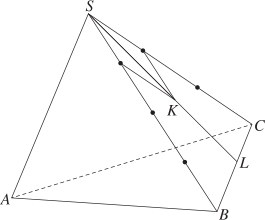
The diagram below shows the tetrahedron with vertices `A, B, C` and `S`.

The point `K` is defined by  `vec(SK)=(1)/(4) vec(SB)+(1)/(3) vec(SC)`, as shown in the diagram.

The point `L` is the point of intersection of the straight lines `S K` and `B C`.


  1. Using part (ii), or otherwise, determine the position of `L` by showing that  `vec(BL)=(4)/(7) vec(BC)`.  (2 marks)

    --- 6 WORK AREA LINES (style=lined) ---

  2. The point `P` is defined by  `vec(AP)=-6 vec(AB)-8 vec(AC)`.
  3. Does `P` lie on the line `A L`? Justify your answer.  (2 marks)

    --- 5 WORK AREA LINES (style=lined) ---

Show Answers Only
  1. `text{Proof (See Worked Solution)}`
  2. `text{Proof (See Worked Solution)}`
  3. `text{Proof (See Worked Solution)}`
  4. `P\ text{lies on}\ vec(AL)\ \ text{(See Worked Solution)}`
Show Worked Solution
i.    `lambda vecu+mu vecv` `=0`
  `lambda vecu` `=-mu vecv`

 
`lambda=0\ \ text{or}\ \ vecu=-(mu/lambda)vecv=k vecv\ \ (kinRR)`

`text{S}text{ince}\ \ vecu and vecv\ \ text{are not parallel}`

`=> lambda=mu=0`
 

ii.  `\lambda_1 \vec{u}+\mu_1 \vec{v}=\lambda_2 \vec{u}+\mu_2 \vec{v}`

`\lambda_1 \vec{u}-\lambda_2 \vec{u}+\mu_1 \vec{v}-\mu_2 \vec{v}` `=vec0`  
`(\lambda_1-\lambda_2)\vec{u}+(\mu_1-\mu_2)\vec{v}` `=vec0`  


`text{Using part (i):}`

`(\lambda_1-\lambda_2)=0 and (\mu_1-\mu_2)=0`

`:.\lambda_1=\lambda_2  and  \mu_1=\mu_2\ …\ text{as required}`


Mean mark (ii) 56%.
iii.   `vec(BL)` `=lambda vec(BC)`
    `=lambda(vec(BS)+vec(SC))\ \ \ …\ (1)`


`vec(BL)` `=vec(BS)+mu vec(SK)`  
  `=-vec(SB)+mu(1/4vec(SB)+1/3vec(SC))`  
  `=-vec(SB)+mu/4vec(SB)+mu/3vec(SC)`  
  `=mu/3vec(SC)+(mu/4-1)vec(SB)\ \ \ …\ (2)`  


♦♦♦ Mean mark (iii) 25%.

`text{Using}\ \ (1) = (2):`

`lambda vec(BS)+ lambda vec(SC)=mu/3vec(SC)+(mu/4-1)vec(SB)`

`mu/3=lambda, \ \ 1-mu/4=lambda`

`mu/3` `=1-mu/4`  
`(4mu+3mu)/12` `=1`  
`(7mu)/12` `=1`  
`mu` `=12/7`  

 
`lambda=(12/7)/3=4/7`

`:.vec(BL)=(4)/(7) vec(BC)\ \ text{… as required}`
 

iv.  `vec(AP)=-6 vec(AB)-8 vec(AC)`

`text{If}\ P\ text{lies on}\ AL, ∃k\ text{such that}\ \ vec(AP)=k vec(AL)`


♦♦♦ Mean mark (iv) 23%.
`-6 vec(AB)-8 vec(AC)` `=k vec(AL)`  
`-6 vec(AB)-8 (vec(AB)+vec(BC))` `=k(vec(AB)+vec(BL))`  
`-14 vec(AB)-8vec(BC)` `=k(vec(AB)+4/7vec(BC))\ \ text{(see part (iii))}`  
`-14 vec(AB)-8vec(BC)` `=kvec(AB)+(4k)/7vec(BC)`  

 
`k=-14, \ \ (4k)/7=-8\ \ =>\ \ k=-14`

`:.\ P\ text{lies on}\ \ AL.`

Filed Under: Vectors and Geometry, Vectors and Vector Equations of Lines Tagged With: Band 4, Band 5, Band 6, smc-1196-25-Point lies on line, smc-1196-30-Parallel, smc-1196-80-3D vectors, smc-1210-20-Pyramid, smc-1210-70-3D problems

Vectors, EXT2 V1 2022 HSC 11e

Let `ℓ_(1)` be the line with equation `([x],[y])=([-1],[7])+lambda([3],[2]),lambda inRR`.

The line `ℓ_(2)` passes through the point  `A(-6,5)`  and is parallel to `ℓ_(1)`.

Find the equation of the line `ℓ_(2)` in the form  `y=mx+c`.  (2 marks)

Show Answers Only

`y=2/3x+9`

Show Worked Solution

`m_(ℓ_(1))=2/3`

`text{Equation of}\ ℓ_(2)\ text{has}\ m=2/3\ text{and passes through}\ (-6,5):`

`y-5` `=2/3(x+6)`  
`y` `=2/3x+9`  

Filed Under: Vectors and Vector Equations of Lines Tagged With: Band 3, smc-1196-30-Parallel, smc-1196-50-Vector to Cartesian, smc-1196-70-2D vectors

Vectors, EXT2 V1 SM-Bank 4

Determine the equation of the line vector `underset~r`, given it passes through the point  `(7, 1, 0)`  and is parallel to the line joining  `P(2, −1, 2)`  and  `Q(3, 4, 1)`.   (2 marks)

--- 3 WORK AREA LINES (style=lined) ---

Show Answers Only

`underset~r = ((7),(1),(0)) + lambda((1),(5),(−1))`

Show Worked Solution

`overset(->)(PQ) = ((3),(4),(1)) – ((2),(−1),(2)) = ((1),(5),(−1))`
 

`:. underset~r = ((7),(1),(0)) + lambda((1),(5),(−1))`

Filed Under: Vectors and Vector Equations of Lines Tagged With: Band 3, smc-1196-30-Parallel

Vectors, EXT2 V1 SM-Bank 1

Consider the vectors  `underset~u = a underset~i - b underset~j + c underset~k`  and  `underset~v = underset~i - 8underset~j + 4underset~k`.

Find all possible values of  `a, b`  and  `c`  if  `underset~u`  is parallel to  `underset~v`  and  has a magnitude of 3.  (3 marks)

Show Answers Only

`1/3 , 8/3 , 4/3`

`text(or)`

` -1/3 , – 8/3 , – 4/3`

Show Worked Solution
`|underset~v|` `= sqrt(1 + 64 + 16) = 9`
`underset~overset^v` `= underset~v /|underset~v| =  (1)/(9) underset~i – (8)/(9) underset~j + (4)/(9) underset~k \ \ text{(magnitude of 1)}`

 
`text(S) text(ince) \ underset~u  \ text(has a magnitude of 3:)`

`underset~u` `= ± 3 ((1)/(9) underset~i – (8)/(9) underset~j + (4)/(9) underset~k)`
  `= ± (1/3 underset~i – 8/3 underset~j + 4/3 underset~k)`


`:. \ a, b, c` `= 1/3 , – 8/3 , 4/3\ \ text{or}\ \ -1/3 , 8/3 , – 4/3`

Filed Under: Vectors and Vector Equations of Lines Tagged With: Band 3, smc-1196-30-Parallel

Copyright © 2014–2025 SmarterEd.com.au · Log in