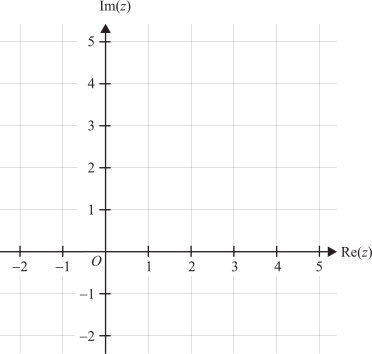
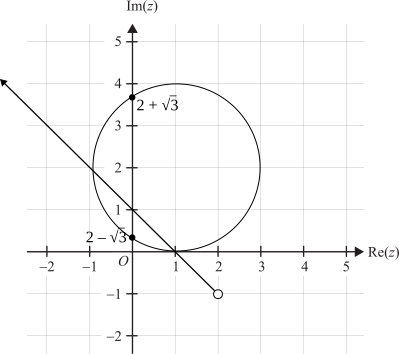
--- 4 WORK AREA LINES (style=lined) --- --- 5 WORK AREA LINES (style=lined) --- --- 2 WORK AREA LINES (style=lined) --- --- 0 WORK AREA LINES (style=lined) --- --- 2 WORK AREA LINES (style=lined) --- --- 4 WORK AREA LINES (style=lined) --- a. \(y=\dfrac{3}{2} x-\dfrac{11}{4}\) b. \(\abs{z-\left(\dfrac{5}{2}+i\right)} = \dfrac{\sqrt{13}}{2}\) c. d.i. \(\text{See image above}\) d.ii. \(\operatorname{Arg}(z-2+i)=\dfrac{3 \pi}{4}\) e. \(A=\pi-2\) a. \(\text{Method 1}\) \(z_1=1+2i, \quad z_2=4\) \(\abs{z-z_1}=\abs{z-z_2}\) \(\text{Equation can be written:}\) \(\text {Find line of points equidistant from \(\ z_1\) and \(z_2\)}\) \(m_{\text{line}\ z_1 z_2}=\dfrac{0-2}{4-1}=\dfrac{-2}{3}\) \(m_{\perp}=\dfrac{3}{2}\) \(\text{Mid point} \ z_1 z_2 =\dfrac{5+2i}{2}=\left(\dfrac{5}{2},1\right)\) \(\perp \ \text{bisector:} \ m=\dfrac{3}{2}, \ \text{passes through} \ \left(\dfrac{5}{2}, 1\right)\) b. \(\text{Centre of circle }=\text {midpoint}\left(z_1 z_2\right)\) \(z_c=\dfrac{z_1+z_2}{2}=\dfrac{5+2 i}{2}=\dfrac{5}{2}+i\) \(\text{Radius}(r)=\dfrac{1}{2} \times \text{diameter}\) \(r=\dfrac{1}{2} \sqrt{(4-1)^2+(0-2)^2}=\dfrac{\sqrt{13}}{2}\) \(\text{Circle equation:}\) \(\abs{z-\left(\dfrac{5}{2}+i\right)} = \dfrac{\sqrt{13}}{2}\) c. \(\text{Find \(y\)-axis intercepts \((z=y i)\):}\) \(4=\abs{z-(1+2i)}^2=\abs{yi-(1+2i)}^2=(-1)^2+(y-2)^2\) \(y^2-4y+1=0 \ \Rightarrow \ =2 \pm \sqrt{3}\) d.i. \(\text{See image above}\) d.ii. \(\operatorname{Arg}(z-2+i)=\dfrac{3 \pi}{4}\) e. \(\text{Circle radius}=2\) \(\text{Angle subtending minor segment}=\dfrac{\pi}{2}\) \(A=\dfrac{r^2}{2}(\theta-\sin \theta)=2\left(\dfrac{\pi}{2}-1\right)=\pi-2\)
\((x-1)^2+(y-2)^2\)
\(=(x-4)^2+y^2\)
\(-2x-4y+5\)
\(=-8x+16 \ \ \ \text{(all squares cancel)}\)
\(6x+4y\)
\(=11\)
\(y\)
\(=\dfrac{3}{2} x-\dfrac{11}{4}\)
\(\text{Method 2}\)
\(y-1\)
\(=\dfrac{3}{2}\left(x-\dfrac{5}{2}\right)\)
\(y\)
\(=\dfrac{3}{2} x-\dfrac{11}{4}\)
Complex Numbers, SPEC2 2024 VCAA 5 MC
If the point \(z=1+\sqrt{3} i\) is represented on an Argand diagram, the point representing \(-\bar{z}\) can be located by
- reflecting the point representing \(z\) in the real axis.
- rotating the point representing \(z\) anticlockwise about the origin by 90\(^{\circ}\).
- reflecting the point representing \(z\) in the imaginary axis.
- rotating the point representing \(z\) clockwise about the origin by 90\(^{\circ}\).
Complex Numbers, SPEC2 2022 VCAA 2
Two complex numbers \(u\) and \(v\) are given by \(u=a+i\) and \(v=b-\sqrt{2}i\), where \(a, b \in R\).
- i. Given that \(uv=(\sqrt{2}+\sqrt{6})+(\sqrt{2}-\sqrt{6})i\), show that \(a^2+(1-\sqrt{3}) a-\sqrt{3}=0\). (2 marks)
--- 7 WORK AREA LINES (style=lined) ---
- ii. One set of possible values for \(a\) and \(b\) is \(a=\sqrt{3}\) and \(b=\sqrt{2}\).
- Hence, or otherwise, find the other set of possible values. (1 mark)
--- 3 WORK AREA LINES (style=lined) ---
- Plot and label the points representing \(u=\sqrt{3}+i\) and \(v=\sqrt{2}-\sqrt{2}i\) on the Argand diagram below.
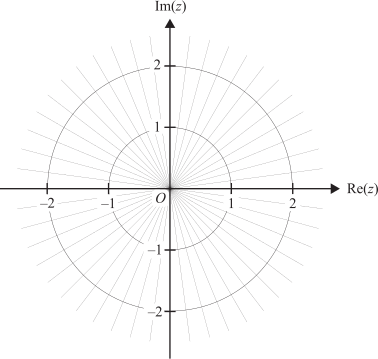
--- 0 WORK AREA LINES (style=lined) ---
- The ray given by \(\text{Arg}(z)=\theta\) passes through the midpoint of the line interval that joins the points \(u=\sqrt{3}+i\) and \(v=\sqrt{2}-\sqrt{2}i\).
- Find, in radians, the value of \(\theta\) and plot this ray on the Argand diagram in part b. (2 marks)
--- 4 WORK AREA LINES (style=lined) ---
- The line interval that joins the points \(u=\sqrt{3}+i\) and \(v=\sqrt{2}-\sqrt{2}i\) cuts the circle \(|z|=2\) into a major and a minor segment.
- Find the area of the minor segment, giving your answer correct to two decimal places. (2 marks)
--- 5 WORK AREA LINES (style=lined) ---
Show Answers Only
a.i. \(\text{See worked solutions.}\)
a.ii. \(a=-1, \ b=-\sqrt{6}\)
b.
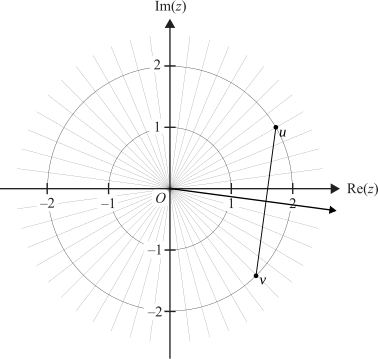
c. \(\theta=-\dfrac{\pi}{24}\)
d. \(0.69\ \text{u}^2\)
Show Worked Solution
a.i. \(u v=(\sqrt{2}+\sqrt{6})+(\sqrt{2}-\sqrt{6}) i\)
\begin{aligned}
(a+i)(b-\sqrt{2} i) & =a b-\sqrt{2} a i+b i+\sqrt{2} \\
& =a b+\sqrt{2}+(b-\sqrt{2}a) i
\end{aligned}
\(\text {Equating co-efficients: }\)
\(ab=\sqrt{6} \ \Rightarrow \ b=\dfrac{\sqrt{6}}{a}\ \cdots\ \text {(1)}\)
\(b-\sqrt{2} a=\sqrt{2}-\sqrt{6}\ \cdots\ \text {(2)}\)
\(\text{Substitute (1) into (2):}\)
\(\dfrac{\sqrt{6}}{a}-\sqrt{2}a=\sqrt{2}-\sqrt{6}\)
\(\sqrt{6}-\sqrt{2} a^2=(\sqrt{2}-\sqrt{6}) a\)
| \(\sqrt{2} a^2+(\sqrt{2}-\sqrt{6}) a-\sqrt{6}\) | \(=0\) | |
| \(a^2+(1-\sqrt{3}) a-\sqrt{3}\) | \(=0\) |
Mean mark (a) 54%.
a.ii. \(\text{Solve } a^2+(1-\sqrt{3}) a-\sqrt{3}=0 \ \ \text{for}\ a :\)
\(a=\sqrt{3} \ \text{ or } -1\)
\(\therefore \text{ Other solution: } a=-1, \ b=-\sqrt{6}\)
b.
c. |
\begin{aligned} \theta & =\frac{\operatorname{Arg}(u)-\operatorname{Arg}(v)}{2} \\ & =\frac{1}{2}\left(\frac{\pi}{6}-\frac{\pi}{4}\right) \\ & =-\frac{\pi}{24} \end{aligned} |
♦ Mean mark (c) 39%.
d. \(\text {Sector angle (centre) }=\dfrac{\pi}{6}+\dfrac{\pi}{4}=\dfrac{5 \pi}{12}\)
\(\text {Area of sector }=\dfrac{\frac{5 \pi}{12}}{2 \pi} \times \pi \times 2^2=\dfrac{5 \pi}{6}\)
\begin{aligned}
\text {Area of segment } & =\frac{5 \pi}{6}-\dfrac{1}{2} \times 2 \times 2 \times \sin \left(\dfrac{5 \pi}{6}\right) \\
& \approx 0.69\ \text{u} ^2
\end{aligned}
♦ Mean mark (d) 40%.
Complex Numbers, SPEC2 2021 VCAA 2
The polynomial `p(z) = z^3 + alpha z^2 + beta z + gamma`, where `z ∈ C` and `alpha, beta, gamma ∈ R`, can also be written as `p(z) = (z-z_1)(z-z_2)(z-z_3)`, where `z_1 ∈ R` and `z_2, z_3 ∈ C`.
- i. State the relationship between `z_2` and `z_3`. (1 mark)
--- 3 WORK AREA LINES (style=lined) ---
- ii. Determine the values of `alpha, beta` and `gamma`, given that `p(2) = -13, |z_2 + z_3| = 0` and `|z_2-z_3| = 6`. (3 marks)
--- 8 WORK AREA LINES (style=lined) ---
Consider the point `z_4 = sqrt3 + i`.
- Sketch the ray given by `text(Arg)(z-z_4) = (5pi)/6` on the Argand diagram below. (2 marks)
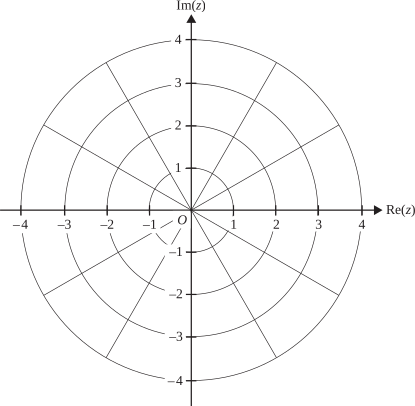
- The ray `text(Arg)(z-z_4) = (5pi)/6` intersects the circle `|z-3i| = 1`, dividing it into a major and a minor segment.
- i. Sketch the circle `|z-3i| = 1` on the Argand diagram in part b. (1 mark)
--- 0 WORK AREA LINES (style=lined) ---
- ii. Find the area of the minor segment. (2 marks)
--- 6 WORK AREA LINES (style=lined) ---
Show Answers Only
-
- `z_2 = barz_3`
- `alpha = -3, beta = 9, gamma = -27`
-
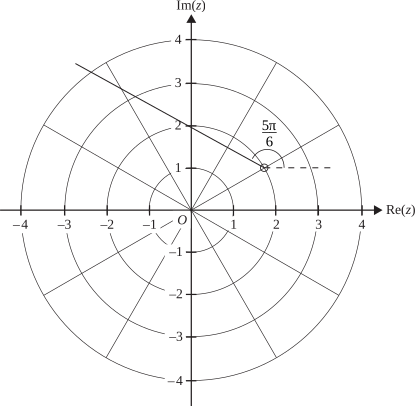
c.i.
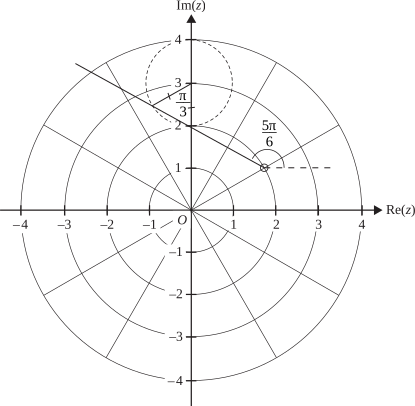
c.ii. `(2pi-3sqrt3)/12\ text(u²)`
Show Worked Solution
a.i. `text(By conjugate root theory)`
`z_2 = barz_3`
a.ii. `text(Let)\ \ z_1 = a + bi, \ z_2 = a-bi`
♦♦ Mean mark part (a.ii.) 35%.
`|z_2 + z_3| = |2a| = 0 \ => \ a = 0`
`|z_2-z_3| = |2b| = 6 \ => \ b = ±3`
`text(Using)\ \ p(2) = -13`
| `(2-z_1)(2-3i)(2 + 3i)` | `= -13` |
| `(2-z_1)(4 + 9)` | `= -13` |
| `2-z_1` | `= -1` |
| `z_1` | `= 3` |
| `p(z)` | `= (z-3)(z-3i)(z + 3i)` |
| `= (z-3)(z^2 + 9)` | |
| `= z^3-3z^2 + 9z-27` |
`:. alpha = –3, \ beta = 9, \ gamma = –27`
♦ Mean mark part (b) 45%.
MARKER’S COMMENT: Point of emanation is not part of required ray (see open circle).
MARKER’S COMMENT: Point of emanation is not part of required ray (see open circle).
b.
c.i.
c.ii. `text(Arg)(z-z_4) = (5pi)/6\ \ text(cuts)\ \ ytext(-axis at angle)\ pi/3`
♦♦ Mean mark part (c.ii.) 30%.
`=>\ text(angle at centre of segment) = pi/3\ (text(equilateral triangle))`
| `text(Area)` | `= (pi/3)/(2pi) xx pi xx 1^2-1/2 xx 1 xx 1 xx sin (pi/3)` |
| `= pi/6-sqrt3/4` | |
| `= (2pi-3sqrt3)/12\ text(u²)` |
Complex Numbers, SPEC2 2012 VCAA 2
- Given that `cos(pi/12) = (sqrt (sqrt 3 + 2))/2`, show that `sin(pi/12) = (sqrt (2-sqrt 3))/2`. (2 marks)
--- 5 WORK AREA LINES (style=lined) ---
- Express `z_1 = (sqrt(sqrt3 + 2))/2 + i(sqrt(2-sqrt3))/2` in polar form. (1 mark)
--- 2 WORK AREA LINES (style=lined) ---
- i. Write down `z_1^4` in polar form. (1 mark)
--- 2 WORK AREA LINES (style=lined) ---
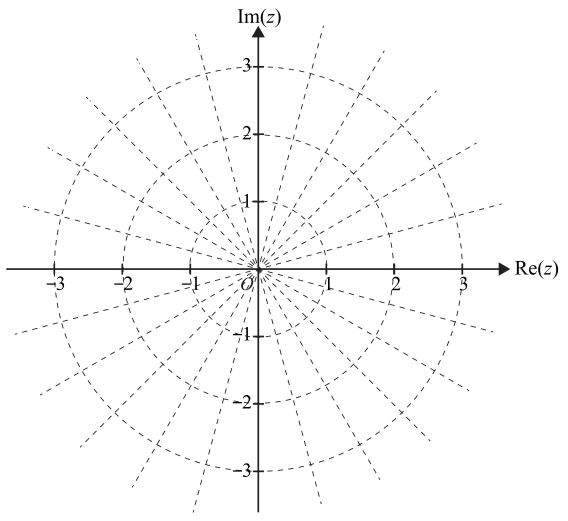
- ii. On the Argand diagram below, shade the region defined by
`{z: text(Arg)(z_1) <= text(Arg)(z) <= text(Arg)(z_1^4)} ∩ {z: 1 <= |\ z\ | <= 2}, z ∈ C`. (2 marks)
--- 0 WORK AREA LINES (style=lined) ---
- Find the area of the shaded region in part c. (2 marks)
--- 5 WORK AREA LINES (style=lined) ---
- i. Find the value(s) of `n` such that `text(Re)(z_1^n) = 0`, where `z_1 = (sqrt(sqrt3 + 2))/2 + i(sqrt(2-sqrt3))/2`. (3 marks)
--- 6 WORK AREA LINES (style=lined) ---
- ii. Find `z_1^n` for the value(s) of `n` found in part i. (1 mark)
--- 2 WORK AREA LINES (style=lined) ---
Show Worked Solution
| a. | `cos^2(pi/12) + sin^2(pi/12)` | `= 1` |
| `sin^2(pi/12)` | `= 1-(sqrt 3 + 2)/4` | |
| `= (2-sqrt 3)/4` |
`:. sin (pi/12) = sqrt(2-sqrt 3)/2,\ \ \ (sin (pi/12) > 0)`
| b.i. | `z_1` | `= cos(pi/12) + i sin (pi/12)` |
| `= text(cis)(pi/12)` |
| b.ii. | `z_1^4` | `= 1^4 text(cis) ((4 pi)/12)` |
| `= text(cis)(pi/3)` |
| c. | 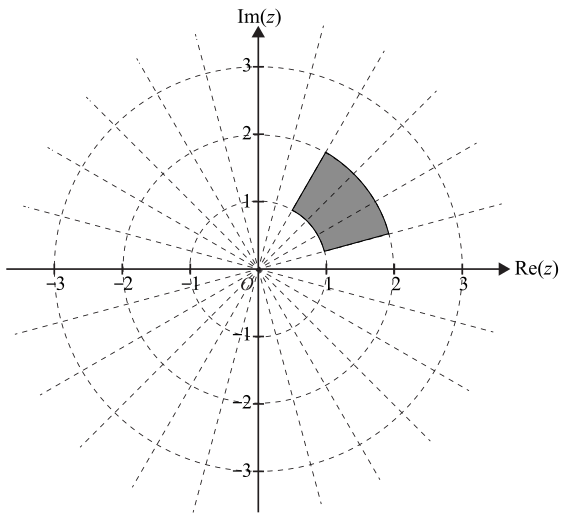 |
d. `text(Area of large sector)`Mean mark 51%.
`=theta/(2pi) xx pi r^2`
`=(pi/3-pi/12)/(2pi) xx pi xx 2^2`
`=pi/2`
`text(Area of small sector)`
`=1/2 xx pi/4 xx 1`
`=pi/8`
`:.\ text(Area shaded)`
`= pi/2-pi/8`
`= (3 pi)/8`
♦ Mean mark (e)(i) 34%.
| e.i. | `z_1^n` | `= 1^n text(cis) ((n pi)/12)` |
| `text(Re)(z_1^n)` | `= cos((n pi)/12) = 0` | |
| `(n pi)/12` | `=cos^(-1)0 +2pik,\ \ \ k in ZZ` | |
| `(n pi)/12` | `= pi/2 + k pi` | |
| `n` | `= 6 + 12k,\ \ \ k in ZZ` |
e.ii. `text(When)\ \ n=(6 + 12k):`♦ Mean mark (e)(ii) 36%.
| `z_1^n` | `= 1^(6 + 12k) text(cis) (((6 + 12k)pi)/12), quad k in ZZ` | |
| `= i xx sin (((6 + 12k)pi)/12)` | ||
| `= i xx sin (pi/2 + k pi)` |
`text(If)\ \ k=0 or text(even,)\ \ z_1^n=i`
`text(If)\ \ k\ text(is odd,)\ \ z_1^n=-i`
`:. z_1^n = +-i,\ \ \ k in ZZ`
Complex Numbers, SPEC2 2012 VCAA 6 MC
For any complex number `z`, the location on an Argand diagram of the complex number `u = i^3 bar z` can be found by
A. rotating `z` through `(3 pi)/2` in an anticlockwise direction about the origin
B. reflecting `z` about the `x`-axis and then reflecting about the `y`-axis
C. reflecting `z` about the `y`-axis and then rotating anticlockwise through `pi/2` about the origin
D. reflecting `z` about the `x`-axis and then rotating anticlockwise through `pi/2` about the origin
E. rotating `z` through `(3 pi)/2` in a clockwise direction about the origin
Complex Numbers, SPEC2 2016 VCAA 5 MC
If `text(Arg) (-1 + ai) = -(2 pi)/3`, then the real number `a` is
- `-sqrt 3`
- `-sqrt 3/2`
- `-1/sqrt 3`
- `1/sqrt 3`
- `sqrt 3`
Complex Numbers, SPEC2 2015 VCAA 9 MC
Let `z_1 = r_1 text(cis)(theta_1)` and `z_2 = r_2 text(cis)(theta_2)`, where `z_1` and `z_1z_2` are shown in the Argand diagram below; `theta_1` and `theta_2` are acute angles.

A statement that is necessarily true is
A. `r_2 > 1`
B. `theta_1 < theta_2`
C. `|\ (z_1)/(z_2)\ | > r_1`
D. `theta_1 = theta_2`
E. `r_1 > 1`
Show Worked Solution
`text(Consider each option:)`♦ Mean mark 47%.
`A:\ \ r_1r_2 < r_1\ \ =>\ \ r_2 < 1`
`B:`

`alpha + pi/2 – theta_1 = theta_2 ~~ theta_1\ \ text(not necessarily true)`
`C:\ \ (r_1)/(r_2) = (|\ z_1\ |)/(|\ z_2\ |) = |(z_1)/(z_2)|`
`text(S)text(ince)\ \ r_2<1\ \ =>\ \ |(z_1)/(z_2)| > r_1`
`D:\ \ theta_1 = theta_2\ \ text(possible but no scale given)`
`E:\ \ r_1>1\ \ text(possible but no scale given.)`
`=> C`
Complex Numbers, SPEC2-NHT 2018 VCAA 4 MC

On the Argand diagram shown above, `4 text(cis)(-(2pi)/3)` is represented by the point
- `P`
- `Q`
- `R`
- `S`
- `T`