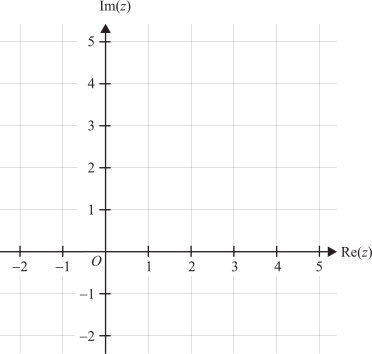
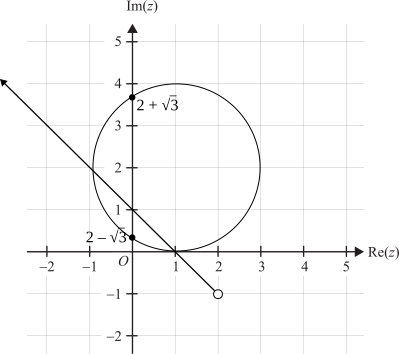
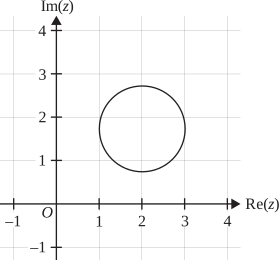
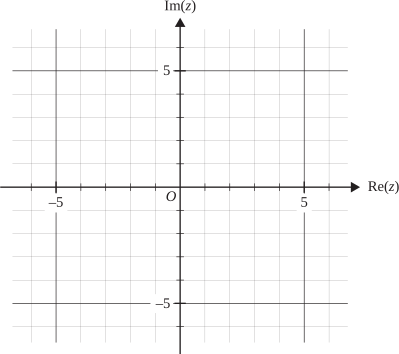
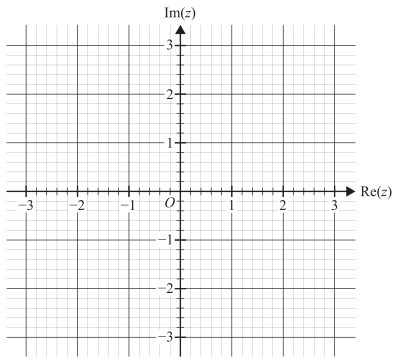
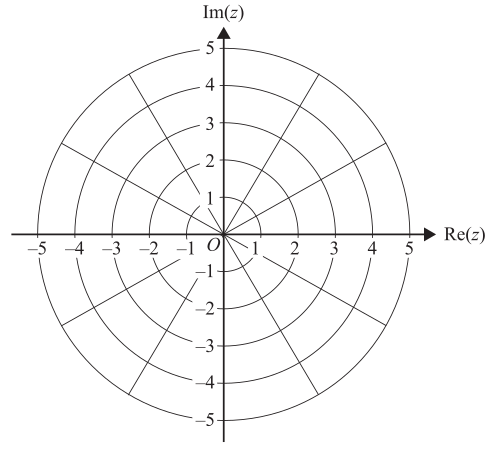
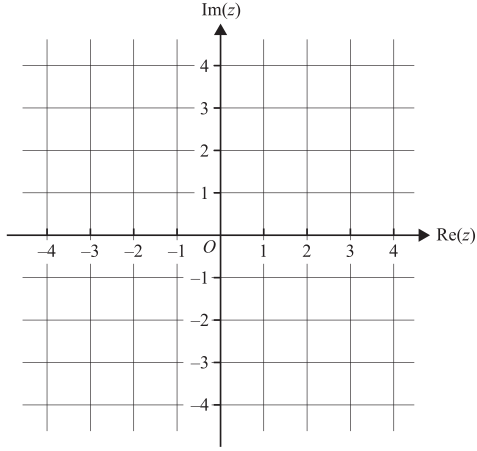
- Sketch \(\{z: z \bar{z}=4, z \in C\}\) on the Argand plane below. (1 mark)
-
- Show that \(\{z:|z-2 i|=|z-\sqrt{3}-i|, z \in C\}\) may be expressed as \(y=\sqrt{3} x\). (2 marks)
--- 5 WORK AREA LINES (style=lined) ---
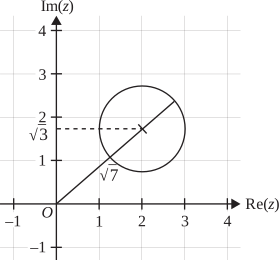
- Sketch \(\{z:|z-2 i|=|z-\sqrt{3}-i|, z \in C\}\) on the Argand plane in part a. (1 mark)
--- 0 WORK AREA LINES (style=lined) ---
- Show that \(\{z:|z-2 i|=|z-\sqrt{3}-i|, z \in C\}\) may be expressed as \(y=\sqrt{3} x\). (2 marks)
-
- Find the points of intersection of the curves defined in part a and in part b.i, expressing your answers in the form \(a+i b\), where \(a, b \in R\). (2 marks)
--- 4 WORK AREA LINES (style=lined) ---
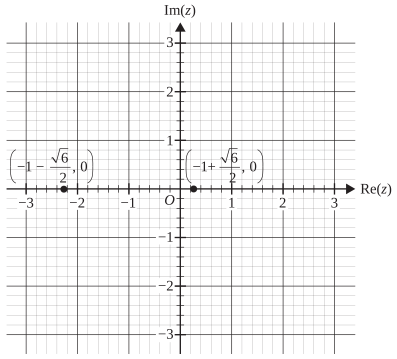
- Label these points on the Argand plane in part a. (1 mark)
--- 0 WORK AREA LINES (style=lined) ---
- Find the points of intersection of the curves defined in part a and in part b.i, expressing your answers in the form \(a+i b\), where \(a, b \in R\). (2 marks)
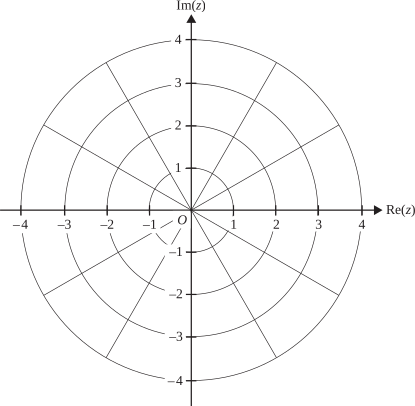
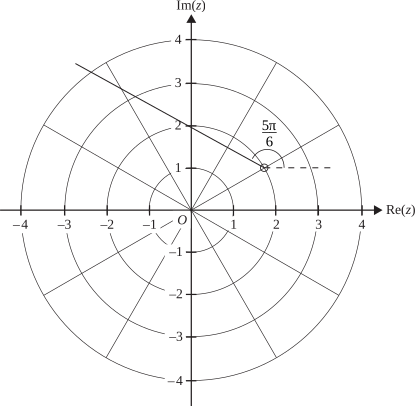
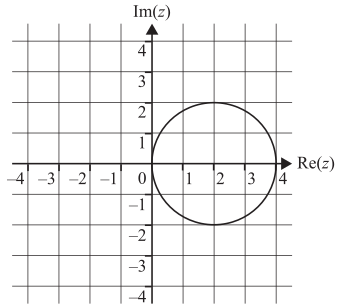
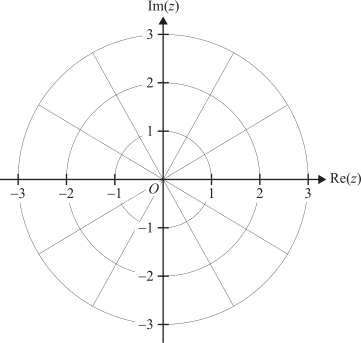
Consider the points \(P\) and \(Q\) labelled on the Argand plane below.
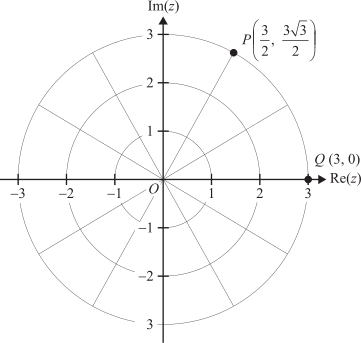
- A ray originating at point \(P\) and passing through point \(Q\) has the equation \(\operatorname{Arg}\left(z-z_0\right)=\theta\), where \(\theta\) is a radian measure.
- Write down the values of \(z_0\) and \(\theta\). (1 mark)
--- 2 WORK AREA LINES (style=lined) ---
- Find the area of the minor segment bounded by the chord connecting the points \(P\) and \(Q\) and the circle given by \(|z|=3\).
- Give your answer in the form \(c \pi+d\), where \(c, d \in R\). (2 marks)
--- 4 WORK AREA LINES (style=lined) ---
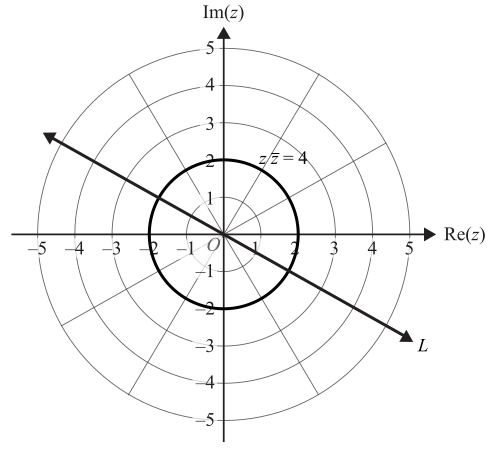
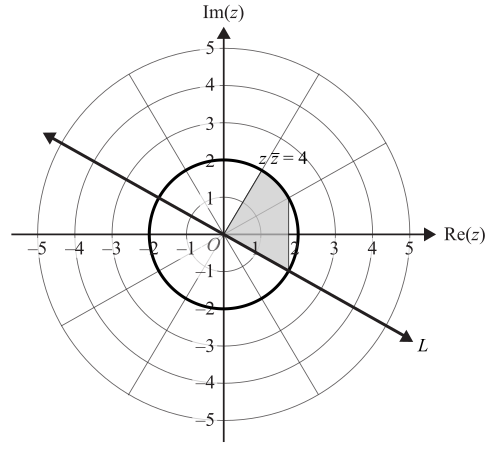
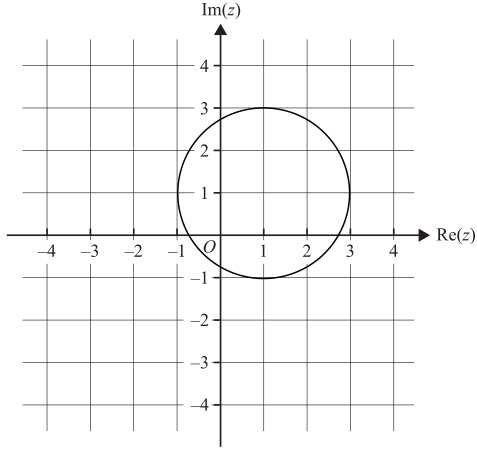
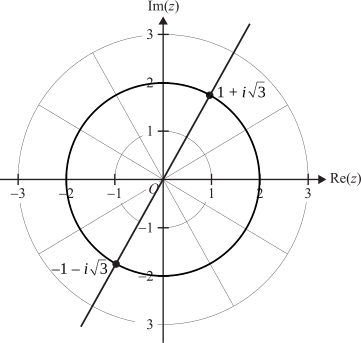
a. \(z \bar{z}=4\ \ \Rightarrow\ \ \text{Circle, centre (0, 0), radius = 2}\)
b.i \(\abs{z-2 i}=\abs{x+(y-2) i}=x^2+(y-2)^2\)
\(\abs{z-\sqrt{3}-i}=\abs{x-\sqrt{3}+(y-1)^2}=(x-\sqrt{3})^2+(y-1)^2\)
\(\text{Equating expressions:}\)
\(x^2+(y-2)^2=(x-\sqrt{3})^2+(y-1)^2\)
\(x^2+y^2-4 y+4=x^2-2 \sqrt{3} x+3+y^2-2 y+1\)
| \(-2 y\) | \(=-2 \sqrt{3} x\) |
| \(y\) | \(=\sqrt{3} x\) |
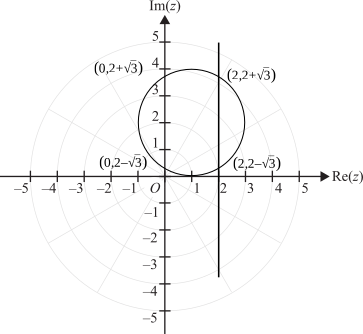
b.ii \(\text {See image in part (a).}\)
\(\abs{z-2 i}=\abs{z-\sqrt{3}-i} \ \Rightarrow \ \text{see straight line in image.}\)
c.i \(\text{Find intersection:}\)
\(x^2+y^2=4 \ \ \text{and} \ \ y=\sqrt{3} x\)
\(x^2+3 x^2=4 \ \ \Rightarrow \ \ x^2=1 \ \ \Rightarrow \ \ x= \pm 1\)
\(\text{Intersection co-ordinates:}\ \ (1, \sqrt{3}),(-1,-\sqrt{3})\)
\(z=1+\sqrt{3} i\)
\(z=-1-\sqrt{3} i\)
c.ii \(\text{See image in part (a)}\)
d. \(z_0=\dfrac{3}{2}+\dfrac{3 \sqrt{3}}{2} i\)
\(\theta=-\dfrac{\pi}{3}\)
| e. | \(A\) | \(=\dfrac{1}{2} \times 3^2 \times\left(\dfrac{\pi}{3}-\sin \dfrac{\pi}{3}\right)\) |
| \(=\dfrac{3}{2} \pi-\dfrac{9 \sqrt{3}}{4}\) |
a. \(z \bar{z}=4\ \ \Rightarrow\ \ \text{Circle, centre (0, 0), radius = 2}\)
b.i \(\abs{z-2 i}=\abs{x+(y-2) i}=x^2+(y-2)^2\)
\(\abs{z-\sqrt{3}-i}=\abs{x-\sqrt{3}+(y-1)^2}=(x-\sqrt{3})^2+(y-1)^2\)
\(\text{Equating expressions:}\)
\(x^2+(y-2)^2=(x-\sqrt{3})^2+(y-1)^2\)
\(x^2+y^2-4 y+4=x^2-2 \sqrt{3} x+3+y^2-2 y+1\)
| \(-2 y\) | \(=-2 \sqrt{3} x\) |
| \(y\) | \(=\sqrt{3} x\) |
b.ii \(\text {See image in part (a).}\)
\(\abs{z-2 i}=\abs{z-\sqrt{3}-i} \ \Rightarrow \ \text{see straight line in image.}\)
c.i \(\text{Find intersection:}\)
\(x^2+y^2=4 \ \ \text{and} \ \ y=\sqrt{3} x\)
\(x^2+3 x^2=4 \ \ \Rightarrow \ \ x^2=1 \ \ \Rightarrow \ \ x= \pm 1\)
\(\text{Intersection co-ordinates:}\ \ (1, \sqrt{3}),(-1,-\sqrt{3})\)
\(z=1+\sqrt{3} i\)
\(z=-1-\sqrt{3} i\)
c.ii \(\text{See image in part (a)}\)
d. \(z_0=\dfrac{3}{2}+\dfrac{3 \sqrt{3}}{2} i\)
\(\theta=-\dfrac{\pi}{3}\)
| e. | \(A\) | \(=\dfrac{1}{2} \times 3^2 \times\left(\dfrac{\pi}{3}-\sin \dfrac{\pi}{3}\right)\) |
| \(=\dfrac{3}{2} \pi-\dfrac{9 \sqrt{3}}{4}\) |