SmarterEd

Aussie Maths & Science Teachers: Save your time with SmarterEd

  • Login
  • Get Help
  • About

Data Analysis, GEN1 2024 NHT 15 MC

The sales revenue, in dollars, from the sale of chocolate eggs is seasonal.

To correct the sales revenue in May for seasonality, the actual sales revenue, to the nearest percent, is decreased by 17 %.

The seasonal index for that month is closest to

  1. 0.77
  2. 0.83
  3. 1.17
  4. 1.20
  5. 1.25
Show Answers Only

\(D\)

Show Worked Solution

\(\text{17% decrease}\ \Rightarrow\ \text{Multiplying factor = 0.83}\)

\(\text{Seasonal index}\ = \dfrac{1}{0.83}=1.204…\)

\(\Rightarrow D\)

Filed Under: Time Series Tagged With: Band 5, smc-266-20-(De)Seasonalising Data

Data Analysis, GEN2 2023 VCAA 4

The time series plot below shows the average monthly ice cream consumption recorded over three years, from January 2010 to December 2012.

The data for the graph was recorded in the Northern Hemisphere.

In this graph, month number 1 is January 2010, month number 2 is February 2010 and so on.
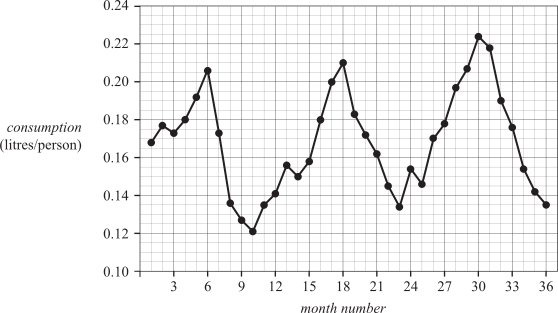
 

  1. Identify a feature of this plot that is consistent with this time series having a seasonal component.  (1 mark)

    --- 3 WORK AREA LINES (style=lined) ---

  2. The long-term seasonal index for April is 1.05
  3. Determine the deseasonalised value for average monthly ice cream consumption in April 2010 (month 4).
  4. Round your answer to two decimal places.  (1 mark)

    --- 2 WORK AREA LINES (style=lined) ---

  5. The table below shows the average monthly ice cream consumption for 2011 . 
Consumption (litres/person)
Year Jan Feb Mar Apr May Jun Jul Aug Sept Oct Nov Dec
2011 0.156 0.150 0.158 0.180 0.200 0.210 0.183 0.172 0.162 0.145 0.134 0.154
  1. Show that, when rounded to two decimal places, the seasonal index for July 2011 estimated from this data is 1.10.  (2 marks)

    --- 5 WORK AREA LINES (style=lined) ---

Show Answers Only

a.    \(\text{Maximum values are 12 months apart.}\)

b.    \(\text{Deseasonalised (Apr)}\ = \dfrac{0.180}{1.05} = 0.1714… = 0.17\ \text{(2 d.p.)}\)

c.    \(\text{2011 monthly mean}\ =\dfrac{2.004}{12}=0.167\)
 

\(\text{Seasonal index (July)}\) \(=\dfrac{0.183}{0.167}\)  
  \(=1.095…\)  
  \(=1.10\ \text{(2 d.p.)}\)  
Show Worked Solution
a.    \(\text{Maximum values are 12 months apart.}\)
♦♦♦ Mean mark (a) 26%.

 
b.
    \(\text{Deseasonalised (Apr)}\ = \dfrac{0.180}{1.05} = 0.1714… = 0.17\ \text{(2 d.p.)}\)

 
c.
    \(\text{2011 monthly mean}\)

\(=(0.156+0.15+0.158+0.18+0.2+0.21+0.183+0.172+\)

\(0.162+0.145+0.134+0.154)\ ÷\ 12 \)

\(=\dfrac{2.004}{12}\)

\(=0.167\)
 

\(\text{Seasonal index (July)}\) \(=\dfrac{0.183}{0.167}\)  
  \(=1.095…\)  
  \(=1.10\ \text{(2 d.p.)}\)  
♦♦ Mean mark (c) 36%.

Filed Under: Time Series Tagged With: Band 4, Band 5, smc-266-10-Seasonal Index from a Table, smc-266-20-(De)Seasonalising Data, smc-266-40-Time Series Trends

Data Analysis, GEN1 2022 VCAA 16 MC

The seasonal index for sales of sunscreen in summer is 1.25

To correct for seasonality, the actual sunscreen sales for summer should be

  1. reduced by 20%
  2. reduced by 25%
  3. reduced by 80%
  4. increased by 20%
  5. increased by 25%
Show Answers Only

\(A\)

Show Worked Solution

\(\text{Deseasonalised Sales}\)

  \(= \dfrac{\text{Actual Sales}}{\text{Seasonal Index}}\)  
  \(=\dfrac{\text{Actual Sales}}{1.25}\)  
  \(=0.8 \times  \text{Actual Sales}\)  

 
\(\therefore \ \text{Summer sales should be reduced by 20%.}\)

\(\Rightarrow A\)


♦ Mean mark 40%.

Filed Under: Time Series Tagged With: Band 5, smc-266-20-(De)Seasonalising Data

Data Analysis, GEN1 2023 VCAA 16 MC

The number of visitors each month to a zoo is seasonal.

To correct the number of visitors in January for seasonality, the actual number of visitors, to the nearest percent, is increased by 35%.

The seasonal index for that month is closest to

  1. 0.61
  2. 0.65
  3. 0.69
  4. 0.74
  5. 0.77
Show Answers Only

\(D\)

Show Worked Solution
\(\text{Seasonal index}\) \(=\ \dfrac{\text{actual}}{\text{deseasonalised}} \)  
  \(=\ \dfrac{\text{actual}}{1.35 \times \text{actual}} \)  
  \(=0.741\)  

 
\(\Rightarrow D\)

Filed Under: Time Series Tagged With: Band 5, smc-266-20-(De)Seasonalising Data

CORE, FUR1 2021 VCAA 16 MC

The number of visitors to a regional animal park is seasonal.

Data is collected and deseasonalised before a least squares line is fitted.

The equation of the least squares line is

deseasonalised number of visitors = 2349 – 198.5 × month number

where month number 1 is January 2020.

The seasonal indices for the 12 months of 2020 are shown in the table below.

 

The actual number of visitors predicted for February 2020 was closest to

  1. 1562
  2. 1697
  3. 1952
  4. 2245
  5. 2440
Show Answers Only

`E`

Show Worked Solution

`text{Deseasonalised number of visitors in February}`

Mean mark 52%.

`= 2349 – 198.5 xx 2`

`= 1952`
 

`text{Actual visitors predicted in February}`

`= 1952 xx 1.25`

`= 2440`
 

`=> E`

Filed Under: Time Series Tagged With: Band 4, smc-266-20-(De)Seasonalising Data

CORE, FUR1 2020 VCAA 17-18 MC

Table 4 below shows the monthly rainfall for 2019, in millimetres, recorded at a weather station, and the associated long-term seasonal indices for each month of the year.
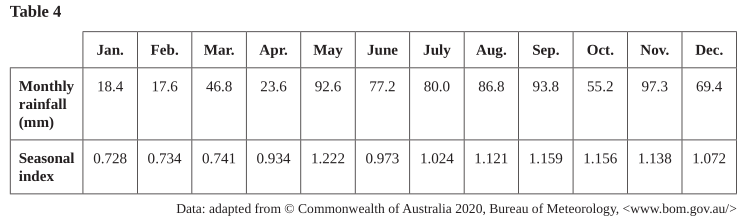


Part 1

The deseasonalised rainfall for May 2019 is closest to

  1.   71.3 mm
  2.   75.8 mm
  3.   86.1 mm
  4.   88.1 mm
  5. 113.0 mm

 
Part 2

The six-mean smoothed monthly rainfall with centring for August 2019 is closest to

  1. 67.8 mm
  2. 75.9 mm
  3. 81.3 mm
  4. 83.4 mm
  5. 86.4 mm
Show Answers Only

`text(Part 1:)\ B`

`text(Part 2:)\ C`

Show Worked Solution

Part 1

`text(Deseasonalised rainfall for May)`

`= 92.6/1.222`

`= 75.8\ text(mm)`
 

`=> B`
 

Part 2

`text{Six-mean smoothed average (Aug)}`

`=[(92.6 + 77.2 + 80 + 86.8 + 93.8 + 55.2) ÷6 +`

`(77.2 + 80 + 86.8 + 93.8 + 55.2 + 97.3) ÷ 6] ÷ 2`

`~~ (80.93 + 81.72) ÷ 2`

`~~ 81.3\ text(mm)`
 

`=> C`

Filed Under: Time Series Tagged With: Band 3, Band 4, smc-266-20-(De)Seasonalising Data, smc-266-60-MEAN Smoothing

CORE, FUR1 2020 VCAA 15-16 MC

Table 3 below shows the long-term mean rainfall, in millimetres, recorded at a weather station, and the associated long-term seasonal indices for each month of the year.

The long-term mean rainfall for December is missing.
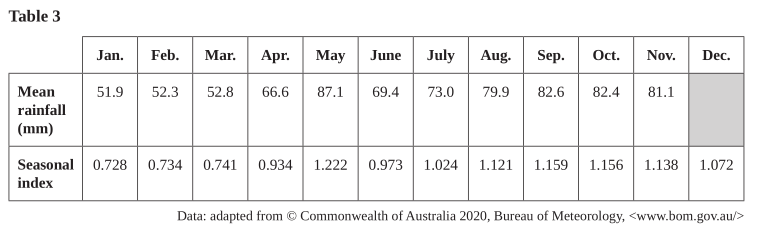


Part 1

To correct the rainfall in March for seasonality, the actual rainfall should be, to the nearest per cent

  1. decreased by 26%
  2. increased by 26%
  3. decreased by 35%
  4. increased by 35%
  5. increased by 74%

 
Part 2

The long-term mean rainfall for December is closest to

  1. 64.7 mm
  2. 65.1 mm
  3. 71.3 mm
  4. 76.4 mm
  5. 82.0 mm
Show Answers Only

`text(Part 1:)\ C`

`text(Part 2:)\ D`

Show Worked Solution

Part 1

`text(Deseasonalised rainfall for March)`

`= 52.8/0.741`

`= 71.255`

`:.\ text(Percentage increase)` `= (71.255 – 52.8)/() xx 100`
  `~~ 35%`

`=> D`
 

Part 2

`text(Mean) = 51.9/0.728 = 71.3`

`text(Actual December)` `= 71.3 xx 1.072`
  `~~ 76.4\ text(mm)`

`=> D`

Filed Under: Time Series Tagged With: Band 4, Band 5, smc-266-10-Seasonal Index from a Table, smc-266-20-(De)Seasonalising Data

Data Analysis, GEN1 2019 NHT 16 MC

A small cafe is open every day of the week except Tuesday.

The table below shows the daily seasonal indices for labour costs at this cafe.

Excluding the day that the cafe is closed, the long-term average weekly labour cost is $9786.

The expected daily labour cost on a Wednesday is closest to

  1.  $1127
  2.  $1315
  3.  $1631
  4.  $1733
  5.  $2022
Show Answers Only

`E`

Show Worked Solution

`text(Average daily labour cost)`

`= 9786/6`

`= 1631`


`:.\ text(Wednesday’s expected cost)`

`= 1631 xx 1.24`

`= $2022.44`
 

`=>\ E`

Filed Under: Time Series Tagged With: Band 4, smc-266-20-(De)Seasonalising Data

CORE, FUR2 2019 VCAA 6

The total rainfall, in millimetres, for each of the four seasons in 2015 and 2016 is shown in Table 5 below.
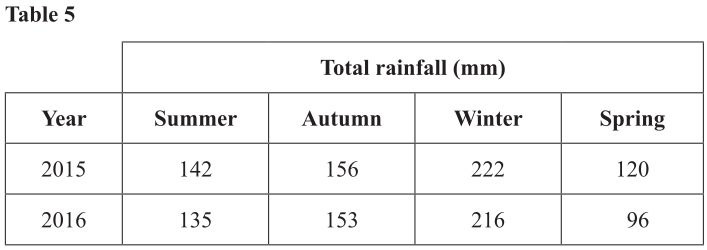
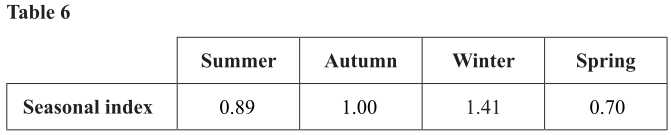
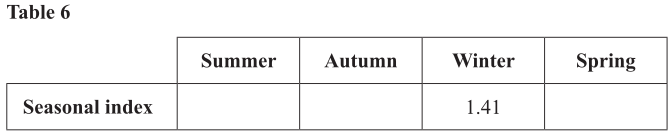
  1. The seasonal index for winter is shown in Table 6 below.


    Use the values in Table 5 to find the seasonal indices for summer, autumn and spring.

  2. Write your answers in Table 6, rounded to two decimal places.   (2 marks)

    --- 4 WORK AREA LINES (style=lined) ---


  3. The total rainfall for each of the four seasons in 2017 is shown in Table 7 below.


    Use the appropriate seasonal index from Table 6 to deseasonalise the total rainfall for winter in 2017.


    Round your answer to the nearest whole number.   (1 mark)

    --- 2 WORK AREA LINES (style=lined) ---

Show Answers Only
  1. `text(See Worked Solutions)`
  2. `186\ text(mm)`
Show Worked Solution
a.  

`text{Average rainfall (2015)}\ = (142 + 156 + 222 + 120)/4 = 160`

`text{Average rainfall (2016)}\ = (135 + 153 + 216 + 96)/4= 150`

`text{SI (Summer)}` `= 1/2 (142/160 + 135/150)=0.89`
`text{SI (Autumn)}` `= 1/2(156/160 + 153/150)=1.00`
`text{SI (Spring)}` `= 1/2 (120/160 + 96/150)=0.70`


b.   `text{Winter (deseasonalised)}` `= 262/1.41`
    `~~ 186\ text(mm)`

Filed Under: Time Series Tagged With: Band 4, Band 5, smc-266-10-Seasonal Index from a Table, smc-266-20-(De)Seasonalising Data

CORE, FUR1 2017 VCAA 16 MC

The seasonal index for the sales of cold drinks in a shop in January is 1.6

To correct the January sales of cold drinks for seasonality, the actual sales should be

  1. `text(reduced by 37.5%)`
  2. `text(reduced by 40%)`
  3. `text(reduced by 62.5%)`
  4. `text(increased by 60%)`
  5. `text(increased by 62.5%)`
Show Answers Only

`A`

Show Worked Solution

`text(Deseasonalised sales)`

`= text(Actual)/text(index)`

`= text(Actual) xx 1/1.6`

`=\ text(Actual × 62.5%)`


`:.\ text(Actual sales need to be reduced by 37.5%)`

`=> A`

Filed Under: Time Series Tagged With: Band 5, smc-266-20-(De)Seasonalising Data

CORE, FUR1 2017 VCAA 11 MC

Which one of the following statistics can never be negative?

  1. the maximum value in a data set
  2. the value of a Pearson correlation coefficient
  3. the value of a moving mean in a smoothed time series
  4. the value of a seasonal index
  5. the value of the slope of a least squares line fitted to a scatterplot
Show Answers Only

`D`

Show Worked Solution

`text(The value of a seasonal index cannot be negative.)`

`=> D`

Filed Under: Time Series Tagged With: Band 4, smc-266-20-(De)Seasonalising Data

CORE, FUR1 2016 VCAA 14-16 MC

The table below shows the long-term average of the number of meals served each day at a restaurant. Also shown is the daily seasonal index for Monday through to Friday.


Part 1

The seasonal index for Wednesday is 0.84

This tells us that, on average, the number of meals served on a Wednesday is

  1. 16% less than the daily average.
  2. 84% less than the daily average.
  3. the same as the daily average.
  4. 16% more than the daily average.
  5. 84% more than the daily average.


Part 2

Last Tuesday, 108 meals were served in the restaurant.

The deseasonalised number of meals served last Tuesday was closest to

  1.   `93`
  2. `100`
  3. `110`
  4. `131`
  5. `152`


Part 3

The seasonal index for Saturday is closest to

  1. `1.22`
  2. `1.31`
  3. `1.38`
  4. `1.45`
  5. `1.49`
Show Answers Only

`text(Part 1:)\ A`

`text(Part 2:)\ E`

`text(Part 3:)\ D`

Show Worked Solution

`text(Part 1)`

`1 – 0.84 = 0.16`

`:.\ text(A seasonal index of 0.84 tell us)`

`text(16% less meals are served.)`

`=> A`


`text(Part 2)`

`text{Deseasonalised number (Tues)}`

`= text(actual number)/text(seasonal index)`

`= 108/0.71`

`~~ 152`

`=> E`


`text(Part 3)`

`text(S)text(ince the same number of deseasonalised)`

`text(meals are served each day.)`

`text{S.I. (Sat)}/190` `= 1.10/145`
`text{S.I. (Sat)}` `= (1.10 xx 190)/145`
  `= 1.44…`

`=> D`

Filed Under: Time Series Tagged With: Band 3, Band 4, Band 5, smc-266-10-Seasonal Index from a Table, smc-266-20-(De)Seasonalising Data

CORE, FUR2 2009 VCAA 4

  1. Table 2 shows the seasonal indices for rainfall in summer, autumn and winter. Complete the table by calculating the seasonal index for spring.   (1 mark)

    --- 0 WORK AREA LINES (style=lined) ---


    CORE, FUR2 2009 VCAA 4

  2. In 2008, a total of 188 mm of rain fell during summer.


    Using the appropriate seasonal index in Table 2, determine the deseasonalised value for the summer rainfall in 2008. Write your answer correct to the nearest millimetre.   (1 mark)

    --- 3 WORK AREA LINES (style=lined) ---

  3. What does a seasonal index of 1.05 tell us about the rainfall in autumn?   (1 mark)

    --- 2 WORK AREA LINES (style=lined) ---

Show Answers Only
  1. `1.10`
  2. `241\ text(mm)`
  3. `text(The Autumn rainfall is 5% above the average)`
    `text(for the four seasons of the year.)`
Show Worked Solution

a.   `text(Seasonal index for Spring)`

`=4-(0.78 + 1.05 + 1.07)`

`= 1.10`


b.   `text{Deseasonalised value (Summer)}`

`= 188/0.78`

`=241.02…`

`=241\ text{mm (nearest mm)}`

♦ Part (c) was “poorly answered” (no exact data).
MARKER’S COMMENT: A common error was to say rainfall was above average monthly rainfall.


c.   `text(The Autumn rainfall is 5% above the average)`

`text(for the four seasons of the year.)`


Filed Under: Time Series Tagged With: Band 3, Band 4, Band 5, smc-266-10-Seasonal Index from a Table, smc-266-20-(De)Seasonalising Data

CORE, FUR1 2010 VCAA 13 MC

A garden supplies outlet sells water tanks. The monthly seasonal indices for the revenue from the sale of water tanks are given below.

The seasonal index for September is missing.

CORE, FUR1 2010 VCAA 13 MC

The revenue from the sale of water tanks in September 2009 was $104 500.

The deseasonalised revenue for September 2009 is closest to

A.     `$42\ 800`

B.     `$74\ 100`

C.   `$104\ 500`

D.   `$141\ 000`

E.   `$147\ 300`

Show Answers Only

`B`

Show Worked Solution
`text(Seasonal index for September)` `=12 -\ text(sum of others)`
  `=12-10.59`
  `=1.41`

`:.\ text(Deseasonalised Revenue for September)`

`= (text(actual))/(text(index))`

`= (104\ 500)/(1.41)`

`= $74\ 113.48`

`=> B`

Filed Under: Time Series Tagged With: Band 4, smc-266-20-(De)Seasonalising Data

CORE, FUR1 2015 VCAA 13 MC

The quarterly seasonal indices for tractor sales for a supplier are displayed in Table 1.

CORE, FUR1 2015 VCAA 13 MC1

The quarterly tractor sales in 2014 for this supplier are displayed in Table 2.

CORE, FUR1 2015 VCAA 13 MC2

The sales data in Table 2 is to be deseasonalised before a least squares regression line is fitted.

The equation of this least squares regression line is closest to

A.   deseasonalised sales = 0.32 + 910 × quarter number

B.   deseasonalised sales = 370 – 2300 × quarter number

C.   deseasonalised sales = 910 + 0.32 × quarter number

D.   deseasonalised sales = 2300 – 370 × quarter number

E.   deseasonalised sales = 2300 – 0.32 × quarter number 

Show Answers Only

`D`

Show Worked Solution

`text(Deseasonalised sales,)`

2015 fur1 core 13

`text(Using quarter number as the independent,)`

♦ Mean mark 47%.

`text(variable and by CAS,)`

`text(deseasonalised sales)\ = 2300 – 370 xx\ text(quarter number)`

`=> D`

Filed Under: Time Series Tagged With: Band 5, smc-266-20-(De)Seasonalising Data

CORE, FUR1 2006 VCAA 11-13 MC

The following information relates to Parts 1, 2 and 3.

The table shows the seasonal indices for the monthly unemployment numbers for workers in a regional town.

Part 1

The seasonal index for October is missing from the table.

The value of the missing seasonal index for October is

A.   `0.93`

B.   `0.95`

C.   `0.96`

D.   `0.98`

E.   `1.03`


Part 2

The actual number of unemployed in the regional town in September is 330.

The deseasonalised number of unemployed in September is closest to

A.   `310`

B.   `344`

C.   `351`

D.   `371`

E.   `640`


Part 3

A trend line that can be used to forecast the deseasonalised number of unemployed workers in the regional town for the first nine months of the year is given by

deseasonalised number of unemployed = 373.3 – 3.38 × month number

where month 1 is January, month 2 is February, and so on.

The actual number of unemployed for June is predicted to be closest to

A.   `304`

B.   `353`

C.   `376`

D.   `393`

E.   `410`

Show Answers Only

`text (Part 1:)\ D`

`text (Part 2:)\ C`

`text (Part 3:)\ A`

Show Worked Solution

`text (Part 1)`

`text(Oct index)` `=12-text(sum of other 11)`
  `=12-11.02`
  `=0.98`

`rArr D`


`text (Part 2)`

`text(Deseasonalised number)` `= text(Actual)/text(Index)`
  `=330/0.94`
  `=351.06…`

`rArr C`


`text (Part 3)`

♦♦ Mean mark 29%.
MARKERS’ COMMENT: 59% of students correctly found the deseasonalised number but failed to convert it to the actual.

`text(Deseasonalised number)`

`=373.3 – 3.38 xx 6`

`=353.02`

`text(Actual number)` `= text(Deseasonalised) xx text(Index)`
  `=353.02 xx 0.86`
  `=303.59…`

`rArr A`

Filed Under: Time Series Tagged With: Band 4, Band 6, smc-266-10-Seasonal Index from a Table, smc-266-20-(De)Seasonalising Data

CORE, FUR1 2014 VCAA 12 MC

The seasonal index for heaters in winter is 1.25.

To correct for seasonality, the actual heater sales in winter should be

A.   reduced by 20%. 

B.   increased by 20%. 

C.   reduced by 25%.

D.   increased by 25%.

E.   reduced by 75%.

Show Answers Only

`A`

Show Worked Solution

`text(Deseasonalised Sales)`

♦♦ Mean mark 26%.
MARKER’S COMMENT: A majority of students appeared to answer this question by inspection only which was not possible. Don’t be tricked!

`=\ text(Actual Sales)/text(Seasonal index)`

`=\ text(Actual Sales)/1.25`

`=80 text(%) xx text(Actual Sales)`

`∴\ text(Winter Sales should be reduced by 20%)`

`=>  A`

Filed Under: Time Series Tagged With: Band 6, smc-266-20-(De)Seasonalising Data

CORE, FUR1 2014 VCAA 10-11 MC

The seasonal indices for the first 11 months of the year, for sales in a sporting equipment store, are shown in the table below.

Part 1

The seasonal index for December is

A.  `0.89`

B.  `0.97`

C.  `1.02`

D.  `1.23`

E.  `1.29`


Part 2

In May, the store sold $213 956 worth of sporting equipment.

The deseasonalised value of these sales was closest to

A.  `$165\ 857`

B.  `$190\ 420`

C.  `$209\ 677`

D.  `$218\ 322`

E.  `$240\ 400`

Show Answers Only

`text(Part 1:)\ E`

`text(Part 2:)\ E`

Show Worked Solution

`text(Part 1)`

`text(Sum of seasonal indices) = 12`

`:.\ text(December’s seasonal index)`

`=12 – text{(1.23 + 0.96 + 1.12 + 1.08 + 0.89}`
`text{+ 0.98 + 0.86 + 0.76 + 0.76 + 0.95 + 1.12)}`
`=1.29`

`=>E`


`text(Part 2)`

`text(May Index)` `=\ text(Actual Sales)/text{Deseasonalised Sales (D)}`
`0.89` `= (213\ 956)/(text{D})`
`:.\ text(D)` `= (213\ 956)/0.89`
  `= $240\ 400`

`=>  E`

Filed Under: Time Series Tagged With: Band 3, smc-266-10-Seasonal Index from a Table, smc-266-20-(De)Seasonalising Data

CORE, FUR1 2011 VCAA 12 MC

The seasonal index for headache tablet sales in summer is 0.80.

To correct for seasonality, the headache tablet sales figures for summer should be

A.   reduced by 80%

B.   reduced by 25%

C.   reduced by 20%

D.   increased by 20%

E.   increased by 25%

Show Answers Only

`E`

Show Worked Solution

`text(Deseasonalised Sales)`

♦♦♦ Mean mark 10%!
MARKERS’ COMMENT: The key to solving this problem is to rearrange the “Seasonal Index” formula in the formula sheet.
`= \ \ text(Actual Sales) / text(Seasonal index)`
`= \ \ text(Actual Sales) / 0.8`
`= \ \ 1.25 xx text(Actual Sales)`


`:.\ text(Deseasonalised Sales need Actual Sales to)`

`text(be increased by 25%)`

`=> E`

Filed Under: Time Series Tagged With: Band 6, smc-266-20-(De)Seasonalising Data

CORE, FUR1 2012 VCAA 13 MC

A trend line was fitted to a deseasonalised set of quarterly sales data for 2012.

The seasonal indices for quarters 1, 2 and 3 are given in the table below. The seasonal index for quarter 4 is not shown.

 The equation of the trend line is

`text(deseasonalised sales) = 256 000 + 15 600 xx text(quarter number)`

Using this trend line, the actual sales for quarter 4 in 2012 are predicted to be closest to

A.   `$222\ 880`

B.   `$244\ 923`

C.   `$318\ 400`

D.   `$382\ 080`

E.   `$413\ 920`

Show Answers Only

`E`

Show Worked Solution

`text {Deseasonalised Sales (Q4)}`

♦ Mean mark 41%.
`= 256\ 000 + 15 600 xx 4`
`= 318\ 400`


`text (Seasonal index (Q4))`

`= 4 – (1.2 + 0.7 + 0.8)`
`= 1.3`


`:.\ text (Actual Sales (Q4))`

`=\ text(Deseasonalised Sales × seasonal index)`
`= 318\ 400 xx 1.3`
`= 413\ 920`

`rArr E`

Filed Under: Time Series Tagged With: Band 5, smc-266-20-(De)Seasonalising Data

CORE, FUR1 2012 VCAA 11-12 MC

Use the following information to answer Parts 1 and 2.

The table below shows the long-term average rainfall (in mm) for summer, autumn, winter and spring. Also shown are the seasonal indices for summer and autumn. The seasonal indices for winter and spring are missing.

Part 1

The seasonal index for spring is closest to

A.  `0.90`

B.  `1.03`

C.  `1.13`

D.  `1.15`

E.  `1.17`


Part 2

In 2011, the rainfall in autumn was 48.9 mm.

The deseasonalised rainfall (in mm) for autumn is closest to

A.  `48.4`

B.  `48.9`

C.  `49.4`

D.  `50.9`

E.  `54.0`

Show Answers Only

`text (Part 1:)\ C`

`text (Part 2:)\ A`

Show Worked Solution

`text (Part 1)`

`text (Average Seasonal Rainfall)`

`= (52.0 + 54.5 + 48.8 + 61.3)/4` 

`=54.15`

`:.\ text {Seasonal index (Spring)}`

`= 61.3/54.15`

`= 1.132…`

`rArr C`


`text (Part 2)`

`:.\ text {Deseasonalised Rainfall (Autumn)}`

`= 48.9/1.01`

`=48.415`

`rArr A`

Filed Under: Time Series Tagged With: Band 4, smc-266-10-Seasonal Index from a Table, smc-266-20-(De)Seasonalising Data

Copyright © 2014–2025 SmarterEd.com.au · Log in