SmarterEd

Aussie Maths & Science Teachers: Save your time with SmarterEd

  • Login
  • Get Help
  • About

Calculus, MET2 2024 VCAA 10 MC

Suppose a function  \(f:[0,5] \rightarrow R\)  and its derivative  \(f^{\prime}:[0,5] \rightarrow R\)  are defined and continuous on their domains. If  \(f^{\prime}(2)<0\)  and  \(f^{\prime}(4)>0\), which one of these statements must be true?

  1. \(f\) is strictly decreasing on \([0,2]\).
  2. \(f\) does not have an inverse function.
  3. \(f\) is positive on \([4,5]\).
  4. \(f\) has a local minimum at  \(x=3\).
Show Answers Only

\(B\)

Show Worked Solution

\(\text{As}\ \ f^{\prime}(2)<0\ \ \text{and}\ \ f^{\prime}(4)>0\ \ \text{the function must have} \)

\(\text{a turning point between}\ \ x=2\ \ \text{and}\ \ x=4.\)

\(\therefore\ f(x)\ \text{will not have an inverse function, as it is many-to-one.}\)

\(\Rightarrow B\)

♦♦ Mean mark 38%.

Filed Under: The Derivative Function and its Graph Tagged With: Band 5, smc-2830-10-Find f(x) given f'(x), smc-2830-40-Increasing/Decreasing intervals

Calculus, MET2 EQ-Bank 2

Jac and Jill have built a ramp for their toy car. They will release the car at the top of the ramp and the car will jump off the end of the ramp.

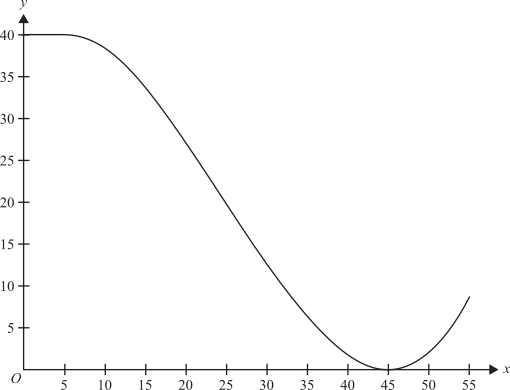
The cross-section of the ramp is modelled by the function \(f\), where

\(f(x)= \begin{cases}\displaystyle \ 40 & 0 \leq x<5 \\ \dfrac{1}{800}\left(x^3-75 x^2+675 x+30\ 375\right) & 5 \leq x \leq 55\end{cases}\)

\(f(x)\) is both smooth and continuous at \(x=5\).

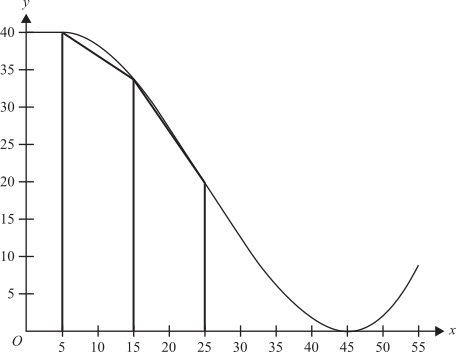
The graph of  \(y=f(x)\)  is shown below, where \(x\) is the horizontal distance from the start of the ramp and \(y\) is the height of the ramp. All lengths are in centimetres.

  1. Find \(f^{\prime}(x)\) for \(0<x<55\).   (2 marks)

    --- 2 WORK AREA LINES (style=lined) ---

  2.   i. Find the coordinates of the point of inflection of \(f\).   (1 mark)

    --- 1 WORK AREA LINES (style=lined) ---

  3.  ii. Find the interval of \(x\) for which the gradient function of the ramp is strictly increasing.   (1 mark)

    --- 1 WORK AREA LINES (style=lined) ---

  4. iii. Find the interval of \(x\) for which the gradient function of the ramp is strictly decreasing.  (1 mark)

    --- 1 WORK AREA LINES (style=lined) ---

Jac and Jill decide to use two trapezoidal supports, each of width \(10 cm\). The first support has its left edge placed at \(x=5\) and the second support has its left edge placed at \(x=15\). Their cross-sections are shown in the graph below.

  1. Determine the value of the ratio of the area of the trapezoidal cross-sections to the exact area contained between \(f(x)\) and the \(x\)-axis between \(x=5\) and \(x=25\). Give your answer as a percentage, correct to one decimal place.   (3 marks)

    --- 5 WORK AREA LINES (style=lined) ---

  2. Referring to the gradient of the curve, explain why a trapezium rule approximation would be greater than the actual cross-sectional area for any interval \(x \in[p, q]\), where \(p \geq 25\).   (1 mark)

    --- 4 WORK AREA LINES (style=lined) ---

  3. Jac and Jill roll the toy car down the ramp and the car jumps off the end of the ramp. The path of the car is modelled by the function \(P\), where

      1. \(P(x)=\begin{cases}f(x) & 0 \leq x \leq 55 \\ g(x) & 55<x \leq a\end{cases}\)
  4. \(P\) is continuous and differentiable at \(x=55, g(x)=-\frac{1}{16} x^2+b x+c\), and \(x=a\) is where the car lands on the ground after the jump, such that \(P(a)=0\).
    1. Find the values of \(b\) and \(c\).   (2 marks)

      --- 6 WORK AREA LINES (style=lined) ---

    2. Determine the horizontal distance from the end of the ramp to where the car lands. Give your answer in centimetres, correct to two decimal places.   (1 mark)

      --- 3 WORK AREA LINES (style=lined) ---

Show Answers Only

a.    \(f^{\prime}(x)= \begin{cases}\displaystyle \ 0 & 0 < x<5 \\ \dfrac{1}{800}\left(3x^2-150 x+675 \right) & 5 \leq x < 55\end{cases}\)

b.i   \((25, 20)\)

b.ii  \([25, 55]\)

b.iii \([5, 25]\)

c.    \(98.1\%\)

d.    \(\text{In the interval }x\in [25, q]\text{ the curve is concave up.}\)

\(\therefore\ \text{The sloped edges of the trapeziums would be above }f(x)\)

\(\text{making the trapezium rule approximation greater than the}\)

\(\text{actual area.}\)

e.i   \(b=8.75, c=-283.4375\)

e.ii  \(34.10\ \text{cm}\)

Show Worked Solution

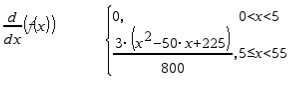
a.    \(\text{Using CAS: Define f(x) then}\)

\(\text{OR}\quad f^{\prime}(x)= \begin{cases}\displaystyle \ 0 & 0 < x<5 \\ \dfrac{1}{800}\left(3x^2-150 x+675 \right) & 5 \leq x < 55\end{cases}\)

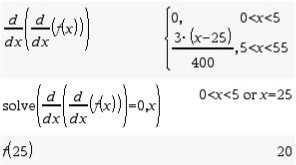
b.i   \(\text{Using CAS: Find }f^”(x)\ \text{then solve }=0\)

\(\therefore\ \text{Point of inflection at }(25, 20)\)
  

b.ii  \(\text{Gradient function strictly increasing for }x\in [25, 55]\)

b.iii \(\text{Gradient function strictly decreasing for }x\in [5, 25]\)

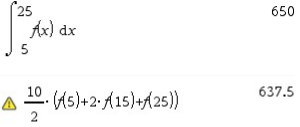
c.    \(\text{Using CAS:}\)

\(\text{Area}\) \(=\dfrac{h}{2}\Big(f(5)+2f(15)+f(25)\Big)\)
  \(=\dfrac{10}{2}\Big(40+2\times 33.75+20\Big)=637.5\)


\(\therefore\ \text{Estimate : Exact}\) \(=637.5:650\)
  \(=\dfrac{637.5}{650}\times 100\)
  \(=98.0769\%\approx 98.1\%\)

    
d.    \(\text{In the interval }x\in [25, q]\text{ the curve is concave up.}\)

\(\therefore\ \text{The sloped edges of the trapeziums would be above }f(x)\)

\(\text{making the trapezium rule approximation greater than the}\)

\(\text{actual area.}\)
 

e.i   \(f(55)=\dfrac{35}{4}\ \text{(Using CAS)}\)

\(\text{and }f(55)=g(55)\rightarrow g(55)=\dfrac{35}{4}\)

\(\therefore -\dfrac{1}{16}\times 55^2+55b+c\) \(=\dfrac{35}{4}\)
\(c\) \(=\dfrac{35}{4}+\dfrac{3025}{16}-55b\)
\(c\) \(=\dfrac{3165}{16}-55b\quad (1)\)

  
\(g'(x)=-\dfrac{x}{8}+b\)

\(\text{and }g'(55)=f'(55)\)

\(\rightarrow\ f'(55)=\dfrac{1}{800}(3\times 55^2-150\times 55+675)=\dfrac{15}{8}\)

\(\rightarrow\ -\dfrac{55}{8}+b=\dfrac{15}{8}\)

\(\therefore b=\dfrac{35}{4}\quad (2)\)

\(\text{Sub (2) into (1)}\)

\(c=\dfrac{3165}{16}-55\times\dfrac{35}{4}\)

\(c=-\dfrac{4535}{16}\)

\(\therefore\ b=\dfrac{35}{4}\ \text{or}\ 8.75 , c=-\dfrac{4535}{16}\ \text{or}\ -283.4375\)
 

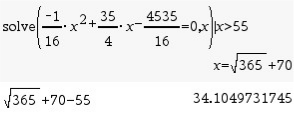
e.ii  \(\text{Using CAS: Solve }g(x)=0|x>55\)

\(\text{Horizontal distance}=\sqrt{365}+70-55=34.104\dots\approx 34.10\ \text{cm (2 d.p.)}\)

Filed Under: Curve Sketching, Standard Differentiation, Standard Integration, The Derivative Function and its Graph, Trapezium Rule and Newton Tagged With: Band 3, Band 4, Band 5, smc-2830-40-Increasing/Decreasing intervals, smc-2830-50-SP problems, smc-5145-04-Trapezium rule, smc-5145-15-Graph, smc-746-35-Standard, smc-749-20-Definite Integrals

Calculus, MET1 SM-Bank 24

The rule for function  `f` is  `f(x) = x^3 - 3x^2 + kx + 8`, where  `k`  is a constant.

Find the values of  `k`  for which  `f(x)`  is an increasing function.   (2 marks)

Show Answers Only

`k>3`

Show Worked Solution
`f(x)` `= x^3 – 3x^2 + kx + 8`
`f prime (x)` `= 3x^2 – 6x + k`

  
`f(x)\ text(is increasing when)\ f prime (x) > 0`

`=> 3x^2 – 6x + k > 0`

♦♦ Mean mark (HSC) 28%.
MARKER’S COMMENT: The arithmetic required to solve `36-12k“<0` proved the undoing of too many students in this question. TAKE CARE!


`text(Note)\ \ \ f prime (x)\ text(is always positive if)`

`f prime (x)\ text(is a positive definite.)`

`text(i.e. when)\ \ a > 0\ text(and)\ Delta < 0`

`a=3>0`

`Delta = b^2\ – 4ac`

`:. (–6)^2 – (4 xx 3 xx k)` `<0`
`36-12k` `<0`
`12k` `>36`
`k` `>3`


`:.\ f(x)\ text(is increasing when)\ k > 3.`

Filed Under: The Derivative Function and its Graph Tagged With: Band 5, smc-2830-40-Increasing/Decreasing intervals

Calculus, MET2 2009 VCAA 8 MC

For the function  `f: R -> R,\ f (x) = (x + 5)^2 (x - 1)`, the subset of `R` for which the gradient of  `f` is negative is

  1. `(– oo, 1)`
  2. `(– 5, 1)`
  3. `(– 5, – 1)`
  4. `(– oo, – 5)`
  5. `(– 5, 0)`
Show Answers Only

`C`

Show Worked Solution

`text(Sketching the curve:)`

`:. f prime (x) < 0\ \ text(for)\ \ x in (– 5, – 1)`

`=>   C`

Filed Under: The Derivative Function and its Graph Tagged With: Band 3, smc-2830-40-Increasing/Decreasing intervals

Calculus, MET2 2009 VCAA 2 MC

At the point `(1, 1)` on the graph of the function with rule  `y = (x - 1)^3 + 1`

  1. there is a local maximum.
  2. there is a local minimum.
  3. there is a stationary point of inflection.
  4. the gradient is not defined.
  5. there is a point of discontinuity.
Show Answers Only

`C`

Show Worked Solution

`y = (x – 1)^3 + 1`

`y′ = 3(x – 1)^2`

`y″ = 6(x – 1)`

`text(Point of inflection at)\ \ x=1.`

`=>   C`

Filed Under: The Derivative Function and its Graph Tagged With: Band 2, smc-2830-40-Increasing/Decreasing intervals

Calculus, MET2 2010 VCAA 16 MC

The gradient of the function  `f: R -> R,\ f(x) = (5x)/(x^2 + 3)`  is negative for

  1. `-sqrt 3 < x < sqrt 3`
  2. `x > 3`
  3. `x in R`
  4. `x < -sqrt 3 and x > sqrt 3`
  5. `x < 0`
Show Answers Only

`D`

Show Worked Solution
`f(x)` `=(5x)/(x^2 + 3)`

`text(By inspection, the gradient is negative when)`

`x < – sqrt 3 \ uu\  x > sqrt 3`

`=>   D`

Filed Under: The Derivative Function and its Graph Tagged With: Band 3, smc-2830-40-Increasing/Decreasing intervals

Calculus, MET2 2012 VCAA 8 MC

The function  `f: R -> R,\ f(x) = ax^3 + bx^2 + cx`, where `a` is a negative real number and `b` and `c` are real numbers.

For the real numbers  `p < m < 0 < n < q`, we have  `f(p) = f(q) = 0`  and  `f prime (m) = f prime (n) = 0.`

The gradient of the graph of  `y = f(x)` is negative for

  1. `(text(−∞), m) uu (n, oo)`
  2. `(m, n)`
  3. `(p, 0) uu (q, oo)`
  4. `(p, m) uu (0, q)`
  5. `(p, q)`
Show Answers Only

`A`

Show Worked Solution

`text(The graph crosses the)\ x text(-axis at)`

♦ Mean mark 49%.

`x=p, x=0 and x=q.`

`text(Turning points at)\ \ x=m and x=n.`

`text(Sketching the function:)`

met1-2012-vcaa-q5-answer

`:. f′(x) < 0quadtext(for)quadx < mquad∪quadx > n`

`=>   A`

Filed Under: The Derivative Function and its Graph Tagged With: Band 5, smc-2830-40-Increasing/Decreasing intervals

Copyright © 2014–2025 SmarterEd.com.au · Log in