SmarterEd

Aussie Maths & Science Teachers: Save your time with SmarterEd

  • Login
  • Get Help
  • About

BIOLOGY, M5 2025 HSC 18 MC

The fruit fly, Drosophila melanogaster, normally has large round eyes. A mutation of the eye shape gene, found on the X-chromosome, causes the eye to be a narrow slit (bar-eye), which is a dominant allele for eye shape.

Offspring were produced when a bar-eyed male was crossed with a normal female. Males are XY and females are XX.
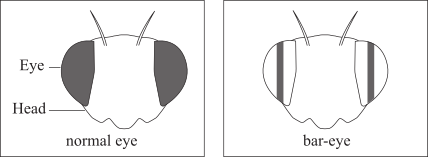
  

Which row in the table shows the correct percentage of male and female offspring produced with bar-eye?
  

    \(\quad\quad\quad\textit{Percentage of offspring with bar-eyes}\quad\quad\quad\)
     \(\quad\textit{Males}\quad\) \(\quad\textit{Females}\quad\)
A.       \(100\)  \(100\)
B. \(0\)  \(100\)
C. \(100\)  \(0\)
D. \(50\)  \(0\) 
   
Show Answers Only

\(B\)

Show Worked Solution
  • B is correct: Males inherit Y from father; all females inherit X with bar-eye.

Other Options:

  • A is incorrect: Males get Y chromosome from father, not X with mutation.
  • C is incorrect: Males cannot inherit bar-eye from father; females must inherit it.
  • D is incorrect: All females receive father’s X chromosome with bar-eye allele.

Filed Under: Genetic Variation / Inheritance Tagged With: Band 6, smc-3648-30-Sex Linkage

BIOLOGY, M5 2024 HSC 20 MC

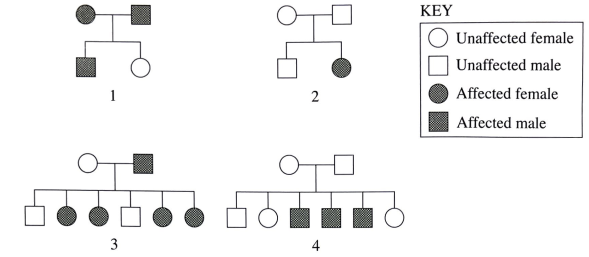
Analyse the following four pedigrees.
 

Which row in the table correctly identifies the pedigree with the type of inheritance?

\begin{align*}
\begin{array}{l}
\ & \\
\\
\\
\rule{0pt}{2.5ex}\textbf{A.}\rule[-1ex]{0pt}{0pt}\\
\rule{0pt}{2.5ex}\textbf{B.}\rule[-1ex]{0pt}{0pt}\\
\rule{0pt}{2.5ex}\textbf{C.}\rule[-1ex]{0pt}{0pt}\\
\rule{0pt}{2.5ex}\textbf{D.}\rule[-1ex]{0pt}{0pt}\\
\\
\end{array}
\begin{array}{|c|c|}
\hline
\rule{0pt}{2.5ex}\textit{Autosomal} & \textit{Sex-linked} & \textit{Autosomal} & \textit{Sex-linked} \\
\textit{dominant} \rule[-1ex]{0pt}{0pt} & \textit{dominant} & \textit{recessive} & \textit{recessive} \\
\hline
\rule{0pt}{2.5ex}\text{2} \rule[-1ex]{0pt}{0pt}& \text{1} & \text{3} & \text{4} \\
\hline
\rule{0pt}{2.5ex}\text{1} \rule[-1ex]{0pt}{0pt}& \text{4} & \text{2} & \text{3} \\
\hline
\rule{0pt}{2.5ex}\text{1} \rule[-1ex]{0pt}{0pt}& \text{3} & \text{2} & \text{4} \\
\hline
\rule{0pt}{2.5ex}\text{2} \rule[-1ex]{0pt}{0pt} & \text{4} & \text{1} & \text{3} \\
\hline
\end{array}
\end{align*}

Show Answers Only

\(C\)

Show Worked Solution

Consider Pedigree 1:

  • Both parents affected, daughter unaffected (received recessive alleles from each parent).
  • Trait autosomal dominant (eliminate \(A\) and \(D\)).

Consider Pedigree 3:

  • Father affected, mother unaffected, all daughters affected, all sons unaffected. Trait sex linked with all daughters inheriting one dominant allele (from father) and one recessive (from mother).

\(\Rightarrow C\)

Filed Under: Genetic Variation / Inheritance Tagged With: Band 4, smc-3648-10-Pedigrees, smc-3648-30-Sex Linkage, smc-3648-35-Autosomal

BIOLOGY, M5 SM-Bank 25

In fruit flies, eye colour is a sex-linked trait inherited on the X chromosome. The red-eye allele R is dominant over the white-eye allele (r). A red-eyed male and white-eyed female have 50 offspring.

Use a Punnett square to predict the number of male and female offspring and their eye colour.   (3 marks)

--- 4 WORK AREA LINES (style=lined) ---

--- 2 WORK AREA LINES (style=lined) ---

Show Answers Only

\begin{array} {|c|c|c|}
\hline  & \text{X}^{\text{R}} & \text{Y} \\
\hline \text{X}^{\text{r}} & \text{X}^{\text{R}}\text{X}^{\text{r}} & \text{X}^{\text{R}}\text{Y} \\
\hline \text{X}^{\text{r}} & \text{X}^{\text{R}}\text{X}^{\text{r}} & \text{X}^{\text{R}}\text{Y} \\  
\hline \end{array}

  • Predicted offspring: 25 red-eyed females and 25 white-eyed males.
Show Worked Solution

\begin{array} {|c|c|c|}
\hline  & \text{X}^{\text{R}} & \text{Y} \\
\hline \text{X}^{\text{r}} & \text{X}^{\text{R}}\text{X}^{\text{r}} & \text{X}^{\text{R}}\text{Y} \\
\hline \text{X}^{\text{r}} & \text{X}^{\text{R}}\text{X}^{\text{r}} & \text{X}^{\text{R}}\text{Y} \\  
\hline \end{array}

  • Predicted offspring: 25 red-eyed females and 25 white-eyed males.

Filed Under: Genetic Variation / Inheritance Tagged With: Band 4, smc-3648-20-Punnet Squares, smc-3648-30-Sex Linkage

BIOLOGY, M5 EQ-Bank 24

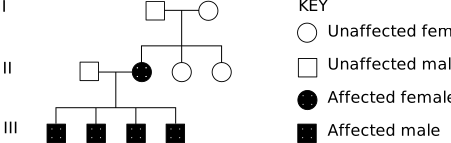
A non-infectious disease was observed in a mother and her four sons who live with her. She has no daughters. The father of these children does not have the disease and does not live with them. The woman's parents and her two sisters who live overseas do not have the disease.

A geneticist suspects that the disease is inherited.

  1. Draw the family pedigree for this disease.   (3 marks)


  2. From the evidence, what indicates that the disease could be the result of a recessive allele and not be sex-linked?   (2 marks)

    --- 4 WORK AREA LINES (style=lined) ---

Show Answers Only

a.   


b.   Evidence disease is recessive and not sex-linked:

  • Generation 1 parents do not have the disease but it is present in their daughter, meaning it must be recessive.
  • If the disease was sex-linked, the same daughter who has the disease must have a father with the disease, however this is not the case.
Show Worked Solution

a.   


b.   Evidence disease is recessive and not sex-linked:

  • Generation 1 parents do not have the disease but it is present in their daughter, meaning it must be recessive.
  • If the disease was sex-linked, the same daughter who has the disease must have a father with the disease, however this is not the case.

Filed Under: Genetic Variation / Inheritance Tagged With: Band 3, Band 4, smc-3648-10-Pedigrees, smc-3648-30-Sex Linkage, smc-3648-35-Autosomal

BIOLOGY, M5 EQ-Bank 15 MC

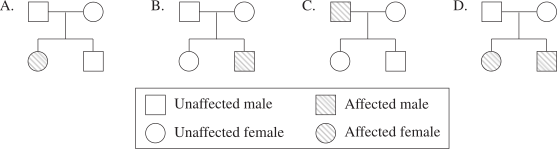
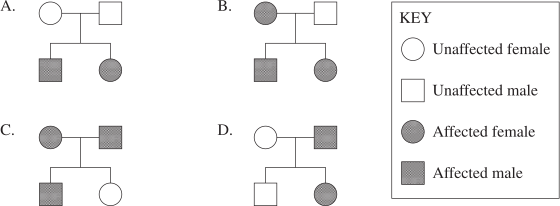
It is suspected that a child has a recessive, sex-linked condition. An initial pedigree was developed.

Which of the following is most likely to depict this initial pedigree?
 

Show Answers Only

`B`

Show Worked Solution

By Elimination

  • Pedigree C displays no information related to the question as no children are affected (Eliminate C).
  • Both pedigree A and D display crosses which are inaccurate and impossible to occur as daughters cannot be affected if the mother does not have recessive sex-linked traits (Eliminate A and D).

`=>B`

Filed Under: Genetic Variation / Inheritance Tagged With: Band 5, smc-3648-10-Pedigrees, smc-3648-30-Sex Linkage

BIOLOGY, M5 EQ-Bank 13 MC

Haemophilia A is a blood clotting disorder that arises from a defect in the gene which is carried on the `text{X}` chromosome.

A couple is considering starting a family. However, the father suffers from Haemophilia A. The mother is healthy with no family history of the disease.

What is the probability that a potential grandson will have Haemophilia A if they have a daughter who partners with an unaffected man?

  1. 0%
  2. 50%
  3. 75%
  4. 100%
Show Answers Only

`B`

Show Worked Solution
  • The probability can be explained by the cross below, where the daughter has a heterozygous phenotype (mother was homozygous recessive and father had haemophilia).
  • Daughter : `text{X}^text{A}text{X}^text{a}`   Husband : `text{X}^text{a}text{Y}`

\begin{array} {|l|c|c|}
\hline  & \text{X}^\text{a} & \text{Y} \\
\hline \text{X}^\text{A} & \text{X}^\text{A}\text{X}^\text{a} & \text{X}^\text{A}\text{Y}\\
\hline \text{X}^\text{a} & \text{X}^\text{a}\text{X}^\text{a} & \text{X}^\text{a}\text{Y} \\
\hline \end{array}

  • This shows that 1 in 2 grandsons will have haemophilia and 1 in 2 granddaughters will have haemophilia, therefore there is a 50% likelihood of grandchildren being affected.

`=>B`

Filed Under: Genetic Variation / Inheritance Tagged With: Band 5, smc-3648-30-Sex Linkage

BIOLOGY, M5 EQ-Bank 9 MC

Muscular Distrophy is a sex-linked recessive trait.

Nicole does not have Muscular Distrophy but her father does. Nicole is married to Keith who does not have Muscular Distrophy. Nicole and Keith are expecting twins, a boy and a girl.

Which row in the table shows the probability of Muscular Distrophy in the boy and the girl?

\begin{align*}
\begin{array}{l}
\rule{0pt}{2.5ex} \ \rule[-1ex]{0pt}{0pt}& \\
\rule{0pt}{2.5ex} \textbf{A.}\rule[-1ex]{0pt}{0pt}\\
\rule{0pt}{2.5ex} \textbf{B.}\rule[-1ex]{0pt}{0pt}\\
\rule{0pt}{2.5ex} \textbf{C.}\rule[-1ex]{0pt}{0pt}\\
\rule{0pt}{2.5ex} \textbf{D.}\rule[-1ex]{0pt}{0pt}\\
\end{array}
\begin{array}{|c|c|}
\hline \rule{0pt}{2.5ex} \quad \quad\  \textit{Boy}\  \quad\quad & \quad \quad\textit{Girl} \quad\quad  \\
\hline \rule{0pt}{2.5ex}  0 \% \rule[-1ex]{0pt}{0pt}& 0 \% \\
\hline \rule{0pt}{2.5ex} 50 \% \rule[-1ex]{0pt}{0pt}& 0 \% \\
\hline \rule{0pt}{2.5ex} 0 \% \rule[-1ex]{0pt}{0pt}& 50 \% \\
\hline \rule{0pt}{2.5ex} 50 \% \rule[-1ex]{0pt}{0pt}& 50 \% \\
\hline
\end{array}
\end{align*}

Show Answers Only

\(B\)

Show Worked Solution
  • The probability can be predicted using the punnet square below.
  • Since Nicole does not have Muscular Dystrophy but her father does, she must be heterozygous.
  • Nicole : \(\text{X}^\text{B} \text{X}^\text{b}\)   Keith : \(\text{X}^\text{b} \text{Y}\)

\begin{array} {|l|c|c|}
\hline  & \text{X}^\text{b} & \text{Y} \\
\hline \text{X}^\text{B} & \text{X}^\text{B}\text{X}^\text{b} & \text{X}^\text{B}\text{Y}\\
\hline \text{X}^\text{b} & \text{X}^\text{b}\text{X}^\text{b} & \text{X}^\text{b}\text{Y} \\
\hline \end{array}

  • This shows that there is a 50% chance for boys to be \(\text{X}^{b} \text{Y}\) and therefore a 50% chance to have Muscular Dystrophy, while the girls will always have an \(\text{X}^\text{B}\) allele and therefore cannot have Muscular Dystrophy.

\(\Rightarrow B\)

Filed Under: Genetic Variation / Inheritance Tagged With: Band 4, smc-3648-30-Sex Linkage

BIOLOGY, M5 2014 HSC 15 MC

Goltz Syndrome is a condition in humans that adversely affects the skin. It is inherited as a dominant gene carried on the X chromosome.

A man with Goltz Syndrome and a woman who does NOT have the trait have two children, a boy and a girl.

Which of the following is correct about the inheritance of Goltz Syndrome in these children?

  1. Both children have the syndrome.
  2. The girl has the syndrome and the boy does not.
  3. The girl has the syndrome and the boy is a carrier.
  4. The girl has a 50% chance of having the syndrome and the boy has a 0% chance.
Show Answers Only

`B`

Show Worked Solution
  • A woman with the genotype XgXg will not have Goltz and a male with XGY will have Goltz.
  • A cross between these individuals will mean that all girls will have Goltz as they have to have the XG allele from the father, and no boys will have Goltz, as they have to inherit the Y chromosome from the father, and both X chromosomes from the mother do not have the gene for Goltz.

`=>B`


♦ Mean mark 48%.

Filed Under: Genetic Variation / Inheritance Tagged With: Band 5, smc-3648-30-Sex Linkage

BIOLOGY, M5 2018 HSC 19 MC

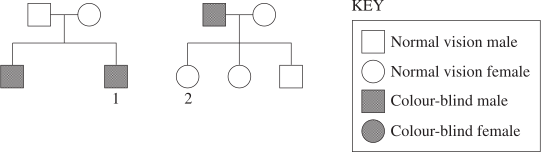
Colour blindness in humans is determined by a sex-linked gene. Two family trees are shown.
 

Which row of the table shows the probability of colour-blind offspring of each sex if individuals 1 and 2 were to have children together?

\begin{align*}
\begin{array}{l}
\rule{0pt}{2.5ex} \ \rule[-1ex]{0pt}{0pt}& \\
\rule{0pt}{2.5ex}\textbf{A.}\rule[-1ex]{0pt}{0pt}\\
\rule{0pt}{2.5ex}\textbf{B.}\rule[-1ex]{0pt}{0pt}\\
\rule{0pt}{2.5ex}\textbf{C.}\rule[-1ex]{0pt}{0pt}\\
\rule{0pt}{2.5ex}\textbf{D.}\rule[-1ex]{0pt}{0pt}\\
\end{array}
\begin{array}{|c|c|}
\hline
\rule{0pt}{2.5ex}\ \textit{Male offspring} \ \rule[-1ex]{0pt}{0pt}& \textit{Female offspring} \\
\hline
\rule{0pt}{2.5ex}0 \% \rule[-1ex]{0pt}{0pt}& 0 \% \\
\hline
\rule{0pt}{2.5ex}50 \% \rule[-1ex]{0pt}{0pt}& 0 \% \\
\hline
\rule{0pt}{2.5ex}50 \% \rule[-1ex]{0pt}{0pt}& 50 \% \\
\hline
\rule{0pt}{2.5ex}0 \% \rule[-1ex]{0pt}{0pt}& 50 \% \\
\hline
\end{array}
\end{align*}

Show Answers Only

\(C\)

Show Worked Solution
  • A female carrier and a colour-blind male will have a 50% chance of producing either male or female offspring with colour blindness.

\(\Rightarrow C\)


Mean mark 55%.

Filed Under: Genetic Variation / Inheritance Tagged With: Band 5, smc-3648-10-Pedigrees, smc-3648-30-Sex Linkage

BIOLOGY, M5 2017 HSC 28

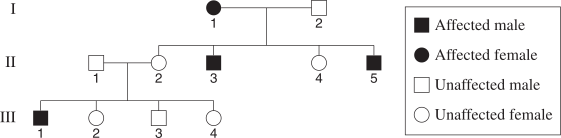
A pedigree chart of an inherited characteristic is shown.


Subsequent genetic analysis showed `text{I-2}` does not have the recessive allele.

Explain the inheritance of this characteristic.   (3 marks)

--- 6 WORK AREA LINES (style=lined) ---

Show Answers Only
  • `text{I-1}` must be homozygous for the condition given that both male offspring `text{(II-3}` and `text{II-5)}` are also affected.
  • The condition must be recessive as `text{III-1}` is affected and both parents `text{(II-1}` and `text{II-2)}` are unaffected.
  • As `text{I-2}` does not have the recessive allele the condition is sex-linked, as autosomal recessive would require both parents to be carriers.
  • `text{II-2}` must be an unaffected carrier (possess the recessive gene) of the sex-linked allele.
Show Worked Solution
  • `text{I-1}` must be homozygous for the condition given that both male offspring `text{(II-3}` and `text{II-5)}` are also affected.
  • The condition must be recessive as `text{III-1}` is affected and both parents `text{(II-1}` and `text{II-2)}` are unaffected.
  • As `text{I-2}` does not have the recessive allele the condition is sex-linked, as autosomal recessive would require both parents to be carriers.
  • `text{II-2}` must be an unaffected carrier (possess the recessive gene) of the sex-linked allele.

Filed Under: Genetic Variation / Inheritance Tagged With: Band 4, smc-3648-10-Pedigrees, smc-3648-30-Sex Linkage

BIOLOGY, M5 2019 HSC 17 MC

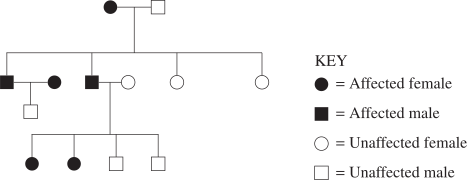
The pedigree shows the inheritance of a genetic disorder.
 

Which row of the table correctly identifies the two possible types of inheritance for this disorder?
 

\begin{align*}
\begin{array}{l}
\rule{0pt}{2.5ex} \ \rule[-1ex]{0pt}{0pt}& \\
\ \rule[-1ex]{0pt}{0pt}& \\
\rule{0pt}{2.5ex}\textbf{A.}\rule[-1ex]{0pt}{0pt}\\
\rule{0pt}{2.5ex}\textbf{B.}\rule[-1ex]{0pt}{0pt}\\
\rule{0pt}{2.5ex}\textbf{C.}\rule[-1ex]{0pt}{0pt}\\
\rule{0pt}{2.5ex}\textbf{D.}\rule[-1ex]{0pt}{0pt}\\
\end{array}
\begin{array}{|c|c|c|c|}
\hline
\rule{0pt}{2.5ex}\quad \textit{Autosomal} \quad &\quad \textit{Autosomal} \quad & \quad \textit{Sex-linked} \quad & \quad \textit{Sex-linked}\quad \\
\textit{dominant} &\textit{recessive} \rule[-1ex]{0pt}{0pt}& \textit{dominant} & \textit{recessive}\\
\hline
\rule{0pt}{2.5ex}\checkmark \rule[-1ex]{0pt}{0pt}& & \checkmark & \\
\hline
\rule{0pt}{2.5ex}\checkmark \rule[-1ex]{0pt}{0pt}& & & \checkmark \\
\hline
\rule{0pt}{2.5ex}& \checkmark \rule[-1ex]{0pt}{0pt}& \checkmark & \\
\hline
\rule{0pt}{2.5ex}& \checkmark \rule[-1ex]{0pt}{0pt}& & \checkmark \\
\hline
\end{array}
\end{align*}

Show Answers Only

\(A\)

Show Worked Solution

By Elimination:

  • If the trait is autosomal recessive, then it would be impossible to not be affected if both parents are affected (aa x aa).
  • This is not the case for the first individual in generation 3 (eliminate C and D).
  • If the trait is sex-linked recessive, then anytime an affected female has male children, they must be affected, as the recessive allele from the mother must couple with the Y chromosome.
  • This is not the case for the first individual in generation 3 (eliminate B).

\(\Rightarrow A\)


♦♦♦ Mean mark 24%.

Filed Under: Genetic Variation / Inheritance Tagged With: Band 6, smc-3648-10-Pedigrees, smc-3648-30-Sex Linkage, smc-3648-35-Autosomal

BIOLOGY, M5 2020 HSC 26

One of the genes involved in determining the colour of a species of fish has two alleles: yellow and orange.

The diagram shows a pedigree chart for the inheritance of colour in the fish.
 

  1. Use the pedigree chart to explain why the yellow allele is recessive.   (2 marks)

    --- 5 WORK AREA LINES (style=lined) ---

  2. Explain how a cross between individuals `text{I}` and `text{II}` could be used to determine whether the inheritance of colour in the fish is sex-linked or autosomal.   (4 marks)

    --- 10 WORK AREA LINES (style=lined) ---

Show Answers Only

a.   The Yellow allele is recessive because:

  • Parents are both orange (exhibiting dominant allele).
  • Some offspring are yellow, indicating that the yellow allele is present in the parents but not expressed.
  • Therefore yellow allele must be recessive.

b.   If sex-linked Inheritance:

  • `text{I}` would be `text{X}^text{A}text{Y}` and `text{II}` would be `text{X}^text{a}text{X}^text{a}`.
  • A cross between these individuals will result in all male offspring being yellow (`text{X}^text{a}text{Y}`) and all female offspring being orange (`text{X}^text{A}text{X}^text{a}`), as shown by the punnet square below.

\begin{array} {|l|c|c|}
\hline  & \text{X}^\text{A} & \text{Y} \\
\hline \text{X}^\text{a} & \text{X}^\text{A}\text{X}^\text{a} & \text{X}^\text{a}\text{Y}\\
\hline \end{array}

Autosomal Inheritance

  • If the inheritance it autosomal, then `text{II}` would have genotype aa and `text{I}` either AA or Aa.
  • A cross between Aa and aa would result in 50% yellow and 50% orange fish, and a cross between AA and aa will result in all orange fish.
  • Both crosses will have orange fish offspring, but sex does not have any influence on inheritance.

Therefore, to determine the inheritance:

  • The absence of orange, male fish would be indicative of a sex-linked inheritance style.
  • The appearance of orange, male fish would confirm the inheritance is autosomal.
Show Worked Solution

a.   The Yellow allele is recessive because:

  • Parents are both orange (exhibiting dominant allele).
  • Some offspring are yellow, indicating that the yellow allele is present in the parents but not expressed.
  • Therefore yellow allele must be recessive.

If sex-linked Inheritance:

  • `text{I}` would be `text{X}^text{A}text{Y}` and `text{II}` would be `text{X}^text{a}text{X}^text{a}`.
  • A cross between these individuals will result in all male offspring being yellow (`text{X}^text{a}text{Y}`) and all female offspring being orange (`text{X}^text{A}text{X}^text{a}`), as shown by the punnet square below.

\begin{array} {|l|c|c|}
\hline  & \text{X}^\text{A} & \text{Y} \\
\hline \text{X}^\text{a} & \text{X}^\text{A}\text{X}^\text{a} & \text{X}^\text{a}\text{Y}\\
\hline \end{array}

Autosomal Inheritance

  • If the inheritance it autosomal, then `text{II}` would have genotype aa and `text{I}` either AA or Aa.
  • A cross between Aa and aa would result in 50% yellow and 50% orange fish, and a cross between AA and aa will result in all orange fish.
  • Both crosses will have orange fish offspring, but sex does not have any influence on inheritance.

Therefore, to determine the inheritance:

  • The absence of orange, male fish would be indicative of a sex-linked inheritance style.
  • The appearance of orange, male fish would confirm the inheritance is autosomal.

♦♦ Mean mark (b) 36%.

Filed Under: Genetic Variation / Inheritance Tagged With: Band 4, Band 5, smc-3648-10-Pedigrees, smc-3648-30-Sex Linkage, smc-3648-35-Autosomal

BIOLOGY, M5 2021 HSC 18 MC

Which human pedigree shows inheritance of a recessive, sex-linked characteristic?
 

Show Answers Only

`D`

Show Worked Solution
  • In order for the recessive sex-linked inheritance to be true, the mother is a carrier (heterozygous).
  • Thus the daughter can be affected (inheriting an affected chromosome from each parent), but the son can remain unaffected (inheriting the unaffected chromosome from the carrier mother).

`=>D`

♦ Mean mark 45%.

Filed Under: Genetic Variation / Inheritance Tagged With: Band 5, smc-3648-30-Sex Linkage

Copyright © 2014–2025 SmarterEd.com.au · Log in