- A prokaryotic and eukaryotic cell are shown.
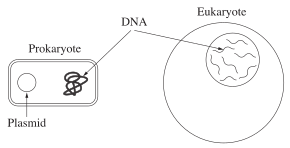
- Contrast ONE feature of the DNA in prokaryotes and eukaryotes. (2 marks)
--- 3 WORK AREA LINES (style=lined) ---
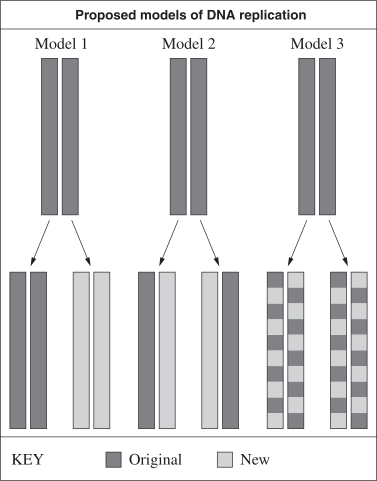
- Outline how ONE feature of DNA allows replication to occur. (2 marks)
--- 4 WORK AREA LINES (style=lined) ---
Show Answers Only
a. Answers could include one of the following:
- Prokaryotic DNA is a single circular chromosome found free in the cytoplasm (nucleoid region), whereas eukaryotic nuclear DNA consists of multiple linear chromosomes enclosed within a nucleus.
- Prokaryotic DNA is not associated with histone proteins, whereas eukaryotic DNA is tightly wound around histones.
- Prokaryotes commonly contain small circular plasmids in addition to their chromosome, whereas plasmids are rare in eukaryotes.
b. Complementary base pairing:
- The two strands of the double helix are held together by weak hydrogen bonds between complementary bases (A–T and C–G), allowing helicase to unwind and separate the strands.
- Each separated strand then acts as a template, with DNA polymerase adding free nucleotides according to complementary base pairing, producing two identical DNA molecules.
Show Worked Solution
a. Answers could include one of the following:
- Prokaryotic DNA is a single circular chromosome found free in the cytoplasm (nucleoid region), whereas eukaryotic nuclear DNA consists of multiple linear chromosomes enclosed within a nucleus.
- Prokaryotic DNA is not associated with histone proteins, whereas eukaryotic DNA is tightly wound around histones.
- Prokaryotes commonly contain small circular plasmids in addition to their chromosome, whereas plasmids are rare in eukaryotes.
b. Complementary base pairing:
- The two strands of the double helix are held together by weak hydrogen bonds between complementary bases (A–T and C–G), allowing helicase to unwind and separate the strands.
- Each separated strand then acts as a template, with DNA polymerase adding free nucleotides according to complementary base pairing, producing two identical DNA molecules.