SmarterEd

Aussie Maths & Science Teachers: Save your time with SmarterEd

  • Login
  • Get Help
  • About

BIOLOGY, M6 2025 HSC 2 MC

What type of mutagen is UV light?

  1. Biochemical
  2. Biological
  3. Chemical
  4. Electromagnetic
Show Answers Only

\(D\)

Show Worked Solution
  • D is correct: UV light is electromagnetic radiation that causes DNA mutations.

Other Options:

  • A is incorrect: Biochemical mutagens are biological molecules like enzymes or toxins.
  • B is incorrect: Biological mutagens include viruses or transposons that alter DNA.
  • C is incorrect: Chemical mutagens are substances like alkylating agents or base analogs.

Filed Under: Mutation Tagged With: Band 3, smc-3652-60-Mutagens

BIOLOGY, M6 2023 HSC 35

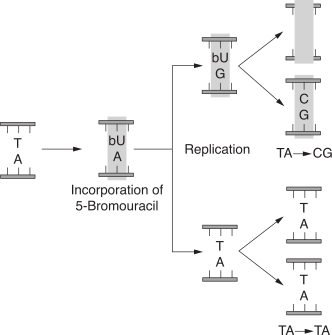
5-Bromouracil (bU) is a synthetic chemical mutagen. It bonds with adenine in place of thymine in DNA. During replication, it then binds with guanine.

This will then make a guanine-cytosine pair on one strand of DNA instead of an adenine-thymine pair.
 

  1. Identify the type of mutation that is caused by bU.   (1 mark)

    --- 2 WORK AREA LINES (style=lined) ---

  2. Describe the possible effects on a protein if this mutation occurred within a gene.   (4 marks)

    --- 8 WORK AREA LINES (style=lined) ---
Show Answers Only

a.   Point mutation or substitution mutation

b.   Protein effects if mutation within gene:

  • If this mutation occurred within coding DNA, then the RNA produced would be G–C instead of A–T (depending on the strand).
  • As a result, when it is read by a ribosome a different codon will be read, which may or may not code for the same amino-acid.
  • If the mutation codes for a different amino-acid, a different polypeptide chain will form. 
  • This mutation process could cause the protein to fold differently which can alter it’s function or render it completely dysfunctional.
  • Alternatively, the new codon could also be interpreted as a stop codon, pre-emptively stopping production of the rest of the polypeptide chain. 

Show Worked Solution

a.   Point mutation or substitution mutation

b.   Protein effects if mutation within gene:

  • If this mutation occurred within coding DNA, then the RNA produced would be G–C instead of A–T (depending on the strand).
  • As a result, when it is read by a ribosome a different codon will be read, which may or may not code for the same amino-acid.
  • If the mutation codes for a different amino-acid, a different polypeptide chain will form. 
  • This mutation process could cause the protein to fold differently which can alter it’s function or render it completely dysfunctional.
  • Alternatively, the new codon could also be interpreted as a stop codon, pre-emptively stopping production of the rest of the polypeptide chain. 
♦ Mean mark (b) 46%.

Filed Under: DNA and Polypeptide Synthesis, Mutation Tagged With: Band 4, Band 5, smc-3650-20-Translation, smc-3650-30-Transcription, smc-3650-60-Proteins, smc-3652-30-Point Mutations, smc-3652-60-Mutagens

BIOLOGY, M6 EQ-Bank 22

The flow chart illustrates the effect of a point mutation on an organism.
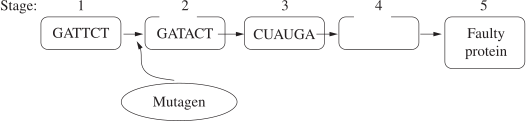
 

  1. Outline the series of events from stages 2 to 4 that resulted in the faulty protein.   (3 marks)

    --- 5 WORK AREA LINES (style=lined) ---

  2. Describe how a type of mutagen may have caused the changes observed in stage 2.   (2 marks)

    --- 5 WORK AREA LINES (style=lined) ---

  3. Given the information in the chart shown, describe the effect caused by the mutation in stage 4 and the effect this would have on the organism.   (3 marks)


    --- 6 WORK AREA LINES (style=lined) ---

Show Answers Only

a.    Events causing faulty protein:

  • Stage 2: A mutagen causes a point mutation in the DNA.
  • Stage 3: The mutated DNA transcription into mRNA.
  • Stage 4: The translation of the mRNA into a polypeptide chain which is not functional due to the mutation.

b.    Possible causes of Stage 2 observed changes:

  • High frequency photons including gamma and X-rays are regarded as ionising radiation due to their extremely high energy.
  • They can interfere with DNA undergoing replication causing misalignment and a possible substation change.
  • High energy gamma radiation may also cause mutation when directly striking a nitrogenous base.  

Answers could also include

  • Chemical mutagens (alkylating, delaminating and structurally similar chemicals).
  • Carcinogenic metals/elements (radon, cadmium)

c.   Effects of Stage 4 mutation:

  • When considering the above sequence as 2 codons, the chart shows us that this mutation results in an arginine amino becoming a stop codon.
  • This mutation will hence cause a premature termination of the polypeptide and result in a non-functional polypeptide/protein it forms a part of.
  • Due to the severity of this type of mutation it usually results in extensive health complications for affected individuals.
Show Worked Solution

a.    Events causing faulty protein:

  • Stage 2: A mutagen causes a point mutation in the DNA.
  • Stage 3: The mutated DNA transcription into mRNA.
  • Stage 4: The translation of the mRNA into a polypeptide chain which is not functional due to the mutation.

b.    Possible causes of Stage 2 observed changes:

  • High frequency photons including gamma and X-rays are regarded as ionising radiation due to their extremely high energy.
  • They can interfere with DNA undergoing replication causing misalignment and a possible substation change.
  • High energy gamma radiation may also cause mutation when directly striking a nitrogenous base.  

Answers could also include

  • Chemical mutagens (alkylating, delaminating and structurally similar chemicals).
  • Carcinogenic metals/elements (radon, cadmium)

c.   Effects of Stage 4 mutation:

  • When considering the above sequence as 2 codons, the chart shows us that this mutation results in an arginine amino becoming a stop codon.
  • This mutation will hence cause a premature termination of the polypeptide and result in a non-functional polypeptide/protein it forms a part of.
  • Due to the severity of this type of mutation it usually results in extensive health complications for affected individuals.

Filed Under: Mutation Tagged With: Band 3, Band 4, Band 5, smc-3652-30-Point Mutations, smc-3652-60-Mutagens

BIOLOGY, M6 EQ-Bank 7 MC

The following events occur after DNA is subjected to radiation. The events are listed in no specific order.

1:  Mutation
2: Change in cell activity
3: Change in protein structure
4: Change in polypeptide sequence

What is the correct sequence of steps?

  1. 1, 2, 3, 4
  2. 4, 2, 1, 3
  3. 4, 3, 2, 1
  4. 1, 4, 3, 2
Show Answers Only

`D`

Show Worked Solution

`=>D`

Filed Under: Mutation Tagged With: Band 4, smc-3652-30-Point Mutations, smc-3652-60-Mutagens

BIOLOGY, M6 2014 HSC 1 MC

Exposure to radiation such as X-rays may change the sequence of bases in DNA.

What is this called?

  1. Mutation
  2. Translation
  3. Replication
  4. Transcription
Show Answers Only

`A`

Show Worked Solution
  • Any permanent change to the DNA sequence is referred to as a mutation.

`=>A`

Filed Under: Mutation Tagged With: Band 2, smc-3652-60-Mutagens

BIOLOGY, M6 2021 HSC 15 MC

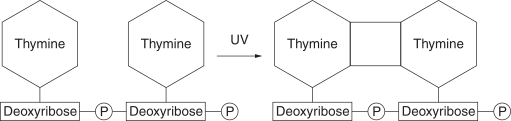
An example of the mutagenic effect of ultraviolet radiation (UV) on DNA is shown in the diagram.
 

What is the mutagenic effect that is modelled?

  1. Thymine is duplicated.
  2. Bonds are formed between adjacent bases.
  3. Nucleotides form bonds in the backbone of DNA.
  4. Thymines on the two strands of DNA form bonds.
Show Answers Only

`B`

Show Worked Solution
  • The diagram shows bonds that have formed between adjacent thymine bases on a single strand of DNA.

`=>B`

Mean mark 56%.

Filed Under: Mutation Tagged With: Band 4, smc-3652-60-Mutagens

Copyright © 2014–2025 SmarterEd.com.au · Log in