SmarterEd

Aussie Maths & Science Teachers: Save your time with SmarterEd

  • Login
  • Get Help
  • About

BIOLOGY, M3 2021 VCE 6

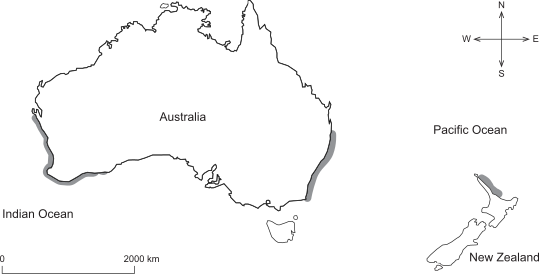
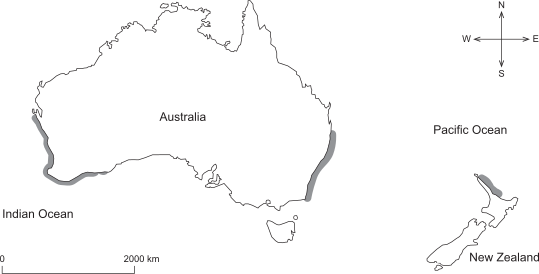
Many species of octopus can be found in the oceans surrounding Australia and New Zealand. Populations of octopus can be found on both the east and west coasts of Australia and on the north coast of New Zealand. The distribution of the populations is shown shaded on the map below.
 

  1. Scientists investigated whether the octopus populations on Australia's east coast are a separate species from the populations on the west coast. After analysing both molecular and morphological results, the scientists concluded that all populations share a distant common ancestor. They also concluded that the populations of octopus on the east coast of Australia are a distinct species from the populations of octopus on the west coast of Australia.

    Describe the process that may have led to the formation of the two distinct species of octopus from the distant common ancestor.   (4 marks)

    --- 8 WORK AREA LINES (style=lined) ---

  1. The scientists also compared the populations of east Australian octopus with the populations of the New Zealand octopus. No significant genetic differences between these populations of the New Zealand octopus and east Australian octopus were found. It is known that young octopi can be carried long distances by water currents. Occasionally, adult octopi have been seen on pieces of floating wood.
  2. Give two reasons that may explain the lack of genetic diversity between the populations.   (2 marks)

    --- 5 WORK AREA LINES (style=lined) ---
Show Answers Only

a.    Geographical separation creates unique environmental selection pressures.

  • Random mutations that change the phenotype of an individual may then be beneficial and provide a survival advantage in their respective environment.
  • By Natural Selection, this survival advantage allows these beneficial traits to be preserved and carried through generations.
  • Over many generations this process produced two different octopus species on the east and west coast. 

b.     Answers can include any two of the following:

  • The populations could share a recent common ancestor which does not leave enough time to develop two seperate species.
  • The relatively close proximity (≈ 3000 km) may have led to very similar selection pressures in the two regions, thus leading to both communities developing similar characteristics.
  • The ability of octopi to travel long distances on wood or in the water currents may have led to interbreeding, causing gene flow between the populations.
Show Worked Solution

a.    Geographical separation creates unique environmental selection pressures.

  • Random mutations that change the phenotype of an individual may then be beneficial and provide a survival advantage in their respective environment.
  • By Natural Selection, this survival advantage allows these beneficial traits to be preserved and carried through generations.
  • Over many generations this process produced two different octopus species on the east and west coast. 

b.     Answers can include any two of the following:

  • The populations could share a recent common ancestor which does not leave enough time to develop two seperate species.
  • The relatively close proximity (≈ 3000 km) may have led to very similar selection pressures in the two regions, thus leading to both communities developing similar characteristics.
  • The ability of octopi to travel long distances on wood or in the water currents may have led to interbreeding, causing gene flow between the populations.

Filed Under: Natural Selection Tagged With: Band 5, smc-3653-10-Biodiversity

BIOLOGY, M6 2023 HSC 34

Cattle have been domesticated by humans for approximately 10 000 years. Many biotechnologies have been employed in the farming of cattle.

The table shows examples of the application of these biotechnologies.

\begin{array} {|l|l|}
\hline
\rule{0pt}{2.5ex} \textbf{Biotechnology} \rule[-1ex]{0pt}{0pt} & \textbf{Example} \\
\hline
\rule{0pt}{2.5ex} \text{Selective breeding} & \text{The offspring of highest milk producing female cows were} \\
\text{} & \text{retained and over time cows that produced more milk were bred,} \\
\text{} \rule[-1ex]{0pt}{0pt} & \text{leading to dairy breeds.} \\
\hline
\rule{0pt}{2.5ex} \text{Artificial} & \text{An American bull holds the current record for artificial} \\
\text{insemination} & \text{insemination. He produced 2.4 million units of semen and has} \\
\text{} \rule[-1ex]{0pt}{0pt} & \text{sired cattle in 50 countries.} \\
\hline
\rule{0pt}{2.5ex} \text{Whole organism} & \text{The success rate of cloning cattle is low. There are currently 30-40} \\
\text{cloning} \rule[-1ex]{0pt}{0pt} & \text{cloned cattle in Australia. They are not used commercially.} \\
\hline
\rule{0pt}{2.5ex} \text{Hybridisation } & \text{There are two species of domestic cattle, Bos taurus and Bos} \\
\text{} & \text{indicus. They can be hybridised to breed cattle with} \\
\text{} \rule[-1ex]{0pt}{0pt} & \text{characteristics of both species.} \\
\hline
\rule{0pt}{2.5ex} \text{Transgenic} & \text{The first transgenic cow produced human serum albumin in its} \\
\text{organisms} \rule[-1ex]{0pt}{0pt}& \text{milk. The use of transgenic cattle is not widespread.} \\
\hline
\end{array}

With reference to the table, evaluate the effect of biotechnologies on the biodiversity of cattle.  (5 marks)

Show Answers Only

  • Biotechnologies can increase, decrease or maintain the size of the gene pool in populations and species, particularly in the case of cattle which have been subject to a range of biotechnologies.
  • Selective breeding, which decreases biodiversity, has been used for hundreds of years by farmers who oversee the reproduction of cattle with favourable characteristics, such as females who produce the most milk.
  • Artificial insemination, which typically reduces biodiversity, allows a single bull to sire many offspring. This process breeds out certain characteristics of cattle, reducing the diversity of the species. However, in certain circumstances, the gene pool of specific communities can be diversified through the introduction of new alleles.
  • Whole cattle cloning reduces biodiversity by making cloned organisms that are identical genotypes to the parent. As the success rate is low and cloned animals are infertile, this does not have the potential to have a large impact on biodiversity.
  • Hybridisation generally increases biodiversity by naturally mating two different cattle species and in the process, introducing genes not originally present. 
  • Hybridisation can however also reduce biodiversity if cattle hybrids are then selectively bred in preference to the original breeds.
  • Transgenic organisms are produced where new alleles are artificially introduced into the species, increasing biodiversity. As this process is expensive and not widespread, it will not have a large effect on biodiversity.
  • In summary, the most wide spread and influential biotechnologies have the overall effect of decreasing the biodiversity of cattle.

Show Worked Solution

  • Biotechnologies can increase, decrease or maintain the size of the gene pool in populations and species, particularly in the case of cattle which have been subject to a range of biotechnologies.
  • Selective breeding, which decreases biodiversity, has been used for hundreds of years by farmers who oversee the reproduction of cattle with favourable characteristics, such as females who produce the most milk.
  • Artificial insemination, which typically reduces biodiversity, allows a single bull to sire many offspring. This process breeds out certain characteristics of cattle, reducing the diversity of the species. However, in certain circumstances, the gene pool of specific communities can be diversified through the introduction of new alleles.
  • Whole cattle cloning reduces biodiversity by making cloned organisms that are identical genotypes to the parent. As the success rate is low and cloned animals are infertile, this does not have the potential to have a large impact on biodiversity.
  • Hybridisation generally increases biodiversity by naturally mating two different cattle species and in the process, introducing genes not originally present. 
  • Hybridisation can however also reduce biodiversity if cattle hybrids are then selectively bred in preference to the original breeds.
  • Transgenic organisms are produced where new alleles are artificially introduced into the species, increasing biodiversity. As this process is expensive and not widespread, it will not have a large effect on biodiversity.
  • In summary, the most wide spread and influential biotechnologies have the overall effect of decreasing the biodiversity of cattle.

Filed Under: Biotechnology, Genetic Technologies Tagged With: Band 4, Band 5, smc-3653-10-Biodiversity, smc-3653-20-Evaluating Genetic Technology, smc-3654-05-Transgenic Organisms, smc-3654-20-Agriculture, smc-3654-51-Reproductive Technologies, smc-3654-70-Whole Organism Cloning

BIOLOGY, M6 2016 HSC 18 MC

How does the production of a new transgenic species have the potential to alter the path of evolution?

  1. The creation of new genes increases biodiversity.
  2. The removal of genes from a species decreases biodiversity.
  3. The transfer of genes within a species increases biodiversity.
  4. The transfer of genes between two species increases biodiversity.
Show Answers Only

`D`

Show Worked Solution
  • A new transgenic species arises through the transfer of genes between species.

`=>D`

Filed Under: Biotechnology Tagged With: Band 4, smc-3653-10-Biodiversity, smc-3653-20-Evaluating Genetic Technology

BIOLOGY, M6 2015 HSC 29

'The application of modern reproductive techniques in plant and animal breeding limits genetic diversity.'

Discuss this statement.   (6 marks)

--- 12 WORK AREA LINES (style=lined) ---

Show Answers Only
  • Artificial pollination occurs when humans perform the natural pollination process and transfer the pollen manually to the stigma of one plant from the anther of another.
  • Artificial insemination is the manual transfer of collected semen into the female reproductive system of animals and humans.
  • Both methods can result in an increase in the number of offspring that can be produced by one parent.
  • Whilst the increase in offspring produced may be beneficial, there is also the added risk of reducing the genetic diversity in future populations as one parent can produce many more offspring.
  • On the other hand where species are endangered, or natural processes are interrupted (for example declining bee populations), the techniques provide an opportunity for numbers to stabilise or even increase in subsequent generations.
  • Another advantage is that the process allows for banks of sperm and pollen to be established that can be accessed by other countries, thus creating genetic diversity, by enabling endangered species to survive across continents.
Show Worked Solution
  • Artificial pollination occurs when humans perform the natural pollination process and transfer the pollen manually to the stigma of one plant from the anther of another.
  • Artificial insemination is the manual transfer of collected semen into the female reproductive system of animals and humans.
  • Both methods can result in an increase in the number of offspring that can be produced by one parent.
  • Whilst the increase in offspring produced may be beneficial, there is also the added risk of reducing the genetic diversity in future populations as one parent can produce many more offspring.
  • On the other hand where species are endangered, or natural processes are interrupted (for example declining bee populations), the techniques provide an opportunity for numbers to stabilise or even increase in subsequent generations.
  • Another advantage is that the process allows for banks of sperm and pollen to be established that can be accessed by other countries, thus creating genetic diversity, by enabling endangered species to survive across continents.

♦ Mean mark 49%.

Filed Under: Biotechnology Tagged With: Band 5, smc-3653-10-Biodiversity, smc-3653-20-Evaluating Genetic Technology

BIOLOGY, M6 2019 HSC 24

Explain the loss of biodiversity that may result from TWO biotechnologies used in agriculture.   (5 marks)

Show Answers Only
  • Biodiversity can refer to both the diversity of species within an ecosystem, but also the variety of genomes and allele frequencies present within a species.
  • Biotechnologies used in agriculture may reduce biodiversity on both scales.
  • Artificial insemination involves the process of manually injecting sperm of favoured genetic traits into females of favoured genetic traits to have a greater chance of producing offspring of a desired type.
  • The repeated use of this process will result in all offspring becoming genetically similar, reducing the diversity within the species.
  • Artificial insemination has an equivalent process in plants which can result in the loss of genetic diversity in a similar way.
  • Transgenic organisms are those whose genomes have been modified by having a gene from another species inserted into it.
  • The mass use of this process will produce genetically advanced animals or crops which out-compete wild and native types, reducing the biodiversity of its species.
  • The use of transgenic organisms such as Bt cotton has also resulted in the reduction of its main pest, Bollworm. While a pest to the crop and the farmers, Bt cotton has resulted in the reduction of Bollworm in areas where it is prominent, reducing the diversity of the ecosystem it resides in. 

Other answers could include

  • Selective breeding.
  • Cloning (both gene and whole organism).
Show Worked Solution
  • Biodiversity can refer to both the diversity of species within an ecosystem, but also the variety of genomes and allele frequencies present within a species.
  • Biotechnologies used in agriculture may reduce biodiversity on both scales.
  • Artificial insemination involves the process of manually injecting sperm of favoured genetic traits into females of favoured genetic traits to have a greater chance of producing offspring of a desired type.
  • The repeated use of this process will result in all offspring becoming genetically similar, reducing the diversity within the species.
  • Artificial insemination has an equivalent process in plants which can result in the loss of genetic diversity in a similar way.
  • Transgenic organisms are those whose genomes have been modified by having a gene from another species inserted into it.
  • The mass use of this process will produce genetically advanced animals or crops which out-compete wild and native types, reducing the biodiversity of its species.
  • The use of transgenic organisms such as Bt cotton has also resulted in the reduction of its main pest, Bollworm. While a pest to the crop and the farmers, Bt cotton has resulted in the reduction of Bollworm in areas where it is prominent, reducing the diversity of the ecosystem it resides in. 

Other answers could include

  • Selective breeding.
  • Cloning (both gene and whole organism).

Mean mark 54%.

Filed Under: Biotechnology, Genetic Technologies Tagged With: Band 4, smc-3653-10-Biodiversity, smc-3653-20-Evaluating Genetic Technology, smc-3654-10-Genetic Diversity, smc-3654-20-Agriculture

BIOLOGY, M6 2021 HSC 33c

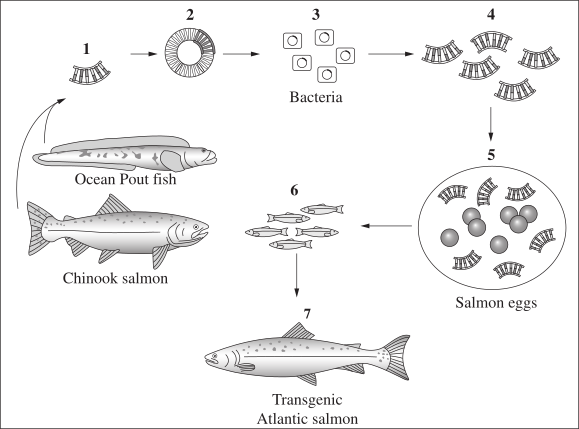
Genetically engineered Atlantic salmon have been produced and approved for aquaculture in the US. These salmon have a transgene that includes a protein-coding sequence from a Chinook salmon's growth hormone gene and the promoter region of an Ocean Pout's antifreeze protein gene. The following diagram provides an overview of the production of the transgenic salmon.
 

Transgenic fish can reproduce and pass on the dominant transgene (T).

Reproduction for aquaculture is strictly controlled using a variety of techniques in order to protect and preserve biodiversity.

Some of these techniques are outlined below. 

1. Homozygous (TT) female (XX) breeding stock are kept in quarantine.

2. The female fish undergo hormone treatment that results in sex reversal and the development of male sex organs and sperm.

3. The sperm produced is collected and used to fertilise eggs obtained from wild-type, non-transgenic salmon.

4. The eggs are treated with pressure shock to prevent the completion of meiosis II. As a result, offspring are triploid (three copies of each chromosome).

All offspring are transgenic female fish and have XXX (XXX fish cannot develop sex organs).

5. Offspring are transported to inland aquaculture tanks to be grown to market size.

Analyse how these techniques protect and preserve biodiversity.   (9 marks)

--- 21 WORK AREA LINES (style=lined) ---

Show Answers Only

Protecting and Preserving Biodiversity:

  • Biodiversity refers to the variety of genes within the gene pool of a species as well as the variety of species within an ecosystem.
  • The nature of the transgenic salmon carries the risk of reducing biodiversity and has the potential to do great harm.
  • If transgenic salmon escape captivity, they may have a survival advantage over natural salmon and other species. In this way, they could outcompete other species and reduce species diversity, as well as outcompete natural salmon.
  • As a result of the transgene being dominant, it will be passed onto offspring, and in time reduce the gene pool.
  • The physical separation techniques 1 and 5 prevent the transgenic salmon from being released into the environment, preserving biodiversity.
  • Reproductive techniques such as the hormone treatment in technique 2 allow sperm to be produced that only carries the X chromosome as the parents are genetically female.
  • This sperm is then used to fertilise from wild-type salmon, and all offspring will be female as sperm does not contain a Y chromosome, and contain the transgene.
  • Technique 4 uses pressure shock to prevent meiosis 2, resulting in infertile, triploid offspring. This produces transgenic salmon incapable of breeding, meaning the transgene cannot be passed on, preserving biodiversity within the gene pool.
  • The use of wild-type salmon eggs to produce transgenic fish is also crucial in preserving biodiversity as it reduces the likelihood of the accumulation of mutations via interbreeding of transgenic salmon.
  • The physical separation techniques of quarantine and inland aquaculture tanks coupled with reproductive techniques are essential biotechnologies to protect and preserve biodiversity from the dangers of transgenic salmon to the ecosystem and gene pool.
Show Worked Solution

Protecting and Preserving Biodiversity:

  • Biodiversity refers to the variety of genes within the gene pool of a species as well as the variety of species within an ecosystem.
  • The nature of the transgenic salmon carries the risk of reducing biodiversity and has the potential to do great harm.
  • If transgenic salmon escape captivity, they may have a survival advantage over natural salmon and other species. In this way, they could outcompete other species and reduce species diversity, as well as outcompete natural salmon.
  • As a result of the transgene being dominant, it will be passed onto offspring, and in time reduce the gene pool.
  • The physical separation techniques 1 and 5 prevent the transgenic salmon from being released into the environment, preserving biodiversity.
  • Reproductive techniques such as the hormone treatment in technique 2 allow sperm to be produced that only carries the X chromosome as the parents are genetically female.
  • This sperm is then used to fertilise from wild-type salmon, and all offspring will be female as sperm does not contain a Y chromosome, and contain the transgene.
  • Technique 4 uses pressure shock to prevent meiosis 2, resulting in infertile, triploid offspring. This produces transgenic salmon incapable of breeding, meaning the transgene cannot be passed on, preserving biodiversity within the gene pool.
  • The use of wild-type salmon eggs to produce transgenic fish is also crucial in preserving biodiversity as it reduces the likelihood of the accumulation of mutations via interbreeding of transgenic salmon.
  • The physical separation techniques of quarantine and inland aquaculture tanks coupled with reproductive techniques are essential biotechnologies to protect and preserve biodiversity from the dangers of transgenic salmon to the ecosystem and gene pool.
♦ Mean mark 44%.

Filed Under: Biotechnology Tagged With: Band 5, Band 6, smc-3653-10-Biodiversity

Copyright © 2014–2025 SmarterEd.com.au · Log in