The diagram shows a process that was used to make multiple clones in sheep.
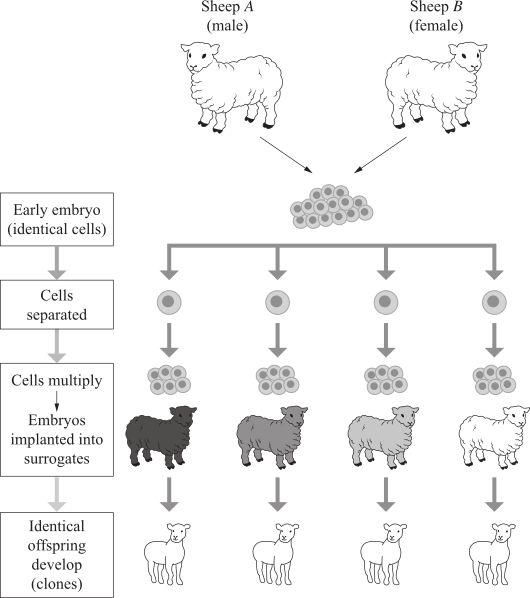
The identical offspring are clones of
- each other.
- only sheep B.
- the surrogates.
- both sheep A and sheep B.
Aussie Maths & Science Teachers: Save your time with SmarterEd
The diagram shows a process that was used to make multiple clones in sheep.
The identical offspring are clones of
One-Eyed Jack was a rescue dog that had been injured and lost an eye before his owner adopted him. One-Eyed Jack was cloned and the clone was born with two eyes. --- 4 WORK AREA LINES (style=lined) --- Describe how animals like dogs can be cloned. (4 marks) --- 8 WORK AREA LINES (style=lined) ---
Cattle have been domesticated by humans for approximately 10 000 years. Many biotechnologies have been employed in the farming of cattle. The table shows examples of the application of these biotechnologies. \begin{array} {|l|l|} With reference to the table, evaluate the effect of biotechnologies on the biodiversity of cattle. (5 marks)
\hline
\rule{0pt}{2.5ex} \textbf{Biotechnology} \rule[-1ex]{0pt}{0pt} & \textbf{Example} \\
\hline
\rule{0pt}{2.5ex} \text{Selective breeding} & \text{The offspring of highest milk producing female cows were} \\
\text{} & \text{retained and over time cows that produced more milk were bred,} \\
\text{} \rule[-1ex]{0pt}{0pt} & \text{leading to dairy breeds.} \\
\hline
\rule{0pt}{2.5ex} \text{Artificial} & \text{An American bull holds the current record for artificial} \\
\text{insemination} & \text{insemination. He produced 2.4 million units of semen and has} \\
\text{} \rule[-1ex]{0pt}{0pt} & \text{sired cattle in 50 countries.} \\
\hline
\rule{0pt}{2.5ex} \text{Whole organism} & \text{The success rate of cloning cattle is low. There are currently 30-40} \\
\text{cloning} \rule[-1ex]{0pt}{0pt} & \text{cloned cattle in Australia. They are not used commercially.} \\
\hline
\rule{0pt}{2.5ex} \text{Hybridisation } & \text{There are two species of domestic cattle, Bos taurus and Bos} \\
\text{} & \text{indicus. They can be hybridised to breed cattle with} \\
\text{} \rule[-1ex]{0pt}{0pt} & \text{characteristics of both species.} \\
\hline
\rule{0pt}{2.5ex} \text{Transgenic} & \text{The first transgenic cow produced human serum albumin in its} \\
\text{organisms} \rule[-1ex]{0pt}{0pt}& \text{milk. The use of transgenic cattle is not widespread.} \\
\hline
\end{array}
Scientists have tried to achieve a viable embryo by fusing two ova (eggs) from the same female.
Explain whether the offspring produced using this process would be a clone of the female whose two ova were used. Use your knowledge of gamete formation and sexual reproduction to support your answer. (5 marks)
--- 10 WORK AREA LINES (style=lined) ---
Both artificial insemination and cloning are reproductive techniques that can decrease the genetic diversity of a population.
Which row of the table provides a correct reason for each technique's contribution to this decrease?
\begin{align*}
\begin{array}{l}
\rule{0pt}{2.5ex} \ \rule[-1ex]{0pt}{0pt}& \\
\rule{0pt}{2.5ex}\textbf{A.}\rule[-1ex]{0pt}{0pt}\\
\rule{0pt}{2.5ex}\textbf{B.}\rule[-1ex]{0pt}{0pt}\\
\rule{0pt}{2.5ex}\textbf{C.}\rule[-1ex]{0pt}{0pt}\\
\rule{0pt}{2.5ex}\textbf{D.}\rule[-1ex]{0pt}{0pt}\\
\end{array}
\begin{array}{|l|l|}
\hline
\rule{0pt}{2.5ex}\quad \quad \textit{Artificial insemination }\rule[-1ex]{0pt}{0pt}& \quad \quad \quad \quad \quad \quad \quad \ \ \ \textit{Cloning} \\
\hline
\rule{0pt}{2.5ex}\text{Random fertilisation takes place}\rule[-1ex]{0pt}{0pt}&\text{Large numbers of individuals are produced}\\
\hline
\rule{0pt}{2.5ex}\text{One male has many offspring}\rule[-1ex]{0pt}{0pt}& \text{All gametes are genetically identical}\\
\hline
\rule{0pt}{2.5ex}\text{All male gametes are identical}\rule[-1ex]{0pt}{0pt}& \text{All individuals have the same phenotype} \\
\hline
\rule{0pt}{2.5ex}\text{Fewer males are used to reproduce}\rule[-1ex]{0pt}{0pt}& \text{All individuals have the same genotype} \\
\hline
\end{array}
\end{align*}
Animal cloning involves inserting the nucleus from a somatic cell of one animal into the
What is the purpose of cloning in agriculture?