SmarterEd

Aussie Maths & Science Teachers: Save your time with SmarterEd

  • Login
  • Get Help
  • About

BIOLOGY, M6 2024 HSC 25

  1. One-Eyed Jack was a rescue dog that had been injured and lost an eye before his owner adopted him. One-Eyed Jack was cloned and the clone was born with two eyes.

  2. Explain why the cloned dog was born with two eyes.   (2 marks)

    --- 4 WORK AREA LINES (style=lined) ---

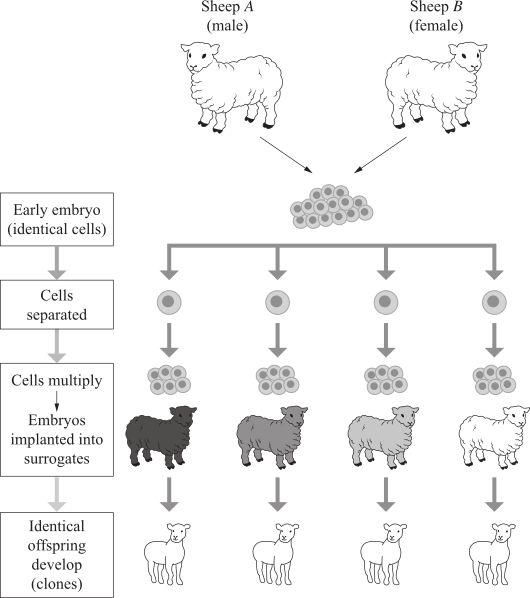
  3. Describe how animals like dogs can be cloned.   (4 marks)

    --- 8 WORK AREA LINES (style=lined) ---

Show Answers Only

a.   Reason(s) the cloned dog had two eyes:

  • The DNA used for cloning came from One-Eyed Jack’s somatic (body) cells which contained the complete genetic code for normal eye development.
  • The physical injury that caused Jack to lose his eye did not alter his genes, so it wasn’t passed on to the clone. 

b.   Animal cloning process:

  • The cloning process begins by removing the nucleus from a host egg cell.
  • This is replaced with the nucleus from a body cell of the animal to be cloned.
  • This produces a zygote.
  • After electrical stimulation causes the reconstructed cell to begin dividing, it is implanted into a surrogate mother’s uterus.
  • It then develops into a cloned offspring.

Show Worked Solution

a.   Reason(s) the cloned dog had two eyes:

  • The DNA used for cloning came from One-Eyed Jack’s somatic (body) cells which contained the complete genetic code for normal eye development.
  • The physical injury that caused Jack to lose his eye did not alter his genes, so it wasn’t passed on to the clone.  

b.   Animal cloning process:

  • The cloning process begins by removing the nucleus from a host egg cell.
  • This is replaced with the nucleus from a body cell of the animal to be cloned.
  • This produces a zygote.
  • After electrical stimulation causes the reconstructed cell to begin dividing, it is implanted into a surrogate mother’s uterus.
  • It then develops into a cloned offspring.
♦ Mean mark (b) 52%.

Filed Under: Biotechnology, Genetic Technologies Tagged With: Band 3, Band 4, smc-3653-20-Evaluating Genetic Technology, smc-3654-70-Whole Organism Cloning

BIOLOGY, M6 2023 HSC 34

Cattle have been domesticated by humans for approximately 10 000 years. Many biotechnologies have been employed in the farming of cattle.

The table shows examples of the application of these biotechnologies.

\begin{array} {|l|l|}
\hline
\rule{0pt}{2.5ex} \textbf{Biotechnology} \rule[-1ex]{0pt}{0pt} & \textbf{Example} \\
\hline
\rule{0pt}{2.5ex} \text{Selective breeding} & \text{The offspring of highest milk producing female cows were} \\
\text{} & \text{retained and over time cows that produced more milk were bred,} \\
\text{} \rule[-1ex]{0pt}{0pt} & \text{leading to dairy breeds.} \\
\hline
\rule{0pt}{2.5ex} \text{Artificial} & \text{An American bull holds the current record for artificial} \\
\text{insemination} & \text{insemination. He produced 2.4 million units of semen and has} \\
\text{} \rule[-1ex]{0pt}{0pt} & \text{sired cattle in 50 countries.} \\
\hline
\rule{0pt}{2.5ex} \text{Whole organism} & \text{The success rate of cloning cattle is low. There are currently 30-40} \\
\text{cloning} \rule[-1ex]{0pt}{0pt} & \text{cloned cattle in Australia. They are not used commercially.} \\
\hline
\rule{0pt}{2.5ex} \text{Hybridisation } & \text{There are two species of domestic cattle, Bos taurus and Bos} \\
\text{} & \text{indicus. They can be hybridised to breed cattle with} \\
\text{} \rule[-1ex]{0pt}{0pt} & \text{characteristics of both species.} \\
\hline
\rule{0pt}{2.5ex} \text{Transgenic} & \text{The first transgenic cow produced human serum albumin in its} \\
\text{organisms} \rule[-1ex]{0pt}{0pt}& \text{milk. The use of transgenic cattle is not widespread.} \\
\hline
\end{array}

With reference to the table, evaluate the effect of biotechnologies on the biodiversity of cattle.  (5 marks)

Show Answers Only

  • Biotechnologies can increase, decrease or maintain the size of the gene pool in populations and species, particularly in the case of cattle which have been subject to a range of biotechnologies.
  • Selective breeding, which decreases biodiversity, has been used for hundreds of years by farmers who oversee the reproduction of cattle with favourable characteristics, such as females who produce the most milk.
  • Artificial insemination, which typically reduces biodiversity, allows a single bull to sire many offspring. This process breeds out certain characteristics of cattle, reducing the diversity of the species. However, in certain circumstances, the gene pool of specific communities can be diversified through the introduction of new alleles.
  • Whole cattle cloning reduces biodiversity by making cloned organisms that are identical genotypes to the parent. As the success rate is low and cloned animals are infertile, this does not have the potential to have a large impact on biodiversity.
  • Hybridisation generally increases biodiversity by naturally mating two different cattle species and in the process, introducing genes not originally present. 
  • Hybridisation can however also reduce biodiversity if cattle hybrids are then selectively bred in preference to the original breeds.
  • Transgenic organisms are produced where new alleles are artificially introduced into the species, increasing biodiversity. As this process is expensive and not widespread, it will not have a large effect on biodiversity.
  • In summary, the most wide spread and influential biotechnologies have the overall effect of decreasing the biodiversity of cattle.

Show Worked Solution

  • Biotechnologies can increase, decrease or maintain the size of the gene pool in populations and species, particularly in the case of cattle which have been subject to a range of biotechnologies.
  • Selective breeding, which decreases biodiversity, has been used for hundreds of years by farmers who oversee the reproduction of cattle with favourable characteristics, such as females who produce the most milk.
  • Artificial insemination, which typically reduces biodiversity, allows a single bull to sire many offspring. This process breeds out certain characteristics of cattle, reducing the diversity of the species. However, in certain circumstances, the gene pool of specific communities can be diversified through the introduction of new alleles.
  • Whole cattle cloning reduces biodiversity by making cloned organisms that are identical genotypes to the parent. As the success rate is low and cloned animals are infertile, this does not have the potential to have a large impact on biodiversity.
  • Hybridisation generally increases biodiversity by naturally mating two different cattle species and in the process, introducing genes not originally present. 
  • Hybridisation can however also reduce biodiversity if cattle hybrids are then selectively bred in preference to the original breeds.
  • Transgenic organisms are produced where new alleles are artificially introduced into the species, increasing biodiversity. As this process is expensive and not widespread, it will not have a large effect on biodiversity.
  • In summary, the most wide spread and influential biotechnologies have the overall effect of decreasing the biodiversity of cattle.

Filed Under: Biotechnology, Genetic Technologies Tagged With: Band 4, Band 5, smc-3653-10-Biodiversity, smc-3653-20-Evaluating Genetic Technology, smc-3654-05-Transgenic Organisms, smc-3654-20-Agriculture, smc-3654-51-Reproductive Technologies, smc-3654-70-Whole Organism Cloning

BIOLOGY, M6 2014 HSC 29

Scientists have tried to achieve a viable embryo by fusing two ova (eggs) from the same female.

Explain whether the offspring produced using this process would be a clone of the female whose two ova were used. Use your knowledge of gamete formation and sexual reproduction to support your answer.   (5 marks)

--- 10 WORK AREA LINES (style=lined) ---

Show Answers Only
  • Despite coming from the same female, meiosis and processes within it cause the genetic material within each ova to be different, and thus the offspring will not be a clone.
  • During meiosis, a germ line cell will replicate, split, then split again, resulting in 4 genetically unique daughter gametes.
  • The processes of independent assortment, the random splitting of each chromosome during each stage, as well as crossing over, where like segments of homologous chromosomes can be exchanged creating new combinations, also contribute to the variability amongst daughter cells.
  • When two of these ova (gametes) are fused, the genetic material of each are contributed to the offspring, with some genes being expressed or suppressed depending on the combinations of alleles from each. In this way, the offspring will be genetically different from the female rather than a clone.
Show Worked Solution
  • Despite coming from the same female, meiosis and processes within it cause the genetic material within each ova to be different, and thus the offspring will not be a clone.
  • During meiosis, a germ line cell will replicate, split, then split again, resulting in 4 genetically unique daughter gametes.
  • The processes of independent assortment, the random splitting of each chromosome during each stage, as well as crossing over, where like segments of homologous chromosomes can be exchanged creating new combinations, also contribute to the variability amongst daughter cells.
  • When two of these ova (gametes) are fused, the genetic material of each are contributed to the offspring, with some genes being expressed or suppressed depending on the combinations of alleles from each. In this way, the offspring will be genetically different from the female rather than a clone.

♦♦ Mean mark 36%.

Filed Under: Genetic Technologies Tagged With: Band 5, smc-3654-70-Whole Organism Cloning

BIOLOGY, M7 2016 HSC 15 MC

Both artificial insemination and cloning are reproductive techniques that can decrease the genetic diversity of a population.

Which row of the table provides a correct reason for each technique's contribution to this decrease?

\begin{align*}
\begin{array}{l}
\rule{0pt}{2.5ex} \ \rule[-1ex]{0pt}{0pt}& \\
\rule{0pt}{2.5ex}\textbf{A.}\rule[-1ex]{0pt}{0pt}\\
\rule{0pt}{2.5ex}\textbf{B.}\rule[-1ex]{0pt}{0pt}\\
\rule{0pt}{2.5ex}\textbf{C.}\rule[-1ex]{0pt}{0pt}\\
\rule{0pt}{2.5ex}\textbf{D.}\rule[-1ex]{0pt}{0pt}\\
\end{array}
\begin{array}{|l|l|}
\hline
\rule{0pt}{2.5ex}\quad \quad \textit{Artificial insemination }\rule[-1ex]{0pt}{0pt}& \quad \quad \quad \quad \quad \quad \quad \ \ \ \textit{Cloning} \\
\hline
\rule{0pt}{2.5ex}\text{Random fertilisation takes place}\rule[-1ex]{0pt}{0pt}&\text{Large numbers of individuals are produced}\\
\hline
\rule{0pt}{2.5ex}\text{One male has many offspring}\rule[-1ex]{0pt}{0pt}& \text{All gametes are genetically identical}\\
\hline
\rule{0pt}{2.5ex}\text{All male gametes are identical}\rule[-1ex]{0pt}{0pt}& \text{All individuals have the same phenotype} \\
\hline
\rule{0pt}{2.5ex}\text{Fewer males are used to reproduce}\rule[-1ex]{0pt}{0pt}& \text{All individuals have the same genotype} \\
\hline
\end{array}
\end{align*}

Show Answers Only

\(D\)

Show Worked Solution
  • Artificial insemination uses pollen with favoured characteristics to pollinate flowers. This means that very few males will be used for their pollen for this process.
  • In whole organism cloning, the offspring have the same genome as the parent.

\(\Rightarrow D\)


♦♦ Mean mark 37%.

Filed Under: Genetic Technologies Tagged With: Band 5, smc-3654-10-Genetic Diversity, smc-3654-51-Reproductive Technologies, smc-3654-70-Whole Organism Cloning

BIOLOGY, M6 2022 HSC 7 MC

Animal cloning involves inserting the nucleus from a somatic cell of one animal into the

  1. plasmid of a bacterium.
  2. uterus of a surrogate animal.
  3. fertilised egg from another animal.
  4. enucleated egg from another animal.
Show Answers Only

`D`

Show Worked Solution
  • The nucleus must be discarded from a donor egg so that the somatic cell’s nucleus can be inserted.

`=>D`

Filed Under: Genetic Technologies Tagged With: Band 4, smc-3654-70-Whole Organism Cloning

BIOLOGY, M6 2020 HSC 12 MC

What is the purpose of cloning in agriculture?

  1. Increasing the frequency of recessive traits
  2. Preserving favourable traits in the offspring
  3. Preserving genetic variability in a population
  4. Increasing combinations of alleles in a population
Show Answers Only

`B`

Show Worked Solution
  • Cloning is often used in agricultural practises within both flora and fauna to preserve favourable market characteristics, such as muscle size in cows.

`=>B`

Filed Under: Genetic Technologies Tagged With: Band 3, smc-3654-20-Agriculture, smc-3654-70-Whole Organism Cloning

Copyright © 2014–2025 SmarterEd.com.au · Log in