SmarterEd

Aussie Maths & Science Teachers: Save your time with SmarterEd

  • Login
  • Get Help
  • About

BIOLOGY, M6 2020 VCE 29 MC

A small sample of DNA was obtained from a fossil. Polymerase chain reaction (PCR) was used to amplify the amount of DNA obtained from the sample.

Which one of the following is a correct statement regarding the PCR process?

  1. DNA polymerase catalyses the pairing of primers with complementary nucleotides.
  2. RNA polymerase catalyses the additions of nucleotides to a DNA strand.
  3. Annealing and extension of the DNA occur at different temperatures.
  4. The number of copies of the DNA is quadrupled in each cycle.
Show Answers Only

\(C\)

Show Worked Solution

Features of the PCR process:

  • the annealing step, where the primers bind to the template DNA, occurs at a low temperature
  • the extension step, where DNA polymerase adds nucleotides to the growing DNA strand, occurs at a higher temperature.

\(\Rightarrow C\)

Filed Under: Genetic Technologies Tagged With: Band 3, smc-3654-80-Gene Cloning

BIOLOGY, M6 2021 VCE 30 MC

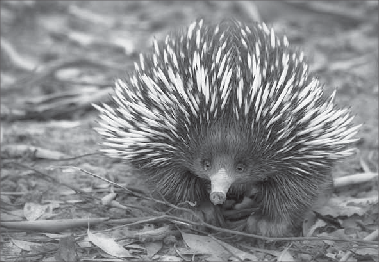
The short-beaked echidna can be found in Australia and New Guinea. 

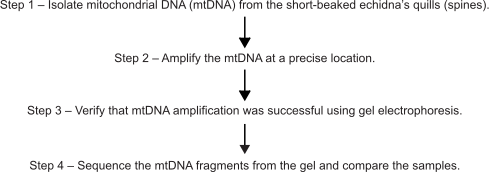
A university Biology student set out to compare DNA from four different short-beaked echidnas living in four different locations. The student aimed to determine the country of origin of each echidna. This was achieved using primers that amplified a 430 base pair (bp) sequence from the echidna's mitochondrial genome.

A flow chart of the steps taken by the student is shown below.
 

Which one of the following would be a requirement of either Step 1 or Step 2?

  1. Step 2 would require the use of a thermocycling machine to maintain the temperature at 37 °C.
  2. Step 1 would require the quill samples to have been stored at a very high temperature.
  3. Step 1 would require the extraction of DNA from the nuclei of quill epithelial cells.
  4. Step 2 would usually require a reaction mixture containing two primers.
Show Answers Only

\(D\)

Show Worked Solution
  • Polymerase chain reaction (PCR), step 2,  needs two primers for the amplification of DNA.
  • Step 1 is the isolation of mtDNA, which is not present in the nucleus. 

\(\Rightarrow D\)


♦ Mean mark 46%.
COMMENT: 31% of students chose option C.

Filed Under: Genetic Technologies Tagged With: Band 5, smc-3654-80-Gene Cloning

BIOLOGY, M6 2021 VCE 28 MC

Small amounts of DNA can be collected from items such as cigarette butts and hair follicles that are found at crime scenes. This DNA can be replicated for analysis and used as evidence in court cases.

Which of the following identifies the method of DNA replication and the enzyme used?

\begin{align*}
\begin{array}{l}
\rule{0pt}{2.5ex} \ \rule[-1ex]{0pt}{0pt}& \\
\rule{0pt}{2.5ex}\textbf{A.}\rule[-1ex]{0pt}{0pt}\\
\rule{0pt}{2.5ex}\textbf{B.}\rule[-1ex]{0pt}{0pt}\\
\rule{0pt}{2.5ex}\textbf{C.}\rule[-1ex]{0pt}{0pt}\\
\rule{0pt}{2.5ex}\textbf{D.}\rule[-1ex]{0pt}{0pt}\\
\end{array}
\begin{array}{|l|l|}
\hline
\rule{0pt}{2.5ex}\quad \quad \quad \quad \text{Method}\rule[-1ex]{0pt}{0pt}& \quad \ \ \  \text{Enzyme} \\
\hline
\rule{0pt}{2.5ex}\text{polymerase chain reaction}\rule[-1ex]{0pt}{0pt}&\textit{Taq}\ \text{polymerase}\\
\hline
\rule{0pt}{2.5ex}\text{DNA profiling}\rule[-1ex]{0pt}{0pt}& \text{DNA ligase}\\
\hline
\rule{0pt}{2.5ex}\text{polymerase chain reaction}\rule[-1ex]{0pt}{0pt} & \text{DNA ligase} \\
\hline
\rule{0pt}{2.5ex}\text{DNA profiling}\rule[-1ex]{0pt}{0pt}& \textit{Taq} \ \text{polymerase} \\
\hline
\end{array}
\end{align*}

Show Answers Only

\(A\)

Show Worked Solution
  • The method of DNA replication used to replicate small amounts of DNA collected from crime scenes is called Polymerase Chain Reaction (PCR).
  • The key enzyme involved in PCR is a thermostable DNA polymerase enzyme called Taq polymerase.

\(\Rightarrow A\)

Filed Under: Genetic Technologies Tagged With: Band 4, smc-3654-80-Gene Cloning

BIOLOGY, M6 2023 HSC 19 MC

The following are the five steps in the process of gene cloning.

  1. Selection of organisms containing recombinant DNA sequences
  2. Creation of recombinant DNA joined using DNA ligase
  3. Introduction of recombinant DNA into host organism
  4. Extraction and amplification of DNA to be cloned
  5. Choice of host organism and cloning vector

Which is the correct order for this process?

  1. 5, 2, 1, 3, 4
  2. 5, 4, 2, 3, 1
  3. 3, 2, 4, 5, 1
  4. 4, 5, 1, 2, 3
Show Answers Only

\(B\)

Show Worked Solution

By Elimination:

  • The choice of host organism and cloning vector (5) must come first (Eliminate C and D).
  • The extraction/amplification of the DNA segment of interest must come before the creation of the recombinant DNA (Eliminate A).

\(\Rightarrow B\)

Filed Under: Genetic Technologies Tagged With: Band 4, smc-3654-80-Gene Cloning

BIOLOGY, M6 2023 HSC 10 MC

The diagram shows a bacterial cell that will be used to produce a protein.
 

Which component would be inserted into gap \(X\) ?

  1. A cell
  2. A gene
  3. An amino acid
  4. A chromosome
Show Answers Only

\(B\)

Show Worked Solution
  • A gene will be inserted into the bacteria's DNA so that it can produce the associated protein of interest.

\(\Rightarrow B\)

Filed Under: Genetic Technologies Tagged With: Band 4, smc-3654-80-Gene Cloning

BIOLOGY, M6 EQ-Bank 26

Draw a flow chart showing the order of events that generates recombinant DNA.   (4 marks)

Show Answers Only

Show Worked Solution

Filed Under: Genetic Technologies Tagged With: Band 5, smc-3654-80-Gene Cloning, smc-3654-95-Draw flow chart

BIOLOGY, M6 2014 HSC 33e

The text below summarises some recent scientific experiments.

\begin{array} {|l|}
\hline
\ \ \rule{0pt}{4ex}  \text{Scientists, studying the development of human female embryos, recently }\\
\ \ \text{discovered a gene called XIST. This gene silences one of the two }\\
\ \ \text{X chromosomes so that they do not over-function in normal human females. }\\
\ \ \text{ }\\
\ \ \text{The scientists were then able to insert the XIST gene into human cells }\\
\ \ \text{grown in tissue culture to successfully silence other chromosomes. }\\
\ \ \text{ }\\
\ \ \text{Scientists are now attempting to insert the XIST gene into the extra }\\
\ \ \text{chromosome of mice that have trisomy. }\rule[-3ex]{0pt}{0pt}\\
\hline
\end{array}

With reference to genetics and gene technologies, explain these experiments and their implications.   (7 marks)

--- 15 WORK AREA LINES (style=lined) ---

Show Answers Only
  • The XIST gene is a gene which can ‘switch off’ whole chromosomes. This occurs naturally in females, where one X chromosome is shut off to prevent over-function.
  • With modern genetic technologies, this chromosome is able to be cut out of female embryos using restriction enzymes, then multiplied to produce adequate copies by PCR or recombinant DNA gene cloning in bacteria.
  • It is then able to silence any chromosome it is then inserted into.
  • This has potential to be a new form of gene therapy for people with conditions involving trisomy, where an individual is born with an extra chromosome.
  • This includes diseases such as Down syndrome (trisomy 21) and Klinefelter syndrome (XXY), which result in decreased quality of life, as well as shorter life span.
  • If successful, the XSIT gene will provide sufferers of these diseases with a normal phenotype by silencing one of their extra chromosomes.
  • This will facilitate a longer lifespan and a normal quality of life as if no abnormal gene was present for people with trisomy conditions, as well as being an effective gene therapy method in reducing international incidence of trisomies.
Show Worked Solution
  • The XIST gene is a gene which can ‘switch off’ whole chromosomes. This occurs naturally in females, where one X chromosome is shut off to prevent over-function.
  • With modern genetic technologies, this chromosome is able to be cut out of female embryos using restriction enzymes, then multiplied to produce adequate copies by PCR or recombinant DNA gene cloning in bacteria.
  • It is then able to silence any chromosome it is then inserted into.
  • This has potential to be a new form of gene therapy for people with conditions involving trisomy, where an individual is born with an extra chromosome.
  • This includes diseases such as Down syndrome (trisomy 21) and Klinefelter syndrome (XXY), which result in decreased quality of life, as well as shorter life span.
  • If successful, the XSIT gene will provide sufferers of these diseases with a normal phenotype by silencing one of their extra chromosomes.
  • This will facilitate a longer lifespan and a normal quality of life as if no abnormal gene was present for people with trisomy conditions, as well as being an effective gene therapy method in reducing international incidence of trisomies.

♦♦♦ Mean mark 29%.

Filed Under: Genetic Technologies Tagged With: Band 6, smc-3654-30-Benefits, smc-3654-80-Gene Cloning

BIOLOGY, M6 2014 HSC 32b

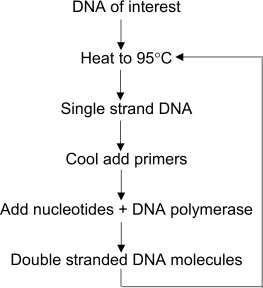
Construct a flow chart to summarise the process of the polymerase chain reaction to amplify DNA.   (4 marks)

Show Answers Only

Show Worked Solution


♦♦ Mean mark 31%.

Filed Under: Genetic Technologies Tagged With: Band 6, smc-3654-80-Gene Cloning, smc-3654-95-Draw flow chart

BIOLOGY, M6 2019 HSC 19-20 MC

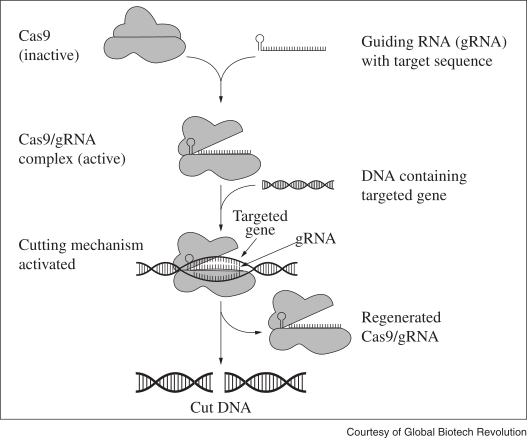
Use the following diagram to answer Questions 19-20.

The diagram shows how CRISPR/Cas9 can be used as a new tool for genetic engineering. This technology has dramatically improved scientists' ability to successfully modify genomes.
 

Question 19

What type of structure must Cas9 be?

  1. Enzyme
  2. mRNA
  3. Ribosome
  4. tRNA

 
Question 20

Scientists have been able to use biotechnology to 'cut and paste' DNA for decades.

Why would the new CRISPR/Cas9 technology have improved the scientists' success in cutting DNA of specific genes?

  1. Cas9 is able to combine with specific DNA.
  2. Cas 9 has an active site that cuts target DNA.
  3. gRNA has the same nucleotides as the target DNA.
  4. gRNA has nucleotides complementary to the target DNA.
Show Answers Only

Question 19: `A`

Question 20: `D`

Show Worked Solution

Question 19

  • Cas9 performs a ‘cutting mechanism’, a property of DNA helicase, a known enzyme.
  • Cas9 also contains a recognition site which it uses to perform its tasks, another property of enzymes.

`=>A`
  

Question 20

  • Cas9 has gRNA with complementary bases to the target gene, as displayed in the diagram above.
  • The improvement is due to this feature, as scientists can now use multiple gRNA sequences to cut various amounts of genes and various recognition sites.

`=>D`


♦♦♦ Mean mark (Q20) 23%.

Filed Under: Biotechnology, Genetic Technologies Tagged With: Band 4, Band 6, smc-3653-20-Evaluating Genetic Technology, smc-3654-05-Transgenic Organisms, smc-3654-80-Gene Cloning

BIOLOGY, M7 2020 HSC 30

Explain the impact that genetic technologies have had on the management of both infectious and non-infectious diseases.   (7 marks)

--- 16 WORK AREA LINES (style=lined) ---

Show Answers Only

Non Infectious diseases

  • Down syndrome and diabetes are examples of non-infectious diseases that are not caused by pathogens and are not contagious.
  • Recombinant DNA: This technology delivers replacement genes by creating recombinant plasmids in bacteria which then multiply via binary fission.
  • This has been used to produce insulin by inserting a copy of the human insulin gene for the treatment of diabetic patients.
  • Pre-Implantation Genetic Testing: before IVF, eggs can be tested for various genetic diseases, such as down syndrome or cystic fibrosis.

Infectious diseases

  • These diseases are caused by pathogens.
  • The genetic makeup of organisms can be altered to lower risk of such diseases.
  • Transgenic Organisms involve technology that combines genes from other species to incorporate certain characteristics.
  • For example, Recombinant Bt corn contains a gene that is toxic to the destructive European corn borer. This will protect the corn and reduce the occurence of the associated infectious disease in humans.
Show Worked Solution

Non Infectious diseases

  • Down syndrome and diabetes are examples of non-infectious diseases that are not caused by pathogens and are not contagious.
  • Recombinant DNA: This technology delivers replacement genes by creating recombinant plasmids in bacteria which then multiply via binary fission.
  • This has been used to produce insulin by inserting a copy of the human insulin gene for the treatment of diabetic patients.
  • Pre-Implantation Genetic Testing: before IVF, eggs can be tested for various genetic diseases, such as down syndrome or cystic fibrosis.

Infectious diseases

  • These diseases are caused by pathogens.
  • The genetic makeup of organisms can be altered to lower risk of such diseases.
  • Transgenic Organisms involve technology that combines genes from other species to incorporate certain characteristics.
  • For example, Recombinant Bt corn contains a gene that is toxic to the destructive European corn borer. This will protect the corn and reduce the occurence of the associated infectious disease in humans.

♦♦ Mean mark 44%.

Filed Under: Genetic Technologies, Prevention Tagged With: Band 5, smc-3654-05-Transgenic Organisms, smc-3654-30-Benefits, smc-3654-80-Gene Cloning, smc-3662-20-Genetic Engineering

BIOLOGY, M6 2020 HSC 13 MC

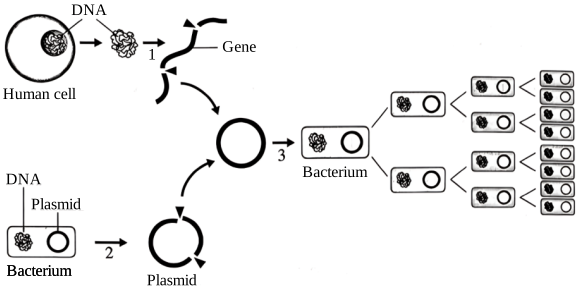
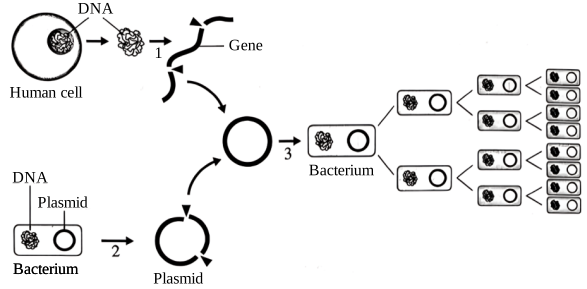
A type of genetic technology is shown in the diagram.


What type of cloning is modelled?

  1. Gene cloning because bacteria are used.
  2. Gene cloning because a human gene is being replicated.
  3. Whole organism cloning because identical offspring are produced.
  4. Whole organism cloning because the bacteria use asexual reproduction.
Show Answers Only

`B`

Show Worked Solution
  • A human gene is extracted and inserted into a bacterial plasmid.
  • This allows multiple copies of the gene to be produced via the process of gene cloning.

`=>B`

Filed Under: Genetic Technologies Tagged With: Band 4, smc-3654-80-Gene Cloning

Copyright © 2014–2025 SmarterEd.com.au · Log in