SmarterEd

Aussie Maths & Science Teachers: Save your time with SmarterEd

  • Login
  • Get Help
  • About

BIOLOGY, M7 2021 VCE 11

Two students designed an experiment to investigate antibiotic resistance in Escherichia coli bacteria. They began with an E. coli culture. The following procedure was conducted in a filtered air chamber using aseptic techniques:

  • On Day 0, spread 1 mL of E. coli culture onto a nutrient agar plate containing \(0 \ \mu \text{g} / \text{mL}\) (micrograms per millilitre) of the antibiotic ampicillin. Spread \(1 \ \text{mL}\) of the \(E. coli \) culture onto a separate nutrient agar plate containing \(1 \ \mu \text{g} / \mathrm{mL}\) of ampicillin. Cover each plate with an airtight lid.
  • On Day 1, transfer a sample of bacteria from one of the Day 0 plates to one of the Day 1 plates containing \(2 \ \mu \text{g} / \text{mL}\) of ampicillin. Transfer a sample of bacteria from the other Day 0 plate to the other Day 1 plate, which also contains \(2 \ \mu \text{g} / \text{mL}\) of ampicillin. Cover as before.
  • On Day 2, transfer a sample of bacteria from one of the Day 1 plates to one of the Day 2 plates containing \(4 \ \mu \text{g} / \text{mL}\) of ampicillin. Transfer a sample of bacteria from the other Day 1 plate to the other Day 2 plate, which also contains \(4 \ \mu \text{g} / \text{mL}\) of ampicillin. Cover as before.
  • On Day 3, transfer a sample of bacteria from one of the Day 2 plates to one of the Day 3 plates containing \(6 \ \mu \text{g} / \text{mL}\) of ampicillin. Transfer a sample of bacteria from the other Day 2 plate to the other Day 3 plate, which also contains \(6 \ \mu \text{g} / \text{mL}\) of ampicillin. Cover and seal the plates.

All plates were incubated at 37 °C for each 24-hour period. Used plates were refrigerated until the end of the experiment. They were then photographed to compare the amount of bacterial growth and disposed of safely.

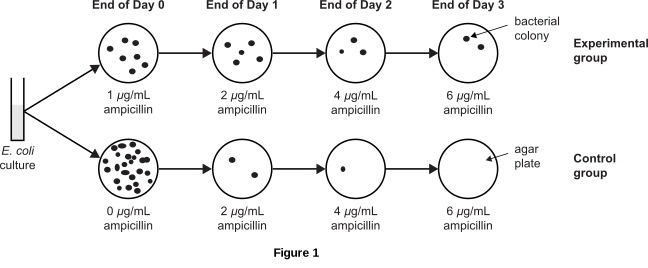
The students drew a diagram (Figure 1) to help explain the experimental design and to show their predicted results in each condition at the end of each day.
 

  1. Identify any two controlled variables for this experiment.   (2 marks)

--- 2 WORK AREA LINES (style=lined) ---

  1. Write a suitable hypothesis for this experiment.   (2 marks)

--- 4 WORK AREA LINES (style=lined) ---

The refrigerated plates kept from Days 0,1,2 and 3 of the experiment were photographed. The diagrams in Figure 2 represent the bacterial growth seen in the photographs.
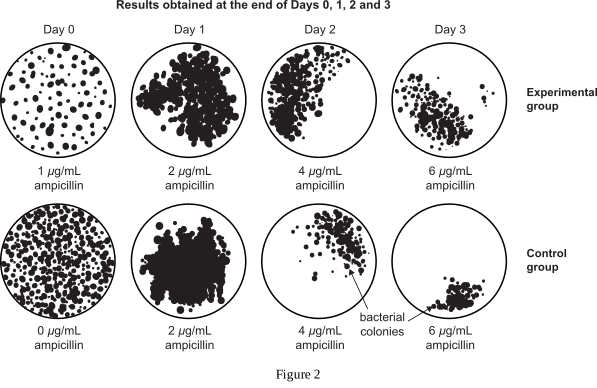


  1.  i. Analyse the results of the experiment shown in Figure 2.   (3 marks)
  2. ii. Explain whether the results of the students' experiment shown in Figure 2 support the predicted results shown in Figure 1.   (2 marks)
Show Answers Only

a.    Examples of suitable responses included two of the following:

  • volume of E. coli first applied to plates
  • type of nutrient agar used
  • size of agar plates used
  • batch or source of ampicillin
  • duration of incubation
  • temperature of incubation
  • exposure time to each concentration of ampicillin.

b.    Hypothesis:

  • If E. coli is exposed to low OR 1 µg/ml concentration of ampicillin, it will exhibit increased growth when exposed to higher levels of ampicillin.

c.i.  Experiment analysis:

  • No ampicillin: More E. coli growth on Day 0.
  • 2 µg/mL ampicillin: No effect on bacterial growth.
  • Days 2/3: Fewer colonies for both groups.
  • Higher ampicillin (4 µg/mL, 6 µg/mL): Significant effect, killed many E. coli.
  • More growth than predicted on all plates.
  • By end: More ampicillin-resistant bacteria on experimental plate.
  • 1 µg/mL ampicillin: Initial exposure led to greater number of resistant E. coli.

c.ii.  If the experimental results did not support the predicted results:

  • E. coli was still present on both plates on Day 3.
  • This shows exposing E. coli to 1 µg/ml ampicillin does not increase its resistance to ampicillin.
  • Resistant E. coli grew regardless of initial exposure to ampicillin.

Any two of the following, if the experimental results did support the predicted results:

  • The number of colonies in both groups decreased over time.
  • More E. coli developed ampicillin resistance in the experimental group.
  • There were more colonies in the experimental group than in the control group on Day 3.
  • There were more colonies than expected as ampicillin concentration increased.
  • No growth was expected at the end of Day 3 for the control group.
Show Worked Solution

a.    Examples of suitable responses included two of the following:

  • volume of E. coli first applied to plates
  • type of nutrient agar used
  • size of agar plates used
  • batch or source of ampicillin
  • duration of incubation
  • temperature of incubation
  • exposure time to each concentration of ampicillin.

b.    Hypothesis:

  • If E. coli is exposed to low OR 1 µg/ml concentration of ampicillin, it will exhibit increased growth when exposed to higher levels of ampicillin.

♦♦♦ Mean mark (b) 40%.

c.i.  Experiment analysis:

  • No ampicillin: More E. coli growth on Day 0.
  • 2 µg/mL ampicillin: No effect on bacterial growth.
  • Days 2/3: Fewer colonies for both groups.
  • Higher ampicillin (4 µg/mL, 6 µg/mL): Significant effect, killed many E. coli.
  • More growth than predicted on all plates.
  • By end: More ampicillin-resistant bacteria on experimental plate.
  • 1 µg/mL ampicillin: Initial exposure led to greater number of resistant E. coli.

♦♦♦ Mean mark (c)(i) 6%.

c.ii.  If the experimental results did not support the predicted results:

  • E. coli was still present on both plates on Day 3.
  • This shows exposing E. coli to 1 µg/ml ampicillin does not increase its resistance to ampicillin.
  • Resistant E. coli grew regardless of initial exposure to ampicillin.

Any two of the following, if the experimental results did support the predicted results:

  • The number of colonies in both groups decreased over time.
  • More E. coli developed ampicillin resistance in the experimental group.
  • There were more colonies in the experimental group than in the control group on Day 3.
  • There were more colonies than expected as ampicillin concentration increased.
  • No growth was expected at the end of Day 3 for the control group.

♦♦ Mean mark (c)(ii) 50%.

Filed Under: Causes of Infectious Disease Tagged With: Band 4, Band 5, Band 6, smc-3655-50-Microbial Tests

BIOLOGY, M7 2023 HSC 5 MC

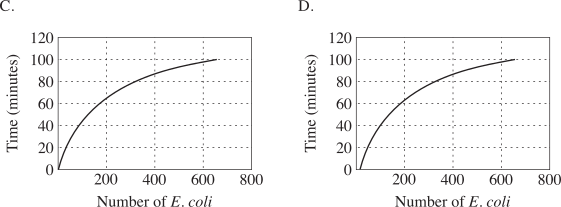
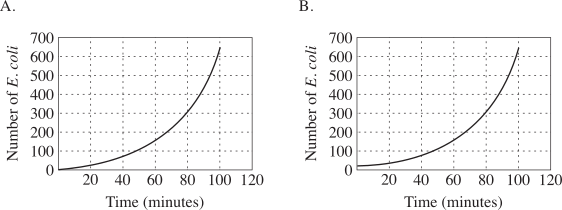
An experiment was conducted to investigate the rate of binary fission in E.coli. The results of the experiment are shown.
 

Time (minutes) Number of E.coli
0 20
20 40
40 80
60 160
80 320
100 640

 
Which graph represents the data in the table?


Show Answers Only

\(B\)

Show Worked Solution

By Elimination:

  • The independent variable (time) must be on the \(x\)-axis (Eliminate C and D).
  • The number of E. Coli starts at 20, not 0 (Eliminate A).

\(\Rightarrow B\)

Filed Under: Causes of Infectious Disease Tagged With: Band 3, smc-3655-50-Microbial Tests

BIOLOGY, M7 EQ-Bank 12

A practical investigation is to be carried out to test for the microbes found in food.

Complete the table to show how to minimise risks that are likely to arise in carrying out this investigation.   (3 marks)
 

--- 0 WORK AREA LINES (style=lined) ---

Show Answers Only

\begin{array} {|l|l|l|}
\hline \textit{Risk} & \textit{Procedure to minimise it} \\
\hline \text{Infection} & \text{Wear gloves.} \\
\hline \text{Growth of pathogenic} & \text{Incubate < 35° to prevent these microbes from growing.} \\
\hline \text{Cross-contamination} & \text{Sanitise bench and equipment.} \\
\hline \end{array}

Show Worked Solution

\begin{array} {|l|l|l|}
\hline \textit{Risk} & \textit{Procedure to minimise it} \\
\hline \text{Infection} & \text{Wear gloves.} \\
\hline \text{Growth of pathogenic} & \text{Incubate < 35° to prevent these microbes from growing.} \\
\hline \text{Cross-contamination} & \text{Sanitise bench and equipment.} \\
\hline \end{array}

Filed Under: Causes of Infectious Disease Tagged With: Band 3, smc-3655-50-Microbial Tests

BIOLOGY, M7 2015 HSC 25

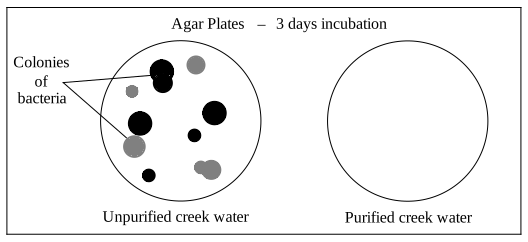
A group of students wanted to test whether water purifying tablets were effective in making creek water free from bacteria.

They conducted an experiment using a water sample collected from the creek and found that the tablets were effective.

  1. Describe a means of addressing ONE identified hazard relevant to this investigation.   (2 marks)

    --- 4 WORK AREA LINES (style=lined) ---

  2. Illustrate the results of this experiment in diagrammatic form.
  3. Use labels to clearly identify the data collected.   (3 marks)


    --- 0 WORK AREA LINES (style=lined) ---

Show Answers Only

a.   Successful answers could include one of the following:

  • A pathogenic microbe might be cultured during the process.
  • Post experiment, agar plates must be heated under high pressure to kill any microbes cultured before disposal.  

b.   Results of experiment:

Show Worked Solution

a.   Successful answers could include one of the following:

  • A pathogenic microbe might be cultured during the process.
  • Post experiment, agar plates must be heated under high pressure to kill any microbes cultured before disposal.  

b.   Results of experiment:

Filed Under: Causes of Infectious Disease Tagged With: Band 3, Band 4, smc-3655-50-Microbial Tests

BIOLOGY, M7 2019 HSC 7 MC

Two types of bacteria were isolated from a patient's throat swab and grown in pure culture on separate agar plates. On each plate there were FOUR different antibiotic discs, `W, X, Y` and `Z`.

The photograph shows the plates seven days later.
 

Which antibiotic should be used to treat the patient?

  1. `W`
  2. `X`
  3. `Y`
  4. `Z`
Show Answers Only

`A`

Show Worked Solution
  • The area of each circle shows the amount of bacterial growth each antibiotic has inhibited.
  • The larger the circle, the more effective that antibiotic is at inhibiting bacterial growth.
  • Antibiotic `W` has the most consistently large disc, and should be used to treat the patient.

`=>A`

Filed Under: Causes of Infectious Disease, Prevention, Treatment and Control Tagged With: Band 4, smc-3655-50-Microbial Tests, smc-3658-11-Pharmaceuticals

BIOLOGY, M7 2020 HSC 7 MC

Students designed and conducted an investigation to test for the presence of microbes in THREE different food samples.

They inoculated agar plates with the samples and placed them in an incubator set to 25°C.

Which row of the table represents a valid design for the investigation?

\begin{align*}
\begin{array}{l}
\rule{0pt}{2.5ex} \ \rule[-1ex]{0pt}{0pt}& \\
\rule{0pt}{2.5ex}\textbf{A.}\rule[-1ex]{0pt}{0pt}\\
\rule{0pt}{2.5ex}\textbf{B.}\rule[-1ex]{0pt}{0pt}\\
\rule{0pt}{2.5ex}\textbf{C.}\rule[-1ex]{0pt}{0pt}\\
\rule{0pt}{2.5ex}\textbf{D.}\rule[-1ex]{0pt}{0pt}\\
\end{array}
\begin{array}{|l|l|l|}
\hline \rule{0pt}{2.5ex}\textit{Independent variable} \rule[-1ex]{0pt}{0pt}& \textit{Dependent variable} & \textit{Experimental control} \\
\hline \rule{0pt}{2.5ex}\text{ Food sample} \rule[-1ex]{0pt}{0pt}& \text {Number of microbes } & \text {An agar plate without a sample } \\
\hline \rule{0pt}{2.5ex}\text{ Number of microbes} \rule[-1ex]{0pt}{0pt}& \text {Food sample } & \text {Temperature set to} 25^{\circ} C \\
\hline \rule{0pt}{2.5ex}\text{ Food sample} \rule[-1ex]{0pt}{0pt}& \text {Number of microbes } & \text {Temperature set to} 25^{\circ} C \\
\hline \rule{0pt}{2.5ex}\text{ Number of microbes} \rule[-1ex]{0pt}{0pt}& \text {Food sample } & \text {An agar plate without a sample} \\
\hline
\end{array}
\end{align*}

Show Answers Only

\(A\)

Show Worked Solution
  • The different food samples are deliberately selected (independent).
  • The number of microbes is a consequence of the specific food samples (dependent).
  • An agar plate with a food sample would be a base of comparison (experimental control) while temperature would be a controlled variable.

\(\Rightarrow A\)

♦ Mean mark 49%.

Filed Under: Causes of Infectious Disease Tagged With: Band 5, smc-3655-50-Microbial Tests

BIOLOGY, M7 2021 HSC 16 MC

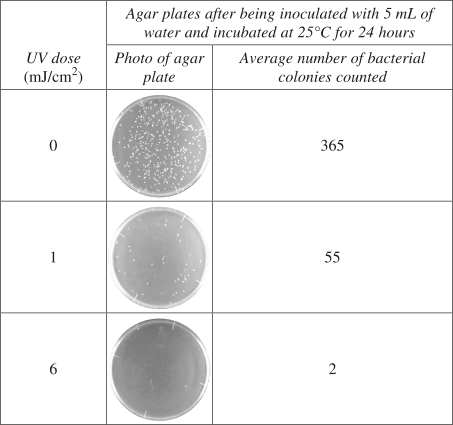
Scientists conducted an experiment to investigate the effectiveness of treating water from storage dams with UV radiation.

The experiment was conducted more than three times. The results are shown in the table.
 

What conclusion may be drawn from the data obtained?

  1. The control plates are contaminated.
  2. High doses of UV eliminate all pathogens.
  3. Exposure to UV inhibits reproduction of bacteria.
  4. The presence of bacteria reduces the amount of UV.
Show Answers Only

`C`

Show Worked Solution
  • As the UV dose increased, the number of bacteria decreased.

`=>C`

♦ Mean mark 79%.

Filed Under: Causes of Infectious Disease Tagged With: Band 3, smc-3655-50-Microbial Tests

Copyright © 2014–2025 SmarterEd.com.au · Log in