SmarterEd

Aussie Maths & Science Teachers: Save your time with SmarterEd

  • Login
  • Get Help
  • About

BIOLOGY, M7 2023 HSC 8 MC

Neutrophils and T-cells are cells of the human immune system. After an infection, the concentration of these types of cells in infected tissue was plotted as a function of time.
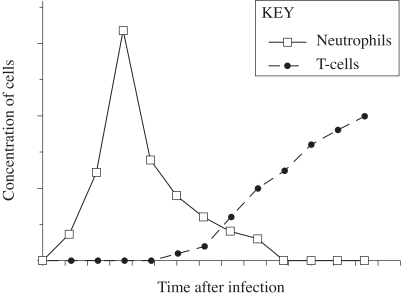
 

Based on the data provided, neutrophils are part of which human immune system?

  1. Acquired
  2. Adaptive
  3. Innate
  4. Primary
Show Answers Only

\(C\)

Show Worked Solution
  • The relatively quick spike in neutrophil concentration when compared to the T-cells (which are part of the specific immune response) would indicate they are part of the innate/non-specific immune response.

\(\Rightarrow C\)

Filed Under: Immunity and Responses to Pathogens Tagged With: Band 4, smc-3657-20-Cell Mediated, smc-3657-30-Innate Response (2nd Line)

BIOLOGY, M7 SM-Bank 22

A summary of case-control studies conducted from 1997 to 2003 showed that a single dose of varicella (chickenpox) vaccine was 97% effective in the first year after vaccination and 86% effective in the second year. From the second to eighth year after vaccination, the vaccine's effectiveness remained stable at 81% to 86%. Most vaccinated children who developed chickenpox during the eight years after vaccination had a mild case of the disease.

Why do most vaccinated individuals, if they are infected, show only a mild case of the disease?  (2 marks)

Show Answers Only

Answers should include two of the following reasons:

  • Virus enters and is detected.
  • Memory cells present.
  • Rapid antibody production where antibodies are produced in large numbers
  • Virus is neutralised
Show Worked Solution

Answers should include two of the following reasons:

  • Virus enters and is detected.
  • Memory cells present.
  • Rapid antibody production where antibodies are produced in large numbers
  • Virus is neutralised

Filed Under: Immunity and Responses to Pathogens Tagged With: Band 4, smc-3657-10-Antibody Mediated, smc-3657-20-Cell Mediated, smc-3657-25-Antibodies

BIOLOGY, M7 EQ-Bank 26

The immune system's primary role is to defend against pathogens. For this to be effective the immune system must be able to recognise cells that belong to the body and cells that do not.

  1. Describe the mechanism that the immune system uses to distinguish between body cells and potential pathogens. Support your answer with an example.   (3 marks)

    --- 8 WORK AREA LINES (style=lined) ---

  2. Explain why this mechanism means that patients who receive an organ donation require immune suppression drugs.   (3 marks)

    --- 8 WORK AREA LINES (style=lined) ---

Show Answers Only

a.    Immune system blood type mechanisms

  • Every cell has proteins on its surface which the body can use to distinguish them from self and non-self.
  • The body’s own cells produce a specific composition of surface proteins referred to as the major histocompatibility complex (MHC), as opposed to other proteins which are not recognised by the immune system and are called antigens.
  • This provides the basis of blood types, where A and B are specific surface proteins while O is blood with no surface proteins.
  • AB blood type individuals are therefore universal recipients, as their immune system has recognised both A and B proteins as self. This also explains why type O individuals are universal donors as their blood has no surface proteins, hence type O, A, B and AB individuals will not recognise it as foreign.
     

b.    Immune systems detect new donated organs as foreign bodies.

  • When foreign cells/material are detected by the body, an immune response will attempt to kill or remove it from the body.
  • The same scenario occurs during an organ transplant, as the donor’s MHC complex is different to that of the recipient.
  • To counteract this, specialists run genetic testing on donors as well as the recipient to find people with a similar chromosome 6 genetic sequence. MHC is coded by genes found on this chromosome and compatible organ donors are often family members.
  • As a precaution, specialists administer immune suppression drugs which will slow the patient’s immune response, reducing the chance of an attack on the donated organ.
Show Worked Solution

a.    Immune system blood type mechanisms

  • Every cell has proteins on its surface which the body can use to distinguish them from self and non-self.
  • The body’s own cells produce a specific composition of surface proteins referred to as the major histocompatibility complex (MHC), as opposed to other proteins which are not recognised by the immune system and are called antigens.
  • This provides the basis of blood types, where A and B are specific surface proteins while O is blood with no surface proteins.
  • AB blood type individuals are therefore universal recipients, as their immune system has recognised both A and B proteins as self. This also explains why type O individuals are universal donors as their blood has no surface proteins, hence type O, A, B and AB individuals will not recognise it as foreign. 

b.    Immune systems detect new donated organs as foreign bodies.

  • When foreign cells/material are detected by the body, an immune response will attempt to kill or remove it from the body.
  • The same scenario occurs during an organ transplant, as the donor’s MHC complex is different to that of the recipient.
  • To counteract this, specialists run genetic testing on donors as well as the recipient to find people with a similar chromosome 6 genetic sequence. MHC is coded by genes found on this chromosome and compatible organ donors are often family members.
  • As a precaution, specialists administer immune suppression drugs which will slow the patient’s immune response, reducing the chance of an attack on the donated organ.

Filed Under: Immunity and Responses to Pathogens Tagged With: Band 4, Band 5, smc-3657-10-Antibody Mediated, smc-3657-20-Cell Mediated

BIOLOGY, M7 EQ-Bank 9 MC

Melanomas are characterised by uncontrolled cell division caused by mutations that continue to occur once the tumour has developed. Scientists have discovered that vaccines produced using antigens extracted from the patient's own melanoma cells can be useful in treating melanoma. When injected, the vaccines stimulate an immune response.

The effect of the melanoma vaccine is to stimulate

  1. T cells which produce antibodies.
  2. cytotoxic T cells which activate B cells.
  3. cell division to produce more lymphocytes.
  4. production of B cells which destroy melanoma cells.
Show Answers Only

`C`

Show Worked Solution
  • The vaccine will encourage the division of lymphocytes (B and T cells) as a response to melanoma antigens.

`=>C`

Filed Under: Immunity and Responses to Pathogens Tagged With: Band 5, smc-3657-10-Antibody Mediated, smc-3657-20-Cell Mediated

BIOLOGY, M7 2018 HSC 16 MC

How do helper T cells assist in raising a specific immune response to a pathogen?

  1. They mass produce specific antibodies.
  2. They stimulate the cloning of specific T cells.
  3. They are cloned and differentiate to become specific cytotoxic T cells.
  4. They produce cytokines that stimulate the cloning of specific phagocytes.
Show Answers Only

`B`

Show Worked Solution

Helper T cells do not:

  • produce antibodies,
  • differentiate into other types of cells.

Further, phagocytes are not part of the immune response.

`=>B`


♦ Mean mark 42%.

Filed Under: Immunity and Responses to Pathogens Tagged With: Band 5, smc-3657-20-Cell Mediated

BIOLOGY, M7 2017 HSC 30a

What is the role of ONE type of T lymphocyte in the immune response?  (2 marks)

Show Answers Only

“

Show Worked Solution

Answers could include one of the following:

  • Helper T cells secrete cytokines to regulate interaction between B and T cells.
  • Killer T cells kill infected cells.
  • Regulatory T cells make B and T cells inactive after the pathogen is destroyed.
  • Memory T cells reactivate quickly in the body once the same pathogen is detected providing acquired immunity.

Filed Under: Immunity and Responses to Pathogens Tagged With: Band 4, smc-3657-20-Cell Mediated

BIOLOGY, M7 2017 HSC 11 MC

A student was asked to complete a table showing whether T cells and B cells have particular characteristics.

Which row did the student complete correctly?

\begin{align*}
\begin{array}{l}
\rule{0pt}{2.5ex} \ \rule[-1ex]{0pt}{0pt}& \\
\rule{0pt}{2.5ex}\textbf{A.}\rule[-1ex]{0pt}{0pt}\\
\rule{0pt}{2.5ex}\textbf{B.}\rule[-1ex]{0pt}{0pt}\\
\rule{0pt}{2.5ex}\textbf{C.}\rule[-1ex]{0pt}{0pt}\\
\rule{0pt}{2.5ex}\textbf{D.}\rule[-1ex]{0pt}{0pt}\\
\end{array}
\begin{array}{|l|c|c|}
\hline
\rule{0pt}{2.5ex}\quad \quad \quad \quad \quad \quad \quad \quad \textit{Characteristic}\rule[-1ex]{0pt}{0pt}& \textit{T cell} & \textit{B cell}\\
\hline
\rule{0pt}{2.5ex}\text{Produces plasma cells}\rule[-1ex]{0pt}{0pt}&\checkmark&\checkmark\\
\hline
\rule{0pt}{2.5ex}\text{Produces antibodies that are released in body fluids}\rule[-1ex]{0pt}{0pt}& \checkmark&\textit{X}\\
\hline
\rule{0pt}{2.5ex}\text{Cell surface receptor can recognise a specific antigen}\rule[-1ex]{0pt}{0pt}& \checkmark&\checkmark\\
\hline
\rule{0pt}{2.5ex}\text{Forms clones once stimulated}\rule[-1ex]{0pt}{0pt}& \textit{X}&\checkmark\\
\hline
\end{array}
\end{align*}

Show Answers Only

\(C\)

Show Worked Solution
  • T and B cell receptors can both recognise specific antigens.

\(\Rightarrow C\)


Mean mark 54%.

Filed Under: Immunity and Responses to Pathogens Tagged With: Band 5, smc-3657-10-Antibody Mediated, smc-3657-20-Cell Mediated

BIOLOGY, M7 2017 HSC 4 MC

What is the role of lymphocytes in the body?

  1. They fight infection.
  2. They initiate blood clotting.
  3. They transport oxygen around the body.
  4. They transport carbon dioxide around the body.
Show Answers Only

`A`

Show Worked Solution
  • Lymphocytes (B and T cells) protect the body from pathogens by coordinating the immune response.

`=>A`

Filed Under: Immunity and Responses to Pathogens Tagged With: Band 3, smc-3657-10-Antibody Mediated, smc-3657-20-Cell Mediated, smc-3657-30-Innate Response (2nd Line)

BIOLOGY, M7 2016 HSC 24

Name an infectious disease and explain how ONE host response is a defence adaptation.   (3 marks)

Show Answers Only

Exemplar solution:

  • A primary immune response is triggered when a person first contracts chicken pox – an infectious disease.
  • Activated B and T cells reproduce in large numbers to fight and destroy the pathogen.
  • The host survives.
  • Subsequent infection with the same pathogen results in an increased secondary immune response.
Show Worked Solution
  • A primary immune response is triggered when a person first contracts chicken pox – an infectious disease.
  • Activated B and T cells reproduce in large numbers to fight and destroy the pathogen.
  • The host survives.
  • Subsequent infection with the same pathogen results in an increased secondary immune response.

Filed Under: Immunity and Responses to Pathogens Tagged With: Band 3, smc-3657-10-Antibody Mediated, smc-3657-20-Cell Mediated

BIOLOGY, M7 2015 HSC 19-20 MC

Refer to the following information to answer Questions 19 and 20 .

The intestinal tract of a human foetus is sterile.
After birth, microflora from the mother are transferred to the baby's mouth through close contact. After a year, the microflora of the baby is similar to the mother's, with the baby's immune system ignoring these microbes.

Also during the first year of life, breast milk from the mother provides antibodies to the baby for any disease the mother has already experienced. When breastfeeding ceases, these antibody levels in the baby start to fall.

After the first year, any new species of invading bacteria is treated as a pathogen by the baby's immune system.

Question 19

A medical consequence for six-month-old babies that have only been bottle-fed with formula milk and not breastfed is that

  1. they will not develop microflora.
  2. their immune system will be damaged.
  3. their consumption of milk cannot be quantified.
  4. they will be at increased risk of infectious disease.

 
Question 20

Strict hygiene practices are followed in the care of newborns, whereas hygiene practices in the care of older babies are less emphasised.

Which of the following is the best reason for this difference?

  1. Vaccinations render personal hygiene unnecessary for older babies.
  2. Procaryotic cells are not identified as antigens in early development.
  3. Antibiotic treatments kill bacterial populations in the digestive system.
  4. Early exposure to pathogens helps to build a strong immune system.


Show Answers Only

Question 19: `D`

Question 20: `B`

Show Worked Solution

Question 19

  • Bottle fed babies will not have the added immunity that is provided by the mother’s breast milk.
  • They will therefore have immune systems that are more susceptible to infectious disease.

`=>D` 
 

Question 20

  • The immune systems of newborns will not work as efficiently as that of older babies as their immune systems are underdeveloped.

`=>B`


♦ Mean mark Q20 45%.

Filed Under: Immunity and Responses to Pathogens Tagged With: Band 3, Band 5, smc-3657-10-Antibody Mediated, smc-3657-20-Cell Mediated

BIOLOGY, M7 2015 HSC 17 MC

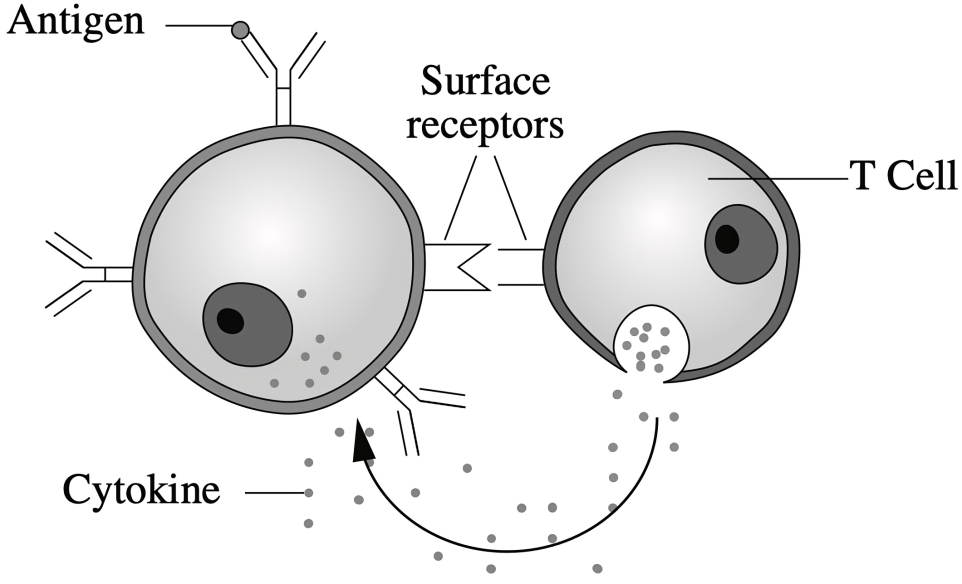
The diagram shows an interaction between cells of the immune system.


What specific process is shown in the diagram?

  1. B cell encountering an antigen
  2. Activation of a macrophage by a helper T cell
  3. Stimulation of a B cell to become a plasma cell
  4. Cytotoxic T cell destroying a virus-infected cell
Show Answers Only

`C`

Show Worked Solution

Consider the activation of the macrophage:

  • The T cell is releasing cytokine to enable this process.

`=>C`


♦♦♦ Mean mark 8%!

Filed Under: Immunity and Responses to Pathogens Tagged With: Band 6, smc-3657-20-Cell Mediated

BIOLOGY, M7 2021 HSC 28b

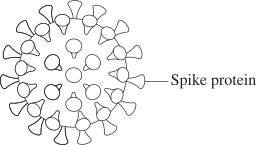
An mRNA vaccine has been developed in order to immunise people against a virus. The vaccine contains modified mRNA which codes for the spike protein on the surface of the virus.
 

Explain how this vaccine can lead to active immunity to the virus.   (5 marks)

Show Answers Only
  • The modified mRNA enters the individuals cells and is translated at the ribosomes to form the viral spike protein, which is then released into the body.
  • The protein will be rendered as an antigen, and will trigger a specific immune response by B and T lymphocytes that match the antigen.
  • Once the viral protein has been removed, memory B and T lymphocytes specific to the protein remain, providing active immunity that allows for a rapid future response.
  • If the individual is later exposed to the virus, the same spike proteins present on the virus’ surface will trigger a rapid and large response by the memory cells. This is the basis for providing active immunity.
Show Worked Solution
  • The modified mRNA enters the individuals cells and is translated at the ribosomes to form the viral spike protein, which is then released into the body.
  • The protein will be rendered as an antigen, and will trigger a specific immune response by B and T lymphocytes that match the antigen.
  • Once the viral protein has been removed, memory B and T lymphocytes specific to the protein remain, providing active immunity that allows for a rapid future response.
  • If the individual is later exposed to the virus, the same spike proteins present on the virus’ surface will trigger a rapid and large response by the memory cells. This is the basis for providing active immunity.

♦ Mean mark 43%.

Filed Under: Immunity and Responses to Pathogens, Prevention, Treatment and Control Tagged With: Band 5, smc-3657-10-Antibody Mediated, smc-3657-20-Cell Mediated, smc-3658-20-Vaccines

Copyright © 2014–2025 SmarterEd.com.au · Log in