SmarterEd

Aussie Maths & Science Teachers: Save your time with SmarterEd

  • Login
  • Get Help
  • About

BIOLOGY, M7 2025 HSC 21

The diagram shows components of the innate immune system in humans.
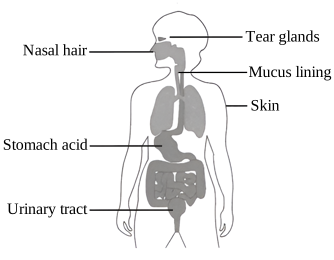
   

State the role of TWO components that protect against infection.   (2 marks)

\begin{array} {|c|c|}
\hline
\rule{0pt}{2.5ex}\quad \quad \textit{Component} \quad \quad \rule[-1ex]{0pt}{0pt} & \quad \quad \textit{How it protects against infection}\quad \quad \rule[-1ex]{0pt}{0pt}\\
\hline
\ & \\
\ & \\
\ & \\
\ & \\
\ & \\
\hline
\ & \\
\ & \\
\ & \\
\ & \\
\ & \\
\hline
\end{array}

--- 0 WORK AREA LINES (style=lined) ---
Show Answers Only

Any TWO of the following components

\begin{array} {|l|l|}
\hline
\rule{0pt}{2.5ex}\textit{Component} \quad \quad \rule[-1ex]{0pt}{0pt} & \textit{How it protects against infection}\quad\rule[-1ex]{0pt}{0pt}\\
\hline
\text{Skin} & \text{Acts as a physical barrier}\\
\ & \text{preventing pathogen entry into} \\
\ & \text{tissue}\\
\hline
\text{Stomach} &\text{Destroys ingested pathogens} \\
\text{acid} & \text{through low pH chemical}\\
\ & \text{environment.}\\
\hline
\text{Mucus} &\text{Traps pathogens and prevents} \\
\text{lining} & \text{their entry into underlying}\\
\ & \text{tissues.}\\
\hline
\text{Nasal} &\text{Filters and traps airborne} \\
\text{hair} & \text{pathogens, preventing}\\
\ & \text{respiratory entry.}\\
\hline
\text{Tear glands} &\text{Produce lysozyme enzyme that} \\
\ & \text{destroys bacterial cell walls.}\\
\hline
\text{Urinary} &\text{Flushes pathogens from the} \\
\text{tract} & \text{urethra preventing infection.}\\
\hline
\end{array}

Show Worked Solution

Any TWO of the following components

\begin{array} {|l|l|}
\hline
\rule{0pt}{2.5ex}\textit{Component} \quad \quad \rule[-1ex]{0pt}{0pt} & \textit{How it protects against infection}\quad\rule[-1ex]{0pt}{0pt}\\
\hline
\text{Skin} & \text{Acts as a physical barrier}\\
\ & \text{preventing pathogen entry into} \\
\ & \text{tissue}\\
\hline
\text{Stomach} &\text{Destroys ingested pathogens} \\
\text{acid} & \text{through low pH chemical}\\
\ & \text{environment.}\\
\hline
\text{Mucus} &\text{Traps pathogens and prevents} \\
\text{lining} & \text{their entry into underlying}\\
\ & \text{tissues.}\\
\hline
\text{Nasal} &\text{Filters and traps airborne} \\
\text{hair} & \text{pathogens, preventing}\\
\ & \text{respiratory entry.}\\
\hline
\text{Tear glands} &\text{Produce lysozyme enzyme that} \\
\ & \text{destroys bacterial cell walls.}\\
\hline
\text{Urinary} &\text{Flushes pathogens from the} \\
\text{tract} & \text{urethra preventing infection.}\\
\hline
\end{array}

Filed Under: Immunity and Responses to Pathogens Tagged With: Band 3, Band 4, smc-3657-30-Innate Response (2nd Line)

BIOLOGY, M7 2025 HSC 3 MC

Which row in the table correctly identifies the role of phagocytes and lymphocytes?

\begin{align*}
\begin{array}{l}
\rule{0pt}{2.5ex} \ \rule[-1ex]{0pt}{0pt}& \\
\rule{0pt}{2.5ex}\textbf{A.}\rule[-1ex]{0pt}{0pt}\\
\rule{0pt}{2.5ex}\textbf{B.}\rule[-1ex]{0pt}{0pt}\\
\rule{0pt}{2.5ex}\textbf{C.}\rule[-1ex]{0pt}{0pt}\\
\rule{0pt}{2.5ex}\textbf{D.}\rule[-1ex]{0pt}{0pt}\\
\end{array}
\begin{array}{|l|l|}
\hline
\rule{0pt}{2.5ex}{Phagocytes}\rule[-1ex]{0pt}{0pt}& {Lymphocytes} \\
\hline
\rule{0pt}{2.5ex}\text{Engulf bacteria}\rule[-1ex]{0pt}{0pt}&\text{Produce antibodies }\\
\hline
\rule{0pt}{2.5ex}\text{Engulf bacteria }\rule[-1ex]{0pt}{0pt}& \text{Produce antigens}\\
\hline
\rule{0pt}{2.5ex}\text{Produce antibodies}\rule[-1ex]{0pt}{0pt}& \text{Engulf bacteria} \\
\hline
\rule{0pt}{2.5ex}\text{Produce antigens}\rule[-1ex]{0pt}{0pt}& \text{Produce antibodies} \\
\hline
\end{array}
\end{align*}

Show Answers Only

\(A\)

Show Worked Solution
  • A is correct: Phagocytes engulf bacteria through phagocytosis and lymphocytes produce antibodies.

Other Options:

  • B is incorrect: Lymphocytes produce antibodies, not antigens.
  • C is incorrect: Roles are reversed; phagocytes engulf, lymphocytes produce antibodies.
  • D is incorrect: Phagocytes engulf bacteria, they don’t produce antigens.

Filed Under: Immunity and Responses to Pathogens Tagged With: Band 4, smc-3657-25-Antibodies, smc-3657-30-Innate Response (2nd Line)

BIOLOGY, M7 2024 HSC 32

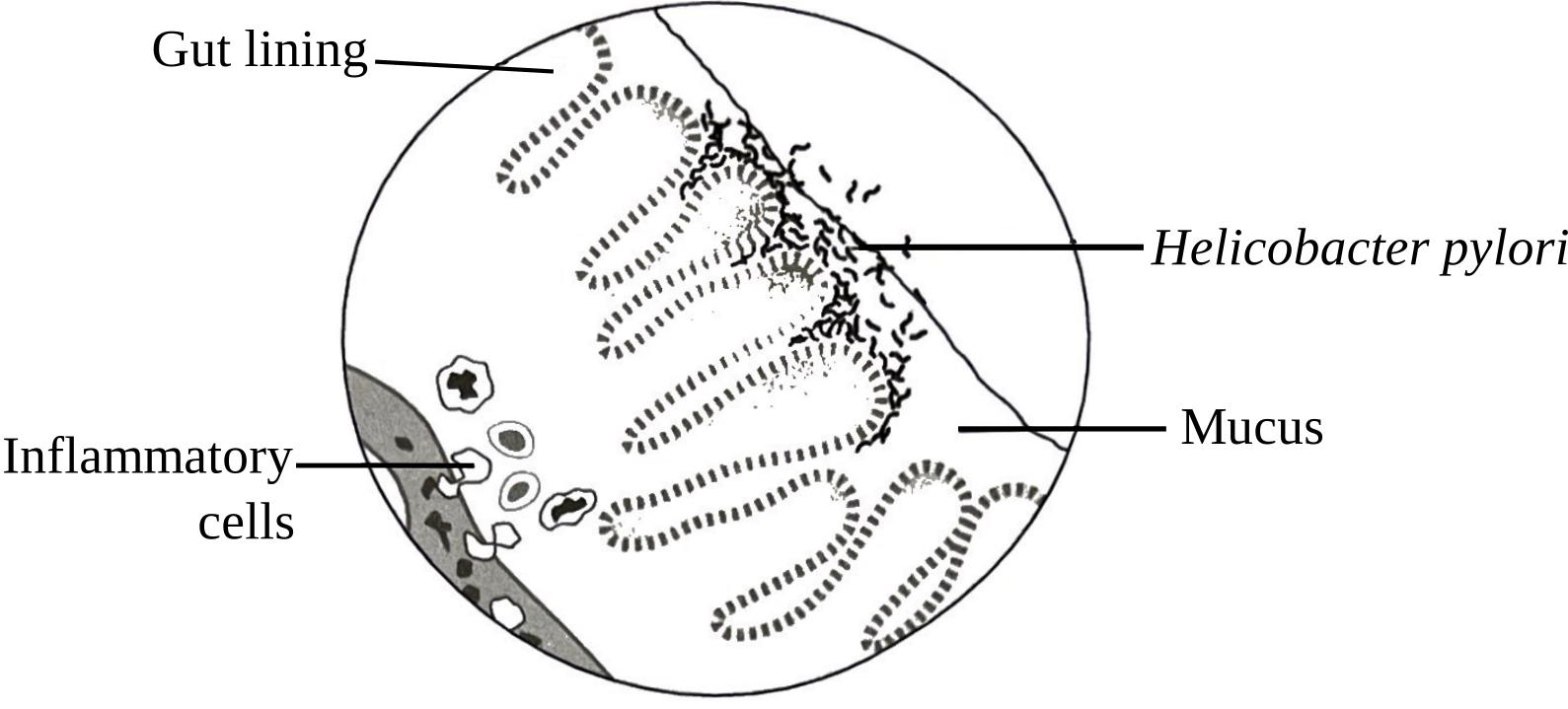
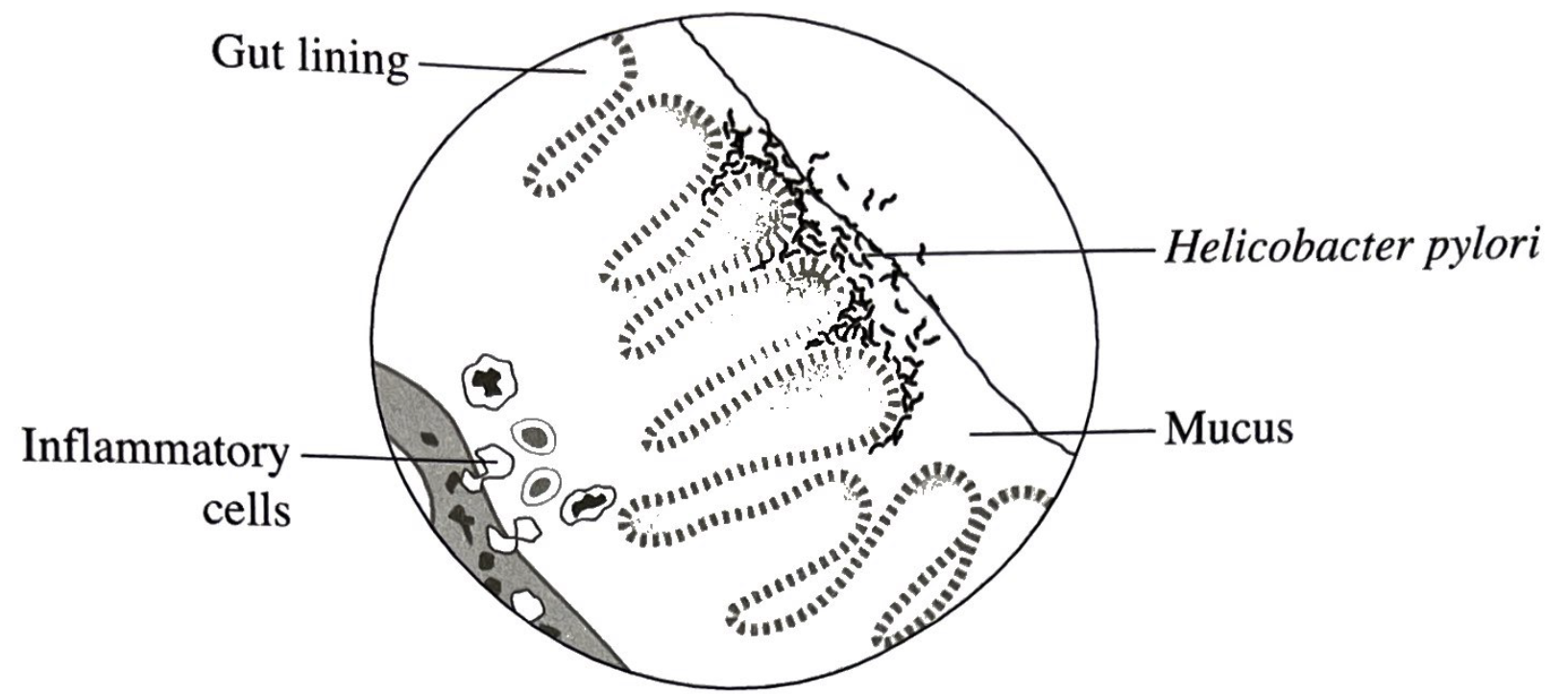
Helicobacter pylori is a bacterium that invades the gut lining and can cause damage to the stomach as shown in the diagram.
 

With reference to innate and adaptive immunity, explain how the body responds after exposure to Helicobacter pylori.   (7 marks)

--- 17 WORK AREA LINES (style=lined) ---
Show Answers Only
  • Damaged cells release chemicals that trigger inflammation as an initial response.
  • The inflammatory response causes blood vessels to dilate, increasing blood flow and allowing phagocytes (macrophages and neutrophils) to move into the infected area.
  • Phagocytes process H.pylori antigens and present them to helper T-cells, which launch the adaptive immune response by releasing cytokines.
  • This cytokine release activates both T and B cells to mount multiple specific defences.
  • Cytotoxic T-cells directly attack H.pylori while memory T-cells remain for secondary rapid responses.
  • Suppressor T-cells regulate the immune response and plasma B-cells produce H.pylori-specific antibodies. Memory B-cells persist for responding to future (secondary) infections.
  • Antibodies work in two ways – direct neutralisation of antigens and tagging antigens for destruction by phagocytes. 

The immune response involves both innate and adaptive immunity systems working together:

  • Innate immunity provides rapid, immediate defence.
  • Adaptive immunity develops more slowly but offers long-term protection through memory cells.
Show Worked Solution
  • Damaged cells release chemicals that trigger inflammation as an initial response.
  • The inflammatory response causes blood vessels to dilate, increasing blood flow and allowing phagocytes (macrophages and neutrophils) to move into the infected area.
  • Phagocytes process H.pylori antigens and present them to helper T-cells, which launch the adaptive immune response by releasing cytokines.
  • This cytokine release activates both T and B cells to mount multiple specific defences.
  • Cytotoxic T-cells directly attack H.pylori while memory T-cells remain for secondary rapid responses.
  • Suppressor T-cells regulate the immune response and plasma B-cells produce H.pylori-specific antibodies. Memory B-cells persist for responding to future (secondary) infections.
  • Antibodies work in two ways – direct neutralisation of antigens and tagging antigens for destruction by phagocytes. 

The immune response involves both innate and adaptive immunity systems working together:

  • Innate immunity provides rapid, immediate defence.
  • Adaptive immunity develops more slowly but offers long-term protection through memory cells.
♦♦ Mean mark 48%.

Filed Under: Immunity and Responses to Pathogens Tagged With: Band 5, Band 6, smc-3657-25-Antibodies, smc-3657-30-Innate Response (2nd Line)

BIOLOGY, M7 2019 VCE 20 MC

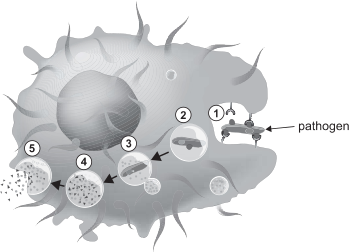
The diagram below shows the process of phagocytosis. This process is vital for immunity against extracellular infections.

What is happening at position 3 ?

  1. Enzymes that break down the microorganism are released into the vesicle.
  2. Antibodies are added to the vesicle to kill the microorganism.
  3. The cell is sampling the vesicle for antigen presentation.
  4. Intracellular microbes are attacking the microorganism.
Show Answers Only

\(A\)

Show Worked Solution
  • When the phagosome and lysosome fuse, they form a phagolysosome (vesicle), an acidic and oxidising environment that can effectively kill and degrade the ingested microorganism.

\(\Rightarrow A\)

Filed Under: Immunity and Responses to Pathogens Tagged With: Band 4, smc-3657-30-Innate Response (2nd Line)

BIOLOGY, M7 2020 VCE 18*

Some human cells produce proteins called cytokines.

Describe the major function of cytokines.   (2 marks)

--- 4 WORK AREA LINES (style=lined) ---

Show Answers Only
  • The major function of cytokines is to regulate the immune response.
  • Cytokines do this by signalling between cells, which helps coordinate the body’s defense against infections and inflammation.
Show Worked Solution
  • The major function of cytokines is to regulate the immune response.
  • Cytokines do this by signalling between cells, which helps coordinate the body’s defense against infections and inflammation.

Filed Under: Immunity and Responses to Pathogens Tagged With: Band 4, smc-3657-30-Innate Response (2nd Line)

BIOLOGY, M7 2021 VCE 15 MC

Neutrophils

  1. secrete complement proteins
  2. migrate to the site of infection and engulf invading pathogens.
  3. increase the diameter of blood vessels to make them more permeable.
  4. release histamine following the binding of the antigen to receptors on the neutrophil's surface.
Show Answers Only

\(B\)

Show Worked Solution
  • Neutrophils use phagocytosis to engulf and destroy invading pathogens, such as bacteria, fungi, and other microorganisms.
  • They recognise and bind to pathogens, then internalize and digest them using various antimicrobial mechanisms.

\(\Rightarrow B\)

Filed Under: Immunity and Responses to Pathogens Tagged With: Band 4, smc-3657-30-Innate Response (2nd Line)

BIOLOGY, M7 2023 HSC 22a

Describe how phagocytes help protect against pathogens.  (2 marks)

Show Answers Only
  • Phagocytes are white blood cells which can identify and engulf foreign material.
  • Upon detection of foreign material, phagocytes can engulf them forming a vesicle which fuses with a lysosome and allows them to be digested.
Show Worked Solution
  • Phagocytes are white blood cells which identify and engulf foreign material.
  • Upon detection of foreign material, phagocytes can engulf them forming a vesicle which fuses with a lysosome and allows them to be digested.

Filed Under: Immunity and Responses to Pathogens Tagged With: Band 4, smc-3657-30-Innate Response (2nd Line)

BIOLOGY, M7 2023 HSC 8 MC

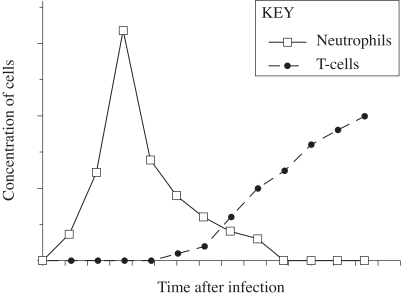
Neutrophils and T-cells are cells of the human immune system. After an infection, the concentration of these types of cells in infected tissue was plotted as a function of time.
 

Based on the data provided, neutrophils are part of which human immune system?

  1. Acquired
  2. Adaptive
  3. Innate
  4. Primary
Show Answers Only

\(C\)

Show Worked Solution
  • The relatively quick spike in neutrophil concentration when compared to the T-cells (which are part of the specific immune response) would indicate they are part of the innate/non-specific immune response.

\(\Rightarrow C\)

Filed Under: Immunity and Responses to Pathogens Tagged With: Band 4, smc-3657-20-Cell Mediated, smc-3657-30-Innate Response (2nd Line)

BIOLOGY, M7 EQ-Bank 5 MC

When a foreign body breaches the first line of defence the mast cells produce histamines in response.

What is the role of histamines in the defence of the body?

  1. To attack the invading pathogen
  2. To activate B and T lymphocytes of the specific immune response
  3. To activate the inflammation response and increase blood flow to the affected area
  4. To retain information on a pathogen's antigen so that the immune system can respond quickly to any subsequent infection
Show Answers Only

`=>C`

Show Worked Solution
  • Histamines are the chemicals released by a mast cell in response to tissue damage.
  • They increase blood flow by dilating blood vessels and increasing permeability of capillaries.

`=>C`

Filed Under: Immunity and Responses to Pathogens Tagged With: Band 4, smc-3657-30-Innate Response (2nd Line)

BIOLOGY, M7 EQ-Bank 2 MC

The runny nose and coughing that is symptomatic of having a cold is an example of the body's response to a pathogen.

How does this response protect the body?

  1. By heating the body to try to kill the virus
  2. By trying to spread the virus to other people
  3. By preventing the virus from entering the body
  4. By attempting to rapidly expel the virus from the airways
Show Answers Only

`D`

Show Worked Solution
  • These symptoms are the body’s response to many illnesses and are methods to remove the virus from airways.

`=>D`

Filed Under: Immunity and Responses to Pathogens Tagged With: Band 3, smc-3657-30-Innate Response (2nd Line)

BIOLOGY, M7 2014 HSC 21

  1. The diagram shows a process that is a part of the immune response.
     

  1. What is the name of the process?   (1 mark)

    --- 2 WORK AREA LINES (style=lined) ---

  2. Outline how inflammation contributes to the immune response.   (2 marks)

    --- 5 WORK AREA LINES (style=lined) ---

Show Answers Only

“

Show Worked Solution

a.   Phagocytosis

  • The black circle represents foreign material such as microbes or toxins, while the outlined circular shape represents a phagocyte engulfing it.  

b.   Answers can include

  • Inflammation increases blood flow, meaning more antibodies and white blood cells can reach the site faster.
  • The swelling confines the infection to a smaller area, allowing white blood cells and antibodies to eliminate it faster, using less resources.
  • The release of histamines and prostaglandins increases permeability of blood vessels, enabling more phagocytes to pass through to the infection site.

Filed Under: Immunity and Responses to Pathogens Tagged With: Band 4, smc-3657-30-Innate Response (2nd Line)

BIOLOGY, M7 2017 HSC 6 MC

What name is given to the process whereby a white blood cell engulfs a microorganism?

  1. Infection
  2. Inflammation
  3. Phagocytosis
  4. Vaccination
Show Answers Only

`C`

Show Worked Solution
  • Phagocytes are white blood cells in the body and they use phagocytosis to engulf microorganisms.

`=>C`

Filed Under: Immunity and Responses to Pathogens Tagged With: Band 3, smc-3657-30-Innate Response (2nd Line)

BIOLOGY, M7 2017 HSC 4 MC

What is the role of lymphocytes in the body?

  1. They fight infection.
  2. They initiate blood clotting.
  3. They transport oxygen around the body.
  4. They transport carbon dioxide around the body.
Show Answers Only

`A`

Show Worked Solution
  • Lymphocytes (B and T cells) protect the body from pathogens by coordinating the immune response.

`=>A`

Filed Under: Immunity and Responses to Pathogens Tagged With: Band 3, smc-3657-10-Antibody Mediated, smc-3657-20-Cell Mediated, smc-3657-30-Innate Response (2nd Line)

BIOLOGY, M7 2018 HSC 3 MC

Which defence adaptation in the table is correctly matched with one of its features?

\begin{align*}
\begin{array}{l}
\rule{0pt}{2.5ex} \ \rule[-1ex]{0pt}{0pt}& \\
\rule{0pt}{2.5ex}\textbf{A.}\rule[-1ex]{0pt}{0pt}\\
\rule{0pt}{2.5ex}\textbf{B.}\rule[-1ex]{0pt}{0pt}\\
\rule{0pt}{2.5ex}\textbf{C.}\rule[-1ex]{0pt}{0pt}\\
\rule{0pt}{2.5ex}\textbf{D.}\rule[-1ex]{0pt}{0pt}\\
\end{array}
\begin{array}{|l|l|}
\hline
\rule{0pt}{2.5ex}\ \text{Defence adaptation}\rule[-1ex]{0pt}{0pt}& \quad \quad \quad \quad \quad  \quad \quad \quad \quad \text{Feature} \\
\hline
\rule{0pt}{2.5ex}\text{Inflammation }\rule[-1ex]{0pt}{0pt}&\text{Constriction of blood vessels}\\
\hline
\rule{0pt}{2.5ex}\text{Phagocytosis}\rule[-1ex]{0pt}{0pt}& \text{Production of antibodies by white blood cells}\\
\hline
\rule{0pt}{2.5ex}\text{Lymph system}\rule[-1ex]{0pt}{0pt}& \text{Transportation of blood to help fight pathogens} \\
\hline
\rule{0pt}{2.5ex}\text{Cell death}\rule[-1ex]{0pt}{0pt}& \text{Formation of a barrier around the pathogen} \\
\hline
\end{array}
\end{align*} 

Show Answers Only

\(D\)

Show Worked Solution
  • In some cases, such as in response to leprosy or tuberculosis, the body seals off a pathogen by forming a granuloma, a collection of cells containing macrophages, lymphocytes then fibroblasts (a structural cell involved in connective tissue), which forms a tough outer wall.

\(\Rightarrow D\)


♦ Mean mark 45%.

Filed Under: Immunity and Responses to Pathogens Tagged With: Band 5, smc-3657-30-Innate Response (2nd Line)

BIOLOGY, M7 2019 HSC 5 MC

Which of the following is part of the innate immune response?

  1. Antibodies
  2. Phagocytes
  3. Stomach acid
  4. B lymphocytes
Show Answers Only

`B`

Show Worked Solution

By Elimination

  • Antibodies and B lymphocytes are specific to a pathogen and form part of the specific immune response (eliminate A and D).
  • Stomach acid is non-specific but is a barrier and always active, it is not a response (eliminate C).
  • Phagocytes engulf pathogens by phagocytosis, a process which is non-specific (innate).

`=>B`


♦♦ Mean mark 48%.

Filed Under: Immunity and Responses to Pathogens Tagged With: Band 5, smc-3657-30-Innate Response (2nd Line)

BIOLOGY, M7 2022 HSC 4 MC

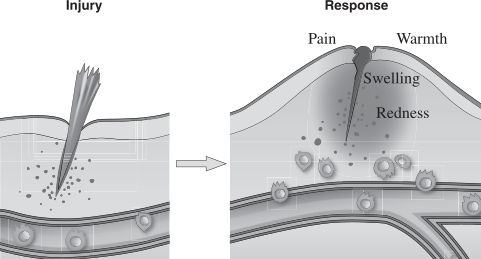
The diagram shows the response to an injury in a human.
 

What is the response shown?

  1. Infection
  2. Inflammation
  3. Phagocytosis
  4. Vasoconstriction
Show Answers Only

`B`

Show Worked Solution
  • Warmth, redness, swelling and pain are all characteristics of inflammation.

`=> B`

Filed Under: Immunity and Responses to Pathogens Tagged With: Band 3, smc-3657-30-Innate Response (2nd Line)

Copyright © 2014–2025 SmarterEd.com.au · Log in