SmarterEd

Aussie Maths & Science Teachers: Save your time with SmarterEd

  • Login
  • Get Help
  • About

BIOLOGY, M7 2025 HSC 11 MC

In 2018, the Victorian government reported the target of vaccinating more than 95% of children below the age of five had been achieved.

What is the benefit of achieving a 95% vaccination rate for an infectious disease?

  1. Only 5% of individuals will catch the disease.
  2. Only 5% of individuals will be protected by the vaccine.
  3. This will protect the remaining 5% who are not vaccinated.
  4. The vaccinated individuals can transfer immunity to the remaining 5%.
Show Answers Only

\(C\)

Show Worked Solution
  • C is correct: High vaccination rate provides herd immunity protecting unvaccinated individuals.

Other Options:

  • A is incorrect: Herd immunity means fewer than 5% will catch disease.
  • B is incorrect: 95% are protected by vaccine, not 5%.
  • D is incorrect: Vaccinated individuals cannot transfer immunity to others through vaccination.

Filed Under: Prevention, Treatment and Control Tagged With: Band 5, smc-3658-20-Vaccines

BIOLOGY, M7 2025 HSC 10 MC

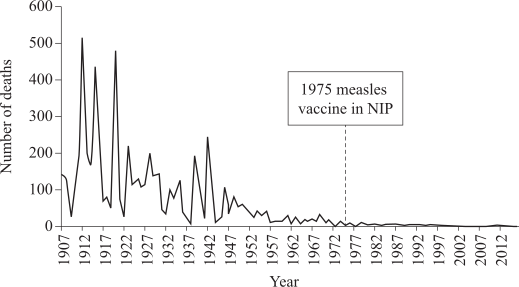
The graph shows the number of recorded deaths, due to measles, before and after the measles vaccine was included in the National Immunisation Program (NIP).
  

Which of the following is a trend shown in the graph?

  1. Most people have been immunised against measles since 1975.
  2. Over the last 100 years the number of deaths has consistently fallen.
  3. The number of measles-induced deaths has fallen to near zero since measles vaccine was added to the NIP.
  4. The National Immunisation Program was the primary reason for the great reduction in measle-induced deaths.
Show Answers Only

\(C\)

Show Worked Solution
  • C is correct: Graph clearly shows deaths fell to near zero after 1975.

Other Options:

  • A is incorrect: Graph shows deaths, not immunisation rates; cannot infer this.
  • B is incorrect: Deaths fluctuated considerably before 1975, not consistent decline.
  • D is incorrect: Deaths were already declining before NIP; cannot claim it’s primary reason.

Filed Under: Prevention, Treatment and Control Tagged With: Band 5, smc-3658-20-Vaccines, smc-3658-40-Interpreting Data

BIOLOGY, M7 2021 VCE 4a

Varicella (chickenpox) is a highly contagious disease caused by the varicella zoster virus. A live, attenuated varicella zoster virus vaccine is recommended for children at age 18 months. In Australia, this vaccine is provided free of charge under the National Immunisation Program.

Once the varicella zoster virus vaccine is injected into the arm of a child, an immune response occurs.

Summarise the immune response that occurs within the child to result in long-term protection from chickenpox.  (5 marks)

--- 10 WORK AREA LINES (style=lined) ---

Show Answers Only
  • The varicella zoster virus vaccine is taken up by cells in the body, such as macrophages.
  • These cells then display the viral antigens on their surface.
  • Antigen-presenting cells then migrate to the lymph nodes, where they interact with naive B cells.
  • The interaction with the antigen-presenting cells stimulates the naive B cells to divide and differentiate into plasma cells and memory B and T cells.
  • Plasma cells produce specific antibodies.
  • Some of the activated B cells and T cells become memory cells.
  • These memory cells provide long-term immunity against the virus. 
Show Worked Solution
  • The varicella zoster virus vaccine is taken up by cells in the body, such as macrophages.
  • These cells then display the viral antigens on their surface.
  • Antigen-presenting cells then migrate to the lymph nodes, where they interact with naive B cells.
  • The interaction with the antigen-presenting cells stimulates the naive B cells to divide and differentiate into plasma cells and memory B and T cells.
  • Plasma cells produce specific antibodies.
  • Some of the activated B cells and T cells become memory cells.
  • These memory cells provide long-term immunity against the virus. 

Filed Under: Prevention, Treatment and Control Tagged With: Band 4, smc-3658-20-Vaccines

BIOLOGY, M7 EQ-Bank 18

It is recommended that a previously unvaccinated 14 year-old female receives two doses of the HPV (Human Papillomavirus) vaccine. The second dose should be given at least four weeks after the first dose.

What is the benefit of having two doses instead of one dose? Justify your response.   (2 marks)

--- 4 WORK AREA LINES (style=lined) ---

Show Answers Only

Benefits of 2 doses of vaccine:

  • The first dose primes the immune system by activating B cells and creating memory cells.
  • The second dose expands the population of memory B cells, enabling a quicker and more effective antibody response.
  • This enhanced secondary immune response provides improved protection against future infections.
Show Worked Solution

Benefits of 2 doses of vaccine:

  • The first dose primes the immune system by activating B cells and creating memory cells.
  • The second dose expands the population of memory B cells, enabling a quicker and more effective antibody response.
  • This enhanced secondary immune response provides improved protection against future infections.

Filed Under: Prevention, Treatment and Control Tagged With: Band 4, smc-3658-20-Vaccines

BIOLOGY, M7 2022 VCE 27 MC

Which of the following cells responds first when a person receives the MMR vaccination?

  1. helper \( \text{T} \) cells
  2. memory \( \text{T} \) cells
  3. cytotoxic \( \text{T} \) cells
  4. antigen-presenting cells
Show Answers Only

\(D\)

Show Worked Solution
  • As the MMR vaccine contains a weakened version of the Measles, Mumps and Rubella viruses, it is the antigen-presenting cells which first respond.

\(\Rightarrow D\)

Filed Under: Prevention, Treatment and Control Tagged With: Band 4, smc-3658-20-Vaccines

BIOLOGY, M7 2023 HSC 30


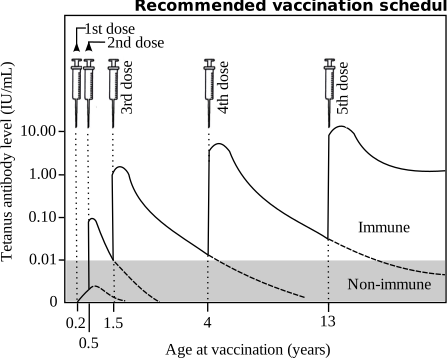
Tetanus vaccines were introduced in 1953 resulting in reduced case numbers. The majority of recorded cases occurred in people aged 65 and over.

The graph shows the vaccination schedule for tetanus.


Assess the use of vaccinations and the vaccination schedule. Use the data provided to support your answer.  (5 marks)

Show Answers Only

  • Vaccines are an excellent tool to reduce the severity and spread of certain infectious diseases.
  • This is because vaccines contain dead or inactive versions of a pathogen, which then stimulates the body to fight it and store memory B cells with the associated antibodies.
  • This can be clearly seen on the graph after the first and second injections of the vaccine, where the first injection is the initial exposure while the second injection has a much larger production of antibodies due to the memory B cells being activated. This is the basis of immunity.
  • This effect is compounded each time with the the length of immunity increasing after each dose.
  • The vaccination schedule is designed so that a new dose is scheduled at the time a person following the recommended schedule would become non-immune.
  • The general trend in the graph/data suggest that the increase in cases of people over 65 is likely due to a long period elapsing since their last booster.
  • In summary, if an individual on the recommended vaccination schedule is exposed to the tetanus virus after 6 months of age, they would have already built up an adequate immunity to be able to fight the tetanus bacteria.
  • This effect makes vaccines especially effective in stopping the spread and severity of infectious diseases such as tetanus.

Show Worked Solution

  • Vaccines are an excellent tool to reduce the severity and spread of certain infectious diseases.
  • This is because vaccines contain dead or inactive versions of a pathogen, which then stimulates the body to fight it and store memory B cells with the associated antibodies.
  • This can be clearly seen on the graph after the first and second injections of the vaccine, where the first injection is the initial exposure while the second injection has a much larger production of antibodies due to the memory B cells being activated. This is the basis of immunity.
  • This effect is compounded each time with the the length of immunity increasing after each dose.
  • The vaccination schedule is designed so that a new dose is scheduled at the time a person following the recommended schedule would become non-immune.
  • The general trend in the graph/data suggest that the increase in cases of people over 65 is likely due to a long period elapsing since their last booster.
  • In summary, if an individual on the recommended vaccination schedule is exposed to the tetanus virus after 6 months of age, they would have already built up an adequate immunity to be able to fight the tetanus bacteria.
  • This effect makes vaccines especially effective in stopping the spread and severity of infectious diseases such as tetanus.

Filed Under: Prevention, Treatment and Control Tagged With: Band 4, smc-3658-20-Vaccines

BIOLOGY, M7 EQ-Bank 7 MC

How do vaccinations prevent disease?

  1. They increase the inflammation process.
  2. They enable the infected cells to seal off the pathogen.
  3. They increase the number of antibodies against the pathogen.
  4. They decrease the number of antigens that trigger the immune response.
Show Answers Only

`C`

Show Worked Solution
  • Vaccines stimulate the immune response, encouraging the division of B cells and therefore producing more antibodies.

`=>C`

Filed Under: Prevention, Treatment and Control Tagged With: Band 4, smc-3658-20-Vaccines

BIOLOGY, M8 2018 HSC 30

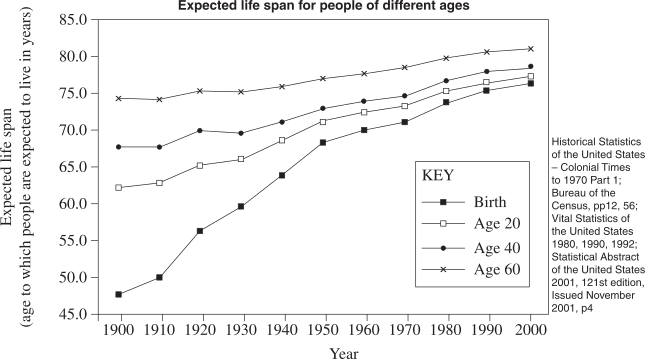
The graph shows the expected life span (the age to which people are expected to live in years) for people of different ages during the 20th century in one country.
 

There have been many biological developments that have contributed to our understanding of the identification, treatment and prevention of disease.

Evaluate the impact of these developments on the expected life span. In your answer, include reference to trends in the data provided.  (8 marks)

--- 18 WORK AREA LINES (style=lined) ---

Show Answers Only
  • For all ages listed in the graph, life expectancy increased during the 20th century.
  • The lifespan from birth has increased more significantly than other ages ~ 48 to 74 years.
  • The smallest increase being for 60 year olds at ~ 5 years.
  • The ability to understand pathogens and the causes of infectious disease (Koch and Pasteur) has led to early identification and treatment of childhood illnesses such as rubella, polio and whooping cough.
  • Koch and Pasteur established germ theory, culture techniques and a set of postulates to follow in order to create the link between a particular pathogen and disease.
  • Vaccines to combat childhood illnesses were developed through a knowledge of germ theory.
  • The infant/childhood mortality rate has improved significantly, and hence life expectancy, due to the immunity provided by vaccines.
  • An understanding of inherited disorders has also improved lifespans with early diagnosis and prenatal genetic screening for genetic disorders and illnesses.
  • Antibiotic remedies were developed to combat bacterial diseases such as Staphylococcus aureus, due to an understanding of the difference between prokaryotic and eukaryotic cells.
  • With the use of antibiotics many diseases were then no longer life threatening, leading to improved mortality rates across all ages.
  • However, bacterial resistance has resulted with the overuse of antibiotics, so some diseases are now unresponsive to antibiotic treatment.
  • Epidemiology studies involving intricate planning and design, control groups and large scale analysis of data have lead to improvements in the treatment of non-infectious diseases such as cancer.
  • For example the discovery of links between smoking and lung cancer, sun exposure and melanoma, obesity and type II diabetes, has lead to widespread public health campaigns to inform people of the health risks and lowered the associated mortality rates.
  • Improved hygiene, food storage and preservation, and water filtration also occurred in the 20th century leading to fewer preventable diseases and hence increased life spans for all age groups.
  • Improved quarantine requirements have helped prevent the spread of plant, animal and human diseases via international travel.
  • In conclusion, developments in biology have lead to increased life expectancy across all age groups, with the biggest improvements for babies and children.
  • These benefits are not necessarily a worldwide phenomenon as poor living conditions and access to medical treatment is not available in many poor socioeconomic communities.
Show Worked Solution
  • For all ages listed in the graph, life expectancy increased during the 20th century.
  • The lifespan from birth has increased more significantly than other ages ~ 48 to 74 years.
  • The smallest increase being for 60 year olds at ~ 5 years.
  • The ability to understand pathogens and the causes of infectious disease (Koch and Pasteur) has led to early identification and treatment of childhood illnesses such as rubella, polio and whooping cough.
  • Koch and Pasteur established germ theory, culture techniques and a set of postulates to follow in order to create the link between a particular pathogen and disease.
  • Vaccines to combat childhood illnesses were developed through a knowledge of germ theory.
  • The infant/childhood mortality rate has improved significantly, and hence life expectancy, due to the immunity provided by vaccines.
  • An understanding of inherited disorders has also improved lifespans with early diagnosis and prenatal genetic screening for genetic disorders and illnesses.
  • Antibiotic remedies were developed to combat bacterial diseases such as Staphylococcus aureus, due to an understanding of the difference between prokaryotic and eukaryotic cells.
  • With the use of antibiotics many diseases were then no longer life threatening, leading to improved mortality rates across all ages.
  • However, bacterial resistance has resulted with the overuse of antibiotics, so some diseases are now unresponsive to antibiotic treatment.
  • Epidemiology studies involving intricate planning and design, control groups and large scale analysis of data have lead to improvements in the treatment of non-infectious diseases such as cancer.
  • For example the discovery of links between smoking and lung cancer, sun exposure and melanoma, obesity and type II diabetes, has lead to widespread public health campaigns to inform people of the health risks and lowered the associated mortality rates.
  • Improved hygiene, food storage and preservation, and water filtration also occurred in the 20th century leading to fewer preventable diseases and hence increased life spans for all age groups.
  • Improved quarantine requirements have helped prevent the spread of plant, animal and human diseases via international travel.
  • In conclusion, developments in biology have lead to increased life expectancy across all age groups, with the biggest improvements for babies and children.
  • These benefits are not necessarily

♦♦ Mean mark 35%.

Filed Under: Causes of Infectious Disease, Epidemiology, Prevention, Treatment and Control Tagged With: Band 5, Band 6, smc-3655-60-Louis Pasteur, smc-3655-70-Robert Koch, smc-3658-11-Pharmaceuticals, smc-3658-20-Vaccines, smc-3658-30-Procedures to Prevent Spread, smc-3661-10-Analysing Results

BIOLOGY, M7 2018 HSC 17 MC

The diagram shows the life cycle of the malaria parasite, Plasmodium sp. Five stages in this life cycle are numbered on the diagram.


To prevent malaria, the following four strategies have been used:

    • taking anti-malarial drugs
    • spraying swamps with insecticides
    • using mosquito nets over beds
    • administering a malaria vaccine.

Which row in the table shows the stage in the life cycle in which each of these strategies would be most effective?
 

\begin{align*}
\begin{array}{l}
\rule{0pt}{2.5ex} \ & \\
 \rule[-2ex]{0pt}{0pt}& \\
\rule{0pt}{2.5ex}\textbf{A.}\rule[-1ex]{0pt}{0pt}\\
\rule{0pt}{2.5ex}\textbf{B.}\rule[-1ex]{0pt}{0pt}\\
\rule{0pt}{2.5ex}\textbf{C.}\rule[-1ex]{0pt}{0pt}\\
\rule{0pt}{2.5ex}\textbf{D.}\rule[-1ex]{0pt}{0pt}\\
\end{array}
\begin{array}{|c|c|c|}
\hline
\rule{0pt}{2.5ex}\textit{Taking}\rule[-1ex]{0pt}{0pt}& \textit{Spraying swamps} & \textit{Using mosquito}& \textit{Adminstering a}\\
\textit{anti-malarial drugs}\rule[-1.5ex]{0pt}{0pt}& \textit{with insecticides} & \textit{nets over beds}& \textit{malaria vaccine}\\
\hline
\rule{0pt}{2.5ex}5\rule[-1ex]{0pt}{0pt}&1& 3& 2\\
\hline
\rule{0pt}{2.5ex}2\rule[-1ex]{0pt}{0pt}&5& 1& 3\\
\hline
\rule{0pt}{2.5ex}1\rule[-1ex]{0pt}{0pt}& 4& 2& 5 \\
\hline
\rule{0pt}{2.5ex}2\rule[-1ex]{0pt}{0pt}& 3 & 5&1\\
\hline
\end{array}
\end{align*}

Show Answers Only

\(D\)

Show Worked Solution
  • Vaccines are most effective when administered before the parasite enters the cell (1).
  • Mosquito nets are only useful if utilised prior to the injection of the parasite into a human (5).
  • Insecticides help prevent the vectors from breeding (3).
  • Anti-malarial drugs may be useful once the disease is present (2).

\(\Rightarrow D\)

Filed Under: Prevention, Treatment and Control Tagged With: Band 4, smc-3658-11-Pharmaceuticals, smc-3658-20-Vaccines, smc-3658-30-Procedures to Prevent Spread, smc-3658-50-Malaria

BIOLOGY, M7 2016 HSC 30

Explain why the combined use of quarantine and vaccination programs is a more effective way of controlling disease than using only one of these strategies.  (5 marks)

--- 10 WORK AREA LINES (style=lined) ---

Show Answers Only
  • Quarantine alone does not provide any immunity from disease, so outbreaks can still occur if exposure occurs.
  • Vaccination can prevent infection, however, immunity takes time to build up, so infection can occur before the vaccine takes effect.
  • Effective vaccination programs can create herd immunity.
  • If this is backed up with isolation of containable outbreaks of the disease, a combined approach can be more effective.
Show Worked Solution
  • Quarantine alone does not provide any immunity from disease, so outbreaks can still occur if exposure occurs.
  • Vaccination can prevent infection, however, immunity takes time to build up, so infection can occur before the vaccine takes effect.
  • Effective vaccination programs can create herd immunity.
  • If this is backed up with isolation of containable outbreaks of the disease, a combined approach can be more effective.

♦ Mean mark 50%.

Filed Under: Prevention, Treatment and Control Tagged With: Band 5, smc-3658-20-Vaccines, smc-3658-30-Procedures to Prevent Spread

BIOLOGY, M8 2016 HSC 19-20 MC

Refer to the following information to answer Questions 19 and 20. 

Melanomas are characterised by uncontrolled cell division caused by mutations that continue to occur once the tumour has developed. Scientists have discovered that vaccines produced using antigens extracted from the patient's own melanoma cells can be useful in treating melanoma. When injected, the vaccines stimulate an immune response.

 
Question 19

What can be inferred from the scientists' discovery?

  1. Cancer cells carry unique antigens.
  2. Self-antigens are not present on cancer cells.
  3. The melanoma patient has a dysfunctional immune system.
  4. The body cannot mount an immune response against cancer cells.

 
Question 20

The effect of the melanoma vaccine is to stimulate

  1. T cells which produce antibodies.
  2. cytotoxic T cells which activate B cells.
  3. cell division to produce more lymphocytes.
  4. production of B cells which destroy melanoma cells.
Show Answers Only

Question 19: `A`

Question 20: `C`

Show Worked Solution

Question 19

  • The vaccine can create an immune response against the cancer cells if self-antigens are not present in the cells.

`=>A`
 

Question 20

  • Lymphocyte development would be promoted by the vaccine.

`=>C`


Mean mark (Q19) 55%
♦♦♦ Mean mark (Q20) 16%

Filed Under: Prevention, Treatment and Control Tagged With: Band 5, Band 6, smc-3658-20-Vaccines

BIOLOGY, M7 2015 HSC 27b

The steps below show the preparation and use of blood products in the treatment of Ebola Virus Disease. This disease is characterised by significant blood loss.

World Health Organisation Protocol

  1. A patient recovers from Ebola Virus Disease.
  2. The same patient is disease-free for 28 days.
  3. Blood is taken from the patient and screened for transmissible diseases.
  4. Plasma is separated from the whole blood.
  5. Plasma is transfused into another person with early signs of Ebola Virus Disease.

 
Explain why this protocol produces an effective treatment for Ebola Virus Disease.   (3 marks)

--- 6 WORK AREA LINES (style=lined) ---

Show Answers Only
  • The plasma has been taken from a person who has survived the Ebola Virus and as a result, it will contain antibodies for the disease.
  • This will assist in the immobilisation of the pathogen in the blood stream of the recipient.
  • The spread of blood-borne diseases such as Ebola from donor to recipient can be prevented through blood screening.
Show Worked Solution
  • The plasma has been taken from a person who has survived the Ebola Virus and as a result, it will contain antibodies for the disease.
  • This will assist in the immobilisation of the pathogen in the blood stream of the recipient.
  • The spread of blood-borne diseases such as Ebola from donor to recipient can be prevented through blood screening.

Filed Under: Prevention, Treatment and Control Tagged With: Band 4, smc-3658-20-Vaccines

BIOLOGY, M7 2019 HSC 2 MC

What does the body produce in response to a vaccine?

  1. Antigens
  2. Antibiotics
  3. Antibodies
  4. Activated toxins
Show Answers Only

`C`

Show Worked Solution
  • The vaccine promotes an immune response, thus producing antibodies.

`=>C`

Filed Under: Prevention, Treatment and Control Tagged With: Band 3, smc-3658-20-Vaccines

BIOLOGY, M7 2022 HSC 9 MC

A new vaccine against an infectious disease was developed. The effectiveness of the vaccine in preventing infection in humans was plotted over time in three different age groups.
 

Which of the following is a valid conclusion that can be drawn from the data in the graph?

  1. The vaccine is ineffective after six months.
  2. The younger the person the more effective the vaccine.
  3. The younger the person, the faster the immunity to infection declines.
  4. The vaccine offers more protection to younger people than those over 65 .
Show Answers Only

`D`

Show Worked Solution
  • The graph shows that the vaccine has a lower effectiveness against infection for people aged over 65 than for the younger age groups over the whole period.

`=>D`

Filed Under: Prevention, Treatment and Control Tagged With: Band 3, smc-3658-20-Vaccines, smc-3658-40-Interpreting Data

BIOLOGY, M7 2020 HSC 32c

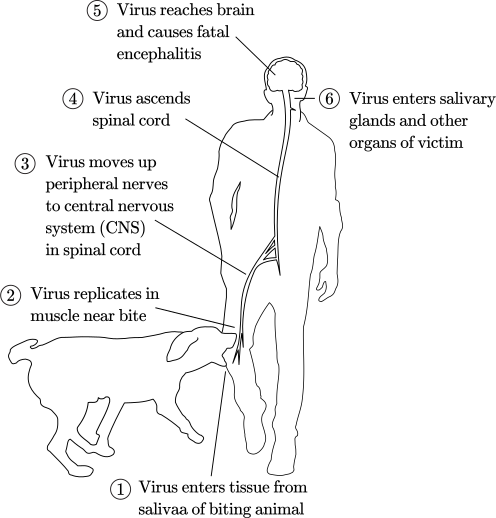
Rabies is a disease that can affect all mammals and is caused by the rabies virus. It is transmitted by the bite of an infected animal. Without treatment it almost always results in death.


  1.  

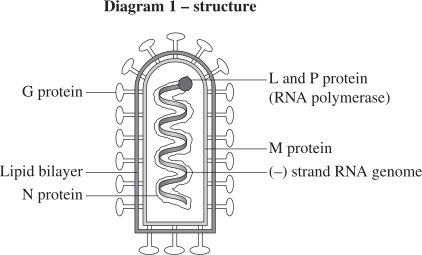
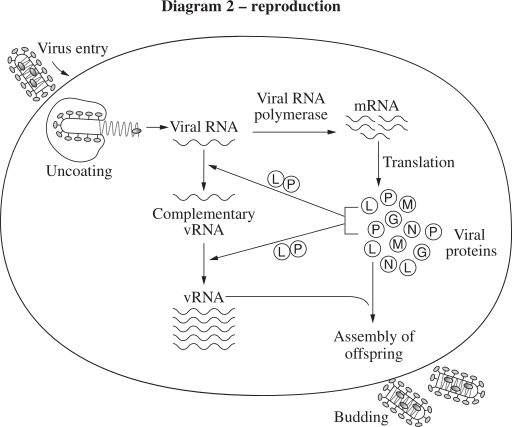
The rabies virus is a single-stranded RNA virus. It contains and codes for only five proteins. The diagrams show the structure and reproduction of the virus.


Post exposure prophylaxis (PEP) is given to patients who have been bitten by a rabid animal.

PEP includes an injection of human rabies antibodies (HRIG) as well as injections of a rabies vaccine at 0, 3, 7 and 14 days after exposure to the virus.

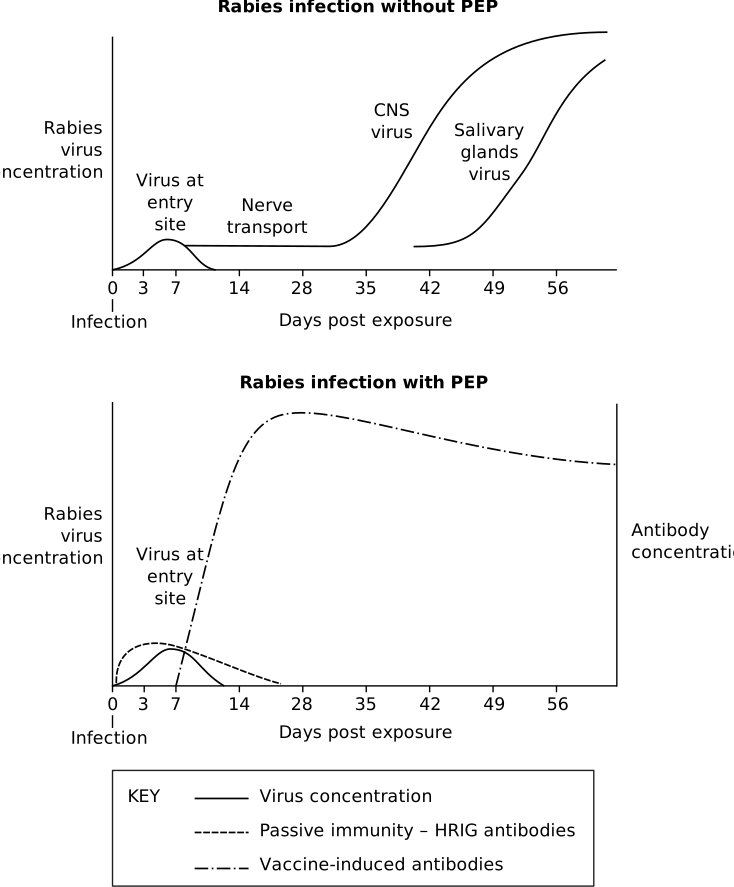
The following graphs show a generalised response to rabies infection without and with PEP.
  

Explain how PEP prevents rabies developing after infection with the virus. Support your answer with reference to the information and data provided above.   (8 marks)

--- 20 WORK AREA LINES (style=lined) ---

Show Answers Only

Once the rabies virus has entered the wound:

  • It will use the patient’s cells to replicate and the viral concentration will increase (as seen in the first five days).
  • Without PEP the virus will continue to replicate, migrate to the CNS (in the first graph this occurs by day 7), and eventually cause rabies and death.
  • Initially, the infected individual will not have the antibodies required to inactivate the virus.
  • A HRIG injection provides the required antibodies to inactivate the virus, through inhibiting replication or enhancing phagocytosis. 
  •  The PEP graph shows that these antibodies will only last up to 21 days, but are essential in inactivating the initial virus, as seen by a reduction in viral concentration after 6-8 days. 

The rabies vaccine works by:

  • containing an inactivated or weakened version of the rabies virus, which stimulates an immune response by the individual.
  • Initially, macrophages will display an MHC-antigen complex on its surface which helper T lymphocytes will bind to.
  • This then stimulates specific plasma B cells which can produce complementary antibodies, and memory B cells, which stay dormant and can rapidly differentiate into plasma B cells when exposed to the same virus.
  • The PEP graph shows the rapid production of antibodies on day 7, which coincides with rapid decrease in the virus concentration over the next few days. 
  • The antibodies then remain in the bloodstream and slowly decline over months, which allows quick diffusion if the virus is encountered within that timeframe.
Show Worked Solution

Once the rabies virus has entered the wound:

  • It will use the patient’s cells to replicate and the viral concentration will increase (as seen in the first five days).
  • Without PEP the virus will continue to replicate, migrate to the CNS (in the first graph this occurs by day 7), and eventually cause rabies and death.
  • Initially, the infected individual will not have the antibodies required to inactivate the virus.
  • A HRIG injection provides the required antibodies to inactivate the virus, through inhibiting replication or enhancing phagocytosis. 
  •  The PEP graph shows that these antibodies will only last up to 21 days, but are essential in inactivating the initial virus, as seen by a reduction in viral concentration after 6-8 days. 

The rabies vaccine works by:

  • containing an inactivated or weakened version of the rabies virus, which stimulates an immune response by the individual.
  • Initially, macrophages will display an MHC-antigen complex on its surface which helper T lymphocytes will bind to.
  • This then stimulates specific plasma B cells which can produce complementary antibodies, and memory B cells, which stay dormant and can rapidly differentiate into plasma B cells when exposed to the same virus.
  • The PEP graph shows the rapid production of antibodies on day 7, which coincides with rapid decrease in the virus concentration over the next few days. 
  • The antibodies then remain in the bloodstream and slowly decline over months, which allows quick diffusion if the virus is encountered within that timeframe.

♦♦ Mean mark 41%.

Filed Under: Immunity and Responses to Pathogens, Prevention, Treatment and Control Tagged With: Band 5, Band 6, smc-3657-10-Antibody Mediated, smc-3657-25-Antibodies, smc-3658-20-Vaccines

BIOLOGY, M7 2021 HSC 30

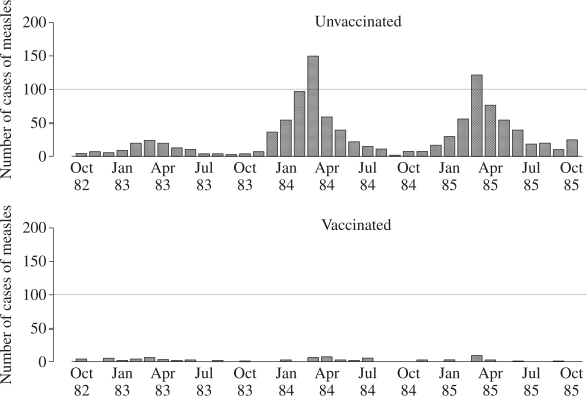
A study compared the incidence of disease and survival of 8134 children who had received the measles vaccine with 8134 children from a neighbouring area who remained unvaccinated against measles. Children in each group were matched for age, sex, size of dwelling, number of siblings and maternal education. The graphs show the number of measles cases among the two groups over three years.


The table compares the cause of death and number of deaths of the two groups over the same three years.
 

'A vaccine only protects the community against a specific disease.'

Analyse the data with reference to this statement.   (7 marks)

--- 17 WORK AREA LINES (style=lined) ---

Show Answers Only
  • These two studies show proof that the vaccine protects against measles.
  • The graphs show the incidence of measles in vaccinated children is extremely low, occasionally zero, compared to unvaccinated children. Since these children are matched for age and other sociocultural/socioeconomic factors, it is highly likely the vaccine is responsible for this difference.
  • The table also supports this conclusion, where 40 children who were unvaccinated died due to measles compared to the 2 who died who were vaccinated.
  • The table also provides evidence that the vaccine may protect children from dying from other diseases, contradicting the statement.
  • The table also uses the same groups as the graph, again, keeping cultural/socioeconomic factors similar. It shows that children vaccinated against measles died at half the rate of unvaccinated children due to diarrhoea and dysentery, and at about a quarter of the rate for oedema.
  • However, the small differences between groups with respect to fever and the small sample size for oedema mean that further research is required.
  • In general, the vaccinated group had less than half the mortality of the unvaccinated group, supporting the conclusion that the vaccine provides a wider protection.
  • However, this statement needs qualification as the data is only with respect to the measles vaccine. 
Show Worked Solution
  • These two studies show proof that the vaccine protects against measles.
  • The graphs show the incidence of measles in vaccinated children is extremely low, occasionally zero, compared to unvaccinated children. Since these children are matched for age and other sociocultural/socioeconomic factors, it is highly likely the vaccine is responsible for this difference.
  • The table also supports this conclusion, where 40 children who were unvaccinated died due to measles compared to the 2 who died who were vaccinated.
  • The table also provides evidence that the vaccine may protect children from dying from other diseases, contradicting the statement.
  • The table also uses the same groups as the graph, again, keeping cultural/socioeconomic factors similar. It shows that children vaccinated against measles died at half the rate of unvaccinated children due to diarrhoea and dysentery, and at about a quarter of the rate for oedema.
  • However, the small differences between groups with respect to fever and the small sample size for oedema mean that further research is required.
  • In general, the vaccinated group had less than half the mortality of the unvaccinated group, supporting the conclusion that the vaccine provides a wider protection.
  • However, this statement needs qualification as the data is only with respect to the measles vaccine. 

Filed Under: Prevention, Treatment and Control Tagged With: Band 4, Band 5, smc-3658-20-Vaccines, smc-3658-40-Interpreting Data

BIOLOGY, M7 2021 HSC 28b

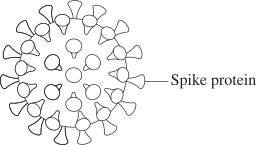
An mRNA vaccine has been developed in order to immunise people against a virus. The vaccine contains modified mRNA which codes for the spike protein on the surface of the virus.
 

Explain how this vaccine can lead to active immunity to the virus.   (5 marks)

Show Answers Only
  • The modified mRNA enters the individuals cells and is translated at the ribosomes to form the viral spike protein, which is then released into the body.
  • The protein will be rendered as an antigen, and will trigger a specific immune response by B and T lymphocytes that match the antigen.
  • Once the viral protein has been removed, memory B and T lymphocytes specific to the protein remain, providing active immunity that allows for a rapid future response.
  • If the individual is later exposed to the virus, the same spike proteins present on the virus’ surface will trigger a rapid and large response by the memory cells. This is the basis for providing active immunity.
Show Worked Solution
  • The modified mRNA enters the individuals cells and is translated at the ribosomes to form the viral spike protein, which is then released into the body.
  • The protein will be rendered as an antigen, and will trigger a specific immune response by B and T lymphocytes that match the antigen.
  • Once the viral protein has been removed, memory B and T lymphocytes specific to the protein remain, providing active immunity that allows for a rapid future response.
  • If the individual is later exposed to the virus, the same spike proteins present on the virus’ surface will trigger a rapid and large response by the memory cells. This is the basis for providing active immunity.

♦ Mean mark 43%.

Filed Under: Immunity and Responses to Pathogens, Prevention, Treatment and Control Tagged With: Band 5, smc-3657-10-Antibody Mediated, smc-3657-20-Cell Mediated, smc-3658-20-Vaccines

Copyright © 2014–2025 SmarterEd.com.au · Log in