SmarterEd

Aussie Maths & Science Teachers: Save your time with SmarterEd

  • Login
  • Get Help
  • About

BIOLOGY, M7 2021 VCE 36 MC

A study assessed the effectiveness and safety of a drug called doxycycline. One hundred and fifty adults hospitalised with malaria were involved. These adults were randomly placed into two groups of equal size. One group received doxycycline in addition to standard care. The other group received standard care only.

The group receiving standard care only was the

  1. control group.
  2. variable group.
  3. unsupported group.
  4. experimental group.
Show Answers Only

\(A\)

Show Worked Solution
  • A control group does not receive the experimental treatment or any intervention being tested.

\(\Rightarrow A\)

Filed Under: Prevention, Treatment and Control Tagged With: Band 2, smc-3658-50-Malaria

BIOLOGY, M7 2023 HSC 26

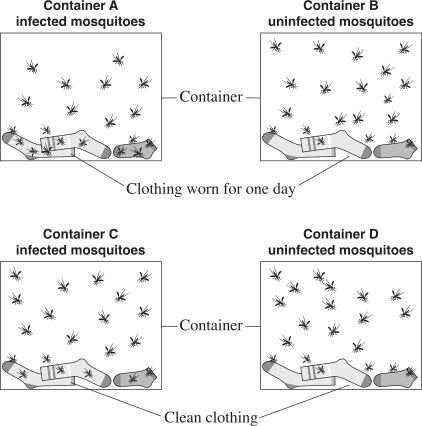
Malaria is a potentially fatal infectious disease that is spread to humans by infected mosquitoes. Scientists investigated the behaviour of 20 mosquitoes for an hour in each of the four containers shown.

Aim: To determine if wearing clean clothing reduces the transmission of malaria.
 

Assume infected mosquitoes that land on clothing transmit malaria.

  1. Identify the dependent variable and a controlled variable in this investigation.   (2 marks)

    --- 3 WORK AREA LINES (style=lined) ---

  2. The results of the investigation showing the number of times mosquitoes landed on the clothing in an hour are provided.
     
    \begin{array}{|c|c|c|c|c|}
    \hline
    \rule{0pt}{2.5ex} \textit {Experiment} \rule[-1ex]{0pt}{0pt}& \textit {Container A} & \textit {Container B} & \textit {Container C} & \textit {Container D} \\
    \hline
    \rule{0pt}{2.5ex}  1 \rule[-1ex]{0pt}{0pt}& 15 & 7 & 12 & 5 \\
    \hline
    \rule{0pt}{2.5ex} 2 \rule[-1ex]{0pt}{0pt}& 19 & 5 & 9 & 3 \\
    \hline
    \rule{0pt}{2.5ex} 3 \rule[-1ex]{0pt}{0pt}& 12 & 4 & 14 & 6 \\
    \hline
    \rule{0pt}{2.5ex} 4 \rule[-1ex]{0pt}{0pt}& 18 & 6 & 13 & 4 \\
    \hline
    \rule{0pt}{2.5ex} 5 \rule[-1ex]{0pt}{0pt}& 19 & 6 & 10 & 3 \\
    \hline
    \end{array}
  1.  Justify a suitable conclusion for this investigation.   (3 marks)

    --- 6 WORK AREA LINES (style=lined) ---

Show Answers Only

a.   Dependant Variable: Number of mosquitos that land on the clothing.

Controlled Variable: Number of mosquitos in each container.

Alternative controlled variable: size of container
 

b.   Data results show:

  • Wearing clean clothing, on average, reduces the number of mosquitos that land on clothes.
  • This effect occurs for both infected and uninfected mosquitos.
  • Conclusion: wearing clean clothing will reduce the transmission of malaria, as infected mosquitos will land on clean clothing less often than on clothing already worn for a day.

Show Worked Solution

a.   Dependant Variable: Number of mosquitos that land on the clothing.

Controlled Variable: Number of mosquitos in each container.

Alternative controlled variable: size of container

♦ Mean mark 51%.

b.   Data results show:

  • Wearing clean clothing, on average, reduces the number of mosquitos that land on clothes.
  • This effect occurs for both infected and uninfected mosquitos.
  • Conclusion: wearing clean clothing will reduce the transmission of malaria, as infected mosquitos will land on clean clothing less often than on clothing already worn for a day.

Filed Under: Prevention, Treatment and Control Tagged With: Band 4, Band 5, smc-3658-50-Malaria

BIOLOGY, M7 2018 HSC 17 MC

The diagram shows the life cycle of the malaria parasite, Plasmodium sp. Five stages in this life cycle are numbered on the diagram.


To prevent malaria, the following four strategies have been used:

    • taking anti-malarial drugs
    • spraying swamps with insecticides
    • using mosquito nets over beds
    • administering a malaria vaccine.

Which row in the table shows the stage in the life cycle in which each of these strategies would be most effective?
 

\begin{align*}
\begin{array}{l}
\rule{0pt}{2.5ex} \ & \\
 \rule[-2ex]{0pt}{0pt}& \\
\rule{0pt}{2.5ex}\textbf{A.}\rule[-1ex]{0pt}{0pt}\\
\rule{0pt}{2.5ex}\textbf{B.}\rule[-1ex]{0pt}{0pt}\\
\rule{0pt}{2.5ex}\textbf{C.}\rule[-1ex]{0pt}{0pt}\\
\rule{0pt}{2.5ex}\textbf{D.}\rule[-1ex]{0pt}{0pt}\\
\end{array}
\begin{array}{|c|c|c|}
\hline
\rule{0pt}{2.5ex}\textit{Taking}\rule[-1ex]{0pt}{0pt}& \textit{Spraying swamps} & \textit{Using mosquito}& \textit{Adminstering a}\\
\textit{anti-malarial drugs}\rule[-1.5ex]{0pt}{0pt}& \textit{with insecticides} & \textit{nets over beds}& \textit{malaria vaccine}\\
\hline
\rule{0pt}{2.5ex}5\rule[-1ex]{0pt}{0pt}&1& 3& 2\\
\hline
\rule{0pt}{2.5ex}2\rule[-1ex]{0pt}{0pt}&5& 1& 3\\
\hline
\rule{0pt}{2.5ex}1\rule[-1ex]{0pt}{0pt}& 4& 2& 5 \\
\hline
\rule{0pt}{2.5ex}2\rule[-1ex]{0pt}{0pt}& 3 & 5&1\\
\hline
\end{array}
\end{align*}

Show Answers Only

\(D\)

Show Worked Solution
  • Vaccines are most effective when administered before the parasite enters the cell (1).
  • Mosquito nets are only useful if utilised prior to the injection of the parasite into a human (5).
  • Insecticides help prevent the vectors from breeding (3).
  • Anti-malarial drugs may be useful once the disease is present (2).

\(\Rightarrow D\)

Filed Under: Prevention, Treatment and Control Tagged With: Band 4, smc-3658-11-Pharmaceuticals, smc-3658-20-Vaccines, smc-3658-30-Procedures to Prevent Spread, smc-3658-50-Malaria

BIOLOGY, M7 2017 HSC 22a

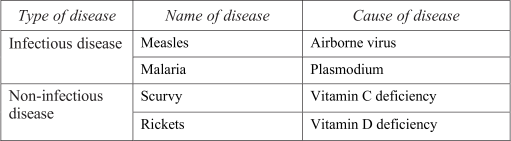
For each type of disease in the following table, name a specific disease and its cause.   (2 marks)

\begin{array} {|l|c|}
\hline
\rule{0pt}{2.5ex} \text{Type of disease} \rule[-1ex]{0pt}{0pt} & \quad \quad\text{Name of disease} \quad\quad &\quad \quad\text{Cause of disease}\quad\quad\\
\hline
\rule{0pt}{2.5ex} \text{Infectious disease} \rule[-1ex]{0pt}{0pt} & \text{} &\text{}\\
\rule{0pt}{2.5ex} \text{} \rule[-1ex]{0pt}{0pt} & \text{} \text{}\\
\hline
\rule{0pt}{2.5ex} \text{Non-infectious} \rule[-1ex]{0pt}{0pt} & \text{} \text{}\\
\text{disease} \rule[-1ex]{0pt}{0pt} & \text{} \text{}\\
\rule{0pt}{2.5ex} \text{} \rule[-1ex]{0pt}{0pt} & \text{} \text{}\\
\hline
\end{array} 

--- 0 WORK AREA LINES (style=lined) ---

Show Answers Only

Answers could include one example of the two given:

Show Worked Solution

Answers could include one example of the two given:

Filed Under: Causes and Effects, Prevention, Treatment and Control Tagged With: Band 4, smc-3658-50-Malaria, smc-3660-11-Environmental/Nutritional

BIOLOGY, M7 2019 HSC 32

Use the following data to answer parts (a) and (b).

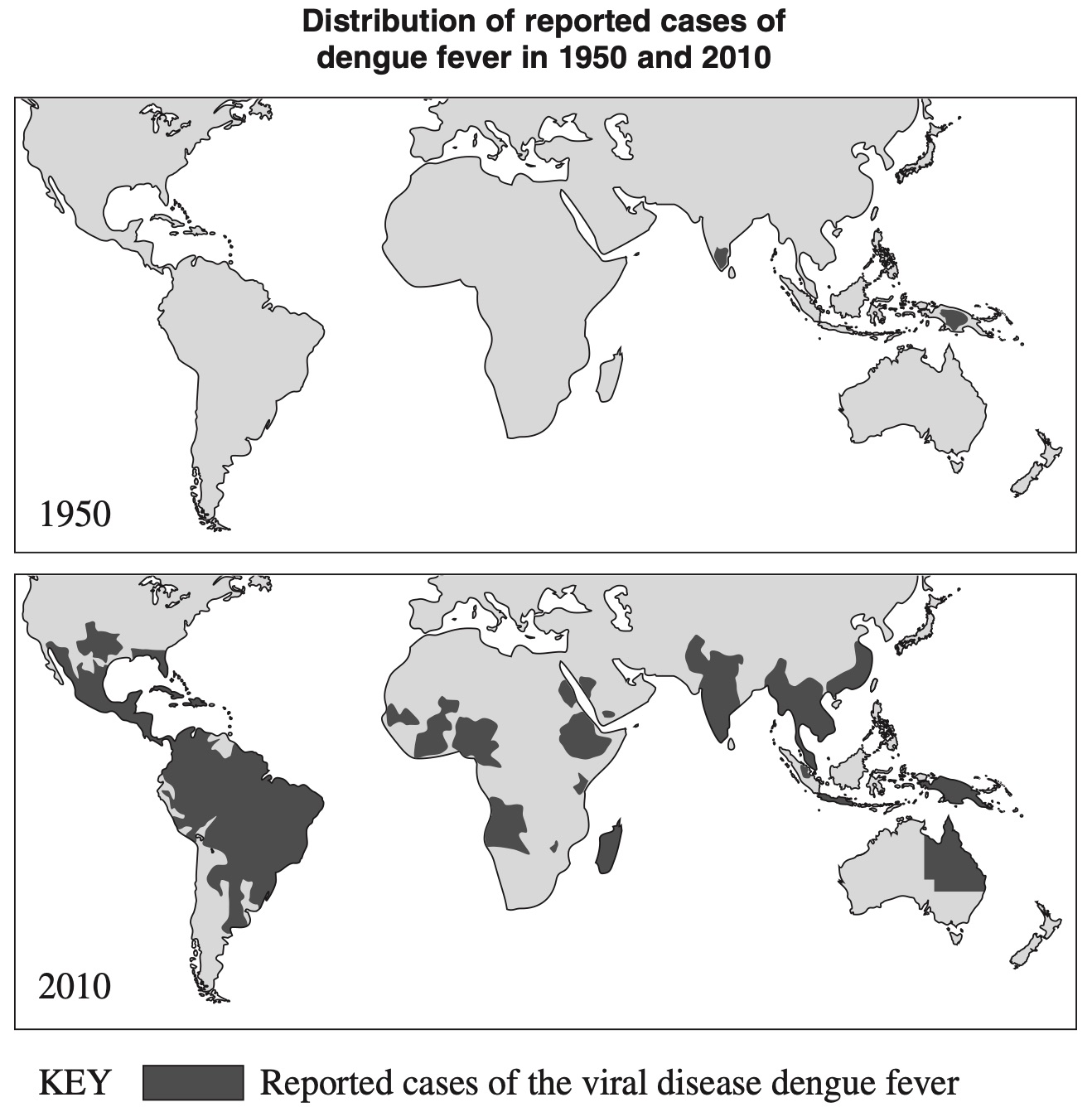
Dengue fever and malaria are examples of infectious diseases transmitted between humans by mosquitoes. Dengue fever is caused by a virus transmitted by mosquitoes of the genus Aedes. Malaria is caused by a single-celled organism transmitted by mosquitoes of the genus Anopheles.

The following data provide information about the global incidence of these two diseases over time.


  1. Based on the data provided, identify trends in the global disease burden for both malaria and dengue fever.   (3 marks)

    --- 8 WORK AREA LINES (style=lined) ---

  2. Analyse factors that could have contributed to the change in global distribution of both dengue fever and malaria over the last 100 years. Support your answer with reference to the data provided.   (7 marks)

    --- 16 WORK AREA LINES (style=lined) ---

Show Answers Only

a.   Trends in global disease burden:

  • The distribution on Dengue Fever has significantly increased since 1950, with continents such as Australia, Europe, South America and Africa now having a significant number of reported cases.
  • This spread is seen both north and south of the equator.
  • Malaria has a declining number of countries with reported cases of the disease.
  • However, population growth means the number of individuals at risk is increasing, having almost doubled between 1965 and 2010.
  • We can conclude however, that there is an increasing number of people at risk of malaria, but representing a smaller portion of the global population. 

b.  Analysis of factors that could have contributed to the change in global distribution of both dengue fever and malaria

Both diseases are transmitted by a mosquito vector. The prevalence of mosquitoes in each area would therefore have a large influence on the number of infected individuals.

  • The increase in international travel allows mosquitoes to spread across the world.
  • The increasing population of the world along with rapid urbanisation gives rise to more urban mosquito habitats.

These factors can be associated with the distribution seen on the Dengue Fever map, however the countries with reported cases of Malaria has shrunk.

  • The mosquitoes responsible for Dengue Fever and Malaria respectively, are from a different genus of mosquito. It is likely that more is known about Anopheles than Aedes.
  • The use of quarantine and pesticides on the Anopheles is most likely being used to contain the spread of malaria.

Medical advances such as vaccines also have the potential to be an effective measure of containing diseases.

  • From both data sets, it would be accurate to conclude, however, that medicinal products had better results when maintaining malaria compared to dengue fever.
  • Antimalarial tablets or a malaria vaccine may be types of malaria medicinal products that may be used to maintain the disease.
  • The rapid evolution of the dengue virus, ineffective antivirals or potentially that there is no known vaccine may be some of the reasons why medicinals may not be effective for dengue fever.
Show Worked Solution

a.   Trends in global disease burden:

  • The distribution on Dengue Fever has significantly increased since 1950, with continents such as Australia, Europe, South America and Africa now having a significant number of reported cases.
  • This spread is seen both north and south of the equator.
  • Malaria has a declining number of countries with reported cases of the disease.
  • However, population growth means the number of individuals at risk is increasing, having almost doubled between 1965 and 2010.
  • We can conclude however, that there is an increasing number of people at risk of malaria, but representing a smaller portion of the global population. 

b.  Analysis of factors that could have contributed to the change in global distribution of both dengue fever and malaria

Both diseases are transmitted by a mosquito vector. The prevalence of mosquitoes in each area would therefore have a large influence on the number of infected individuals.

  • The increase in international travel allows mosquitoes to spread across the world.
  • The increasing population of the world along with rapid urbanisation gives rise to more urban mosquito habitats.

These factors can be associated with the distribution seen on the Dengue Fever map, however the countries with reported cases of Malaria has shrunk.

  • The mosquitoes responsible for Dengue Fever and Malaria respectively, are from a different genus of mosquito. It is likely that more is known about Anopheles than Aedes.
  • The use of quarantine and pesticides on the Anopheles is most likely being used to contain the spread of malaria.

Medical advances such as vaccines also have the potential to be an effective measure of containing diseases.

  • From both data sets, it would be accurate to conclude, however, that medicinal products had better results when maintaining malaria compared to dengue fever.
  • Antimalarial tablets or a malaria vaccine may be types of malaria medicinal products that may be used to maintain the disease.
  • The rapid evolution of the dengue virus, ineffective antivirals or potentially that there is no known vaccine may be some of the reasons why medicinals may not be effective for dengue fever.

♦ Mean mark (b) 52%.

Filed Under: Prevention, Treatment and Control Tagged With: Band 4, Band 5, smc-3658-40-Interpreting Data, smc-3658-50-Malaria

BIOLOGY, M7 2022 HSC 30

Malaria is a disease transmitted by a mosquito vector. There has been no effective vaccine developed.

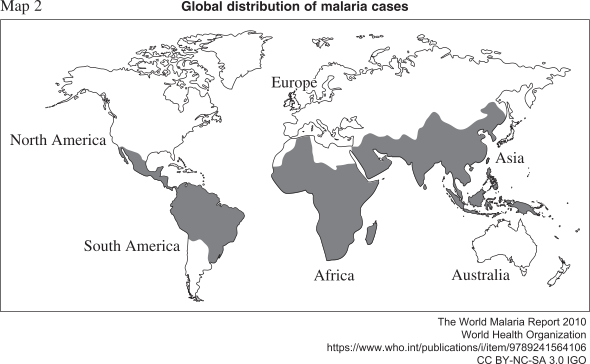
Refer to the maps below to answer Question 30.


Discuss possible reasons for the differences in the distribution of malaria and its vector. Include detailed reference to Map 1 and Map 2.  (7 marks)

--- 16 WORK AREA LINES (style=lined) ---

Show Answers Only
  • Malaria is a disease which is transmitted via a female mosquito.
  • The plasmodium responsible for the disease can multiply inside a mosquito.
  • When it bites an individual, it enters the bloodstream via the mosquito’s saliva.
  • The presence of infected individuals and the malaria vector (mosquito) in the same regional area is an obvious overlap between the two maps.

 Regions with mosquito vector but no infected individuals

  • Areas such as Japan, Western Europe and North America have the mosquito vector responsible for malaria but no infected individuals.

This can be due to:

  • Accessibility to medical treatment such as pharmaceuticals which can treat infected individuals.
  • Better mosquito control eg effective repellent.
  • Better quarantine of infected individuals.

 Regions with no mosquito vector but infected individuals

  • Areas such as China, sections of Northern and Southern Africa and areas of the North-Western coast of South America have cases of malaria but no mosquito vectors in the area.

This can be due to:

  • Migration of infected individuals to the areas stated above from surrounding areas where both the vector and disease are present.
Show Worked Solution
  • Malaria is a disease which is transmitted via a female mosquito.
  • The plasmodium responsible for the disease can multiply inside a mosquito.
  • When it bites an individual, it enters the bloodstream via the mosquito’s saliva.
  • The presence of infected individuals and the malaria vector (mosquito) in the same regional area is an obvious overlap between the two maps.

 Regions with mosquito vector but no infected individuals

  • Areas such as Japan, Western Europe and North America have the mosquito vector responsible for malaria but no infected individuals.

This can be due to:

  • Accessibility to medical treatment such as pharmaceuticals which can treat infected individuals.
  • Better mosquito control eg effective repellent.
  • Better quarantine of infected individuals.

 Regions with no mosquito vector but infected individuals

  • Areas such as China, sections of Northern and Southern Africa and areas of the North-Western coast of South America have cases of malaria but no mosquito vectors in the area.

This can be due to:

  • Migration of infected individuals to the areas stated above from surrounding areas where both the vector and disease are present.

Mean mark 56%.

Filed Under: Prevention, Treatment and Control Tagged With: Band 4, Band 5, smc-3658-30-Procedures to Prevent Spread, smc-3658-50-Malaria

Copyright © 2014–2025 SmarterEd.com.au · Log in