SmarterEd

Aussie Maths & Science Teachers: Save your time with SmarterEd

  • Login
  • Get Help
  • About

CHEMISTRY, M7 2025 HSC 27

Mixtures of hydrocarbons can be obtained from crude oil by the process of fractional distillation. Examples include petrol, diesel and natural gas.

  1. Outline an environmental implication for a use of a named hydrocarbon mixture that is obtained from crude oil.   (2 marks)

    --- 5 WORK AREA LINES (style=lined) ---

  2. Ethene is a simple hydrocarbon obtained from crude oil.
  3. Using structural formulae, write the chemical equation for the conversion of ethene to ethanol, including any other necessary reagents.   (3 marks)

    --- 0 WORK AREA LINES (style=lined) ---

  1. When ethanol is reacted with ethanoic acid, ethyl ethanoate is formed, as shown by the equation.
      1. \(\text{ethanol} \ + \ \text{ethanoic acid } \ \rightleftharpoons \ \text{ethyl ethanoate} \ +\ \text{water}\)
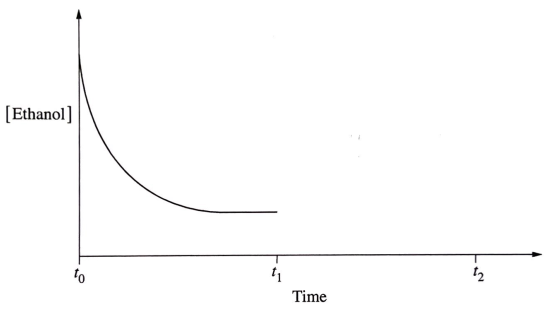
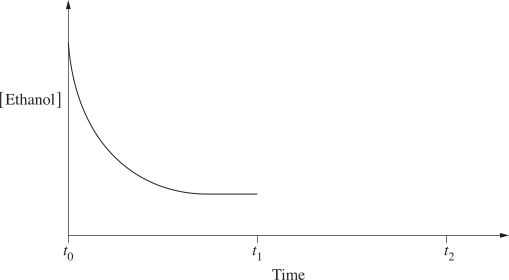
  2. The graph below shows the concentration of ethanol from the start of the reaction, \(t_0\), up to a time \(t_1\).
  3. At time \(t_1\), an additional amount of ethanol is added to the system.
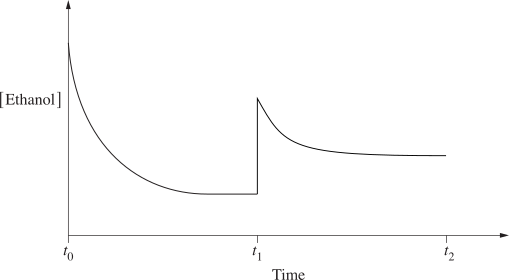
  4. Sketch on the graph the changes that occur in the concentration of ethanol between time \(t_1\), and when the system reaches a new equilibrium before time \(t_2\).   (3 marks)

    --- 0 WORK AREA LINES (style=lined) ---
Show Answers Only

a.    Environmental implication:

  • The combustion of petrol, a hydrocarbon mixture obtained from crude oil, leads to the release of large amounts of carbon dioxide.
  • Increased \(\ce{CO2}\) levels intensify the enhanced greenhouse effect, contributing to global warming, climate change, and associated environmental impacts such as rising sea levels and extreme weather patterns.
  • A typical component of petrol, octane, burns according to:
  •    \(\ce{2C8H18(l) + 25O2(g) -> 16CO2(g) + 18H2O(g)}\)

b.    

           

c.    
       

Show Worked Solution

a.    Environmental implication:

  • The combustion of petrol, a hydrocarbon mixture obtained from crude oil, leads to the release of large amounts of carbon dioxide.
  • Increased \(\ce{CO2}\) levels intensify the enhanced greenhouse effect, contributing to global warming, climate change, and associated environmental impacts such as rising sea levels and extreme weather patterns.
  • A typical component of petrol, octane, burns according to:
  •    \(\ce{2C8H18(l) + 25O2(g) -> 16CO2(g) + 18H2O(g)}\)

b.    
           

c.    
       

  • There will be a sudden increase at \(t_1\) and then the concentration of ethanol will decrease smoothly until a new equlibrium concentration (greater than the original equilibrium concentration) is reached.
Filed Under: Factors that Affect Equilibrium, Hydrocarbons and Associated Reactions Tagged With: Band 4, Band 5, smc-3670-30-Concentration, smc-3670-60-Concentration diagrams, smc-3677-70-Reactions of Unsaturated Hydrocarbons, smc-3677-90-Environment

CHEMISTRY, M5 2024 HSC 26

The equilibrium equation for the reaction of iodine with hydrogen cyanide in aqueous solution is given.

\(\ce{I_2(aq) + HCN(aq)\rightleftharpoons ICN(aq) + I^{-}(aq) + H^{+}(aq)}\)

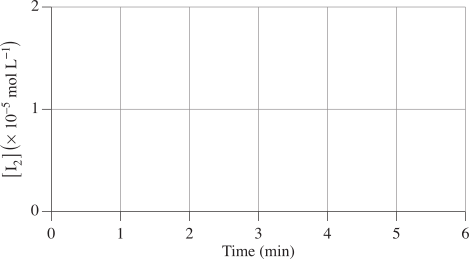
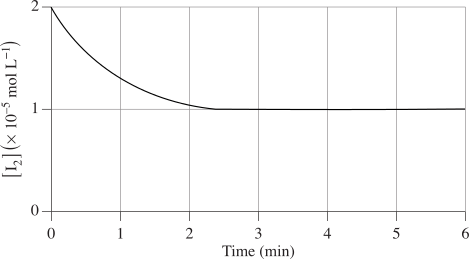
At  \(t=0\) min, \(\ce{I2}\) was added to a mixture of \(\ce{HCN, I^{-}}\) and \(\ce{H^{+}}\), bringing \(\left[ \ce{I2}\right]\) to 2.0 × 10\(^{-5}\) mol L\(^{-1}\). After 3 minutes, the system was at equilibrium, and an analysis of the mixture found that half of the \(\ce{I2}\) had reacted.

  1. On the axes provided, sketch a graph to show how \(\left[\ce{I_2}\right]\) changes in the solution between  \(t=0\) min  and  \(t=6\) min.   (2 marks)

    --- 0 WORK AREA LINES (style=lined) ---


  1. Using collision theory, explain the rate of reaction between  \(t=0\) min  and  \(t=6\) min. Refer to the \(\left[ \ce{I2}\right]\) in your answer.   (3 marks)

    --- 8 WORK AREA LINES (style=lined) ---

Show Answers Only

a.    

b.    Initially, the high \(\ce{[I2]}\) results in a large number of collisions between reactants.

  • This results in an initially high reaction rate for the forward reaction. 
  • Between \(t=0\) and \(t=3\), the concentration of \(\ce{I2}\) decreases. Less collisions between reactant particles occur leading to a decrease in the rate of the forward reaction.
  • Between \(t=0\) and \(t=3\), as the concentration of reactants decrease, the concentration of the products increase. This leads to an increase in the number of successful collisions between product particles and a subsequent increase in the rate of the reverse reaction.
  • Between \(t=3\) and \(t=6\), the concentration of \(\ce{I2}\) remains constant. This is due to the system reaching a state of dynamic equilibrium so the frequency of successful collisions between the reactants is equal to the frequency of successful collisions between the products. i.e. the rates of the forward and reverse reactions are equal. 

Show Worked Solution

a.   


b.    Initially, the high \(\ce{[I2]}\) results in a large number of collisions between reactants.

  • This results in an initially high reaction rate for the forward reaction. 
  • Between \(t=0\) and \(t=3\), the concentration of \(\ce{I2}\) decreases. Less collisions between reactant particles occur leading to a decrease in the rate of the forward reaction.
  • Between \(t=0\) and \(t=3\), as the concentration of reactants decrease, the concentration of the products increase. This leads to an increase in the number of successful collisions between product particles and a subsequent increase in the rate of the reverse reaction.
  • Between \(t=3\) and \(t=6\), the concentration of \(\ce{I2}\) remains constant. This is due to the system reaching a state of dynamic equilibrium so the frequency of successful collisions between the reactants is equal to the frequency of successful collisions between the products. i.e. the rates of the forward and reverse reactions are equal. 
Mean mark (b) 56%.

Filed Under: Factors that Affect Equilibrium Tagged With: Band 4, Band 5, smc-3670-30-Concentration, smc-3670-40-Collision theory, smc-3670-60-Concentration diagrams

CHEMISTRY, M5 2024 HSC 7 MC

The following equilibrium was established in a container.

\(\ce{2SO_2(g) + O_2(g) \rightleftharpoons 2SO_3(g) \quad \Delta H= -198 kJ mol^{-1}}\)

Which of the following would increase the yield of \(\ce{SO_3(g)}\)?

  1. Increasing the volume
  2. Increasing the temperature
  3. Removing the product as it is formed
  4. Keeping temperature and volume constant
Show Answers Only

\(C\)

Show Worked Solution
  • \(A\): Increasing the volume decreases the pressure of the system → favours the reverse reaction, decreasing yield.
  • \(B\): Increasing the temperature will favour the reverse endothermic reaction, decreasing yield.
  • \(C\): Removing \(\ce{SO3(g)}\) as it is formed decreases the concentration of \(\ce{SO3(g)}\). By Le Chatelier’s principle, the equilibrium system will shift to increase the concentration of \(\ce{SO3(g)}\), increasing the yield.
  • \(D\): Keeping temp and volume constant will have no impact on the equilibrium system.

\(\Rightarrow C\)

Filed Under: Factors that Affect Equilibrium Tagged With: Band 4, smc-3670-30-Concentration, smc-3670-70-Max yield conditions

CHEMISTRY, M5 EQ-Bank 21

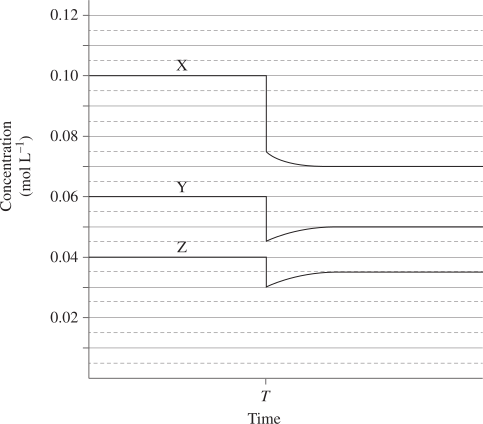
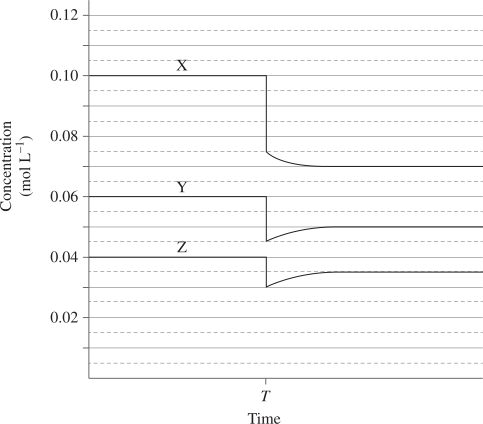
Three gases \(\ce{X, Y}\) and \(\ce{Z}\) were mixed in a closed container and allowed to reach equilibrium. A change was imposed at time \(\ce{$T$}\) and the equilibrium was re-established. The concentration of each gas is plotted against time.
 

  1. What is a possible change that was imposed at time \(\ce{$T$}\)?   (1 mark)

    --- 2 WORK AREA LINES (style=lined) ---

  2. Write a chemical reaction that is represented by the concentration graph above.   (2 marks)

    --- 4 WORK AREA LINES (style=lined) ---

Show Answers Only

a.    An increase in the volume of the container.

b.    \( \ce{X(g) \rightleftharpoons Y(g) + Z(g)}\)

Show Worked Solution

a.   At time \(\ce{$T$}\):

  • The concentration of all species decreases by an amount proportional to their initial concentration.
  • This could be due to an increase in the volume of the container.

b.   Chemical reaction:

  • After the system change, equilibrium re-establishes by favouring the conversion of \(\ce{X}\) into \(\ce{Y}\) and \(\ce{Z}\) .
  • As change in concentration of all species is equal, they react in a 1:1:1 molar ratio.
  • Therefore the chemical reaction is:  \( \ce{X(g) \rightleftharpoons Y(g) + Z(g)}\)

Filed Under: Factors that Affect Equilibrium Tagged With: Band 3, Band 5, smc-3670-30-Concentration, smc-3670-60-Concentration diagrams

CHEMISTRY, M5 2016 HSC 28

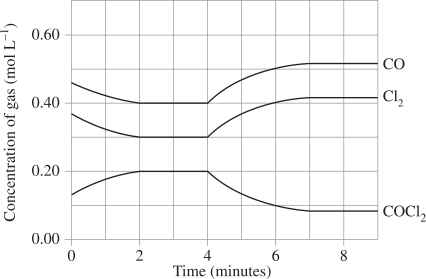
A mixture of carbon monoxide, chlorine and phosgene \(\ce{(COCl_2)}\) gases was placed in a closed container. The concentrations of the gases were monitored over time.
 

  1. At what time does the system first reach equilibrium? Justify your answer.   (2 marks)

    --- 2 WORK AREA LINES (style=lined) ---

  2. At four minutes, the temperature of the container was increased.
  3. Explain, with reference to the graph, whether the decomposition of \(\ce{COCl_2}\) into \(\ce{CO}\) and \(\ce{Cl_2}\) is exothermic or endothermic.   (3 marks)

    --- 5 WORK AREA LINES (style=lined) ---

Show Answers Only

a.    At two minutes (where the concentrations stop changing)

b.    \(\ce{CO(g) + Cl2(g) \rightleftharpoons COCl2(g)}\)

  • From the graph, when the temperature is increased, the \(\ce{COCl2}\) concentration decreases while \(\ce{CO}\) and \(\ce{Cl2}\) concentrations increases.
  • The reaction is countering the increase in temperature by shifting to the left and absorbing heat (Le Chatelier’s principle).
  • Therefore the decomposition of \(\ce{COCl2(g)}\) is endothermic.
Show Worked Solution

a.    At two minutes (where the concentrations stop changing)

b.    \(\ce{CO(g) + Cl2(g) \rightleftharpoons COCl2(g)}\)

  • From the graph, when the temperature is increased, the \(\ce{COCl2}\) concentration decreases while \(\ce{CO}\) and \(\ce{Cl2}\) concentrations increases.
  • The reaction is countering the increase in temperature by shifting to the left and absorbing heat (Le Chatelier’s principle).
  • Therefore the decomposition of \(\ce{COCl2(g)}\) is endothermic.

Filed Under: Factors that Affect Equilibrium Tagged With: Band 3, Band 4, smc-3670-10-Temperature, smc-3670-30-Concentration, smc-3670-60-Concentration diagrams

CHEMISTRY, M5 2019 HSC 25

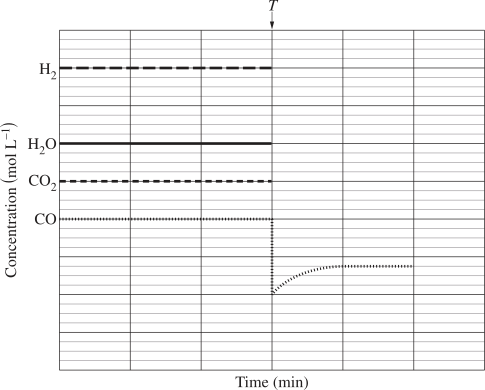
The concentrations of reactants and products as a function of time for the following system were determined.

`text{CO}(g)+ text{H}_(2) text{O}(g) ⇌ text{CO}_(2)(g)+ text{H}_(2)(g)`

At time \(T\), some \(\ce{CO(g)}\) was removed from the system.

  1. The concentration of \(\ce{CO}\) after time \(T\) is shown.
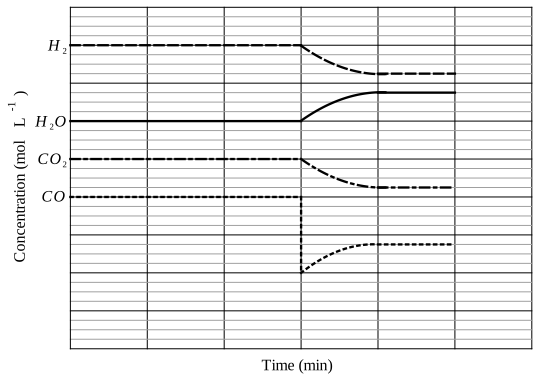
  2. Sketch the concentrations after time \(T\) for the remaining species.   (2 marks)


  3. Using collision theory, explain the change in the concentration of \(\text{CO}\) after time \(T\).  (3 marks)

    --- 8 WORK AREA LINES (style=lined) ---

Show Answers Only

a.   
     

b.   Changes in \(\ce{CO}\) after time \(T\):

  • The removal of \(\ce{CO}\) from the system leads to a decrease in the concentration of  CO, which in turn leads to a decrease in the rate of the forward reaction.
  • This is because there are fewer collisions between \(\ce{CO}\) and \(\ce{H2O}\) molecules, which are necessary for the forward reaction to occur.
  • The rate of the reverse reaction increases, becoming greater than the rate of the forward reaction. This results in a shift in the equilibrium to the left, leading to an increase in the concentration of \(\ce{CO}\) and \(\ce{H2O}\) and a decrease in the concentration of \(\ce{H2}\) and \(\ce{CO2}\).
  • Over time, the rate of the forward reaction subsequently increases until it becomes equal to the rate of the reverse reaction, at which point the system reaches a new equilibrium state with constant concentrations of all species.


Show Worked Solution

a.   
     

b.   Changes in \(\ce{CO}\) after time \(T\):

  • The removal of \(\ce{CO}\) from the system leads to a decrease in the concentration of  CO, which in turn leads to a decrease in the rate of the forward reaction.
  • This is because there are fewer collisions between \(\ce{CO}\) and \(\ce{H2O}\) molecules, which are necessary for the forward reaction to occur.
  • The rate of the reverse reaction increases, becoming greater than the rate of the forward reaction. This results in a shift in the equilibrium to the left, leading to an increase in the concentration of \(\ce{CO}\) and \(\ce{H2O}\) and a decrease in the concentration of \(\ce{H2}\) and \(\ce{CO2}\).
  • Over time, the rate of the forward reaction subsequently increases until it becomes equal to the rate of the reverse reaction, at which point the system reaches a new equilibrium state with constant concentrations of all species.

Filed Under: Factors that Affect Equilibrium Tagged With: Band 4, smc-3670-30-Concentration, smc-3670-40-Collision theory, smc-3670-60-Concentration diagrams

CHEMISTRY, M5 2017 HSC 18 MC

Three gases `text{X}`, `text{Y}` and `text{Z}` were mixed in a closed container and allowed to reach equilibrium. A change was imposed at time `T` and the equilibrium was re-established. The concentration of each gas is plotted against time.
 

Which reaction is represented by the graph?

  1. `text{X}(g)+ text{Y}(g)⇌2 text{Z}(g)`
  2. `2 text{X}(g)⇌ text{Y}(g)+ text{Z}(g)`
  3. `2 text{X}(g)⇌ text{Y}(g)+3 text{Z}(g)`
  4. `text{X}(g)⇌ text{Y}(g)+text{Z}(g)`
Show Answers Only

`D`

Show Worked Solution

Concentration changes at T:

  • Concentrations of X ↓ 25%, Y ↓ 25%, Z ↓ 25% 

New equilibrium after T:

  • Concentrations of X ↓ 0.005 mol L ¯1, Y ↑ 0.005 mol L ¯1, Z ↑ 0.005 mol L ¯1
  • Shift is equimolar (1:1:1) and Y and Z are on the same side of the equation (both increase)

`=>D`


♦ Mean mark 42%.

Filed Under: Factors that Affect Equilibrium Tagged With: Band 5, smc-3670-30-Concentration, smc-3670-60-Concentration diagrams

CHEMISTRY, M5 2020 HSC 19 MC

Nitrogen dioxide reacts to form dinitrogen tetroxide in a sealed flask according to the following equation.

`2 text{NO}_(2)(g) ⇌ text{N}_(2) text{O}_(4)(g) qquadqquad Delta H =-57.2 \ text{kJ  mol}^(-1)`

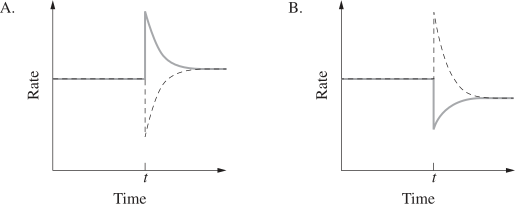
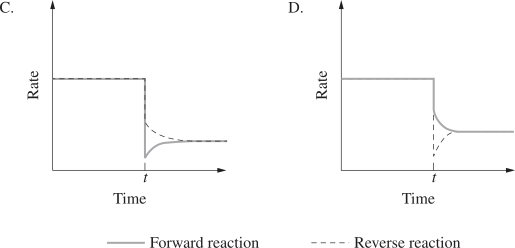
Which graph best represents the rates of both the forward and reverse reactions when an equilibrium system containing these gases is cooled at time `t` ?


Show Answers Only

`D`

Show Worked Solution
  • When the temperature decreases, both the forward and reverse reaction rates will decrease (eliminate A).
  • Exothermic reactions have a lower activation energy threshold (i.e. their reaction rates are less affected by cooling).
  • Therefore, the exothermic reaction rate will decrease to a smaller extent (eliminate B and C).

`=> D`


♦♦♦ Mean mark 22%.

Filed Under: Factors that Affect Equilibrium Tagged With: Band 6, smc-3670-30-Concentration, smc-3670-60-Concentration diagrams

CHEMISTRY, M5 2022 HSC 23

Consider the following system which is at equilibrium in a rigid, sealed container.

\( \ce{4NH3(g) + 5O2(g) \rightleftharpoons 4NO(g) + 6H2O(g)} \ \ \ \ \ \  \Delta H = -950\ \text{kJ mol}^{-1} \) 

  1. Identify what would happen to the amount of \( \ce{NO(g)} \) if the temperature was increased.   (1 mark)

--- 1 WORK AREA LINES (style=lined) ---

  1. Explain why a catalyst does not affect the equilibrium position of this system.   (2 marks)

--- 5 WORK AREA LINES (style=lined) ---

  1. Using collision theory, explain what would happen to the concentration of \( \ce{NO(g)} \) if \( \ce{H2O(g)} \) was removed from the system.   (3 marks)

--- 8 WORK AREA LINES (style=lined) ---

Show Answers Only

a.   The amount of \( \ce{NO2}\) decreases.

b.   Catalyst affect on equilibrium:

  • A catalyst lowers the activation energy and equally increases the rate of both the forward and reverse reactions.
  • As a result, there is no net change in equilibrium, and thus the equilibrium position remains unchanged.

c.   If \( \ce{H2O}\) is removed from the system:

  • This would cause the reverse reaction to decrease because there would be a lower likelihood of successful collisions between \( \ce{NO}\) and \( \ce{H2O}\) molecules.
  • As a result, the forward reaction rate is greater than the reverse reaction rate, thus, the equilibrium would shift to the right, causing \( \ce{[NO]}\) and \( \ce{[H2O]}\) to increase.
  • As the equilibrium is shifting to the right, the forward reaction rate decreases, whilst the reverse reaction rate increases, until they reach equilibrium.
  • At equilibrium, the concentration of all substances remain constant.
Show Worked Solution

a.   The amount of \( \ce{NO2}\) decreases. 

b.   Catalyst affect on equilibrium:

  • A catalyst lowers the activation energy and equally increases the rate of both the forward and reverse reactions.
  • As a result, there is no net change in equilibrium, and thus the equilibrium position remains unchanged.

c.   If \( \ce{H2O}\) is removed from the system:

  • This would cause the reverse reaction to decrease because there would be a lower likelihood of successful collisions between \( \ce{NO}\) and \( \ce{H2O}\) molecules.
  • As a result, the forward reaction rate is greater than the reverse reaction rate, thus, the equilibrium would shift to the right, causing \( \ce{[NO]}\) and \( \ce{[H2O]}\) to increase.
  • As the equilibrium is shifting to the right, the forward reaction rate decreases, whilst the reverse reaction rate increases, until they reach equilibrium.
  • At equilibrium, the concentration of all substances remain constant.

Filed Under: Factors that Affect Equilibrium Tagged With: Band 3, Band 4, smc-3670-10-Temperature, smc-3670-30-Concentration, smc-3670-40-Collision theory, smc-3670-90-Catalyst

CHEMISTRY, M5 2022 HSC 14 MC

Nitrogen dioxide can react with itself to produce dinitrogen tetroxide.

\( \ce{2NO2(g)  \rightleftharpoons  N2O4(g)\ \ \ \ \ \ $K_{eq}$ = 0.010} \)

In an experiment, 100.0 cm³ of \( \ce{NO2}\) is placed in a syringe. The plunger is then pushed in until the volume is 50.0 cm³, while maintaining a constant temperature. The system is allowed to return to equilibrium.

Which statement is true for the system at equilibrium?

  1. The value of `K_{eq}` has increased.
  2. The ratio `([\text{NO}_2])/([\text{N}_2\text{O}_4])` has decreased.
  3. The concentration of `\text{N}_2\text{O}_4` has decreased.
  4. The concentrations of `\text{NO}_2` and `\text{N}_2\text{O}_4` have doubled.
Show Answers Only

`B`

Show Worked Solution
  • As the volume is decreased, the pressure increases. According to Le Chatelier’s Principle, the equilibrium will shift toward the right with fewer moles of gas in order to counteract the change in equilibrium (ie decrease pressure).
  • As a result, \( \ce{[N2O4]} \) will increase and \( \ce{[NO2]} \) will decrease.
  • Therefore, `([\text{NO}_2])/([\text{N}_2\text{O}_4])` will decrease.

`=> B`


♦♦ Mean mark 35%.

Filed Under: Factors that Affect Equilibrium Tagged With: Band 5, smc-3670-29-Pressure, smc-3670-30-Concentration, smc-3670-35-Volume

CHEMISTRY, M5 2022 HSC 13 MC

Nitrosyl bromide decomposes according to the following equation.

\(\ce{2NOBr(g)  \rightleftharpoons  2NO(g) + Br2(g)}\)

A 0.64 mol sample of \(\ce{NOBr}\) is placed in an evacuated 1.00 L flask. After the system comes to equilibrium, the flask contains 0.46 mol \(\ce{NOBr}\).

What are the concentrations of \(\ce{NO}\) and \(\ce{Br2}\) in the flask at equilibrium?

\begin{align*}
\begin{array}{l}
\rule{0pt}{2.5ex} \ \rule[-1ex]{0pt}{0pt}& \\
\rule{0pt}{2.5ex}\textbf{A.}\rule[-1.2ex]{0pt}{0pt}\\
\rule{0pt}{2.5ex}\textbf{B.}\rule[-1.2ex]{0pt}{0pt}\\
\rule{0pt}{2.5ex}\textbf{C.}\rule[-1.2ex]{0pt}{0pt}\\
\rule{0pt}{2.5ex}\textbf{D.}\rule[-1.2ex]{0pt}{0pt}\\
\end{array}
\begin{array}{|c|c|}
\hline\ce{[NO]}\left( \text{mol L}^{-1}\right) &  \ce{\left[Br_2\right]} \left(\text{mol L}^{-1}\right)\\
\hline \rule{0pt}{2.5ex}0.18 \rule[-1ex]{0pt}{0pt}& 0.09 \\
\hline \rule{0pt}{2.5ex}0.18 \rule[-1ex]{0pt}{0pt}& 0.18 \\
\hline \rule{0pt}{2.5ex}0.36 \rule[-1ex]{0pt}{0pt}& 0.18 \\
\hline \rule{0pt}{2.5ex}0.92 \rule[-1ex]{0pt}{0pt}& 0.46 \\
\hline
\end{array}
\end{align*}

Show Answers Only

`A`

Show Worked Solution

\begin{array} {|l|c|c|c|}
\hline  & \text{NOBr} & \text{NO} & \text{Br}_2 \\
\hline \text{Initial} & 0.64 & 0 & 0 \\
\hline \text{Change} & -0.18 & +0.18 & +0.09 \\
\hline \text{Equilibrium} & 0.46 & 0.18 & 0.09 \\
\hline \end{array}

 
`[text{NO}] = 0.18\ text{mol L}^-1`

`[text{Br}_2] = 0.09\ text{mol L}^-1`

`=> A`

Filed Under: Equilibrium Constant, Factors that Affect Equilibrium Tagged With: Band 4, smc-3670-30-Concentration, smc-3671-35-Chemical equation given

CHEMISTRY, M5 2021 HSC 22

Consider the following equilibrium system.

The solution is orange.

Justify TWO ways to shift the equilibrium to the left to change the colour of the solution.   (3 marks)

--- 6 WORK AREA LINES (style=lined) ---

Show Answers Only

Answers could include two of the following methods.

Add `text{Cr}_2 text{O}_7 \ ^(2-)` ions:

  • This would increase the concentration of `text{Cr}_2 text{O}_7\ ^(2-)` ions.
  • According to Le Chatelier’s Principle, this would cause the equilibrium to shift left to counteract the change and decrease the concentration of `text{Cr}_2 text{O}_7\ ^(2-)` ions.

Decrease the concentration of `text{H}^+` ions by adding a base:

  • This would decrease the concentration of `text{H}^+` ions through an acid-base reaction.
  • According to Le Chatelier’s Principle, this would cause the equilibrium to shift left to counteract the change and increase the concentration of `text{H}^+` ions.

Increase the temperature:

  • According to Le Chatelier’s Principle, this would cause the equilibrium to shift left towards the endothermic side to counteract the change and decrease the temperature. 
Show Worked Solution

Answers could include two of the following methods.

Add `text{Cr}_2 text{O}_7 \ ^(2-)` ions:

  • This would increase the concentration of `text{Cr}_2 text{O}_7\ ^(2-)` ions.
  • According to Le Chatelier’s Principle, this would cause the equilibrium to shift left to counteract the change and decrease the concentration of `text{Cr}_2 text{O}_7\ ^(2-)` ions.

Decrease the concentration of `text{H}^+` ions by adding a base:

  • This would decrease the concentration of `text{H}^+` ions through an acid-base reaction.
  • According to Le Chatelier’s Principle, this would cause the equilibrium to shift left to counteract the change and increase the concentration of `text{H}^+` ions.

Increase the temperature:

  • According to Le Chatelier’s Principle, this would cause the equilibrium to shift left towards the endothermic side to counteract the change and decrease the temperature. 

Filed Under: Factors that Affect Equilibrium Tagged With: Band 3, smc-3670-10-Temperature, smc-3670-30-Concentration

CHEMISTRY, M5 2021 HSC 11 MC

Consider this system in a fixed volume at constant temperature.

\(\ce{PCl5}(s)\rightleftharpoons \ce{PCl3}(l) + \ce{Cl2}(g)\) 

This system is initially at equilibrium. A small amount of solid \(\ce{PCl5}\) is added.

Which statement is correct?

  1. The amount of \(\ce{Cl2}\) will increase.
  2. The amount of \(\ce{PCl3}\) will decrease.
  3. The amount of \(\ce{Cl2}\) will not change.
  4. The amount of \(\ce{PCl5}\) will increase then decrease.
Show Answers Only

`C`

Show Worked Solution

The equilibrium constant expression is:  `text{K}_(eq) = [text{Cl}_(2)(g)]`

  • As we can see from the equilibrium constant expression, the value of `text{K}_(eq)` is only dependent on the concentration of `text{Cl}_(2)`.
  • As a result, the addition of solid `text{PCl}_5\` will have no affect on the value of `text{K}_(eq)` and thus has no impact on the equilibrium position.
  • Thus, the amount of `text{Cl}_(2)` will not change.

`=> C`


♦♦♦ Mean mark 19%.

Filed Under: Factors that Affect Equilibrium Tagged With: Band 6, smc-3670-30-Concentration

Copyright © 2014–2025 SmarterEd.com.au · Log in