SmarterEd

Aussie Maths & Science Teachers: Save your time with SmarterEd

  • Login
  • Get Help
  • About

CHEMISTRY, M5 2024 HSC 26

The equilibrium equation for the reaction of iodine with hydrogen cyanide in aqueous solution is given.

\(\ce{I_2(aq) + HCN(aq)\rightleftharpoons ICN(aq) + I^{-}(aq) + H^{+}(aq)}\)

At  \(t=0\) min, \(\ce{I2}\) was added to a mixture of \(\ce{HCN, I^{-}}\) and \(\ce{H^{+}}\), bringing \(\left[ \ce{I2}\right]\) to 2.0 × 10\(^{-5}\) mol L\(^{-1}\). After 3 minutes, the system was at equilibrium, and an analysis of the mixture found that half of the \(\ce{I2}\) had reacted.

  1. On the axes provided, sketch a graph to show how \(\left[\ce{I_2}\right]\) changes in the solution between  \(t=0\) min  and  \(t=6\) min.   (2 marks)

    --- 0 WORK AREA LINES (style=lined) ---


  1. Using collision theory, explain the rate of reaction between  \(t=0\) min  and  \(t=6\) min. Refer to the \(\left[ \ce{I2}\right]\) in your answer.   (3 marks)

    --- 8 WORK AREA LINES (style=lined) ---

Show Answers Only

a.    

b.    Initially, the high \(\ce{[I2]}\) results in a large number of collisions between reactants.

  • This results in an initially high reaction rate for the forward reaction. 
  • Between \(t=0\) and \(t=3\), the concentration of \(\ce{I2}\) decreases. Less collisions between reactant particles occur leading to a decrease in the rate of the forward reaction.
  • Between \(t=0\) and \(t=3\), as the concentration of reactants decrease, the concentration of the products increase. This leads to an increase in the number of successful collisions between product particles and a subsequent increase in the rate of the reverse reaction.
  • Between \(t=3\) and \(t=6\), the concentration of \(\ce{I2}\) remains constant. This is due to the system reaching a state of dynamic equilibrium so the frequency of successful collisions between the reactants is equal to the frequency of successful collisions between the products. i.e. the rates of the forward and reverse reactions are equal. 

Show Worked Solution

a.   


b.    Initially, the high \(\ce{[I2]}\) results in a large number of collisions between reactants.

  • This results in an initially high reaction rate for the forward reaction. 
  • Between \(t=0\) and \(t=3\), the concentration of \(\ce{I2}\) decreases. Less collisions between reactant particles occur leading to a decrease in the rate of the forward reaction.
  • Between \(t=0\) and \(t=3\), as the concentration of reactants decrease, the concentration of the products increase. This leads to an increase in the number of successful collisions between product particles and a subsequent increase in the rate of the reverse reaction.
  • Between \(t=3\) and \(t=6\), the concentration of \(\ce{I2}\) remains constant. This is due to the system reaching a state of dynamic equilibrium so the frequency of successful collisions between the reactants is equal to the frequency of successful collisions between the products. i.e. the rates of the forward and reverse reactions are equal. 
Mean mark (b) 56%.

Filed Under: Factors that Affect Equilibrium Tagged With: Band 4, Band 5, smc-3670-30-Concentration, smc-3670-40-Collision theory, smc-3670-60-Concentration diagrams

CHEMISTRY, M5 EQ-Bank 5 MC

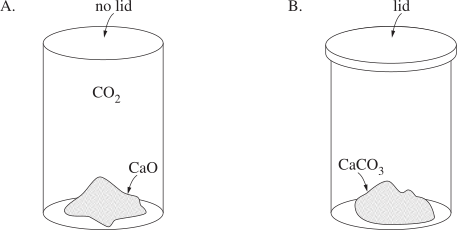
The conversion of calcium carbonate to calcium oxide and carbon dioxide is a reversible reaction and will reach equilibrium under certain conditions.

In which diagram is the system most likely to have reached equilibrium?


Show Answers Only

`D`

Show Worked Solution
  • In order to reach equilibrium, the reaction must occur in a closed system. In this system, a lid must be on the container.
  • When the reaction  \(\ce{CaCO3(s) \rightleftharpoons CaO(s) + CO2(g)} \)  has reached equilibrium, both the forwards and reverse reactions will be occurring.
  • All three species will be present.

`=>D`

Filed Under: Static and Dynamic Equilibrium Tagged With: Band 4, smc-3669-30-Open/Closed Systems, smc-3670-40-Collision theory

CHEMISTRY, M5 2018 HSC 25

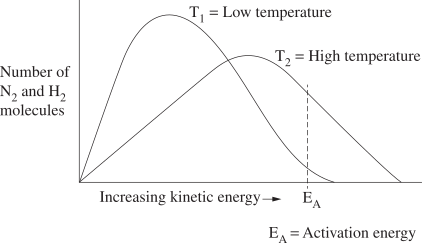
The graph shows the number of molecules of \(\ce{N2}\) and \(\ce{H2}\) that possess a certain kinetic energy at two different temperatures.
 

With reference to the graph, explain why changing the temperature and adding a catalyst would change the rate of production of ammonia.  (4 marks)

--- 10 WORK AREA LINES (style=lined) ---

Show Answers Only
  • Gas particles need to attain activation energy \( \text{E}_\text{A} \) in order to react when they collide.
  • \( \text{E}_\text{A} \) is a level of kinetic energy that is sufficient for reactions to occur.
  • Some \(\ce{N2}\) and \(\ce{H2}\) particles have a kinetic energy above \( \text{E}_\text{A} \) when the temperature is lower at \(\text{T}_1\) (see graph above).
  • However, the number of \(\ce{N2}\) and \(\ce{H2}\) particles with enough energy to react and produce ammonia is significantly greater at the higher temperature \(\text{T}_2\), where the graph has shifted to the right.
  • A catalyst lowers the \( \text{E}_\text{A} \). On the graph, this would shift the dotted \( \text{E}_\text{A} \) line to the left.
  • In the presence of a catalyst, both graphs show there will be a greater number of particles that can react in a given time and therefore the rate of ammonia production will increase in both cases.
Show Worked Solution
  • Gas particles need to attain activation energy \( \text{E}_\text{A} \) in order to react when they collide.
  • \( \text{E}_\text{A} \) is a level of kinetic energy that is sufficient for reactions to occur.
  • Some \(\ce{N2}\) and \(\ce{H2}\) particles have a kinetic energy above \( \text{E}_\text{A} \) when the temperature is lower at \(\text{T}_1\) (see graph above).
  • However, the number of \(\ce{N2}\) and \(\ce{H2}\) particles with enough energy to react and produce ammonia is significantly greater at the higher temperature \(\text{T}_2\), where the graph has shifted to the right.
  • A catalyst lowers the \( \text{E}_\text{A} \). On the graph, this would shift the dotted \( \text{E}_\text{A} \) line to the left.
  • In the presence of a catalyst, both graphs show there will be a greater number of particles that can react in a given time and therefore the rate of ammonia production will increase in both cases.

Mean mark 53%.

Filed Under: Factors that Affect Equilibrium Tagged With: Band 4, Band 5, smc-3670-10-Temperature, smc-3670-40-Collision theory, smc-3670-80-Other graphs

CHEMISTRY, M5 2019 HSC 25

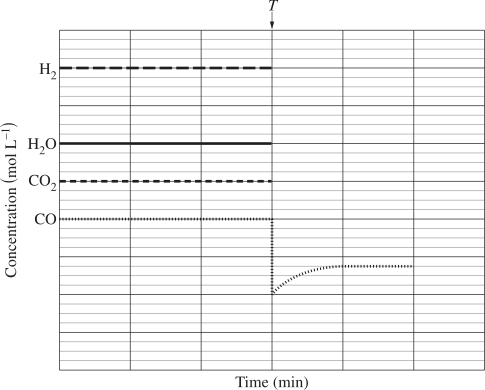
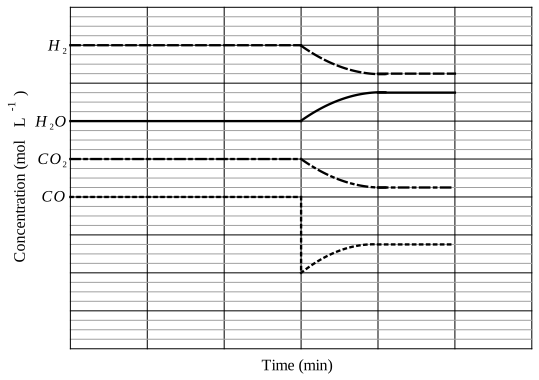
The concentrations of reactants and products as a function of time for the following system were determined.

`text{CO}(g)+ text{H}_(2) text{O}(g) ⇌ text{CO}_(2)(g)+ text{H}_(2)(g)`

At time \(T\), some \(\ce{CO(g)}\) was removed from the system.

  1. The concentration of \(\ce{CO}\) after time \(T\) is shown.
  2. Sketch the concentrations after time \(T\) for the remaining species.   (2 marks)


  3. Using collision theory, explain the change in the concentration of \(\text{CO}\) after time \(T\).  (3 marks)

    --- 8 WORK AREA LINES (style=lined) ---

Show Answers Only

a.   
     

b.   Changes in \(\ce{CO}\) after time \(T\):

  • The removal of \(\ce{CO}\) from the system leads to a decrease in the concentration of  CO, which in turn leads to a decrease in the rate of the forward reaction.
  • This is because there are fewer collisions between \(\ce{CO}\) and \(\ce{H2O}\) molecules, which are necessary for the forward reaction to occur.
  • The rate of the reverse reaction increases, becoming greater than the rate of the forward reaction. This results in a shift in the equilibrium to the left, leading to an increase in the concentration of \(\ce{CO}\) and \(\ce{H2O}\) and a decrease in the concentration of \(\ce{H2}\) and \(\ce{CO2}\).
  • Over time, the rate of the forward reaction subsequently increases until it becomes equal to the rate of the reverse reaction, at which point the system reaches a new equilibrium state with constant concentrations of all species.


Show Worked Solution

a.   
     

b.   Changes in \(\ce{CO}\) after time \(T\):

  • The removal of \(\ce{CO}\) from the system leads to a decrease in the concentration of  CO, which in turn leads to a decrease in the rate of the forward reaction.
  • This is because there are fewer collisions between \(\ce{CO}\) and \(\ce{H2O}\) molecules, which are necessary for the forward reaction to occur.
  • The rate of the reverse reaction increases, becoming greater than the rate of the forward reaction. This results in a shift in the equilibrium to the left, leading to an increase in the concentration of \(\ce{CO}\) and \(\ce{H2O}\) and a decrease in the concentration of \(\ce{H2}\) and \(\ce{CO2}\).
  • Over time, the rate of the forward reaction subsequently increases until it becomes equal to the rate of the reverse reaction, at which point the system reaches a new equilibrium state with constant concentrations of all species.

Filed Under: Factors that Affect Equilibrium Tagged With: Band 4, smc-3670-30-Concentration, smc-3670-40-Collision theory, smc-3670-60-Concentration diagrams

CHEMISTRY, M5 2020 HSC 26

Nitric oxide gas (`text{NO}`) can be produced from the direct combination of nitrogen gas and oxygen gas in a reversible reaction.

  1. Write the balanced chemical equation for this reaction.   (1 mark)

    --- 1 WORK AREA LINES (style=lined) ---

  2. The energy profile diagram for this reaction is shown. 
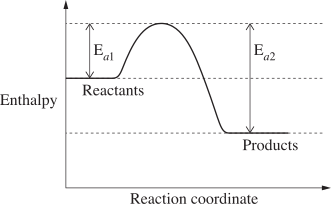


  1. Explain, using collision theory, how an increase in temperature would affect the value of `K_{eq}` for this system. Refer to the diagram in your answer.   (4 marks)

    --- 8 WORK AREA LINES (style=lined) ---
Show Answers Only

a.   \(\ce{N2(g) + O2(g) \rightleftharpoons 2NO(g) }\)
 

b.    Increased temperature’s effect on `K_{eq}`:

  • From the graph, the forward reaction is endothermic.
  • The activation energy of the forward endothermic reaction is greater than the activation energy of the reverse exothermic reaction.
  • An increase in temperature would cause the rates of both the forward and reverse reaction due to the higher average kinetic energy, resulting in a larger likelihood of a successful collisions.
  • However, the rate of the forward reaction would increase to a higher extent than the reverse reaction, since it is an endothermic reaction.
  • Using  `K_(eq) = ([text{NO}]^2)/([text{N}_2][text{O}_2])`, as the equilibrium shifts right, the equilibrium constant would increase.
Show Worked Solution

a.   \(\ce{N2(g) + O2(g) \rightleftharpoons 2NO(g) }\)
 

b.    Increased temperature’s effect on `K_{eq}`:

  • From the graph, the forward reaction is endothermic.
  • The activation energy of the forward endothermic reaction is greater than the activation energy of the reverse exothermic reaction.
  • An increase in temperature would cause the rates of both the forward and reverse reaction due to the higher average kinetic energy, resulting in a larger likelihood of a successful collisions.
  • However, the rate of the forward reaction would increase to a higher extent than the reverse reaction, since it is an endothermic reaction.
  • Using  `K_(eq) = ([text{NO}]^2)/([text{N}_2][text{O}_2])`, as the equilibrium shifts right, the equilibrium constant would increase.

Filed Under: Factors that Affect Equilibrium, Static and Dynamic Equilibrium Tagged With: Band 3, Band 4, smc-3669-10-Static/Dynamic Models, smc-3669-20-Entropy/Enthalpy, smc-3669-50-Collision Theory, smc-3670-10-Temperature, smc-3670-40-Collision theory

CHEMISTRY, M5 2022 HSC 23

Consider the following system which is at equilibrium in a rigid, sealed container.

\( \ce{4NH3(g) + 5O2(g) \rightleftharpoons 4NO(g) + 6H2O(g)} \ \ \ \ \ \  \Delta H = -950\ \text{kJ mol}^{-1} \) 

  1. Identify what would happen to the amount of \( \ce{NO(g)} \) if the temperature was increased.   (1 mark)

--- 1 WORK AREA LINES (style=lined) ---
  1. Explain why a catalyst does not affect the equilibrium position of this system.   (2 marks)

--- 5 WORK AREA LINES (style=lined) ---

  1. Using collision theory, explain what would happen to the concentration of \( \ce{NO(g)} \) if \( \ce{H2O(g)} \) was removed from the system.   (3 marks)

--- 8 WORK AREA LINES (style=lined) ---

Show Answers Only

a.   The amount of \( \ce{NO2}\) decreases.

b.   Catalyst affect on equilibrium:

  • A catalyst lowers the activation energy and equally increases the rate of both the forward and reverse reactions.
  • As a result, there is no net change in equilibrium, and thus the equilibrium position remains unchanged.

c.   If \( \ce{H2O}\) is removed from the system:

  • This would cause the reverse reaction to decrease because there would be a lower likelihood of successful collisions between \( \ce{NO}\) and \( \ce{H2O}\) molecules.
  • As a result, the forward reaction rate is greater than the reverse reaction rate, thus, the equilibrium would shift to the right, causing \( \ce{[NO]}\) and \( \ce{[H2O]}\) to increase.
  • As the equilibrium is shifting to the right, the forward reaction rate decreases, whilst the reverse reaction rate increases, until they reach equilibrium.
  • At equilibrium, the concentration of all substances remain constant.
Show Worked Solution

a.   The amount of \( \ce{NO2}\) decreases. 

b.   Catalyst affect on equilibrium:

  • A catalyst lowers the activation energy and equally increases the rate of both the forward and reverse reactions.
  • As a result, there is no net change in equilibrium, and thus the equilibrium position remains unchanged.

c.   If \( \ce{H2O}\) is removed from the system:

  • This would cause the reverse reaction to decrease because there would be a lower likelihood of successful collisions between \( \ce{NO}\) and \( \ce{H2O}\) molecules.
  • As a result, the forward reaction rate is greater than the reverse reaction rate, thus, the equilibrium would shift to the right, causing \( \ce{[NO]}\) and \( \ce{[H2O]}\) to increase.
  • As the equilibrium is shifting to the right, the forward reaction rate decreases, whilst the reverse reaction rate increases, until they reach equilibrium.
  • At equilibrium, the concentration of all substances remain constant.

Filed Under: Factors that Affect Equilibrium Tagged With: Band 3, Band 4, smc-3670-10-Temperature, smc-3670-30-Concentration, smc-3670-40-Collision theory, smc-3670-90-Catalyst

Copyright © 2014–2025 SmarterEd.com.au · Log in