SmarterEd

Aussie Maths & Science Teachers: Save your time with SmarterEd

  • Login
  • Get Help
  • About

CHEMISTRY, M5 2025 HSC 32

The following three solids were added together to 1 litre of water:

  • \(\ce{0.006\ \text{mol}\ Mg(NO3)2}\)
  • \(\ce{0.010\ \text{mol}\ NaOH}\)
  • \(\ce{0.002\ \text{mol}\ Na2CO3}\).

Which precipitate(s), if any, will form? Justify your answer with appropriate calculations.   (5 marks)

--- 12 WORK AREA LINES (style=lined) ---

Show Answers Only

All sodium and nitrate salts are soluble  \(\Rightarrow\)  possible precipitates are \(\ce{Mg(OH)2}\) and \(\ce{MgCO3}\). 

\(\ce{\left[Mg^{2+}\right]=6 \times 10^{-3} \quad\left[ OH^{-}\right]=1 \times 10^{-2} \quad\left[ CO3^{2-}\right]=2 \times 10^{-3}}\)

\(\ce{\left[Mg^{2+}\right]\left[ OH^{-}\right]^2=6 \times 10^{-7} \quad \quad \quad \ \ \ K_{\textit{sp}}=5.61 \times 10^{-12}}\)

\(\ce{\left[ Mg^{2+}\right]\left[ CO3^{2-}\right]=1.2 \times 10^{-5} \quad \quad  K_{\textit{sp}}=6.82 \times 10^{-6}}\)
 

\(\ce{Mg(OH)2}\) is a lot less soluble than \(\ce{MgCO3}\) and will precipitate preferentially.

\(\ce{\left[Mg^{2+}\right]\left[OH^{-}\right]^2 > K_{\textit{sp}}}\)

\(\Rightarrow \ce{Mg(OH)2}\) will precipitate.
 

\(\ce{Mg^{2+}(aq) + 2OH-(aq) \rightarrow Mg(OH)2(s)}\)

Since \(K_{\textit{sp}}\) is small, assume reaction goes to completion.

\(\ce{n(Mg^{2+})=0.006\ mol, n(OH^{-})=0.010\ mol}\)

Using stoichiometric ratio \((1:2)\)

\(0.006 > \dfrac{0.010}{2}=0.005\ \ \Rightarrow \ce{Mg^{2+}}\) is in excess.

Concentration drops to: \(6 \times 10^{-3}-5 \times 10^{-3}=1 \times 10^{-3}\).
 

Check if \(\ce{MgCO3}\) will precipitate:

\(\ce{\left[Mg^{2+}\right]\left[CO3^{2-}\right]}\) becomes  \(2 \times 10^{-6} <K_{\textit{sp}}\).

\(\ce{\Rightarrow\ MgCO3}\) won’t precipitate.
Show Worked Solution

All sodium and nitrate salts are soluble  \(\Rightarrow\)  possible precipitates are \(\ce{Mg(OH)2}\) and \(\ce{MgCO3}\). 

\(\ce{\left[Mg^{2+}\right]=6 \times 10^{-3} \quad\left[ OH^{-}\right]=1 \times 10^{-2} \quad\left[ CO3^{2-}\right]=2 \times 10^{-3}}\)

\(\ce{\left[Mg^{2+}\right]\left[ OH^{-}\right]^2=6 \times 10^{-7} \quad \quad \quad \ \ \ K_{\textit{sp}}=5.61 \times 10^{-12}}\)

\(\ce{\left[ Mg^{2+}\right]\left[ CO3^{2-}\right]=1.2 \times 10^{-5} \quad \quad  K_{\textit{sp}}=6.82 \times 10^{-6}}\)

♦♦ Mean mark 40%.

\(\ce{Mg(OH)2}\) is a lot less soluble than \(\ce{MgCO3}\) and will precipitate preferentially.

\(\ce{\left[Mg^{2+}\right]\left[OH^{-}\right]^2 > K_{\textit{sp}}}\)

\(\Rightarrow \ce{Mg(OH)2}\) will precipitate.
 

\(\ce{Mg^{2+}(aq) + 2OH-(aq) \rightarrow Mg(OH)2(s)}\)

Since \(K_{\textit{sp}}\) is small, assume reaction goes to completion.

\(\ce{n(Mg^{2+})=0.006\ mol, n(OH^{-})=0.010\ mol}\)

Using stoichiometric ratio \((1:2)\)

\(0.006 > \dfrac{0.010}{2}=0.005\ \ \Rightarrow \ce{Mg^{2+}}\) is in excess.

Concentration drops to: \(6 \times 10^{-3}-5 \times 10^{-3}=1 \times 10^{-3}\).
 

Check if \(\ce{MgCO3}\) will precipitate:

\(\ce{\left[Mg^{2+}\right]\left[CO3^{2-}\right]}\) becomes  \(2 \times 10^{-6} <K_{\textit{sp}}\).

\(\ce{\Rightarrow\ MgCO3}\) won’t precipitate.
Filed Under: Solution Equilibria Tagged With: Band 5, Band 6, smc-3672-10-Mixed ionic solutions, smc-3672-20-Calcs given K(sp), smc-3672-70-Precipitate

CHEMISTRY, M5 2023 HSC 34

When 125 mL of a magnesium nitrate solution is mixed with 175 mL of a 1.50 mol L\(^{-1} \) sodium fluoride solution, 0.6231 g of magnesium fluoride (MM = 62.31 g mol\(^{-1} \)) precipitates. The \( K_{s p} \) of magnesium fluoride is 5.16 × 10\(^{-11} \).

Calculate the equilibrium concentration of magnesium ions in this solution.  (5 marks)

--- 12 WORK AREA LINES (style=lined) ---

Show Answers Only

\(7.90 \times 10^{-11}\ \text{mol L}^{-1} \)

Show Worked Solution

\(\ce{MgF2(s) \rightleftharpoons Mg^{2+}(aq) + 2F-(aq)}\)

\(\ce{n(MgF2) = \dfrac{\text{m}}{\text{MM}} = \dfrac{0.6231}{62.31} = 1.000 \times 10^{-2} \text{mol}} \)

\(\ce{n(F^{-})_{init} = c \times V = 1.50 \times 0.175 = 0.263\ \text{mol}} \)

\(\ce{n(F^{-})_{after} = 0.263-2 \times 1.00 \times 10^{-2} = 0.243\ \text{mol}} \) 

\(\ce{[F^{-}]_{after} = \dfrac{\text{n}}{\text{V}} = \dfrac{0.243}{0.300} = 0.808\ \text{mol L}^{-1}} \)

♦ Mean mark 45%.

\(K_{sp} = \ce{[Mg^{2+}][F^{-}]^2 }\)

\(\text{Since}\ K_{sp}\ \text{is small}\ \ \Rightarrow \text{assume}\ \ce{[F^{-}]_{eq} = 0.808\ \text{mol L}^{-1}} \)

\(\ce{[Mg^{2+}]_{eq} = \dfrac{5.16 \times 10^{-11}}{0.808^2} = 7.90 \times 10^{-11}\ \text{mol L}^{-1}} \)

Filed Under: Solution Equilibria Tagged With: Band 5, smc-3672-10-Mixed ionic solutions, smc-3672-20-Calcs given K(sp)

CHEMISTRY, M5 EQ-Bank 24

When a sample of solid silver chloride is added to a `1.00 xx10^(-2)` mol L−1 sodium chloride solution, only some of the silver chloride dissolves.

Calculate the equilibrium concentration of silver ions in the resulting solution, given that the `K_(sp)` of silver chloride is `1.8 xx10^(-10)`.   (3 marks)

--- 6 WORK AREA LINES (style=lined) ---

Show Answers Only

\(\ce{[Ag^+] = 1.80 \times 10^{-8} mol L^{-1}}\)

Show Worked Solution

 \(\ce{AgCl(s) \rightleftharpoons Ag^+(aq) + Cl^-(aq)}\)

\begin{array} {|l|c|c|c|}
\hline  & \ce{[AgCl(s)]} & \ce{[Ag^+(aq)]} & \ce{[Cl^-(aq)]} \\
\hline \text{Initial} &  & 0 & 1.00 \times 10^{-2} \\
\hline \text{Change} &  & +x & +x \\
\hline \text{Equilibrium} &  & x & 1.00 \times 10^{-2} +x \\
\hline \end{array}

\(\ce{Let \ $x$ = [Ag^+]}\)

\[\ce{$K_{sp}$ = [Ag^+][Cl^-]}\]

\(\ce{$K_{sp} = x$(1.00 \times 10^{-2} + $x$) = 1.80 \times 10^{-10}}\)

\(\ce{Since $x$\ is small, 1.00 \times 10^{-2} + $x$ ≈ 1.00 \times 10^{-2}}\)

\begin{aligned}
\ce{$x$(1.00 \times 10^{-2})} & \ce{= 1.80 \times 10^{-10}}  \\
\ce{$x$} & \ce{= 1.80 \times 10^{-8}}  \\
\ce{\therefore [Ag^+]} & \ce{= 1.80 \times 10^{-8} mol L^{-1}}  \\
\end{aligned}

Filed Under: Equilibrium Constant, Solution Equilibria Tagged With: Band 4, smc-3671-60-Ionic solutions, smc-3672-10-Mixed ionic solutions, smc-3672-20-Calcs given K(sp)

CHEMISTRY, M5 2019 HSC 18 MC

Consider the following equilibrium.

\(\ce{HF(aq) + CF3COO-(aq) \rightleftharpoons F-(aq) + CF3COOH(aq) \ \ \ \ \ \ $K_{eq}$ = 3.80 \times 10^{-4}} \)

Which row of the table correctly identifies the strongest acid and the strongest base in this system?
 

  \(\text{Strongest acid}\) \(\text{Strongest base}\)
A.   \(\ce{CF3OOH(aq)}\) \(\ce{F-(aq)}\)
B. \(\ce{CF3OOH(aq)}\) \(\ce{CF3OO-(aq)}\)
C. \(\ce{HF(aq)}\) \(\ce{F-(aq)}\)
D. \(\ce{HF(aq)}\) \(\ce{CF3OO-(aq)}\)

Show Answers Only

`A`

Show Worked Solution
  • The small size of `K_(eq)` means that there is a higher concentration of reactants than products at equilibrium.
  • This shifts the equilibrium towards the reactants, which means that the reverse reaction is more likely to occur.
  • Because \(\ce{F-}\) is more likely to accept a proton than \(\ce{CF3COO-}\), it is a stronger base.
  • On the other hand, \(\ce{CF3COO-}\) is more likely to donate a proton than \(\ce{HF}\), making it the stronger acid.

`=>A`


♦♦♦ Mean mark 23%.

Filed Under: Solution Equilibria Tagged With: Band 6, smc-3672-10-Mixed ionic solutions

CHEMISTRY, M5 2020 HSC 35

In aqueous solution, iodide ions `(text{I}^-)`react rapidly with iodine `(text{I}_2)` to form triiodide ions `text{I}_(3)^(\ -)`, making the equilibrium system shown in the chemical equation:

`text{I}^(-)(aq)+ text{I}_(2)(aq) ⇌ text{I}_(3)^(\ -)(aq)`

The following relationships can be derived from the reaction mechanism:

`[text{I}^(-)]_(eq)=2[text{I}_(2)]_(eq)`

`[text{I}^(-)]_(i nitial)=4[text{I}_(2)]_(eq)+3[text{I}_(3)^(\ -)]_(eq)`

where 'initial' designates the initial concentration and 'eq' designates the equilibrium concentration.

The absorbance of the solution in the UV-Vis spectrum is given by:

`A=[text{I}_(3)^(\ -)]xx2.76 xx10^(4)`

Determine the value of the equilibrium constant, given that  `A = 0.745`  at equilibrium and  `[text{I}^(-)]_(i nitial )=7.00 xx10^(-4)\ text{mol L}^(-1)`.   (4 marks)

--- 14 WORK AREA LINES (style=lined) ---

Show Answers Only

`K_text{eq}= 564`

Show Worked Solution
`text{A}` \(\ce{= [I3–]_{eq} \times 2.76 × 10^4}\)
`0.745` \(\ce{= [I3–]_{eq} \times 2.76 × 10^4}\)
\(\ce{[I3–]_{eq}}\) `= 2.70 \times 10^(−5)\ text{mol L}^(–1)`


\(\ce{[I– ]_{initial}}\) \(\ce{= 4[I2 ]_{eq} + 3 [I3– ]_{eq}}\)
`7.00 xx 10^(−4)` `= 4 [text{I}_2 ]_text{eq} + (3 xx 2.70 xx 10^(−5))`
\(\ce{[I2 ]_{eq}}\) `=(7.00 xx 10^(−4)-(3 xx 2.70 xx 10^(−5)))/4`
  `= 1.55 xx 10^(−4)\ text{mol L}^(–1)`


`[text{I}^– ]_text(eq) = 2 [text{I}_2 ]_text(eq) = 2 xx (1.55 xx 10^(−4)) = 3.10 xx 10^(−4)\ text{mol L}^(–1)`


`K_text{eq}` `=[text{I}_3\^(\ -)]_text(eq) /[[text{I}^–]_text(eq) xx [text{I}_2]_text(eq)]`
  `= [2.70 xx 10^(−5)] / [3.10 xx 10^(−4) xx 1.55 xx 10^(−4)]`
  `= 564`

Mean mark 55%.

Filed Under: Equilibrium Constant, Solution Equilibria Tagged With: Band 5, smc-3671-10-Find K(eq), smc-3671-35-Chemical equation given, smc-3671-60-Ionic solutions, smc-3672-10-Mixed ionic solutions

CHEMISTRY, M5 2020 HSC 17 MC

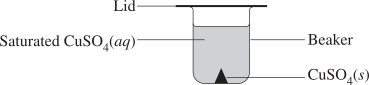
The following apparatus was set up in a temperature-controlled laboratory.


Excess solid sodium hydroxide is added to the beaker.

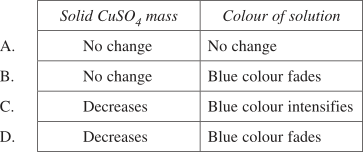
Which row of the table correctly identifies the change in the `text{CuSO}_(4)(s)` mass and the colour of the solution after several days?
 

Show Answers Only

`D`

Show Worked Solution

\(\ce{CuSO4(s) \rightleftharpoons Cu^2+ (aq) + SO4^2– (aq)}\)

  • The addition of \(\ce{NaOH}\) to the solution would result in a precipitate \(\ce{Cu(OH)2}\) and thus decreases the amount of \(\ce{Cu^2+}\) ions.
  • According to Le Chatlelier’s Principle, the system would shift right in an attempt to counteract the change and increase \(\ce{[Cu^2+]}\), thereby decreasing the mass of the precipitate.
  • The blue colour will fade since the \(\ce{[Cu^2+]}\) in the final solution is less.

`=>D`


♦♦ Mean mark 35%.

Filed Under: Solution Equilibria Tagged With: Band 5, smc-3672-10-Mixed ionic solutions, smc-3672-70-Precipitate

CHEMISTRY, M5 2022 HSC 35

A precipitate of strontium hydroxide `\text{Sr}(\text{OH})_2`, (`MM` = 121.63 g mol ¯1) was produced when 80.0 mL of 1.50 mol L ¯1 strontium nitrate solution was mixed with 80.0 mL of 0.855 mol L ¯1 sodium hydroxide solution. The mass of the dried precipitate was 3.93 g.

What is the `K_{sp}` of strontium hydroxide?   (5 marks)

--- 15 WORK AREA LINES (style=lined) ---

Show Answers Only

`3.06 × 10^(−4)`

Show Worked Solution

\( \ce{Sr(NO3)2(aq) + 2NaOH(aq) -> Sr(OH)2(s) + 2NaNO3(aq)} \)

\( \ce{n(Sr(NO3)2) = c \times V = 1.50 \times 0.0800= 0.120\ mol}\)

\( \ce{n(NaOH) = 0.855 \times 0.0800 = 0.0684  \text{mol} }\)

`text{NaOH = limiting reagent}, \ \ \ text{Sr(NO}_3)_2 = text{excess reagent}`

`text{n(Sr(OH)}_2text{) produced}\ = 1 / 2 xx 0.0684= 0.0342  text{mol}`

`text{Thus, 0.0342 moles of Sr(OH)}_2  text{can be produced in solution.}`

`text{n(Sr(OH)}_2\text{)} \ text{precipitate}= text{m} / text{MM}=3.93/121.63=0.0323111  text{mol}`
 

`text{n(Sr(OH)}_2)\ text{in solution}` `=text{n(Sr(OH)}_2)\ text{produced}  –  text{n(Sr(OH)}_2)\ text{precipitate}`
  `=0.0342-0.0323111`
  `= 0.0018889  text{mol}`

 
\( \ce{Sr(OH)2(s) \rightleftharpoons Sr^2+(aq) + 2OH-(aq)} \)

\( \ce{n(Sr(NO3)2)_{init} = 0.120 – \dfrac{1}{2} \times 0.0684 = 0.0858\ \text{mol}} \) 

\begin{array} {|l|c|c|}
\hline  & \text{Sr}^{2+} & \text{OH}^– \\
\hline \text{Initial} & 0.0858 & 0 \\
\hline \text{Change} & +0.0018889 & +2 \times 0.0018889 \\
\hline \text{Equilibrium} & 0.0877 & 0.00378 \\
\hline \end{array}

 
`text{V (total)} = 0.08 + 0.08= 0.16\ text{L}`

`[text{Sr}^(2+)]= text{n} / text{V} = 0.0877 / 0.16 = 0.548  text{mol L}^(–1)`

`[text{OH}^–]=0.00378 / 0.16= 0.0236  text{mol L}^–1`

`K_(sp)= [text{Sr}^(2+)][text{OH}^–]^2= 0.548 xx (0.02362)^2= 3.06 xx 10^(−4)`


♦ Mean mark 43%

Filed Under: Solution Equilibria Tagged With: Band 5, smc-3672-10-Mixed ionic solutions, smc-3672-15-Find K(sp), smc-3672-70-Precipitate

CHEMISTRY, M5 2020 HSC 11 MC

Equal volumes of two 0.04 mol L ¯1 solutions were mixed together.

Which pair of solutions would give the greatest mass of precipitate?

  1. `text{Ba(OH)}_(2) \ text{and} \ text{MgCl}_(2)`
  2. `text{Ba(OH)}_(2) \ text{and} \ text{MgSO}_(4)`
  3. `text{Ba(OH)}_(2) \ text{and} \ text{NaCl}`
  4. `text{Ba(OH)}_(2) \ text{and} \ text{Na}_(2) text{SO}_(4)`
Show Answers Only

`B`

Show Worked Solution

\(\ce{Ba(OH)2(aq) + MgSO4(aq) → BaSO4(s) + Mg(OH)2(s)}\)

  • Reaction B produces 2 molecules of precipitate
  • Reactions A and D produce 1 molecule of precipitate each
  • Reaction C does not produce a precipitate.

`=> B`

Filed Under: Solution Equilibria Tagged With: Band 4, smc-3672-10-Mixed ionic solutions, smc-3672-25-Solubility rules, smc-3672-70-Precipitate

Copyright © 2014–2026 SmarterEd.com.au · Log in