SmarterEd

Aussie Maths & Science Teachers: Save your time with SmarterEd

  • Login
  • Get Help
  • About

CHEMISTRY, M5 2025 HSC 20 MC

The solubility constant for silver\(\text{(I)}\) oxalate \(\ce{(Ag2C₂O4)}\) was determined using the following method.

  • 2.0 g of solid \(\ce{Ag2C2O4}\) was added to 100 mL of distilled water.
  • A sample of the saturated solution above the undissolved \(\ce{Ag₂C₂O}\) was diluted by a factor of 2000, using distilled water.
  • This diluted solution was analysed using atomic absorption spectroscopy (AAS).

The calibration curve for the AAS is provided below.
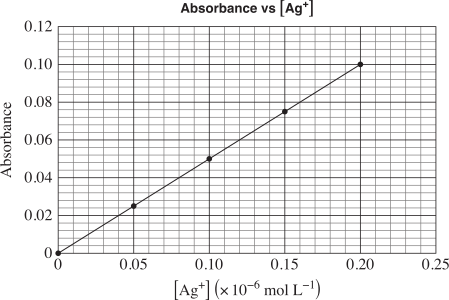
 

The absorbance of the diluted sample was 0.055.

What is the \(K_{s p}\) for silver oxalate?

  1. \(8.8 \times 10^{-14}\)
  2. \(5.3 \times 10^{-12}\)
  3. \(1.1 \times 10^{-11}\)
  4. \(2.1 \times 10^{-11}\)
Show Answers Only

\(B\)

Show Worked Solution
  • By interpolation, the observed concentration of silver ions for an absorbance of \(0.055\)  is  \(0.11 \times 10^{-6}\ \text{mol L}^{-1}\).
  • Since this sample was diluted by a factor of 2000:
  •    \(\ce{[Ag+]_{\text{saturated}} = 2000 \times [Ag+]_{\text{diluted}}} = 2000 \times 0.11 \times 10^{-6} = 2.2 \times 10^{-4}\ \text{mol L}^{-1}\)
  • The equation for the dissolution of \(\ce{Ag2C₂O4}\) is
  •    \(\ce{Ag2C₂O4 \leftrightharpoons 2Ag+(aq) + C2O4^{2-}(aq)}\)
  • Hence \(\ce{[C2O4^{2-}]_{\text{saturated}} = 0.5 \times [Ag+]_{\text{saturated}}} = 0.5 \times 2.2 \times 10^{-4} = 1.1 \times 10^{-4}\)
  •    \(K_{sp} = \ce{[Ag+]^2[C2O4^{2-}]} = (2.2 \times 10^{-4})^2(1.1 \times 10^{-4}) = 5.3 \times 10^{-12}\)

\(\Rightarrow B\)

Filed Under: Inorganic Substances, Solution Equilibria Tagged With: Band 5, smc-3672-15-Find K(sp), smc-3682-60-Colourimetry UV-Vis and AAS

CHEMISTRY, M5 2023 HSC 4 MC

Sodium chloride dissolves in water according to the following equation.

\( \ce{NaCl}(s) \rightleftharpoons \ce{Na^{+}} (aq) + \ce{Cl^{-}}(aq) \)

A saturated solution of \(\ce{NaCl}\) in water contains sodium and chloride ions at the following concentrations.
 

\( Ion \) \( Concentration \) \( \left(\text{mol L}^{-1}\right)  \)
\( \ce{Na}^{+}\)   \(6.13\)
\( \ce{Cl}^{-}\) \(6.13\)
  
What is the \(K_{s p}\) of sodium chloride?
 
  1. \(2.65 \times 10^{-2}\)
  2. \(8.16 \times 10^{-2}\)
  3. \(12.26\)
  4. \(37.6\)
Show Answers Only

\(D\)

Show Worked Solution

\( \ce{NaCl}(s) \rightleftharpoons \ce{Na^{+}} (aq) + \ce{Cl^{-}}(aq) \)

\(K_{sp} = \dfrac{\ce{[Na+][Cl-]}}{\ce{[NaCl]}} \)

\(\ce{ \text{Since}\ NaCl\ \text{is a solid, its concentration is assumed to be 1.}}\)

\(K_{sp}= 6.13 \times 6.13= 37.6\)

\(\Rightarrow D\)

Filed Under: Solution Equilibria Tagged With: Band 3, smc-3672-15-Find K(sp)

CHEMISTRY, M5 EQ-Bank 29

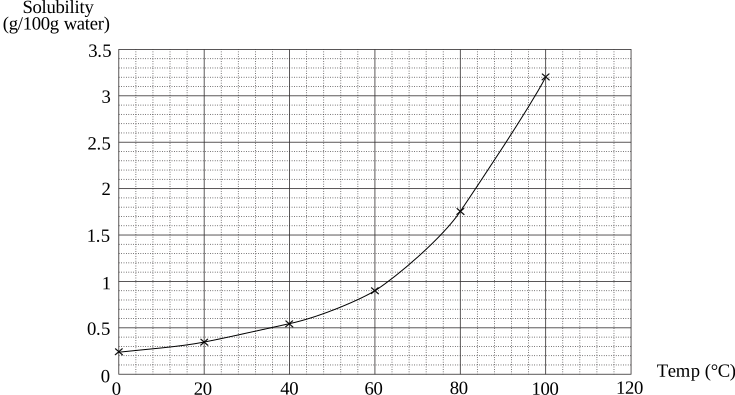
The information in the table shows how the solubility of lead chloride is affected by temperature.  
 

Using a graph, calculate the solubility product \((K_{sp})\) of the dissolution of lead chloride at 50°C. Include a fully labelled graph and a relevant chemical equation in your answer   (6 marks)
 

--- 12 WORK AREA LINES (style=lined) ---

Show Answers Only

\(\ce{K_{sp} = 6.4 \times 10^{-5}}\)

Show Worked Solution


\(\ce{PbCl2(s) \rightleftharpoons Pb^2+(aq) + 2Cl^-(aq)}\)

\(\ce{Using the graph:}\)

\(\ce{Solubility (50°) = 0.7 g/100 g water = 7 g/L}\)

\(\ce{Converting to mol L^{-1}:}\)

\[\ce{MM(PbCl2) = 207.2 + 2 \times 35.45 = 278.1}\]

\[\ce{n = \frac{m}{MM} = \frac{7}{278.1} = 0.0252 mol L^{-1}}\]

\(\ce{[Pb^2+(aq)] = 0.0252 mol L^{-1}}\)
 

\(\ce{Mole ratio \ Pb^2+ : Cl^- = 1:2}\)

\(\Rightarrow \ce{[Cl^-]  = 2 \times 0.0252 = 0.0504 mol L^{-1}}\)
 

\begin{aligned}
\ce{$K_{sp}$} & \ce{= [Pb^2+][Cl^-]^{2}} \\
 & \ce{=0.0252 \times (0.0504)^{2}}  \\
 & \ce{= 6.4 \times 10^{-5}}  \\
\end{aligned}

Filed Under: Solution Equilibria Tagged With: Band 4, Band 5, smc-3672-15-Find K(sp), smc-3672-60-Concentration graphs

CHEMISTRY, M5 EQ-Bank 28

A 100 mL saturated solution of calcium hydroxide at 25°C contains 0.173 g of calcium hydroxide.

  1. Calculate the solubility product \(\ce{($K_{sp}$)}\) of this salt at 25°C.  (3 marks)

    --- 7 WORK AREA LINES (style=lined) ---

  2. Explain why the undissolved solid is not included in the expression for the solubility product constant.  (1 marks)

    --- 2 WORK AREA LINES (style=lined) ---

Show Answers Only

a.    \(\ce{$K_{sp}$ = 5.06 \times 10^{-5}}\)

b.    Undissolved solid:

  • \(\ce{[CaOH2(s)]}\) is constant throughout the reaction.
  • Since it does not change, it is not included in the equilibrium expression.
Show Worked Solution

a.   \(\ce{CaOH2(s) \rightleftharpoons Ca^2+(aq) + 2OH^-(aq)}\)

\(\ce{Solubility = 0.173 g/100 mL = 1.73 g/L}\)

\[\ce{n = \frac{m}{MM} = \frac{1.73}{74.093} = 0.00233 mol}\]

\(\ce{[Ca^{2+}] = 0.0233 mol L^{-1}}\)
 

\(\ce{Mole ratio  \ Ca^2+ : OH^- = 1:2}\)

\(\ce{$K_{sp}$   =[Ca^2+][OH^-]^{2}}\)


\(\ce{[OH^-]  = 2 \times 0.0233 = 0.0466 mol L^{-1}}\)
 

\begin{aligned}
\ce{$K_{sp}$} & \ce{=[Ca^2+][OH^-]^{2}}  \\
 & \ce{= 0.0233 \times (0.0466)^{2}}  \\
 & \ce{= 5.06 \times 10^{-5}}  \\
\end{aligned}

 
b. 
   Undissolved solid:

  • \(\ce{[CaOH2(s)]}\) is constant throughout the reaction.
  • Since it does not change, it is not included in the equilibrium expression.

Filed Under: Solution Equilibria Tagged With: Band 4, Band 5, smc-3672-15-Find K(sp)

CHEMISTRY, M5 2020 HSC 20 MC

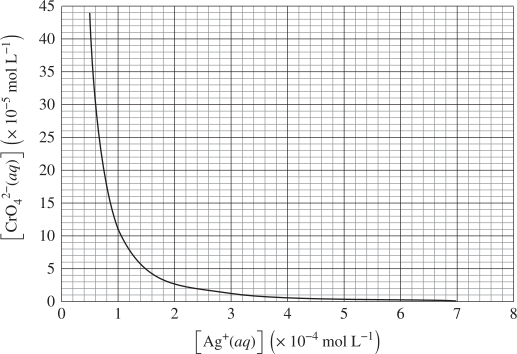
The graph shows the concentration of silver and chromate ions which can exist in a saturated solution of silver chromate.
 

Based on the information provided, what is the `K_{sp}` for silver chromate?

  1. `1.1 xx10^(-8)`
  2. `2.2 xx10^(-8)`
  3. `1.1 xx10^(-12)`
  4. `4.4 xx10^(-12)`
Show Answers Only

`C`

Show Worked Solution

When \(\ce{[Ag+]} = 1 \times 10^{-4}\ \text{mol L}^{-1} \),

\( \ce{CrO4^2–} = 11 \times\ 10^{-5}\ \text{mol L}^{-1} \) 

\begin{align}
K_{sp} &= \ce{[Ag+]^2}\ce{[CrO4^2–]}\\
& =(1 \times 10^{−4})^2(11×10^{−5}) \\
&=1.1×10^{−12}\ \text{mol L}^{–1} \\
\end{align}

`=> C`


♦ Mean mark 43%.

Filed Under: Solution Equilibria Tagged With: Band 5, smc-3672-15-Find K(sp), smc-3672-60-Concentration graphs

CHEMISTRY, M5 2022 HSC 35

A precipitate of strontium hydroxide `\text{Sr}(\text{OH})_2`, (`MM` = 121.63 g mol ¯1) was produced when 80.0 mL of 1.50 mol L ¯1 strontium nitrate solution was mixed with 80.0 mL of 0.855 mol L ¯1 sodium hydroxide solution. The mass of the dried precipitate was 3.93 g.

What is the `K_{sp}` of strontium hydroxide?   (5 marks)

--- 15 WORK AREA LINES (style=lined) ---

Show Answers Only

`3.06 × 10^(−4)`

Show Worked Solution

\( \ce{Sr(NO3)2(aq) + 2NaOH(aq) -> Sr(OH)2(s) + 2NaNO3(aq)} \)

\( \ce{n(Sr(NO3)2) = c \times V = 1.50 \times 0.0800= 0.120\ mol}\)

\( \ce{n(NaOH) = 0.855 \times 0.0800 = 0.0684  \text{mol} }\)

`text{NaOH = limiting reagent}, \ \ \ text{Sr(NO}_3)_2 = text{excess reagent}`

`text{n(Sr(OH)}_2text{) produced}\ = 1 / 2 xx 0.0684= 0.0342  text{mol}`

`text{Thus, 0.0342 moles of Sr(OH)}_2  text{can be produced in solution.}`

`text{n(Sr(OH)}_2\text{)} \ text{precipitate}= text{m} / text{MM}=3.93/121.63=0.0323111  text{mol}`
 

`text{n(Sr(OH)}_2)\ text{in solution}` `=text{n(Sr(OH)}_2)\ text{produced}  –  text{n(Sr(OH)}_2)\ text{precipitate}`
  `=0.0342-0.0323111`
  `= 0.0018889  text{mol}`

 
\( \ce{Sr(OH)2(s) \rightleftharpoons Sr^2+(aq) + 2OH-(aq)} \)

\( \ce{n(Sr(NO3)2)_{init} = 0.120 – \dfrac{1}{2} \times 0.0684 = 0.0858\ \text{mol}} \) 

\begin{array} {|l|c|c|}
\hline  & \text{Sr}^{2+} & \text{OH}^– \\
\hline \text{Initial} & 0.0858 & 0 \\
\hline \text{Change} & +0.0018889 & +2 \times 0.0018889 \\
\hline \text{Equilibrium} & 0.0877 & 0.00378 \\
\hline \end{array}

 
`text{V (total)} = 0.08 + 0.08= 0.16\ text{L}`

`[text{Sr}^(2+)]= text{n} / text{V} = 0.0877 / 0.16 = 0.548  text{mol L}^(–1)`

`[text{OH}^–]=0.00378 / 0.16= 0.0236  text{mol L}^–1`

`K_(sp)= [text{Sr}^(2+)][text{OH}^–]^2= 0.548 xx (0.02362)^2= 3.06 xx 10^(−4)`


♦ Mean mark 43%

Filed Under: Solution Equilibria Tagged With: Band 5, smc-3672-10-Mixed ionic solutions, smc-3672-15-Find K(sp), smc-3672-70-Precipitate

CHEMISTRY, M5 2021 HSC 27

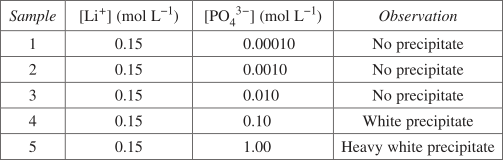
An experiment is carried out to determine the \(K_{sp}\) value for lithium phosphate \(\ce{(Li_3PO_4)}\).

Five samples of \(\ce{Li^+}\) ion solution were prepared, and a different solution of \(\ce{PO_4^3-}\) was added to each of them. Columns 2 and 3 of the table show the values before any reaction occurs.
 

  1. Calculate the range within which the \(K_{sp}\) value of lithium phosphate lies.   (4 marks)

    --- 10 WORK AREA LINES (style=lined) ---

  2. Justify ONE way in which the procedure of this investigation could be improved to increase the accuracy of the calculated result.   (2 marks)

    --- 5 WORK AREA LINES (style=lined) ---

Show Answers Only

a.  \(K_{sp}\) is between the range of  \(3.4 \times 10^{-5}\)  and  \(3.4 \times 10^{-4}\).
 

b.   Answers could include one of the following.

  • Add more solutions of  \(\ce{PO4^{3-}}\)  ions between the concentrations of 0.010 mol L¯1 and 0.10 mol L¯1, thus increasing the accuracy of the estimated SI value.
  • Form a precipitate titration by titrating the \(\ce{Li}^{+}\) ions against a \(\ce{PO4^{3-}}\) ion solution until a precipitate is formed. This would allow the experimental value to be closer to the correct SI value for lithium phosphate, and in turn increase the accuracy of the calculated results.
Show Worked Solution

a.   \(\ce{Li3PO4(s) \leftrightharpoons 3Li^{+} (aq) + PO4^{3-}(aq)}\)

\(K_{sp} = \ce{[Li^{+}]^3 [PO4^{3-}]} \) 

To calculate the range, we compare the point just before no precipitation occurs to the point when the precipitation first occurs.

Sample 3:

\(K_{sp} = \ce{[Li^{+}]^3 [PO4^{3-}]} = (0.15)^3 \times 0.010 = 3.375 \times 10^{-5} \) 

Sample 4:

\(K_{sp} = (0.15)^3 \times 0.10 = 3.375 \times 10^{-4} \) 

Therefore the \(K_{sp}\) is between the range of  \(3.4 \times 10^{-5}\)  and  \(3.4 \times 10^{-4}\)


♦ Mean mark (a) 50%.

b.   Answers could include one of the following.

  • Add more solutions of  \(\ce{PO4^{3-}}\)  ions between the concentrations of 0.010 mol L¯1 and 0.10 mol L¯1, thus increasing the accuracy of the estimated SI value.
  • Form a precipitate titration by titrating the \(\ce{Li}^{+}\) ions against a \(\ce{PO4^{3-}}\) ion solution until a precipitate is formed. This would allow the experimental value to be closer to the correct SI value for lithium phosphate, and in turn increase the accuracy of the calculated results.

Mean mark (b) 52%.

Filed Under: Solution Equilibria Tagged With: Band 5, smc-3672-15-Find K(sp)

Copyright © 2014–2025 SmarterEd.com.au · Log in