SmarterEd

Aussie Maths & Science Teachers: Save your time with SmarterEd

  • Login
  • Get Help
  • About

CHEMISTRY, M5 2023 HSC 16 MC

A solution contains potassium iodide and potassium chloride. It was analysed by performing a precipitation titration using silver nitrate. The titration curve for this reaction is shown, where  \( \ce{pAg}=-\log _{10}\left[\ce{Ag}^{+}\right]\).
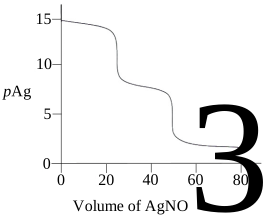
 

Why is this a valid and correct procedure for quantifying the amount of each anion present in the mixture?

  1. \( \ce{AgCl} \) would precipitate out first, followed by \( \ce{AgI} \).
  2. \( \ce{AgI}\) would precipitate out first, followed by \( \ce{AgCl} \).
  3. Both \( \ce{AgI} \) and \( \ce{AgCl} \) precipitate out of the solution together.
  4. Neither \( \ce{AgCl} \) nor \( \ce{AgI} \) would precipitate out of the solution.
Show Answers Only

\(B\)

Show Worked Solution
  • This procedure is only correct and valid if the ions precipitated out at different times.
  • Therefore \( \ce{AgI}\) would precipitate out first as it is less soluble than \( \ce{AgCl} \).

\(\Rightarrow B\)

♦ Mean mark 41%.

Filed Under: Inorganic Substances, Solution Equilibria Tagged With: Band 5, smc-3672-25-Solubility rules, smc-3682-70-Precipitation Titrations

CHEMISTRY, M5 2019 HSC 3 MC

Which of the following metal carbonates has the highest molar solubility?

  1. Calcium carbonate
  2. Copper`text{(II)}` carbonate
  3. Iron`text{(II)}` carbonate
  4. Lead`text{(II)}` carbonate
Show Answers Only

`A`

Show Worked Solution
  • Calcium carbonate has the greatest solubility product among the listed metal carbonates.
  • Since all of these metal carbonates release the same amount of ions in solutions, their solubility products can be directly compared to determine which substance is most soluble.

`=>A`

Filed Under: Solution Equilibria Tagged With: Band 3, smc-3672-25-Solubility rules

CHEMISTRY, M5 2020 HSC 11 MC

Equal volumes of two 0.04 mol L ¯1 solutions were mixed together.

Which pair of solutions would give the greatest mass of precipitate?

  1. `text{Ba(OH)}_(2) \ text{and} \ text{MgCl}_(2)`
  2. `text{Ba(OH)}_(2) \ text{and} \ text{MgSO}_(4)`
  3. `text{Ba(OH)}_(2) \ text{and} \ text{NaCl}`
  4. `text{Ba(OH)}_(2) \ text{and} \ text{Na}_(2) text{SO}_(4)`
Show Answers Only

`B`

Show Worked Solution

\(\ce{Ba(OH)2(aq) + MgSO4(aq) → BaSO4(s) + Mg(OH)2(s)}\)

  • Reaction B produces 2 molecules of precipitate
  • Reactions A and D produce 1 molecule of precipitate each
  • Reaction C does not produce a precipitate.

`=> B`

Filed Under: Solution Equilibria Tagged With: Band 4, smc-3672-10-Mixed ionic solutions, smc-3672-25-Solubility rules, smc-3672-70-Precipitate

CHEMISTRY, M5 2022 HSC 31

Silver ions form the following complex with ammonia solution.

\( \ce{Ag+(aq) + 2NH3(aq) \rightleftharpoons [Ag(NH3)2]+(aq)}\)

The equilibrium constant is `1.6 × 10^(7)` at 25°C.

  1. In order to determine the free \( \ce{Ag+}\) concentration in an aqueous ammonia solution, a student carried out a precipitation titration with \( \ce{NaI(aq)}\) as the titrant.
  2. Evaluate the suitability of this method.   (3 marks)

--- 8 WORK AREA LINES (style=lined) ---

  1. If 0.010% of the total silver ions in solution are present as \( \ce{Ag+(aq)}\) at equilibrium, calculate the equilibrium concentration of aqueous ammonia in this solution.   (4 marks)

--- 11 WORK AREA LINES (style=lined) ---

Show Answers Only

a.  The method is not suitable. 

  • Adding \( \ce{NaI}\) would cause the \( \ce{I-}\) ions to precipitate with the \( \ce{Ag+}\) ions to form \( \ce{AgI}\)
  •    \( \ce{AgI(s) \rightleftharpoons  Ag+(aq) + I- (aq)}\)
  • As a result, this would decrease \( \ce{[Ag+]}\), and disturb the equilibrium.
  • According to Le Chatelier’s Principle, the equilibrium will shift to the right in an attempt to counteract the change and increase \( \ce{[Ag+]}\).
  •    \( \ce{Ag+(aq) + 2NH3(aq) \rightleftharpoons [Ag(NH3)2]+(aq)}\)
  • As a result, \( \ce{[Ag(NH3)2]+}\) would shift to the left and increase \( \ce{[Ag+]} \). 

 
b.   
\({K_{eq}=\dfrac{\ce{[[Ag(NH3)2]+]}}{\ce{[Ag+][NH3]^2}}} \)

\[\ce {[[Ag(NH3)2]+] = \frac{99.99%}{0.010%} \times [Ag+] \ \ \ …\ (1)}\]

Substitute (1) into \(\ce {K_{eq}:}\)

`1.6 xx 10^7` `= [(99.99%) xx [text{Ag}^+ ]] / [(0.010%) xx [text{Ag}^+ ][text{NH}_3 ]^2]= [99.99%] / [0.010% [text{NH}_3 ]^2]`
`[text{NH}_3 ]^2` `=(99.99%)/(1.6 xx 10^7 xx 0.010%)`
`[text{NH}_3 ]` `=sqrt((99.99%)/(1.6 xx 10^7 xx 0.010%))= 0.025  text{mol L}^-1`

 
Therefore, the concentration of \(\ce {NH3}\) at equilibrium is 0.025 mol L¯1.

Show Worked Solution

a.  The method is not suitable. 

  • Adding \( \ce{NaI}\) would cause the \( \ce{I-}\) ions to precipitate with the \( \ce{Ag+}\) ions to form \( \ce{AgI}\)
  •    \( \ce{AgI(s) \rightleftharpoons  Ag+(aq) + I- (aq)}\)
  • As a result, this would decrease \( \ce{[Ag+]}\), and disturb the equilibrium.
  • According to Le Chatelier’s Principle, the equilibrium will shift to the right in an attempt to counteract the change and increase \( \ce{[Ag+]}\).
  •    \( \ce{Ag+(aq) + 2NH3(aq) \rightleftharpoons [Ag(NH3)2]+(aq)}\)
  • As a result, \( \ce{[Ag(NH3)2]+}\) would shift to the left and increase \( \ce{[Ag+]} \). 

♦ Mean mark (a) 40%.

b.   \({K_{eq}=\dfrac{\ce{[[Ag(NH3)2]+]}}{\ce{[Ag+][NH3]^2}}} \)

\[\ce {[[Ag(NH3)2]+] = \frac{99.99%}{0.010%} \times [Ag+] \ \ \ …\ (1)}\]

Substitute (1) into \(\ce {K_{eq}:}\)

`1.6 xx 10^7` `= [(99.99%) xx [text{Ag}^+ ]] / [(0.010%) xx [text{Ag}^+ ][text{NH}_3 ]^2]= [99.99%] / [0.010% [text{NH}_3 ]^2]`
`[text{NH}_3 ]^2` `=(99.99%)/(1.6 xx 10^7 xx 0.010%)`
`[text{NH}_3 ]` `=sqrt((99.99%)/(1.6 xx 10^7 xx 0.010%))= 0.025  text{mol L}^-1`

 
Therefore, the concentration of \(\ce {NH3}\) at equilibrium is 0.025 mol L¯1.


♦ Mean mark (b) 40%.

Filed Under: Solution Equilibria Tagged With: Band 5, smc-3672-20-Calcs given K(sp), smc-3672-25-Solubility rules

CHEMISTRY, M5 2022 HSC 19 MC

What is the molar solubility of iron(`text{II}`) hydroxide?

  1. `2.3 × 10^(-6)\ text{mol}\ text{L}^(-1)`
  2. `2.9 × 10^(-6)\ text{mol}\ text{L}^(-1)`
  3. `3.7 × 10^(-6)\ text{mol}\ text{L}^(-1)`
  4. `4.9 × 10^(-9)\ text{mol}\ text{L}^(-1)`
Show Answers Only

`A`

Show Worked Solution

`text{Fe(OH)}_2 (s) ⇌ text{Fe}^(2+) (aq) + 2 text{OH}^– (aq)`

Solids are not included in the `K_(sp)`  expression

\begin{array} {|l|c|c|}
\hline  & \text{Fe}^{2+} & \ \ \text{OH}^– \ \  \\
\hline \text{Initial} & 0 & 0  \\
\hline \text{Change} & + x & + 2x  \\
\hline \text{Equilibrium} & x & 2x \\
\hline \end{array}

`text{K}_(sp)` `= [text{Fe}^(2+)][text{OH}^–]^2`
`4.87 xx 10^(−17) ` `= x xx (2x)^2`
`4.87 xx 10^(−17)` `= 4x^3`
`:.x` `= root3((4.87 xx 10^(−17))/4)`
  `=2.30 xx 10^(−6)  text{mol L}^(–1)`

`=> A`


♦ Mean mark 45%.

Filed Under: Solution Equilibria Tagged With: Band 5, smc-3672-20-Calcs given K(sp), smc-3672-25-Solubility rules

Copyright © 2014–2025 SmarterEd.com.au · Log in