SmarterEd

Aussie Maths & Science Teachers: Save your time with SmarterEd

  • Login
  • Get Help
  • About

CHEMISTRY, M7 2024 HSC 35

Unknown samples of three carboxylic acids, labelled \(\text{X , Y}\) and \(\text{Z}\), are analysed to determine their identities.

  • Both \(\text{Y}\) and \(\text{Z}\) react rapidly with bromine in the absence of UV light, but \(\text{X}\) does not. A 0.100 g sample of \(\text{Y}\) reacts with the same amount of bromine as a 0.200 g sample of \(\text{Z}\).
  • Separate 0.100 g samples of \(\text{X , Y}\) and \(\text{Z}\) are titrated with 0.0617 mol L\(^{-1}\) sodium hydroxide solution. The titre volumes are shown.

\(
\begin{array}{|l|c|c|c|}
\hline \textit{Acid } & X & Y & Z \\
\hline \begin{array}{l}
\text {Volume of } \ce{NaOH \text{(mL)}} \\
\end{array} & 21.88 & 22.49 & 22.49 \\
\hline
\end{array}
\)
 

  • Both \(\text{Y}\) and \(\text{Z}\) can undergo hydration reactions in the presence of a suitable catalyst. Two products are possible for the hydration of \(\text{Y}\), but only one product is possible with \(\text{Z}\).

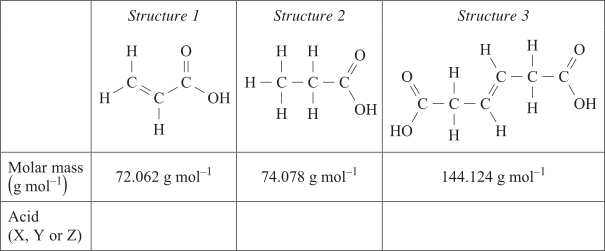
Identify which structures 1, 2 and 3 in the table are acids \(\text{X , Y}\) and \(\text{Z}\). Justify your answer with reference to the information provided.   (7 marks)


--- 22 WORK AREA LINES (style=lined) ---

Show Answers Only

  • Both sample \(\text{Y}\) and \(\text{Z}\) undergo an addition reaction with bromine and a hydration reaction. Therefore these samples must contain a \(\ce{C=C}\) bond.
  • As sample \(\text{X}\), undergoes neither of these reactions, it must have no \(\ce{C=C}\) bond, thus sample \(\text{X}\) is structure \(2\).
  • Both structure \(1\) and structure \(3\) contain 1 \(\ce{C=C}\) each \(\Rightarrow\) they will react in a \(1:1\) with \(\ce{Br2}\). Hence the same number of moles of the carboxylic acid samples will react with the bromine.
  • Since the mass of sample \(\text{Z}\) that reacts with the bromine is double the mass of sample \(\text{Y}\), the molar mass of sample \(\text{Z}\) must be double the molar mass of sample \(\text{Y}\) following the formula \(m = n \times MM\).
  • Therefore, sample \(\text{Y}\) is structure 1 and sample \(\text{Z}\) is structure 3.

Other information provided that could support identification includes:

  • The two products formed for the hydration of \(\text{Y}\) is due to the asymmetry of structure 1 and the single product formed in the hydration of \(\text{Z}\) is due to the symmetrical nature of structure 3.

The titration values are consistent with the proposed samples and their corresponding structures.

  • \(\ce{n(NaOH)}\) reacted with \(\text{X} = 0.0617 \times 0.02188 = 1.35 \times 10^{-3}\ \text{mol}\)
  • \(\text{n}_{\text{X}}= \dfrac{0.100}{74.078}= 0.00135\ \text{mol}\). Therefore \(\text{X}\) reacts in a \(1:1\) molar ratio as it is a monoprotic acid.
  • \(\ce{n(NaOH)}\) reacted with \(\text{Y}\) and \(\text{Z} = 0.0617 \times 0.02249 = 1.39 \times 10^{-3}\ \text{mol}\)
  • \(\text{n}_{\text{Y}}= \dfrac{0.100}{72.062}= 0.00139\ \text{mol}\). Therefore \(\text{Y}\) reacts in a \(1:1\) molar ratio as it is a monoprotic acid.
  • \(\text{n}_{\text{Z}}= \dfrac{0.100}{144.124}= 0.0006938\ \text{mol}\). Therefore \(\text{Z}\) reacts in a \(2:1\) molar ratio with \(\ce{NaOH}\) as it is a diprotic acid.
  • The equal volumes of \(\text{Y}\) and \(\text{Z}\) used in the titration can be attributed to \(\text{Z}\) having twice the molar mass of \(\text{Y}\) and being a diprotic acid.

Show Worked Solution

  • Both sample \(\text{Y}\) and \(\text{Z}\) undergo an addition reaction with bromine and a hydration reaction. Therefore these samples must contain a \(\ce{C=C}\) bond.
  • As sample \(\text{X}\), undergoes neither of these reactions, it must have no \(\ce{C=C}\) bond, thus sample \(\text{X}\) is structure \(2\).
  • Both structure \(1\) and structure \(3\) contain 1 \(\ce{C=C}\) each \(\Rightarrow\) they will react in a \(1:1\) with \(\ce{Br2}\). Hence the same number of moles of the carboxylic acid samples will react with the bromine.
  • Since the mass of sample \(\text{Z}\) that reacts with the bromine is double the mass of sample \(\text{Y}\), the molar mass of sample \(\text{Z}\) must be double the molar mass of sample \(\text{Y}\) following the formula \(m = n \times MM\).
  • Therefore, sample \(\text{Y}\) is structure 1 and sample \(\text{Z}\) is structure 3.

Other information provided that could support identification includes:

  • The two products formed for the hydration of \(\text{Y}\) is due to the asymmetry of structure 1 and the single product formed in the hydration of \(\text{Z}\) is due to the symmetrical nature of structure 3.

The titration values are consistent with the proposed samples and their corresponding structures.

  • \(\ce{n(NaOH)}\) reacted with \(\text{X} = 0.0617 \times 0.02188 = 1.35 \times 10^{-3}\ \text{mol}\)
  • \(\text{n}_{\text{X}}= \dfrac{0.100}{74.078}= 0.00135\ \text{mol}\). Therefore \(\text{X}\) reacts in a \(1:1\) molar ratio as it is a monoprotic acid.
  • \(\ce{n(NaOH)}\) reacted with \(\text{Y}\) and \(\text{Z} = 0.0617 \times 0.02249 = 1.39 \times 10^{-3}\ \text{mol}\)
  • \(\text{n}_{\text{Y}}= \dfrac{0.100}{72.062}= 0.00139\ \text{mol}\). Therefore \(\text{Y}\) reacts in a \(1:1\) molar ratio as it is a monoprotic acid.
  • \(\text{n}_{\text{Z}}= \dfrac{0.100}{144.124}= 0.0006938\ \text{mol}\). Therefore \(\text{Z}\) reacts in a \(2:1\) molar ratio with \(\ce{NaOH}\) as it is a diprotic acid.
  • The equal volumes of \(\text{Y}\) and \(\text{Z}\) used in the titration can be attributed to \(\text{Z}\) having twice the molar mass of \(\text{Y}\) and being a diprotic acid.
♦ Mean mark 55%.

Filed Under: Hydrocarbons and Associated Reactions, Quantitative Analysis Tagged With: Band 4, Band 5, smc-3675-10-Titration, smc-3677-70-Reactions of Unsaturated Hydrocarbons

CHEMISTRY, M6 2024 HSC 20 MC

The concentration of ascorbic acid \(\left(M M=176.124\ \text{g mol}^{-1}\right)\) in solution \(\text{A}\) was determined by titration.

    • A 25.00 mL sample of solution \(\text{A}\) was titrated with potassium hydroxide solution.
    • 50.00 mg of ascorbic acid was added to a second 25.00 mL sample of solution \(\text{A}\), which was titrated in the same way.

Titration volumes for both titrations are given.

\begin{array} {|l|c|}
\hline
\rule{0pt}{2.5ex} \textit{Solution} \rule[-1ex]{0pt}{0pt} & \textit{Titre}\text{ (mL)} \\
\hline
\rule{0pt}{2.5ex} \text{25.00 mL solution A} \rule[-1ex]{0pt}{0pt} & 17.50 \\
\hline
\rule{0pt}{2.5ex} \text{25.00 mL solution A+}& 33.10 \\
\text{50.00 mg of ascorbic acid}& \text{} \\
\hline
\end{array}

What is the concentration of ascorbic acid in solution \(\text{A}\)?

  1. \(5.352 \times 10^{-3} \text{ mol L}^{-1}\)
  2. \(6.004 \times 10^{-3} \text{ mol L}^{-1}\)
  3. \(1.012 \times 10^{-2} \text{ mol L}^{-1}\)
  4. \(1.274 \times 10^{-2} \text{ mol L}^{-1}\)
Show Answers Only

\(D\)

Show Worked Solution
  • \(\ce{n(ascorbic acid)} = \dfrac{0.05}{176.124} = 0.00028389\ \text{mol}\)
  • Volume of \(\ce{KOH}\) to neutralise the two samples = 15.6 mL.
  • 15.6 mL was required to neutralise the extra 0.00028389 mol of ascorbic acid.
  • Concentration of potassium hydroxide \(=\dfrac{\text{n}}{\text{V}}= \dfrac{0.00028389}{0.0156} = 0.018198\ \text{mol L}^{-1}\)
  • \(\ce{n(KOH)}\) used in the first titration \(\ce{= c \times V} = 0.018198 \times 0.0175 = 0.0003185\ \text{mol} = \ce{n(ascorbic acid)}\)
  • \(\ce{[ascrobic acid]} = \dfrac{0.0003185}{0.0250} = 0.01274 = 1.274 \times 10^{-2}\ \text{mol L}^{-1}\)

\(\Rightarrow D\)

♦ Mean mark 43%.

Filed Under: Quantitative Analysis Tagged With: Band 5, smc-3675-10-Titration

CHEMISTRY, M6 2009 HSC 14 MC

Citric acid, the predominant acid in lemon juice, is a triprotic acid. A student titrated 25.0 mL samples of lemon juice with 0.550 mol L\(^{-1}\ \ce{NaOH}\). The mean titration volume was 29.50 mL. The molar mass of citric acid is 192.12 g mol\(^{-1}\).

What was the concentration of citric acid in the lemon juice?

  1. 1.04 g L\(^{-1}\)
  2. 41.6 g L\(^{-1}\)
  3. 125 g L\(^{-1}\)
  4. 374 g L\(^{-1}\)
Show Answers Only

\(B\)

Show Worked Solution

\(\ce{H3A(aq) + 3NaOH(aq) → Na3A(aq) + 3H2O(l)}\)

\(\ce{n(NaOH)=c \times v=0.550 \times 0.0295=0.016225\ \text{mol}}\)

\(\ce{n(citric acid)= \dfrac{0.016225}{3}=0.00541\ \text{mol}}\)

\(\ce{[citric acid]=\dfrac{0.00541}{0.025}=0.216\ \text{molL}^{-1}}\)

Multiply by molar mass:.

\(\text{Concentration (citric acid)}\ = 0.216 \times 192.12 = 41.5\ \text{g L}^{-1}\)

\(\Rightarrow B\)

Filed Under: Quantitative Analysis Tagged With: Band 5, smc-3675-10-Titration

CHEMISTRY, M6 2023 HSC 14 MC

What volume of 0.540 mol L\(^{-1} \) hydrochloric acid will react completely with 1.34 g of sodium carbonate?

  1. 11.7 mL
  2. 23.4 mL
  3. 29.9 mL
  4. 46.8 mL
Show Answers Only

\(D\)

Show Worked Solution

\(\ce{2HCl + Na2CO3 \rightarrow 2NaCl +H2CO3}\)

\(\ce{n(Na2CO3) = \dfrac{\text{m}}{\text{MM}} = \dfrac{1.34}{105.99} = 0.0126\ \text{mol}}\)

\(\ce{n(HCl) = 0.0126 \times 2 = 0.0253\ \text{mol}} \)

\(\text{Vol (HCl)}\ = \dfrac{0.0253}{0.540} = 0.0468\ \text{L} = 46.8\ \text{mL}\)

\(\Rightarrow D\)

♦ Mean mark 45%.

Filed Under: Quantitative Analysis Tagged With: Band 5, smc-3675-10-Titration

CHEMISTRY, M6 2023 HSC 32

The ammonium ion content of mixtures can be determined by boiling the mixture with a known excess of sodium hydroxide. This converts the ammonium ions into gaseous ammonia, which is removed from the system.

\( \ce{NH4^{+}(aq) + OH^{-}(aq) \rightarrow NH3(g) + H2O(l)} \)

The excess sodium hydroxide can then be titrated with an acid solution of known concentration.

A fertiliser containing ammonium ions was analysed as follows.

  • A sample of fertiliser was treated with 50.00 mL of 1.124 mol L\(^{-1} \) sodium hydroxide solution and the solution boiled.
  • After all of the ammonia was removed, the resulting solution was transferred to a 250.0 mL volumetric flask and made up to the mark with deionised water.
  • 20.00 mL aliquots of this solution were titrated with 0.1102 mol L\(^{-1} \) hydrochloric acid, giving the following results.
\( Titration \) \(Volume \ \ce{HCl} \ \text{(mL)} \)
1 22.65
2 22.05
3 22.00
4 21.95

Calculate the mass of ammonium ions in the sample of fertiliser.   (5 marks)

--- 14 WORK AREA LINES (style=lined) ---
Show Answers Only

\(0.4671\ \text{g} \)

Show Worked Solution

\(\text{Average titre (HCl)}\ =\dfrac{22.05+22.00+21.95}{3}=22.00\ \text{mL} = 0.02200\ \text{L} \)

\(\ce{n(HCl)} = \ce{c \times V} = 0.02200 \times 0.1102 = 2.424 \times 10^{-3}\ \text{mol} \)

\(\ce{n(NaOH \text{excess})} = 2.424 \times 10^{-3}\ \text{mol} \)

Mean mark 56%.

\(\text{In the 250 mL flask:}\)

\(\ce{n(NaOH \text{excess})} = \dfrac{250.0}{20.00} \times 2.424 \times 10^{-3} = 3.031 \times 10^{-2}\ \text{mol} \)

\(\ce{n(NaOH \text{total}) = \ce{c \times V} = 0.0500 \times 1.124 = 5.620 \times 10^{-2}\ \text{mol}} \)

\(\ce{n(NaOH\ \text{reacting with}\ NH4+) = 5.620 \times 10^{-2}-3.031 \times 10^{-2} = 2.589 \times 10^{-2}\ \text{mol}} \)

\(\ce{n(NH4+) = 2.589 \times 10^{-2}\ \text{mol}} \)

\(\ce{MM(NH4+) = 14.01 + 4 \times 1.008 = 18.042} \)

\(\ce{m(NH4+) = 2.589 \times 10^{-2} \times 18.042 = 0.4671\ \text{g}} \)

Filed Under: Quantitative Analysis Tagged With: Band 5, smc-3675-10-Titration

CHEMISTRY, M6 2012 HSC 30

A chemist analysed aspirin tablets for quality control. The initial step of the analysis was the standardisation of a \(\ce{NaOH}\) solution. Three 25.00 mL samples of a 0.1034 mol L\(^{-1}\) solution of standardised \(\ce{HCl}\) were titrated with the \( \ce{NaOH} \) solution. The average volume required for neutralisation was 25.75 mL.

  1. Calculate the molarity of the \(\ce{NaOH}\) solution.  (2 marks)

Three flasks were prepared each containing a mixture of 25 mL of water and 10 mL of ethanol. An aspirin tablet was dissolved in each flask. The aspirin in each solution was titrated with the standardised \(\ce{NaOH}\) solution according to the following equation:

\(\ce{C9H8O4(aq) + NaOH(aq) \rightarrow C9H7O4Na(aq) + H2O(l)}\)

The following titration results were obtained.

\begin{array} {|c|c|}
\hline
\rule{0pt}{2.5ex}\textit{Tablet}\rule[-1ex]{0pt}{0pt} & \textit{Volume}\ \text{(mL)}\\
\hline
\rule{0pt}{2.5ex}\text{1}\rule[-1ex]{0pt}{0pt} & 16.60\\
\hline
\rule{0pt}{2.5ex}\text{2}\rule[-1ex]{0pt}{0pt} & 16.50\\
\hline
\rule{0pt}{2.5ex}\text{3}\rule[-1ex]{0pt}{0pt} & 16.55\\
\hline
\end{array}

  1. Calculate the average mass (mg) of aspirin per tablet.  (3 marks)
Show Answers Only

a.    \(\ce{0.1004 mol L^{-1}}\)

b.    \(\ce{299.2 mg}\)

Show Worked Solution

a.    \(\ce{n(HCl) = c \times V = 0.1034 \times 0.02500 = 2.585 \times 10^{-3} moles}\)

\(\ce{n(HCl) = n(OH^{-})}\)

\[\ce{[OH-] = \frac{2.585 \times 10^{-3}}{0.02575} = 0.1004 mol L^{-1}}\]  

b.    \(\ce{n(HCl) = c \times V = 0.1004 \times 0.01655 = 1.661 \times 10^{-3} moles}\)

\(\ce{n(HCl) = n(C9H8O4) = 1.661 \times 10^{-3} moles}\)

\(\ce{MM(C9H8O4) = 9 \times 12.01 + 8 \times 1.008 + 4 \times 16.00 = 180.154 g}\)

\(\ce{Average mass of C9H8O4  per tablet}\)

\(\ce{= n \times MM = 1.661 \times 10^{-3} \times 180.154 = 0.2992 g = 299.2 mg}\)

Filed Under: Quantitative Analysis Tagged With: Band 4, Band 5, smc-3675-10-Titration

CHEMISTRY, M2 2010 HSC 7 MC

Equal volumes of four 0.1 mol L\(^{-1}\) acids were titrated with the same sodium hydroxide solution.

Which one requires the greatest volume of base to change the colour of the indicator?

  1. Citric acid
  2. Acetic acid
  3. Sulfuric acid
  4. Hydrochloric acid
Show Answers Only

\(A\)

Show Worked Solution
  • Citric acid is triprotic.
  • Sulfuric acid is diprotic.
  • Acetic acid and Hydrochloric acid are monoprotic.
  • The greatest volume of \(\ce{NaOH}\) is required for the triprotic acid as it has a 1:3, acid:base, stoichiometric ratio.

\(\Rightarrow A\)

Filed Under: Quantitative Analysis Tagged With: Band 4, smc-3675-10-Titration

CHEMISTRY, M6 2014 HSC 30

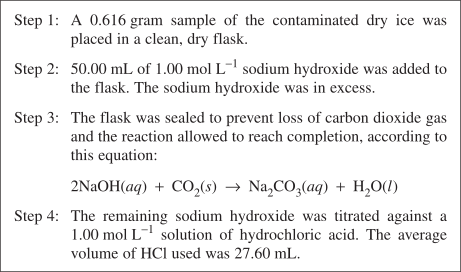
A batch of dry ice (solid \(\ce{CO_2}\)) was contaminated during manufacture. To determine its purity, the following steps were carried out.

  1. Calculate the number of moles of \(\ce{NaOH}\) added in Step 2.  (1 mark)
  2. Calculate the percentage purity by mass of this batch of dry ice.  (4 marks)
Show Answers Only

a.   0.0500 moles

b.   80.0%

Show Worked Solution

a.    \(\ce{n(NaOH) = c \times V = 0.0500 \times 1.00 = 0.0500 moles}\)
  

b.    \(\ce{n(HCl) = c \times V = 0.0276 \times 1.00 = 0.0276 mol (titrate excess NaOH)}\)

\(\ce{n(NaOH to neutralise CO2) = 0.0500-0.0276 = 0.0224 mol}\)
 

\(\ce{Ratio \ NaOH\ : CO2 = 2\ : 1  (from equation)}\)

\(\ce{n(CO2) = \frac{1}{2} \times n(NaOH) = \frac{1}{2} \times 0.0224 = 0.0112 mol}\)

\(\ce{MM (CO2) = 12.01 + 2 \times 16 = 44.01}\)

\(\ce{Mass (CO2) = n \times MM = 0.0112 \times 44.01 = 0.493 g}\)

\[\ce{\% Dry ice (by mass) = \frac{0.493}{0.616} \times 100\% = 80.0\%}\]

♦ Mean mark (b) 41%.

Filed Under: Quantitative Analysis Tagged With: Band 4, Band 5, smc-3675-10-Titration

CHEMISTRY, M6 2016 HSC 29

A solution of hydrochloric acid was standardised by titration against a sodium carbonate solution using the following procedure.

  • All glassware was rinsed correctly to remove possible contaminants.
  • Hydrochloric acid was placed in the burette.
  • 25.0 mL of sodium carbonate solution was pipetted into the conical flask.

The titration was performed and the hydrochloric acid was found to be 0.200 mol L\(^{-1} \).

  1. Identify the substance used to rinse the conical flask and justify your answer.   (2 marks)

    --- 4 WORK AREA LINES (style=lined) ---

  2. Seashells contain a mixture of carbonate compounds. The standardised hydrochloric acid was used to determine the percentage by mass of carbonate in a seashell using the following procedure.
    • A 0.145 g sample of the seashell was placed in a conical flask.
    • 50.0 mL of the standardised hydrochloric acid was added to the conical flask.
    • At the completion of the reaction, the mixture in the conical flask was titrated with 0.250 mol L\(^{-1} \) sodium hydroxide.
  1. The volume of sodium hydroxide used in the titration was 29.5 mL.
  2. Calculate the percentage by mass of carbonate in the sample of the seashell.   (4 marks)

    --- 14 WORK AREA LINES (style=lined) ---
Show Answers Only

a.   Substance for rinse:

  • Water should be used to rinse the conical flask as this will not change the number of moles of \(\ce{Na2CO3}\) placed in it.

b.   \( 54.3\% \)

Show Worked Solution

a.   Substance for rinse:

  • Water should be used to rinse the conical flask as this will not change the number of moles of \(\ce{Na2CO3}\) placed in it.

b.   \(\ce{HCl + NaOH \rightarrow H2O + NaCl}\)

\(\ce{n(NaOH) = c \times V = 0.250 \times 0.0295 = 7.375 \times 10^{-3} moles}\)

\(\ce{n(HCl) = 7.375 \times 10^{-3} (after reaction)}\)

\(\ce{n(HCl – original) = c \times V = 0.200 \times 0.0500 = 0.0100 moles}\)

\(\ce{n(HCl – used) = 0.0100-7.375 \times 10^{-3} = 2.625 \times 10^{-3} moles}\)
 

\(\ce{2HCl + CO3^{2-} \rightarrow H2O + CO2 + 2Cl-}\)

\(\ce{HCl\ : CO3^{2-} = 2\ : 1}\)

\[\ce{n(CO3^{2-}) = \frac{2.625 \times 10^{-3}}{2} = 1.3125 \times 10^{-3} moles}\]

\(\ce{m(CO3^{2-}) = 1.3125 \times 10^{-3} \times 60.01 = 0.07876 g}\)

\[\ce{\text{% Mass} (CO3^{2-}) = \frac{0.07876}{0.145} \times 100\% = 54.3\%} \]

♦ Mean mark (b) 40%.

Filed Under: Quantitative Analysis Tagged With: Band 4, Band 5, smc-3675-10-Titration

CHEMISTRY, M6 EQ-Bank 28

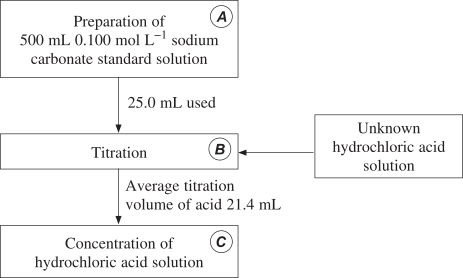
The flowchart shown outlines the sequence of steps used to determine the concentration of an unknown hydrochloric acid solution.
 

Describe steps A, B and C including correct techniques, equipment and appropriate calculations. Determine the concentration of the hydrochloric acid.  (8 marks)

--- 16 WORK AREA LINES (style=lined) ---

Show Answers Only

Step A

  • Prepare \(\ce{Na2CO3}\) by drying. Protect solid \(\ce{Na2CO3}\) from moisture in the air by storing in a desiccator.
  • Calculate mass of dried \(\ce{Na2CO3}\) required and weigh accurately.
  •    \(\ce{m(Na2CO3) = 0.1 \times 0.5 \times 105.99 = 5.30 g}\)
  • Clean and rinse a 500 mL volumetric flask with distilled water.
  • Add 5.30 grams of \(\ce{Na2CO3}\) to the volumetric flask using a funnel and wash funnel using distilled water. Add distilled water to the flask to the bottom of the meniscus.

Step B

  • Clean and rinse a 50 mL burette. Fill burette with the unknown acid and place on a retort stand.
  • Clean and rinse a 250 mL conical flask with distilled water.
  • Clean a 25 mL pipette and rinse with 0.1 M \(\ce{Na2CO3}\) solution. Fill pipette with \(\ce{Na2CO3}\) solution to bottom of meniscus.
  • Transfer all pipette solution into conical flask and add an appropriate indicator. A white background (tile) should be placed under the flask to highlight any colour changes in the solution.
  • Slowly add acid solution from the burette into the conical flask and record the volume used when the indicator changes colour.

Step C

  • The initial titration represents a test run to establish an indicative volume. Three subsequent titrations should be performed with the average titration forming the basis of \(\ce{HCl}\) concentration calculations.
  • Calculate the concentration of \(\ce{HCl}\)
  •    \(\ce{2H^+(aq) + CO3^{2-} (aq) \rightarrow H2CO3 (aq) \rightarrow H2O (l) + CO2 (g)}\)
  •    \(\ce{M(Na2CO3) = 0.1 \times 0.025 = 2.5 \times 10^{-3}}\)
  •    \(\ce{M(HCl) = 2 \times M(Na2CO3) = 5\times 10^{-3}}\)
  •    \[\ce{[HCl] = \frac{M(HCl)}{Vol HCl} = \frac{5 \times 10^{-3}}{21.4 \times 10^{-3}} = 0.234 mol L^{-1}}\]
Show Worked Solution

Step A

  • Prepare \(\ce{Na2CO3}\) by drying. Protect solid \(\ce{Na2CO3}\) from moisture in the air by storing in a desiccator.
  • Calculate mass of dried \(\ce{Na2CO3}\) required and weigh accurately.
  •    \(\ce{m(Na2CO3) = 0.1 \times 0.5 \times 105.99 = 5.30 g}\)
  • Clean and rinse a 500 mL volumetric flask with distilled water.
  • Add 5.30 grams of \(\ce{Na2CO3}\) to the volumetric flask using a funnel and wash funnel using distilled water. Add distilled water to the flask to the bottom of the meniscus.

Step B

  • Clean and rinse a 50 mL burette. Fill burette with the unknown acid and place on a retort stand.
  • Clean and rinse a 250 mL conical flask with distilled water.
  • Clean a 25 mL pipette and rinse with 0.1 M \(\ce{Na2CO3}\) solution. Fill pipette with \(\ce{Na2CO3}\) solution to bottom of meniscus.
  • Transfer all pipette solution into conical flask and add an appropriate indicator. A white background (tile) should be placed under the flask to highlight any colour changes in the solution.
  • Slowly add acid solution from the burette into the conical flask and record the volume used when the indicator changes colour.

Step C

  • The initial titration represents a test run to establish an indicative volume. Three subsequent titrations should be performed with the average titration forming the basis of \(\ce{HCl}\) concentration calculations.
  • Calculate the concentration of \(\ce{HCl}\)
  •    \(\ce{2H^+(aq) + CO3^{2-} (aq) \rightarrow H2CO3 (aq) \rightarrow H2O (l) + CO2 (g)}\)
  •    \(\ce{M(Na2CO3) = 0.1 \times 0.025 = 2.5 \times 10^{-3}}\)
  •    \(\ce{M(HCl) = 2 \times M(Na2CO3) = 5\times 10^{-3}}\)
  •    \[\ce{[HCl] = \frac{M(HCl)}{Vol HCl} = \frac{5 \times 10^{-3}}{21.4 \times 10^{-3}} = 0.234 mol L^{-1}}\]

Filed Under: Quantitative Analysis Tagged With: Band 4, Band 5, smc-3675-10-Titration

CHEMISTRY, M6 2018 HSC 29

The concentration of hydrochloric acid in a solution was determined by an acid base titration using a standard solution of sodium carbonate.

  1. Explain why sodium carbonate is a suitable compound for preparation of a standard solution.  (2 marks)

    --- 5 WORK AREA LINES (style=lined) ---

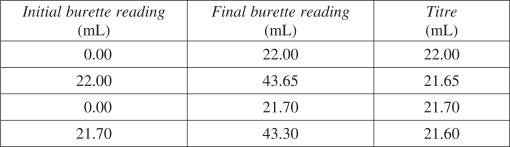
  2. A 25.00 mL sample of 0.1050 mol L¯1 sodium carbonate solution was added to a conical flask and three drops of methyl orange indicator added. The mixture was titrated with the hydrochloric acid and the following readings were recorded.


    Using the data from the table, calculate the concentration of the hydrochloric acid.  (3 marks)

    --- 6 WORK AREA LINES (style=lined) ---

  3. Explain the effect on the calculated concentration of hydrochloric acid if phenolphthalein is used as the indicator instead of methyl orange.  (2 marks)

    --- 5 WORK AREA LINES (style=lined) ---

Show Answers Only

a.    Suitability of  \(\ce{Na2CO3}\):

  • \(\ce{Na2CO3}\) is a stable compound.
  • \(\ce{Na2CO3}\) is a pure solid that will not readily absorb water from the atmosphere.
  • An accurate weight of \(\ce{Na2CO3}\) can therefore be obtained in the experiment’s measurements. 

b.    0.2425 mol L–¹

c.    This is a strong acid / weak base titration.

  • Its equivalence point will occur at a pH less than seven and phenolphthalein changes colour in the pH range 10 – 8.3.
  • Phenolphthalein indicator would therefore signal the end point before equivalence (i.e. with a lower volume of acid). 
  • The calculated concentration of \(\ce{HCl}\) would be higher than the correct concentration.
Show Worked Solution

a.    Suitability of  \(\ce{Na2CO3}\):

  • \(\ce{Na2CO3}\) is a stable compound.
  • \(\ce{Na2CO3}\) is a pure solid that will not readily absorb water from the atmosphere.
  • An accurate weight of \(\ce{Na2CO3}\) can therefore be obtained in the experiment’s measurements. 

♦ Mean mark (a) 43%.

b.   \(\ce{Na2CO3(aq) + 2HCl(aq) -> 2NaCl(aq) + H2O(l) + CO2(g)}\)

\[\ce{Average titre = \frac{21.65 + 21.70 + 21.60}{3} = 21.65 mL}\]

\[\ce{n(Na2CO3) = c \times V = 0.1050 \times 0.0250 = 0.002625 mol}\]

\(\ce{n(HCl) = 2 \times n(Na2CO3) = 0.005250 mol}\)

\[\ce{[HCl] = \frac{n}{V} = \frac{0.005250}{0.02165} = 0.2425 mol L^{-1}}\]  

c.    This is a strong acid / weak base titration.

  • Its equivalence point will occur at a pH less than seven and phenolphthalein changes colour in the pH range 10 – 8.3.
  • Phenolphthalein indicator would therefore signal the end point before equivalence (i.e. with a lower volume of acid). 
  • The calculated concentration of \(\ce{HCl}\) would be higher than the correct concentration.

♦♦♦ Mean mark (c) 29%.

Filed Under: Properties of Acids and Bases, Quantitative Analysis Tagged With: Band 4, Band 5, Band 6, smc-3673-15-Indicators, smc-3675-10-Titration, smc-3675-45-Standard Solutions

CHEMISTRY, M6 2015 HSC 26

A sodium hydroxide solution was titrated against citric acid \(\ce{(C6H8O7)}\) which is triprotic.

  1. Draw the structural formula of citric acid (2-hydroxypropane-1,2,3-tricarboxylic acid).   (1 mark)
     

--- 0 WORK AREA LINES (style=lined) ---

  1. How could a computer-based technology be used to identify the equivalence point of this titration?   (2 marks)

    --- 4 WORK AREA LINES (style=lined) ---

  2. The sodium hydroxide solution was titrated against 25.0 mL samples of 0.100 mol L ¯1 citric acid. The average volume of sodium hydroxide used was 41.50 mL.
  3. Calculate the concentration of the sodium hydroxide solution.   (4 marks)

    --- 10 WORK AREA LINES (style=lined) ---
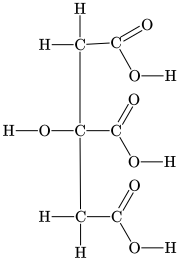
Show Answers Only

a.   
         

b.   Technology solution

  • A digital pH probe could be placed in the flask and used to collect data that plots the pH of the solution against the volume of sodium hydroxide added.
  • The equivalence point would be identified by a steep rise in the pH on the graph.
     

c.   \(\ce{C6H8O7 + 3NaOH -> C6H5O7Na3 + 3H2O}\)

\(\ce{n(C6H8O7) = c \times V = 0.100 \times 0.0250 = 0.00250 mol}\)

\(\ce{n(NaOH) = 3 \times 0.00250 = 0.00750 mol}\)

\[\ce{[NaOH] = \frac{n}{V} = \frac{0.00750}{0.04150} = 0.181 mol L^{-1} (3 sig fig)}\]

Show Worked Solution
a.   
         

♦ Mean mark (a) 46%.

b.   Technology solution

  • A digital pH probe could be placed in the flask and used to collect data that plots the pH of the solution against the volume of sodium hydroxide added.
  • The equivalence point would be identified by a steep rise in the pH on the graph.

♦ Mean mark (b) 42%.

c.   \(\ce{C6H8O7 + 3NaOH -> C6H5O7Na3 + 3H2O}\)

\(\ce{n(C6H8O7) = c \times V = 0.100 \times 0.0250 = 0.00250 mol}\)

\(\ce{n(NaOH) = 3 \times 0.00250 = 0.00750 mol}\)

\[\ce{[NaOH] = \frac{n}{V} = \frac{0.00750}{0.04150} = 0.181 mol L^{-1} (3 sig fig)}\]


Mean mark (c) 56%.

Filed Under: Quantitative Analysis, Reactions of Organic Acids and Bases Tagged With: Band 4, Band 5, smc-3675-10-Titration, smc-3680-20-Formulae and Properties

CHEMISTRY, M6 2015 HSC 14 MC

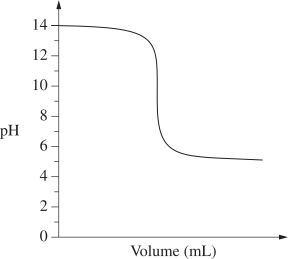
The graph shows the changes in pH during a titration.
 

Which pH range should an indicator have to be used in this titration?

  1. \(3.1-4.4\)
  2. \(5.0-8.0\)
  3. \(6.0-7.6\)
  4. \(8.3-10.0\)
Show Answers Only

\(D\)

Show Worked Solution
  • The indicator suitable for this titration needs to completely change colour at the centre of the vertical section of the graph (equivalence point).
  • The range that will achieve this is  \(8.3-10.0\).

\(\Rightarrow D\)

Filed Under: Quantitative Analysis Tagged With: Band 4, smc-3675-10-Titration

CHEMISTRY, M6 2017 HSC 24

A solution of sodium hydroxide was titrated against a standardised solution of acetic acid which had a concentration of 0.5020 mol L¯1.

  1. The end point was reached when 19.30 mL of sodium hydroxide solution had been added to 25.00 mL of the acetic acid solution.
  2. Calculate the concentration of the sodium hydroxide solution.   (3 marks)

    --- 7 WORK AREA LINES (style=lined) ---
  3. Explain why the pH of the resulting salt solution was not 7. Include a relevant chemical equation in your answer.   (2 marks)

    --- 4 WORK AREA LINES (style=lined) ---
Show Answers Only

a.   \(\ce{CH3COOH(aq) + NaOH(aq) -> NaCH3COO(aq) + H2O(l)}\)
 

b.   \(\ce{CH3COO-(aq) + H2O \rightleftharpoons CH3COOH(aq) + OH-(aq)}\)

  • The acetate ion is a weak base.
  • As a result, it has accepted a proton from the water resulting in production of hydroxide ions.
  • Therefore the solution has a pH > 7.
Show Worked Solution

a.   \(\ce{CH3COOH(aq) + NaOH(aq) -> NaCH3COO(aq) + H2O(l)}\)

\(\ce{n(CH3COOH) = c \times V = 0.5020 \times 0.0250 = 0.01255 mol}\)

\(\ce{n(NaOH) = n(CH3COOH) = 0.01255 mol}\)

\[\ce{[NaOH] = \frac{n}{V} = \frac{0.01255}{0.01930} = 0.6503 mol L^{-1}}\]  

b.   \(\ce{CH3COO-(aq) + H2O \rightleftharpoons CH3COOH(aq) + OH-(aq)}\)

  • The acetate ion is a weak base.
  • As a result, it has accepted a proton from the water resulting in production of hydroxide ions.
  • Therefore the solution has a pH > 7.

♦♦ Mean mark (b) 34%.

Filed Under: Bronsted-Lowry Theory, Quantitative Analysis Tagged With: Band 4, Band 5, smc-3674-18-Dissociation in Water, smc-3675-10-Titration

CHEMISTRY, M6 2015 HSC 2 MC

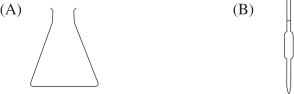
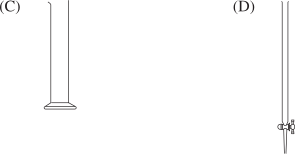
Which type of glassware is used in a titration to deliver an accurate volume of a solution to a known volume of another solution?


Show Answers Only

`D`

Show Worked Solution
  • A burette is used in a titration.

`=>D`

Filed Under: Quantitative Analysis Tagged With: Band 3, smc-3675-10-Titration

CHEMISTRY, M6 2017 HSC 13 MC

25.0 mL of a 0.100 mol L ¯1 acid is to be titrated against a sodium hydroxide solution until final equivalence is reached.

Which of the following acids, if used in the titration, would require the greatest volume of sodium hydroxide?

  1. Acetic
  2. Citric
  3. Hydrochloric
  4. Sulfuric
Show Answers Only

`B`

Show Worked Solution
  • Citric acid is triprotic (i.e. ratio moles NaOH : acid = 3 : 1). It therefore requires the greates volume of NaOH.
  • Acetic acid and Hydrochloric acid are monoprotic (i.e. ratio moles NaOH : acid = 1 : 1)
  • Sulfuric acid is diprotic (i.e. ratio moles NaOH : acid = 2 : 1)

`=>B`


♦♦♦ Mean mark 29%.

Filed Under: Quantitative Analysis Tagged With: Band 6, smc-3675-10-Titration

CHEMISTRY, M6 2017 HSC 1 MC

In an experiment, 30 mL of water is to be transferred into a conical flask.

Which piece of equipment would deliver the volume with the greatest accuracy?

  1. Burette
  2. Beaker
  3. Test tube
  4. Measuring cylinder
Show Answers Only

`A`

Show Worked Solution
  • A burette can measure and deliver to 0.05 mL accuracy, making it easily the most accurate measuring device of the given options.

`=>A`

Filed Under: Quantitative Analysis Tagged With: Band 4, smc-3675-10-Titration

CHEMISTRY, M6 2019 HSC 24

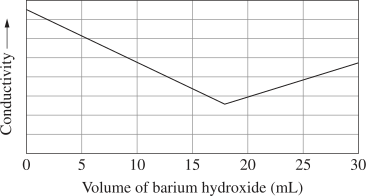
A conductometric titration was undertaken to determine the concentration of a barium hydroxide solution. The solution was added to 250.0 mL of standardised 1.050 × 10 ¯ 3 mol L ¯1 hydrochloric acid solution. The results of the titration are shown in the conductivity graph.


  1. Explain the shape of the titration curve.   (3 marks)

    --- 8 WORK AREA LINES (style=lined) ---
  2. The equivalence point was reached when a volume of 17.15 mL of barium hydroxide was added.
  3. Calculate the concentration of barium hydroxide (in mol L¯1), and give a relevant chemical equation.   (4 marks)

    --- 10 WORK AREA LINES (style=lined) ---
Show Answers Only

a.   Titration curve shape:

  • The conductivity of a solution of hydrochloric acid is initially very high due to the high concentration of ions in the solution.
  • As barium hydroxide is added, the conductivity decreases because the concentration of \(\ce{H+}\) decreases due to the neutralization reaction with \(\ce{OH-}\) ions.
  • The conductivity reaches a minimum at the equivalence point, which is when all the \(\ce{H+}\) ions have been removed and the solution only contains \(\ce{Ba^2+}\) and \(\ce{Cl-}\) ions.
  • These ions are much less mobile than \(\ce{H+}\) or \(\ce{OH-}\) ions, so the conductivity is lower at the equivalence point.
  • After the equivalence point, the conductivity increases as more barium hydroxide is added, resulting in an increase in the concentration of \(\ce{OH-}\) ions and therefore an increase in conductivity.
     

b.   \(\ce{2HCl(aq) + Ba(OH)2(aq) -> BaCl2(aq) + 2H2O(l)} \)

\(\ce{[Ba(OH)2]} = 7.653 \times 10^{-3}\ \text{mol L}^{-1}\)

Show Worked Solution

a.   Titration curve shape:

  • The conductivity of a solution of hydrochloric acid is initially very high due to the high concentration of ions in the solution.
  • As barium hydroxide is added, the conductivity decreases because the concentration of \(\ce{H+}\) decreases due to the neutralization reaction with \(\ce{OH-}\) ions.
  • The conductivity reaches a minimum at the equivalence point, which is when all the \(\ce{H+}\) ions have been removed and the solution only contains \(\ce{Ba^2+}\) and \(\ce{Cl-}\) ions.
  • These ions are much less mobile than \(\ce{H+}\) or \(\ce{OH-}\) ions, so the conductivity is lower at the equivalence point.
  • After the equivalence point, the conductivity increases as more barium hydroxide is added, resulting in an increase in the concentration of \(\ce{OH-}\) ions and therefore an increase in conductivity.

♦ Mean mark (a) 46%.

b.   \(\ce{2HCl(aq) + Ba(OH)2(aq) -> BaCl2(aq) + 2H2O(l)} \)

\(\ce{n(HCl) = c \times V = 1.050 \times 10^{-3} \times 250 = 2.625 \times 10^{-4} mol }\)

\(\ce{n(Ba(OH)2) = 0.5 \times n(HCl) = 1.3125 \times 10^{-4} mol}\)

\(\ce{[Ba(OH)2] = \dfrac{\text{n}}{\text{V}}}=\dfrac{1.3125 \times 10^{-4}}{0.01715}=7.653 \times 10^{-3}\ \text{mol L}^{-1}\)

Filed Under: Quantitative Analysis Tagged With: Band 4, Band 5, smc-3675-10-Titration, smc-3675-20-Titration Curves and Conductivity Graphs

CHEMISTRY, M6 2020 HSC 28

A chemist used the following method to determine the concentration of a dilute solution of propanoic acid `(pK_(a)=4.88)`.

The chemist weighed out 1.000 g of solid `text{NaOH}` on an electronic balance and then made up the solution in a 250.0 mL volumetric flask.

The chemist then performed titrations, using bromocresol green as the indicator. This indicator is yellow below pH 3.2 and green above pH 5.2.

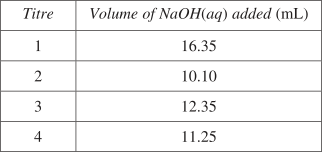
The results are shown in the table.


Explain why this method produces inaccurate and unreliable results.   (3 marks)

--- 8 WORK AREA LINES (style=lined) ---
Show Answers Only
  • `text{NaOH}` is hygroscopic and cannot be accurately used as a primary standard in titration experiments.
  • When the solid `text{NaOH}` is weighed, it will have absorbed water from the atmosphere, which means that the solution made from it will be more dilute than expected.
  • Furthermore, because this is a titration between a weak acid and a strong base which produces a basic salt, the pH at the equivalence point will be greater than 7.
  • Using Bromocresol green as an indicator in this case would not be suitable because it changes colour in the pH range of 3.2–5.2. This is the flat region of the titration curve, before the equivalence point.
  • The results of the titration are also unreliable because the indicator used produces a non-sharp endpoint, resulting in significantly different titres in each titration.
Show Worked Solution
  • `text{NaOH}` is hygroscopic and cannot be accurately used as a primary standard in titration experiments.
  • When the solid `text{NaOH}` is weighed, it will have absorbed water from the atmosphere, which means that the solution made from it will be more dilute than expected.
  • Furthermore, because this is a titration between a weak acid and a strong base which produces a basic salt, the pH at the equivalence point will be greater than 7.
  • Using Bromocresol green as an indicator in this case would not be suitable because it changes colour in the pH range of 3.2–5.2. This is the flat region of the titration curve, before the equivalence point.
  • The results of the titration are also unreliable because the indicator used produces a non-sharp endpoint, resulting in significantly different titres in each titration.

♦ Mean mark 48%.

Filed Under: Quantitative Analysis Tagged With: Band 5, smc-3675-10-Titration

CHEMISTRY, M6 2022 HSC 32

The concentration of citric acid, a triprotic acid, in a carbonated soft drink was to be determined.

Step 1: A solution of \( \ce{NaOH(aq)} \) was standardised by titrating it against 25.00 mL aliquots of a solution of the monoprotic acid potassium hydrogen phthalate \( \ce{(KHP)} \). The \( \ce{(KHP)} \) solution was produced by dissolving 4.989 g in enough water to make 100.0 mL of solution. The molar mass of \( \ce{(KHP)} \) is 204.22 g mol ¯1.

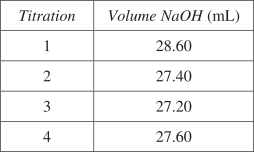
The results of the standardisation titration are given in the table.
 

Step 2: A 75.00 mL bottle of the drink was opened and the contents quantitatively transferred to a beaker. The soft drink was gently heated to remove \( \ce{CO2}\).

Step 3: The cooled drink was quantitatively transferred to a 250.0 mL volumetric flask and distilled water was added up to the mark.

Step 4: 25.00 mL samples of the solution were titrated with the \( \ce{NaOH(aq)}\) solution. The average volume of \( \ce{NaOH(aq)} \) used was 13.10 mL.

  1. Calculate the concentration of the triprotic citric acid in the soft drink.  (6 marks)

--- 20 WORK AREA LINES (style=lined) ---
  1. Explain how your answer to part (a) would be different if the carbon dioxide was not removed from the soft drink.  (2 marks)

--- 5 WORK AREA LINES (style=lined) ---
Show Answers Only

a.  `0.1298  text{mol L}^(–1)`

b.  \( \ce{CO2} \) can dissolve in water to produce \( \ce{H2CO3}\):

\( \ce{CO2(g) + H2O(l) \rightleftharpoons H2CO3(aq)} \)

  • This would enable \( \ce{NaOH} \) to react with \( \ce{H2CO3:} \)
  •    \( \ce{2NaOH(aq) + H2CO3(aq) -> Na2CO3(aq) + 2H2O(l)} \)
  • Therefore, if \( \ce{CO2} \) was not removed, more \( \ce{NaOH} \) would be required to reach the endpoint.
  • This would result in a higher citric acid concentration calculation.
Show Worked Solution

a.   \( \ce{KHP(aq) + NaOH(aq) -> NaKP(aq) + H2O(l)} \)

`text{n(HX)}= 4.989 / 204.22= 0.02443\ text{mol}`

`[text(HX)]= \text{n}/\text{V}= 0.02443 / 0.1000= 0.2443  text{mol L}^(–1)`

`text{n(HX) titrated} =  text{c} xx text{V}= 0.2443 xx 0.02500= 0.0006107\ text{mol}`

 `=>\ text{n(NaOH)}= 0.0006107  text{mol}`
 

Eliminate the first trial because it is an outlier.

`text{V}_(text(avg))text{(NaOH)}= 1 / 3 xx (27.40 + 27.20 + 27.60)= 27.40\ text{mL}`

`text{[NaOH]}= text{n} / text{V}= [6.107 xx 10^−3] / 0.02740 = 0.2229  text{mol L}^(–1)`

\( \ce{H3X(aq) + 3NaOH(aq) -> Na3X(aq) + 3H2O(l)} \)

`text{n(NaOH) titrated}= text{c} xx text{V}=0.2229 xx 0.01310= 2.920 xx 10^(−3)\ text{mol}`

`text{n(H}_3 text{X)}= 1/3 xx 2.920 xx 10^(−3)= 9.733 xx 10^(−4)\ text{mol}`

`text{[H}_3 text{X] diluted} = text{n} / text{V} = (9.733 xx 10^(−4) )/ 0.025= 0.03893 \ text{mol L}^(–1)`

`text{[H}_3 text{X] original}= 250.0 / 75.00 xx 0.03893= 0.1298  text{mol L}^(–1)`

Therefore, the concentration of citric acid in the soft drink is 0.1298 mol L¯1.


♦ Mean mark (a) 48%.

b.   \( \ce{CO2} \) can dissolve in water to produce \( \ce{H2CO3}\):

\( \ce{CO2(g) + H2O(l) \rightleftharpoons H2CO3(aq)} \)

This would enable \( \ce{NaOH} \) to react with \( \ce{H2CO3:} \)

\( \ce{2NaOH(aq) + H2CO3(aq) -> Na2CO3(aq) + 2H2O(l)} \)

  • Therefore, if \( \ce{CO2} \) was not removed, more \( \ce{NaOH} \) would be required to reach the endpoint.
  • This would result in a higher citric acid concentration calculation.

♦♦ Mean mark (b) 28%.

Filed Under: Quantitative Analysis Tagged With: Band 5, Band 6, smc-3675-10-Titration

CHEMISTRY, M6 2021 HSC 35

A manufacturer requires that its product contains at least 85% v/v ethanol.

The concentration of ethanol in water can be determined by a back titration. Ethanol is first oxidised to ethanoic acid using an excess of acidified potassium dichromate solution.

\(\ce{3C2H5OH($aq$) + 2Cr2O7^2-($aq$) + 16H^+($aq$) ->3CH3COOH($aq$) + 4Cr^3+($aq$) + 11H2O($l$)}\)   

The remaining dichromate ions are reacted with excess iodide ions to produce iodine \(\ce{(I2)}\)

\(\ce{Cr2O7^2-($aq$) + 14H^+($aq$) + 61^-($aq$) -> 2Cr^3+($aq$) + 7H2O($l$) + 3I2($aq$)}\)

The iodine produced is then titrated with sodium thiosulfate \(\ce{(Na2S2O3)}\).

\(\ce{I2($aq$) + 2S2O3^2-($aq$) -> 2I^-($aq$) + S4O6^2-($aq$)}\)   

A 25.0 mL sample of the manufacturer's product was diluted with distilled water to 1.00 L. A 25.0 mL aliquot of the diluted solution was added to 20.0 mL of 0.500 mol L¯1 acidified potassium dichromate solution in a conical flask. Potassium iodide (5.0 g) was added and the solution titrated with 0.900 mol L¯1 sodium thiosulfate. This was repeated three times.

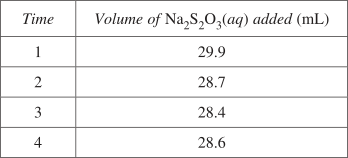
The following results were obtained.


The density of ethanol is 0.789 g mL¯1.

Does the sample meet the manufacturer's requirements? Support your answer with calculations.   (7 marks)

--- 22 WORK AREA LINES (style=lined) ---

Show Answers Only
\( \text{V}_\text{avg}\  (\ce{Na2S2O3}) \) `= (28.7 + 28.4 + 28.6) / 3`
  `= 28.5666…  text{mL}`
  `= 0.0285666…  text{L}`
   
  •  The first titration is an outlier and so is excluded from the average.

`text{n(Na}_2 text{S}_2 text{O}_3text{)}=\ text{c} xx text{V}= 0.900 xx 0.0285666…= 0.02571  text{mol}`

\( \ce{n(S2O3^2-) = n(Na2S2O3) = 0.02571\ \text{mol}} \)
 

`text{I}_2  text{and S}_2 text{O}_3  ^(2-)\ text{are in a}\ 1 : 2\ text{ratio:}`

`text{n(I}_2text{)} = 1/2 xx  text{n(S}_2 text{O}_3^( 2-) text{)}= 1/2 xx 0.02571= 0.012855\ text{mol}`
 

`text{Excess Cr}_2 text{O}_7^(\ \ 2-)  text{and I}_2  text{are in}\ 1:3\ text{ratio:}`

`text{n(Cr}_2 text{O}_7^(\ \ 2-) text{) excess}= 1/3 xx  text{n(I}_2 text{)}= 1/3 xx 0.012855= 0.004285\ text{mol}`

`text{n(Cr}_2 text{O}_7^(\ \ 2-) text{) initial}= text{c} xx text{V}= 0.500 xx 20/1000= 0.01\ text{mol}`

`text{n(Cr}_2 text{O}_7^(\ \ 2-) text{) reacted with ethanol}`

`= text{n(Cr}_2 text{O}_7^(\ \ 2-) text{) initial}-text{n(Cr}_2 text{O}_7^(\ \ 2-) text{) excess}`

`= 0.01-0.004285`

`= 0.005715\ text{mol}`
 

`text{n(C}_2 text{H}_5 text{OH)}= 3/2 xx text{n(Cr}_2 text{O}_7^(\ \ 2-) text{)}= 3/2 xx 0.005715= 0.0085725\ text{mol}`

`text{m(C}_2 text{H}_5 text{OH)}= text{n} xx text{MM}=0.0085725 xx (2 xx 12.01 + 6 xx 1.008 + 16.00)= 0.3949\ text{g}`
 

  • Thus, 0.3949 g of ethanol is in a diluted 25 mL solution.

Find the mass of ethanol in the original solution:

`text{m(C}_2 text{H}_5 text{OH) original}= 0.3949… xx 1000/25= 15.796…\ text{g}`

`text{D}= text{m} / text{V}\ \ =>\ \ text{V}= text{m} / text{D}`

`text{V(C}_2 text{H}_5 text{OH)}= 15.796 / 0.789= 20.021\ text{mL}`

`text{% (C}_2text{H}_5text{OH)}= text{V(ethanol)} / text{V(sample)}= 20.021 / 25.0= 80.08… %\ text{v}//text{v}`
 

  • Therefore, the product doesn’t meet the manufacturer’s requirement as the concentration is less than 85%.
Show Worked Solution
\( \text{V}_\text{avg}\  (\ce{Na2S2O3}) \) `= (28.7 + 28.4 + 28.6) / 3`
  `= 28.5666…  text{mL}`
  `= 0.0285666…  text{L}`
   
  •  The first titration is an outlier and so is excluded from the average.

`text{n(Na}_2 text{S}_2 text{O}_3text{)}=\ text{c} xx text{V}= 0.900 xx 0.0285666…= 0.02571  text{mol}`

\( \ce{n(S2O3^2-) = n(Na2S2O3) = 0.02571\ \text{mol}} \)
 

`text{I}_2  text{and S}_2 text{O}_3  ^(2-)\ text{are in a}\ 1 : 2\ text{ratio:}`

`text{n(I}_2text{)} = 1/2 xx  text{n(S}_2 text{O}_3^( 2-) text{)}= 1/2 xx 0.02571= 0.012855\ text{mol}`
 

`text{Excess Cr}_2 text{O}_7^(\ \ 2-)  text{and I}_2  text{are in}\ 1:3\ text{ratio:}`

`text{n(Cr}_2 text{O}_7^(\ \ 2-) text{) excess}= 1/3 xx  text{n(I}_2 text{)}= 1/3 xx 0.012855= 0.004285\ text{mol}`

`text{n(Cr}_2 text{O}_7^(\ \ 2-) text{) initial}= text{c} xx text{V}= 0.500 xx 20/1000= 0.01\ text{mol}`

`text{n(Cr}_2 text{O}_7^(\ \ 2-) text{) reacted with ethanol}`

`= text{n(Cr}_2 text{O}_7^(\ \ 2-) text{) initial}-text{n(Cr}_2 text{O}_7^(\ \ 2-) text{) excess}`

`= 0.01-0.004285`

`= 0.005715\ text{mol}`
 

`text{n(C}_2 text{H}_5 text{OH)}= 3/2 xx text{n(Cr}_2 text{O}_7^(\ \ 2-) text{)}= 3/2 xx 0.005715= 0.0085725\ text{mol}`

`text{m(C}_2 text{H}_5 text{OH)}= text{n} xx text{MM}=0.0085725 xx (2 xx 12.01 + 6 xx 1.008 + 16.00)= 0.3949\ text{g}`
 

  • Thus, 0.3949 g of ethanol is in a diluted 25 mL solution.

Find the mass of ethanol in the original solution:

`text{m(C}_2 text{H}_5 text{OH) original}= 0.3949… xx 1000/25= 15.796…\ text{g}`

`text{D}= text{m} / text{V}\ \ =>\ \ text{V}= text{m} / text{D}`

`text{V(C}_2 text{H}_5 text{OH)}= 15.796 / 0.789= 20.021\ text{mL}`

`text{% (C}_2text{H}_5text{OH)}= text{V(ethanol)} / text{V(sample)}= 20.021 / 25.0= 80.08… %\ text{v}//text{v}`
 

  • Therefore, the product doesn’t meet the manufacturer’s requirement as the concentration is less than 85%.

♦♦♦ Mean mark 39%.

Filed Under: Alcohols, Quantitative Analysis Tagged With: Band 5, Band 6, smc-3675-10-Titration, smc-3679-30-Oxidation

CHEMISTRY, M6 2021 HSC 5 MC

A student used the following method to titrate an acetic acid solution of unknown concentration with a standardised solution of dilute sodium hydroxide.

    • Rinse burette with deionised water.
    • Fill burette with sodium hydroxide solution.
    • Rinse pipette and conical flask with acetic acid solution.
    • Pipette 25.00 mL of acetic acid solution into conical flask.
    • Add appropriate indicator to the conical flask.
    • Titrate to endpoint and record volume of sodium hydroxide solution used.

Compared to the actual concentration of the acetic acid, the calculated concentration will be

  1. lower.
  2. higher.
  3. the same.
  4. different, but higher or lower cannot be predicted.
Show Answers Only

`B`

Show Worked Solution

Two points to consider in method:

Burette rinsed with water instead of sodium hydroxide.

  • Sodium hydroxide solution diluted requiring more sodium hydroxide to neutralise the acetic acid.

This will result in greater moles of acetic acid, and thus the calculated concentration of acetic acid would be greater than the actual concentration.

 
Conical flask rinsed with acetic acid

  • Results in a greater number of moles of acid. More volume of sodium hydroxide would be added
  • Greater number of moles of acetic acid.

This would result in a greater number of moles, and thus the calculated concentration would be higher than the actual concentration.

In both cases, the calculated concentration would be higher than the actual concentration.

`=>B`


♦ Mean mark 45%.

Filed Under: Quantitative Analysis Tagged With: Band 5, smc-3675-10-Titration

Copyright © 2014–2025 SmarterEd.com.au · Log in