SmarterEd

Aussie Maths & Science Teachers: Save your time with SmarterEd

  • Login
  • Get Help
  • About

CHEMISTRY, M7 2020 VCE 3

Below is a reaction pathway beginning with hex-3-ene.
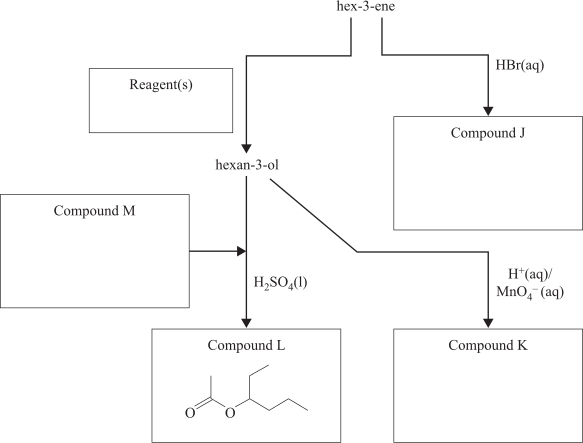
  1. Write the IUPAC name of Compound J in the box provided.  (1 mark)

    --- 0 WORK AREA LINES (style=lined) ---

  2. State the reagent(s) required to convert hex-3-ene to hexan-3-ol in the box provided.  (1 mark)

    --- 0 WORK AREA LINES (style=lined) ---

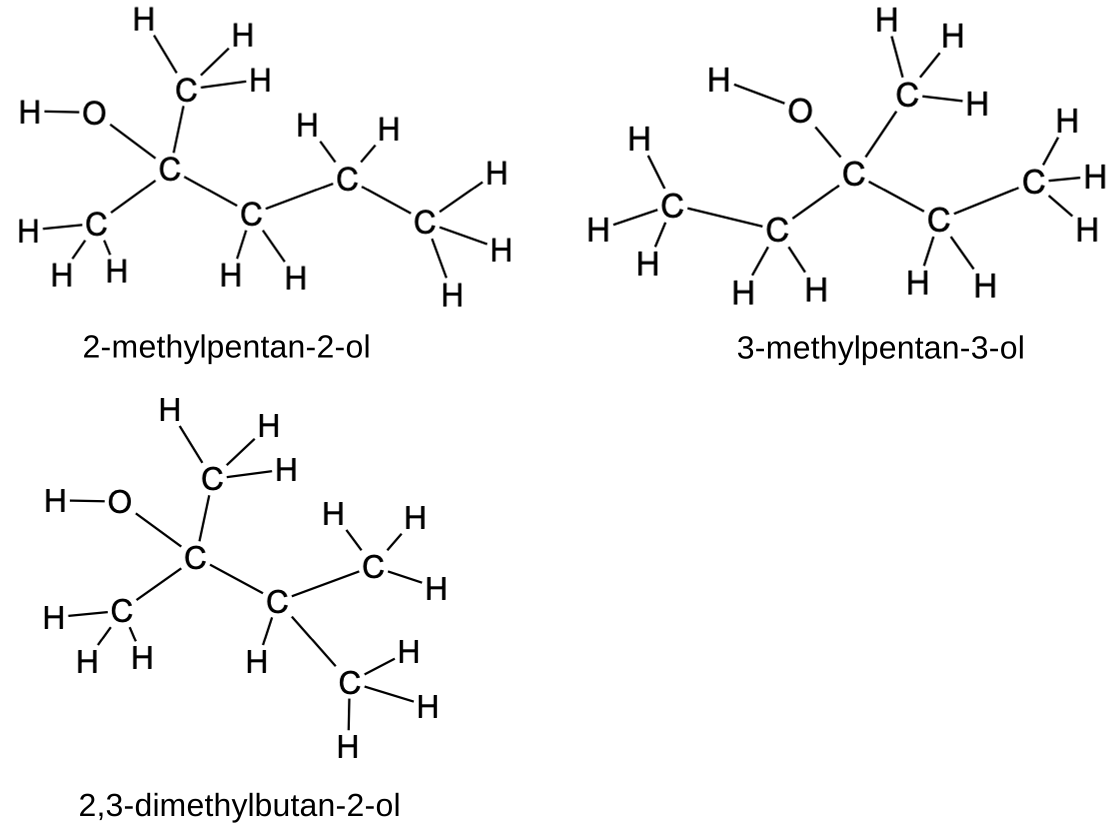
  3. Draw the structural formula for a tertiary alcohol that is an isomer of hexan-3-ol.  (1 mark)

    --- 6 WORK AREA LINES (style=lined) ---

  4. Hexan-3-ol is reacted with Compound M under acidic conditions to produce Compound L.
  5. Draw the semi-structural formula for Compound M in the box provided on the image above.  (1 mark)

    --- 0 WORK AREA LINES (style=lined) ---

  6.  i. Draw the semi-structural formula for Compound K in the box provided on the image above.  (1 mark)

    --- 0 WORK AREA LINES (style=lined) ---

  7. ii. Name the class of organic compound (homologous series) to which Compound K belongs.  (1 mark)

    --- 1 WORK AREA LINES (style=lined) ---

  8. What type of reaction produces Compound K from hexan-3-ol?  (1 mark)

    --- 1 WORK AREA LINES (style=lined) ---

Show Answers Only

a.   3-bromohexane

b.   Steam and any specific inorganic strong acid (although not \(\ce{HCl}\)) is correct.

eg. \(\ce{H2O, H+}\)

c.   
 

d.   Correct answers included one of:

\(\ce{CH3COOH}\)  or  \(\ce{HOOCCH3}\)

e.i.  Correct answers included one of the following:

\(\ce{CH3CH2COCH2CH2CH3}\)

\(\ce{CH3CH2CH2COCH2CH3}\)

\(\ce{CH3CH2CO(CH2)2CH3}\)

e.ii.   Ketone

f.    Oxidation
Show Worked Solution

a.   3-bromohexane

b.   Steam and any specific inorganic strong acid (although not \(\ce{HCl}\)) is correct.

eg. \(\ce{H2O, H+}\)
 

♦ Mean mark (b) 38%.

c.   


♦ Mean mark (c) 49%.

d.   Correct answers included one of:

\(\ce{CH3COOH}\)  or  \(\ce{HOOCCH3}\)
 

e.i.  Correct answers included one of the following:

\(\ce{CH3CH2COCH2CH2CH3}\)

\(\ce{CH3CH2CH2COCH2CH3}\)

\(\ce{CH3CH2CO(CH2)2CH3}\)
 

e.ii.   Ketone
 

f.    Oxidation
♦ Mean mark e(i) 39%.

Filed Under: Reactions of Organic Acids and Bases Tagged With: Band 4, Band 5, smc-3680-15-Reaction Pathways

CHEMISTRY, M7 2016 VCE 7a

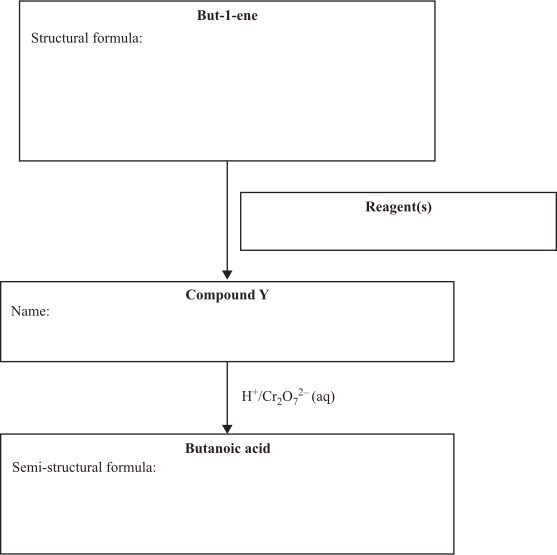
Butanoic acid is the simplest carboxylic acid that is also classified as a fatty acid. Butanoic acid may be synthesised as outlined in the following reaction flow chart.
 

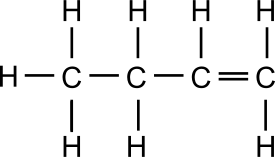
  1. Draw the structural formula of but-1-ene in the box provided.  (1 mark)

    --- 0 WORK AREA LINES (style=lined) ---

  2. State the reagent(s) needed to convert but-1-ene to Compound Y in the box provided.  (1 mark)

    --- 0 WORK AREA LINES (style=lined) ---

  3. Write the systematic name of Compound Y in the box provided.  (1 mark)

    --- 0 WORK AREA LINES (style=lined) ---

  4. Write the semi-structural formula of butanoic acid in the box provided.  (1 mark)

    --- 0 WORK AREA LINES (style=lined) ---

  5. Write a balanced half-equation for the conversion of \(\ce{Cr2O7^2– to Cr3+}\).  (2 marks)

    --- 1 WORK AREA LINES (style=lined) ---

Show Answers Only

i.    
       

ii.    \(\ce{H2O}\) and \(\ce{H3PO4}\) (catalyst)

iii.   butan-1-ol or 1-butanol

iv.   \(\ce{CH3CH2CH2COOH}\)

v.   \(\ce{Cr2O7^{2-}(aq) + 14H+(aq) + 6e- \rightarrow 2Cr^{3+}(aq) + 7H2O(l)} \)

Show Worked Solution

i.    
       

ii.    \(\ce{H2O}\) and \(\ce{H3PO4}\) (catalyst)

iii.   butan-1-ol or 1-butanol

iv.   \(\ce{CH3CH2CH2COOH}\)

v.   \(\ce{Cr2O7^{2-}(aq) + 14H+(aq) + 6e- \rightarrow 2Cr^{3+}(aq) + 7H2O(l)} \)

♦♦ Mean mark (ii) 29%.

Filed Under: Reactions of Organic Acids and Bases Tagged With: Band 3, Band 4, Band 5, smc-3680-15-Reaction Pathways

CHEMISTRY, M7 2015 VCE 5c

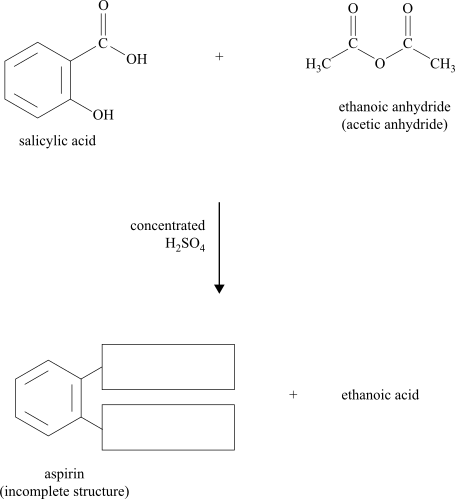
A student mixed salicylic acid with ethanoic anhydride (acetic anhydride) in the presence of concentrated sulfuric acid. The products of this reaction were the painkilling drug aspirin (acetyl salicylic acid) and ethanoic acid.
 

  1. An incomplete structure of the aspirin molecule is shown above.
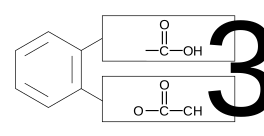
  2. Complete the structure by filling in the two boxes provided in the diagram.  (2 marks)

    --- 0 WORK AREA LINES (style=lined) ---

  3. Sulfuric acid is used as a catalyst in this reaction.
  4. Explain how a catalyst increases the rate of this reaction.  (2 marks)

    --- 2 WORK AREA LINES (style=lined) ---

Show Answers Only

a.    
       

b.    Sulphuric acid increases the rate of reaction by:

  • providing an alternative reaction pathway that involves a lower activation energy for the reagents.
  • this increases the likelihood of successful collisions.

Show Worked Solution

a.    
     

♦ Mean mark (i) 48%.

b.    Sulphuric acid increases the rate of reaction by:

  • providing an alternative reaction pathway that involves a lower activation energy for the reagents.
  • this increases the likelihood of successful collisions.

Filed Under: Reactions of Organic Acids and Bases Tagged With: Band 4, Band 5, smc-3680-15-Reaction Pathways

CHEMISTRY, M7 2015 VCE 5a

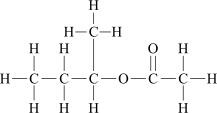
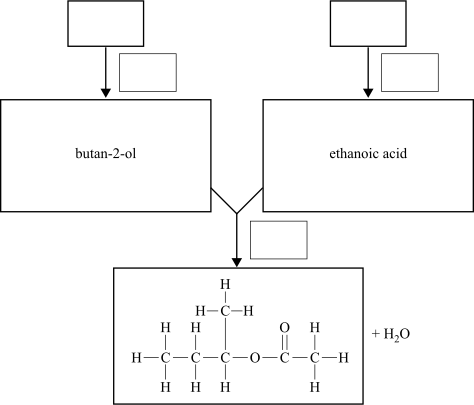
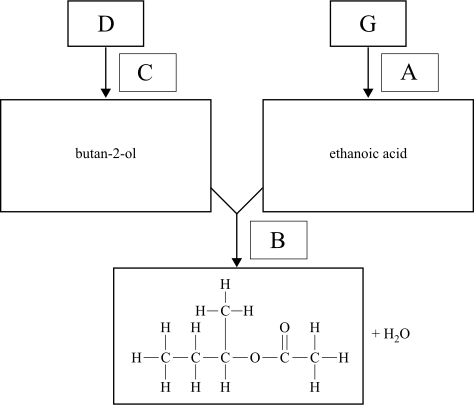
A reaction pathway is designed for the synthesis of the compound that has the structural formula shown below.
 

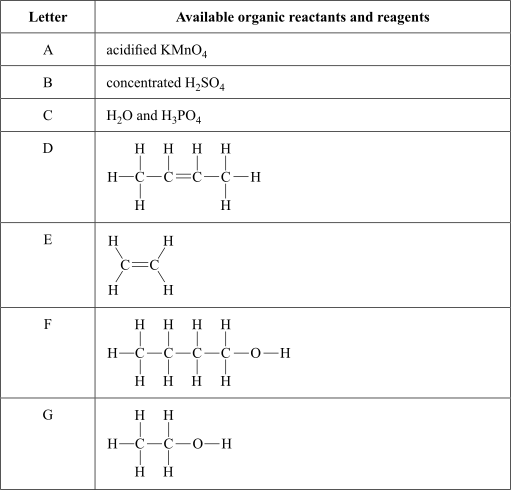
The table below gives a list of available organic reactants and reagents.


Complete the reaction pathway design flow chart below. Write the corresponding letter for the structural formula of all organic reactants in each of the boxes provided. The corresponding letter for the formula of other necessary reagents should be shown in the boxes next to the arrows.   (5 marks)

--- 0 WORK AREA LINES (style=lined) ---

Show Answers Only

Show Worked Solution

Filed Under: Organic Substances Tagged With: Band 3, Band 4, smc-3680-15-Reaction Pathways

CHEMISTRY, M7 2019 HSC 34

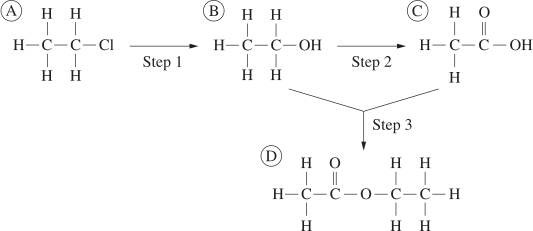
The following reaction scheme can be used to synthesise ethyl ethanoate.


Outline the reagents and conditions required for each step and how the product of each step could be identified.   (7 marks) 

--- 16 WORK AREA LINES (style=lined) ---

Show Answers Only

Step 1:

  • To synthesise chloroethane (A) into ethanol (B), \(\ce{NaOH}\) is added and heated. \(\ce{KMnO4 / H+}\) is then added and heated.
  • The mixture is then treated with concentrated sulfuric acid and refluxed.
  • Ethanol (B) can be identified using infrared spectroscopy by looking for a broad absorption between 3230 cm ¯1 and 3550 cm ¯1, which indicates the presence of an \(\ce{O-H}\) bond. This absorption would not be present in chloroethane (A).
  • Alternative ways to identify ethanol include: mass spectrum analysis (single ion peak at m/z = 46), reactivity tests, and \( \ce{^1H NMR}\) spectrum analysis (3 signals vs 2 for chloroethane). 

Step 2:

  • Ethanol (B) can be converted into ethanoic acid (C) by combining it with a strong oxidant like sodium carbonate, which produces carbon dioxide bubbles, confirming the presence of a carboxylic acid.
  • Ethanol will not react as above and the compounds can be distinguished.
  • Alternative ways to identify ethanoic acid include: IR or \( \ce{^13C NMR}\) spectrum analysis, litmus indicators, mass spectrum analysis (ion peak at m/z = 60 vs m/z = 46) 

Step 3

  • Ethyl ethanoate (D) can be synthesised by heating a mixture of ethanol, ethanoic acid and concentrated sulfuric acid under reflux.
  • A \( \ce{^1H NMR}\) spectrum can be used to identify ethyl ethanoate as it will have 3 signals versus ethanol and ethanoic acid that will only have 2 each.
  • Alternative ways to identify ethyl ethanoate include: a distinct smell, no \(\ce{O-H}\) peaks in the IR spectrum or mass spectrum analysis (ion peak at m/z = 102).
Show Worked Solution

Step 1:

  • To synthesise chloroethane (A) into ethanol (B), \(\ce{NaOH}\) is added and heated. \(\ce{KMnO4 / H+}\) is then added and heated.
  • The mixture is then treated with concentrated sulfuric acid and refluxed.
  • Ethanol (B) can be identified using infrared spectroscopy by looking for a broad absorption between 3230 cm ¯1 and 3550 cm ¯1, which indicates the presence of an \(\ce{O-H}\) bond. This absorption would not be present in chloroethane (A).
  • Alternative ways to identify ethanol include: mass spectrum analysis (single ion peak at m/z = 46), reactivity tests, and \( \ce{^1H NMR}\) spectrum analysis (3 signals vs 2 for chloroethane). 

Step 2:

  • Ethanol (B) can be converted into ethanoic acid (C) by combining it with a strong oxidant like sodium carbonate, which produces carbon dioxide bubbles, confirming the presence of a carboxylic acid.
  • Ethanol will not react as above and the compounds can be distinguished.
  • Alternative ways to identify ethanoic acid include: IR or \( \ce{^13C NMR}\) spectrum analysis, litmus indicators, mass spectrum analysis (ion peak at m/z = 60 vs m/z = 46) 

Step 3

  • Ethyl ethanoate (D) can be synthesised by heating a mixture of ethanol, ethanoic acid and concentrated sulfuric acid under reflux.
  • A \( \ce{^1H NMR}\) spectrum can be used to identify ethyl ethanoate as it will have 3 signals versus ethanol and ethanoic acid that will only have 2 each.
  • Alternative ways to identify ethyl ethanoate include: a distinct smell, no \(\ce{O-H}\) peaks in the IR spectrum or mass spectrum analysis (ion peak at m/z = 102).

♦♦ Mean mark 38%.

Filed Under: Alcohols, Reactions of Organic Acids and Bases Tagged With: Band 5, Band 6, smc-3679-20-Reactions of Alcohols, smc-3679-70-Production, smc-3680-10-Esters, smc-3680-15-Reaction Pathways

CHEMISTRY, M7 2021 HSC 26

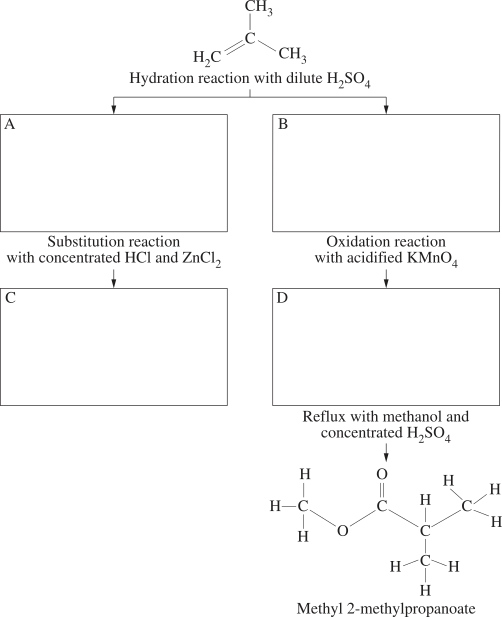
A sequence of chemical reactions, starting with 2-methylprop-1-ene, is shown in the flow chart.

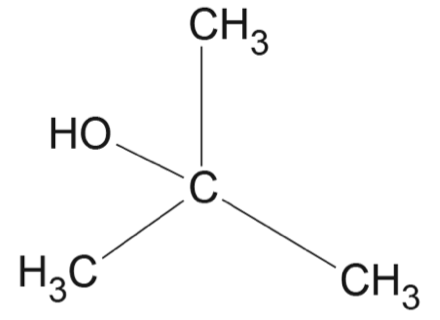
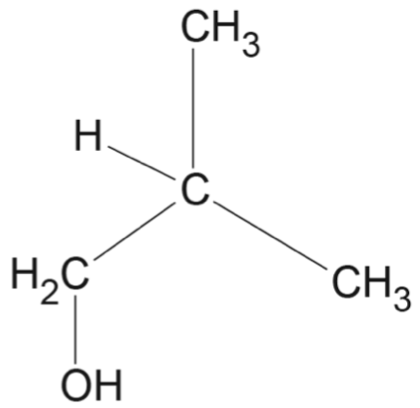
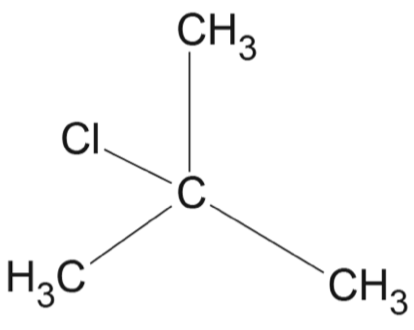
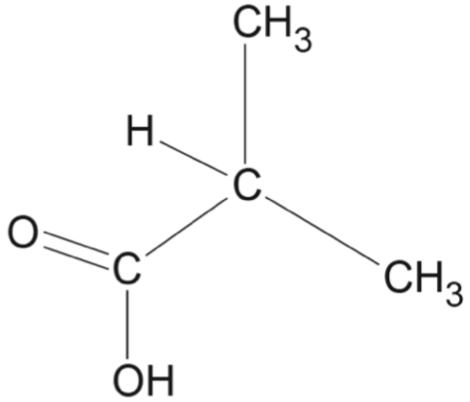
  1. Complete the flow chart by drawing structural formulae for compounds `text{A}`, `text{B}`, `text{C}`, and `text{D}`.   (4 marks)


  2. Reflux is used in the synthesis of methyl 2-methylpropanoate.
  3. Provide TWO reasons for using this technique.   (2 marks)

    --- 5 WORK AREA LINES (style=lined) ---

Show Answers Only

a.   Compound A:

Compound B:

Compound C:

Compound D:


b.  Reasons for reflux technique:

  • Reflux heats the reaction mixture which increases the average kinetic energy, and thus increases the reaction rate.
  • Heating causes the volatile substances to form vapour molecules. Refluxing uses a condenser to cool the vapour molecules into liquids, and thus retains the substances.
Show Worked Solution

a.   Compound A:

Compound B:

Compound C:

Compound D:


b.  Reasons for reflux technique:

  • Reflux heats the reaction mixture which increases the average kinetic energy, and thus increases the reaction rate.
  • Heating causes the volatile substances to form vapour molecules. Refluxing uses a condenser to cool the vapour molecules into liquids, and thus retains the substances.

♦ Mean mark (b) 46%.

Filed Under: Alcohols, Reactions of Organic Acids and Bases Tagged With: Band 4, Band 5, smc-3679-20-Reactions of Alcohols, smc-3679-30-Oxidation, smc-3680-15-Reaction Pathways

Copyright © 2014–2025 SmarterEd.com.au · Log in