SmarterEd

Aussie Maths & Science Teachers: Save your time with SmarterEd

  • Login
  • Get Help
  • About

CHEMISTRY, M8 2025 HSC 4 MC

A student is presented with two clear colourless solutions. One contains \(\ce{Pb^2+}\) and the other \(\ce{Na+}\) ions.

Which ion can be added to the solutions to identify the solutions?

  1. \(\ce{I-}\)
  2. \(\ce{NH4+}\)
  3. \(\ce{NO3-}\)
  4. \(\ce{CH3COO-}\)
Show Answers Only

\(A\)

Show Worked Solution
  • When \(\ce{I-}\) ions are added to a solution containing \(\ce{Pb^2+}\) a bright yellow precipiate is formed:
  • \(\ce{Pb^2+(aq) + I-(aq) -> PbI2(s)}\).
  • When \(\ce{I-}\) ions are added to a solution containing \(\ce{Na+}\) ions the solution is clear. Therefore \(\ce{I-}\) can be used to identify the solutions.
  • Nitrate \((\ce{NO3-})\) and ethanoate \((\ce{CH3COO-})\) ions are soluble with both \(\ce{Pb^2+}\) and \(\ce{Na+}\) ions so they could not be used to identify the solutions.
  • \(\ce{NH4+}\) is a postive cation and so will not form a precipate with other postive cations and so cannot be used to distinguish between the two solutions.

\(\Rightarrow A\)

Filed Under: Inorganic Substances Tagged With: Band 3, smc-3682-10-Tests for Ions in Solution

CHEMISTRY, M8 2024 HSC 27

The following procedure is proposed to test for the presence of lead\(\text{(II)}\) and barium ions in water at concentrations of 0.1 mol L\(^{-1}\).

  1. Add excess 0.1 mol L\(^{-1}\) sodium sulfate solution. If a precipitate is produced, then barium ions are present.
  2. Filter any precipitate produced.
  3. Add excess 0.1 mol L\(^{-1}\) sodium bromide solution to the filtrate. If a precipitate is produced, then lead\(\text{(II)}\) ions are present.

Explain why this procedure gives correct results when only barium ions are present, but not when both barium and lead\(\text{(II)}\) ions are present. Include ONE balanced chemical equation in your answer.   (4 marks)

--- 8 WORK AREA LINES (style=lined) ---

Show Answers Only

Barium and lead\(\text{(II)}\) ions both present:

  • The procedure gives the incorrect results as both of these ions form precipitates with sulfate ions in step one.
  • Although barium sulfate has a lower solubility in water than lead sulfate and would precipitate out of the solution first, there is the potential for all of the lead ions to also precipitate out of solution according to the following chemical equation:
  •    \(\ce{Pb^{2+}(aq) + SO4^{2-}(aq) -> PbSO4(s)}\)
  • At step three, there would be no precipitate formed as all the lead ions would have been precipitated out of the solution during step one, leading to an incorrect conclusion.

Barium ions only present:

  • If only barium ions are present in the original sample, they will precipitate out of the solution in the presence of the sulfate ions in step one but will not form a precipitate in step three in the presence of bromide ions.
  • In this case, the conclusion that only \(\ce{Ba^{2+}\) ions are in the sample is correct.

Show Worked Solution

Barium and lead\(\text{(II)}\) ions both present:

  • The procedure gives the incorrect results as both of these ions form precipitates with sulfate ions in step one.
  • Although barium sulfate has a lower solubility in water than lead sulfate and would precipitate out of the solution first, there is the potential for all of the lead ions to also precipitate out of solution according to the following chemical equation:
  •    \(\ce{Pb^{2+}(aq) + SO4^{2-}(aq) -> PbSO4(s)}\)
  • At step three, there would be no precipitate formed as all the lead ions would have been precipitated out of the solution during step one, leading to an incorrect conclusion.

Barium ions only present:

  • If only barium ions are present in the original sample, they will precipitate out of the solution in the presence of the sulfate ions in step one but will not form a precipitate in step three in the presence of bromide ions.
  • In this case, the conclusion that only \(\ce{Ba^{2+}\) ions are in the sample is correct.

Filed Under: Inorganic Substances Tagged With: Band 4, smc-3682-10-Tests for Ions in Solution

CHEMISTRY, M8 2012 VCE 6

The iron content in multivitamin tablets was determined using atomic absorption spectroscopy.

The absorbances of four standards were measured.

Three multivitamin tablets were selected. Each tablet was dissolved in 100.0 mL of water. The absorbance of each of the three solutions was then measured.

The following absorbances were obtained.

\begin{array}{|l|c|c|}
\hline
\rule{0pt}{2.5ex}\quad \ \textbf{Solution} \rule[1ex]{0pt}{0pt} & \textbf{Concentration} & \textbf{Absorbance} \\
& \textbf{mg/L} & \\
\hline
\rule{0pt}{2.5ex} \text{Standard 1} \quad \quad & 0.00 & 0.06 \\
\hline
\rule{0pt}{2.5ex} \text{Standard 2} & 100.0 & 0.16 \\
\hline
\rule{0pt}{2.5ex} \text{Standard 3} & 200.0 & 0.25 \\
\hline
\rule{0pt}{2.5ex} \text{Standard 4} & 300.0 & 0.36 \\
\hline
\rule{0pt}{2.5ex} \text{Standard 5} & 400.0 & 0.46 \\
\hline
\rule{0pt}{2.5ex} \text{Tablet 1} & - & 0.39 \\
\hline
\rule{0pt}{2.5ex} \text{Tablet 2} & - & 0.42 \\
\hline
\rule{0pt}{2.5ex} \text{Tablet 3} & - & 0.45 \\
\hline
\end{array}
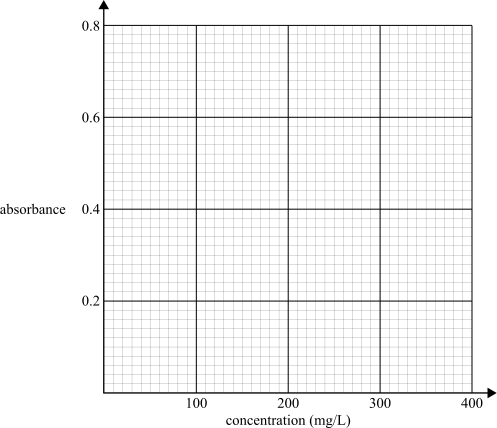
  1.  i.  Use the grid below to construct a calibration graph of the absorbances of the standard solutions.  (2 marks)

    --- 0 WORK AREA LINES (style=lined) ---

  2. ii.  Determine the average iron content, in milligrams, of the multivitamin tablets.  (2 marks)

    --- 4 WORK AREA LINES (style=lined) ---

Spectroscopic techniques work on the principle that, under certain conditions, atoms, molecules or ions will interact with electromagnetic radiation. The type of interaction depends on the wavelength of the electromagnetic radiation.

  1. Name one spectroscopic technique that you have studied this year.

    --- 1 WORK AREA LINES (style=lined) ---

    1. Which part of the electromagnetic spectrum does this technique use?  (1 mark)

      --- 1 WORK AREA LINES (style=lined) ---

    2. How does this part of the electromagnetic spectrum interact with matter? What information does this spectroscopic technique provide?  (2 marks)

      --- 5 WORK AREA LINES (style=lined) ---

Show Answers Only

a.i.  

a.ii.  \(35.5\ \text{mg}\)
 

b.i. Answers could include:

  • AAS (visible light)
  • UV-Vis (UV or visible light)
  • IR (Infrared radiation)
  • NMR (radio waves) 

b.ii. Spectroscopic technique: AAS (one of many possible – see b.i.)

  • During AAS energy of a certain frequency is transferred to electrons within atoms to move them into higher energy levels.
  • The absorption of the light indicates the concentration of the targeted element within the sample.

Show Worked Solution

a.i.  

a.ii. Average absorbance (tablets) \(=\dfrac{0.39+0.42+0.45}{3}=0.42\)

Using the graph: absorbance value of \(0.42 → 355\ \text{mg L}^{-1}\)

\(\ce{m(Fe) (100\ \text{ml}) = 355 \times 0.1 =35.5\ \text{mg}}\)
 

b.i.  Answers could include:

  • AAS (visible light)
  • UV-Vis (UV or visible light)
  • IR (Infrared radiation)
  • NMR (radiowaves) 

b.ii. Spectroscopic technique: AAS (one of many possible – see b.i.)

  • During AAS energy of a certain frequency is transferred to electrons within atoms to move them into higher energy levels.
  • The absorption of the light indicates the concentration of the targeted element within the sample.
♦ Mean mark (b.ii) 42%.

Filed Under: Inorganic Substances Tagged With: Band 4, Band 5, smc-3682-10-Tests for Ions in Solution, smc-3682-60-Colourimetry UV-Vis and AAS

CHEMISTRY, M8 2023 HSC 13 MC

The table shows four separate tests used to identify a dilute, aqueous sample of a compound.

 \begin{array} {|c|l|l|}
\hline
\rule{0pt}{2.5ex} \textbf{Test Number} \rule[-1ex]{0pt}{0pt} & \quad \quad \quad \quad  \quad \textbf{Test}  & \quad \quad \quad \textbf{Observation}\\
\hline
\rule{0pt}{2.5ex} 1\rule[-1ex]{0pt}{0pt} & \text{Test with Red litmus} & \text{Stays red}\\
\hline
\rule{0pt}{2.5ex} 2 \rule[-1ex]{0pt}{0pt} & \text{Add \( \ce{Ba}^{2+} \) ions to a sample} & \text{White precipitate formed}\\
\hline
\rule{0pt}{2.5ex} 3 \rule[-1ex]{0pt}{0pt} & \text{Add \( \ce{OH}^{-} \) ions to a sample}& \text{Brown precipitate formed} \\
\hline
\rule{0pt}{2.5ex} 4 \rule[-1ex]{0pt}{0pt} & \text{Add \( \ce{Cl}^{-}\) ions to a sample}& \text{White precipitate formed}\\
\hline
\end{array}

Which compound would produce the observations shown?

  1. Silver sulfate
  2. Lead(\(\text{II}\)) acetate
  3. Iron(\(\text{II}\)) bromide
  4. Magnesium carbonate
Show Answers Only

\(A\)

Show Worked Solution

\(\Rightarrow A\)

Filed Under: Inorganic Substances Tagged With: Band 4, smc-3682-10-Tests for Ions in Solution

CHEMISTRY, M8 2018 HSC 22

A bottle of solution is missing its label. It is either `text{Pb(NO}_(3))_(2), text{Ba(NO}_(3))_(2)` or `text{Fe(NO}_(3))_(2)`

Using only `text{HCl, NaOH}` and `text{H}_(2) text{SO}_(4)` solutions, outline a sequence of steps that could be followed to confirm the identity of the solution in the bottle. Include observed results and ionic equations in your answer.    (4 marks)

--- 8 WORK AREA LINES (style=lined) ---

Show Answers Only

“

Show Worked Solution

Prepare 1 test tube of the unknown solution.

Step 1: Add \(\ce{HCl}\) to the solution.

  • If a white precipitate forms, \(\ce{Pb(NO3)2}\) is present.
  • \(\ce{Pb^2+(aq) + 2Cl-(aq) -> PbCl2(s)}\) 

Step 2: Add \(\ce{H2SO4}\) to solution if no precipitate in Step 1.

  • If a white precipitate forms, \(\ce{Ba(NO3)2}\) is present.
  • \(\ce{Ba^2+(aq) + SO4^2-(aq) -> BaSO4(s)}\) 

Step 3: Add \(\ce{NaOH}\) to solution if no precipitate in Step 1 and 2.

  • If a green precipitate forms, \(\ce{Fe(NO3)2}\) is present.
  • \(\ce{Fe^2+(aq) + 2OH-(aq) -> Fe(OH)2(s)}\)

Mean mark 56%.

Filed Under: Inorganic Substances Tagged With: Band 4, Band 5, smc-3682-10-Tests for Ions in Solution

CHEMISTRY, M8 2016 HSC 13 MC

The flow chart shows the steps used to identify a sample of a substance.
 

If the substance is sodium sulfate, what should have been observed in Tests 1,2 and 3 ?
 

  Test 1 Test 2 Test 3
A.    Bright orange flame No bubbles White precipitate formed
B. Bright orange flame Bubbles No precipitate formed
C.  Blue-green flame No bubbles No precipitate formed
D. Blue-green flame Bubbles White precipitate formed
Show Answers Only

`A`

Show Worked Solution

By Elimination:

  • Sodium produces a bright yellow-orange colour in a flame test (eliminate C and D)
  • No gas is produced when sulphate reacts with acid (eliminate B)

`=>A`

Filed Under: Inorganic Substances Tagged With: Band 4, smc-3682-10-Tests for Ions in Solution, smc-3682-20-Flame Tests

CHEMISTRY, M8 2017 HSC 8 MC

There are two unlabelled solutions. One is barium nitrate and the other lead nitrate.

Which of the following could be added to the two unlabelled solutions to distinguish between them?

  1. Sodium sulfate
  2. Sodium nitrate
  3. Sodium chloride
  4. Sodium carbonate
Show Answers Only

`C`

Show Worked Solution
  • If sodium chloride is added to barium nitrate, barium chloride (soluble) is formed but no precipitate results.
  • If sodium chloride is added to lead nitrate, lead chloride (insoluble) is formed and a precipitate results.
  • All other options will produce either a precipitate or no precipitate in both solutions and not distinguish between them.

`=>C`


♦ Mean mark 49%.

Filed Under: Inorganic Substances Tagged With: Band 5, smc-3682-10-Tests for Ions in Solution

CHEMISTRY, M8 2020 HSC 22

A 0.1 mol L ¯1 solution of an unknown salt is to be analysed. The cation is one of magnesium, calcium or barium. The anion is one of chloride, acetate or hydroxide.

Outline a sequence of tests that could be performed in a school laboratory to confirm the identity of this salt solution. Include expected observations and a balanced chemical equation in your answer.   (5 marks)

--- 8 WORK AREA LINES (style=lined) ---

Show Answers Only

Cation:

  • The cation can be identified via a flame test. 
  • A pale green flame indicates barium, a brick red flame indicates calcium, and no flame colour observed indicates magnesium.

Anion:

  • To identify anion, add copper nitrate.
  • If a precipitate forms, it indicates the presence of hydroxide ions.
  • Next, add silver nitrate. If a white precipitate forms, this indicates chloride ions present. If no precipiate forms, it indicates acetate ions present.
  •    \( \ce{Ag+(aq) + Cl-(aq) -> AgCl(s)} \)

Other answers

  • Identify anion by testing pH with universal indicator.
  • Interpret result: Neutral (`text{Cl}^-` present), slightly basic (`text{CH}_3text{COO}^-` present), very basic (`text{OH}^-` present).
Show Worked Solution

Cation:

  • The cation can be identified via a flame test. 
  • A pale green flame indicates barium, a brick red flame indicates calcium, and no flame colour observed indicates magnesium.

Anion:

  • To identify anion, add copper nitrate.
  • If a precipitate forms, it indicates the presence of hydroxide ions.
  • Next, add silver nitrate. If a white precipitate forms, this indicates chloride ions present. If no precipiate forms, it indicates acetate ions present.
  •    \( \ce{Ag+(aq) + Cl-(aq) -> AgCl(s)} \)

Other answers

  • Identify anion by testing pH with universal indicator.
  • Interpret result: Neutral (`text{Cl}^-` present), slightly basic (`text{CH}_3text{COO}^-` present), very basic (`text{OH}^-` present).

♦ Mean mark 49%.

Filed Under: Inorganic Substances Tagged With: Band 4, Band 5, smc-3682-10-Tests for Ions in Solution, smc-3682-20-Flame Tests

CHEMISTRY, M8 2021 HSC 30

A student was trying to identify the ions present in a dilute aqueous solution.

The solution contained ions of barium, calcium or magnesium, and ions of hydroxide or acetate.

The student performed the following tests and recorded their observations. A fresh sample of the solution was used for each test.

    • When aqueous sodium chloride was added, no visible reaction was observed.
    • When aqueous silver nitrate was added, brown precipitate was produced. The precipitate dissolved when dilute hydrochloric acid was added.
    • When concentrated aqueous sodium sulfate was added, white precipitate was produced.

Evaluate this procedure as a method of identifying the ions.   (5 marks)

Show Answers Only
  • The first test is unnecessary for the student to identify cations or anions.
  • All possible ions present will not form a precipitate with the `text{NaCl}` reagent being added.
     
  • The second test is an appropriate method to identify the presence of cations or anions.
  • The addition of silver nitrate will form a precipitate with hydroxide ions but not acetate ions. Thus, the brown precipate formed by the second test indicates the presence of hydroxide ions.
  • Additionally, it also eliminates the presence of magnesium cation, as magnesium hydroxide is insoluble.
     
  • The third test is an invalid method.
  • Sodium sulfate will form a precipitate with both barium and calcium ions, giving both a white precipitate. Thus, it is not possible to accurately distinguish between calcium and barium ions.
  • Instead, a flame test would be best to identify the cations, where a red flame will be found for calcium and a green flame would be found for barium.
Show Worked Solution
  • The first test is unnecessary for the student to identify cations or anions.
  • All possible ions present will not form a precipitate with the `text{NaCl}` reagent being added.
     
  • The second test is an appropriate method to identify the presence of cations or anions.
  • The addition of silver nitrate will form a precipitate with hydroxide ions but not acetate ions. Thus, the brown precipate formed by the second test indicates the presence of hydroxide ions.
  • Additionally, it also eliminates the presence of magnesium cation, as magnesium hydroxide is insoluble.
     
  • The third test is an invalid method.
  • Sodium sulfate will form a precipitate with both barium and calcium ions, giving both a white precipitate. Thus, it is not possible to accurately distinguish between calcium and barium ions.
  • Instead, a flame test would be best to identify the cations, where a red flame will be found for calcium and a green flame would be found for barium.

♦ Mean mark 47%.

Filed Under: Inorganic Substances Tagged With: Band 4, Band 5, smc-3682-10-Tests for Ions in Solution

CHEMISTRY, M8 2021 HSC 2 MC

Which ion can be detected using a precipitation reaction with silver nitrate?

  1. \(\ce{Ag+}\)
  2. \(\ce{Cl-}\)
  3. \(\ce{Mg^2+}\)
  4. \(\ce{NO3-}\)
Show Answers Only

`B`

Show Worked Solution

Silver Nitrate →`\ text{Ag}^(+)\ text{and}\ text{NO}_(3)^(\ \ -)`

Solubility rules → all nitrates are soluble

  • `text{Ag}^(+)` is involved in the precipitation reaction
  • `text{Ag}^(+)` will form a precipitate with `text{Cl}^(-)`

`=>B`

Filed Under: Inorganic Substances Tagged With: Band 4, smc-3682-10-Tests for Ions in Solution

Copyright © 2014–2025 SmarterEd.com.au · Log in