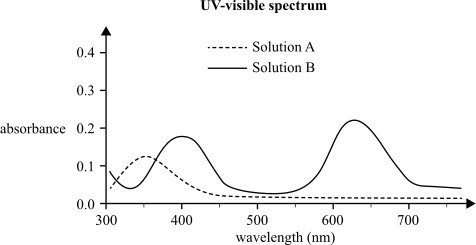
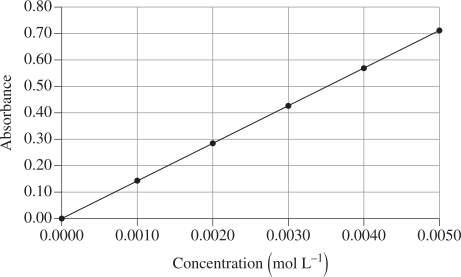
Copper ions can form coloured complexes with water molecules and with chloride ions in dilute aqueous solutions.
\begin{array}{|c|c|}
\hline
\rule{0pt}{2.5ex} \text{Complex ion} \rule[-1ex]{0pt}{0pt}& \quad \quad \text{Colour} \quad \quad\\
\hline
\rule{0pt}{2.5ex} \left[\ce{Cu}\left(\ce{H2O}\right)_6\right]^{2+} \rule[-1ex]{0pt}{0pt}& \text{Blue} \\
\hline
\rule{0pt}{2.5ex} \left[ \ce{CuCl4}\right]^{2-} \rule[-1ex]{0pt}{0pt}& \text{Green} \\
\hline
\end{array}
Which of the following analytical techniques would be most suitable to distinguish between these two complexes?
- Infrared spectrophotometry
- Carbon-13 NMR spectroscopy
- UV-visible spectrophotometry
- Atomic absorption spectroscopy