SmarterEd

Aussie Maths & Science Teachers: Save your time with SmarterEd

  • Login
  • Get Help
  • About

PHYSICS, M5 2024 HSC 9 MC

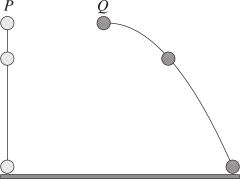
Object \(P\) is dropped from rest, and object \(Q\) is launched horizontally from the same height.
 

Which option correctly compares the projectile motion of \(P\) and \(Q\) ?

  1. The acceleration of \(P\) is less than the acceleration of \(Q\).
  2. The final velocity of \(Q\) is greater than the final velocity of \(P\).
  3. The time of flight of \(Q\) is greater than the time of flight of \(P\).
  4. The initial vertical velocity of \(P\) is less than the initial vertical velocity of \(Q\).
Show Answers Only

\(B\)

Show Worked Solution
  • Both objects start with the same initial vertical velocity and experience the same acceleration due to gravity. Therefore both objects will hit the ground at the same time with the same final vertical velocity.
  • Object \(Q\) however, has both vertical and horizontal velocity while object \(P\) only has vertical velocity. Therefore object \(Q\) will have a greater total final velocity when compared with \(P\).

\(\Rightarrow B\)

Filed Under: Projectile Motion Tagged With: Band 4, smc-3690-10-Projectile Motion Models, smc-3690-35-Initial Velocity, smc-3690-90-Velocity and Acceleration

PHYSICS, M5 2023 HSC 8 MC

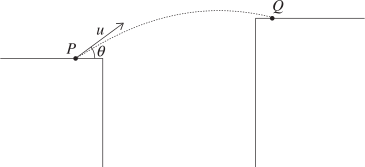
A ball is launched from a platform at position \(A\) with velocity \(u\). It lands in the position shown.


The ball could be made to land at position \(B\) by increasing the

  1. velocity \(u\).
  2. launch angle.
  3. mass of the ball.
  4. height of the platform.
Show Answers Only

\(B\)

Show Worked Solution
  • As the launch angle increases, the horizontal velocity of the ball decreases.
  • At a steep launch angle, the ball will travel high into the air but have a short range, thus it could be made to land at position \(B\) as seen in the diagram below.
     

\(\Rightarrow B\)

Mean mark 56%.

Filed Under: Projectile Motion Tagged With: Band 4, smc-3690-10-Projectile Motion Models, smc-3690-25-Range

PHYSICS, M5 EQ-Bank 1 MC

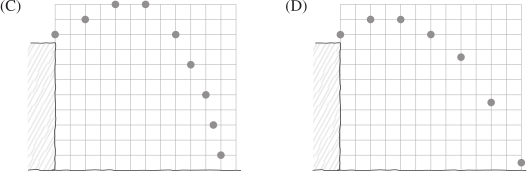
Some students were testing the hypothesis that launching a projectile at an angle of 45° will give the maximum horizontal range.

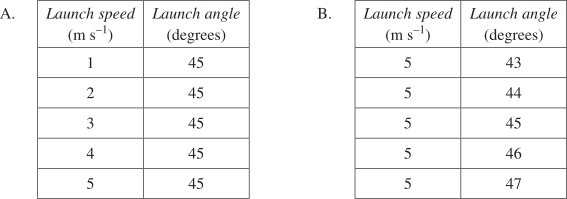
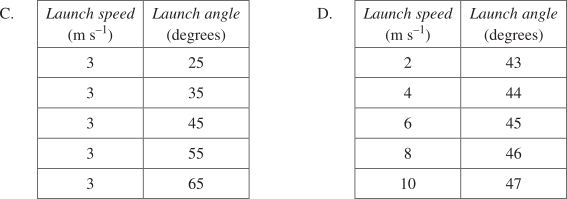
Which experimental setup will best test the hypothesis?
 

Show Answers Only

`C`

Show Worked Solution

By Elimination:

  • In this experiment horizontal range is the dependent variable and launch angle is the independent variable. So, launch angle must be varied (eliminate `A`).
  • To be a valid experiment, the independent variable, i.e. the launch angle, must be the only variable which changes (eliminate `D`).
  • Between `B` and `C`, `C` has a larger range of angles tested, whereas `B` uses too narrow a range of angles to make a valid conclusion.

`=>C`

Filed Under: Projectile Motion Tagged With: Band 3, smc-3690-10-Projectile Motion Models, smc-3690-25-Range

PHYSICS, M5 2015 HSC 4 MC

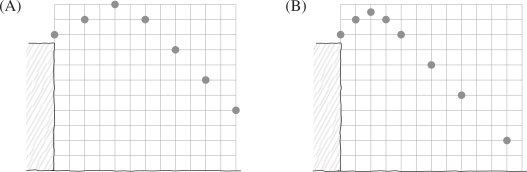
A projectile is launched from a cliff top. The dots show the position of the projectile at equal time intervals.

Assuming negligible air resistance, which diagram best shows the path of the projectile?


Show Answers Only

`D`

Show Worked Solution
  • There will be a constant horizontal spacing between the dots as the projectile has a constant horizontal velocity.
  • The vertical spacing between the dots will first decrease until the projectile reaches its maximum height then increase as it moves downwards, due to its downwards acceleration due to gravity.

`=>D`

Filed Under: Projectile Motion Tagged With: Band 3, smc-3690-10-Projectile Motion Models

PHYSICS, M5 2016 HSC 28

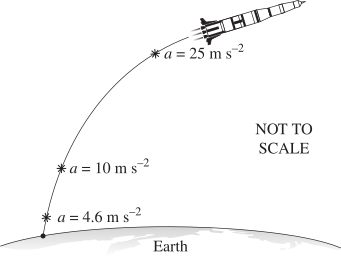
The following diagram shows the acceleration of a rocket during the first stage of its launch.
 

Explain the acceleration of the rocket with reference to the law of conservation of momentum.   (5 marks)

Show Answers Only
  • The combustion of fuel and expulsion of gases causes propulsion of the rocket. The rocket exerts a force on these gases in order to expel them backwards.
  • An equal and opposite force is exerted back on the rocket by the gases (Newton’s Third Law).
  • As the rocket and gases form a closed system, the law of conservation of momentum applies, meaning the momentum of the rocket is equal in magnitude and opposite in direction to the momentum of the fuel.
  • The momentum of the rocket is given by  `p=mv`. Since the force (and hence momentum) of the fuel is constant, the velocity of the rocket must increase as its mass decreases due to the expulsion of its fuel.
  • The rocket will accelerate. Also, using  `F=ma`, as the force acting on the rocket due to the gases is constant, the acceleration of the rocket must increase as its mass decreases.
Show Worked Solution
  • The combustion of fuel and expulsion of gases causes propulsion of the rocket. The rocket exerts a force on these gases in order to expel them backwards.
  • An equal and opposite force is exerted back on the rocket by the gases (Newton’s Third Law).
  • As the rocket and gases form a closed system, the law of conservation of momentum applies, meaning the momentum of the rocket is equal in magnitude and opposite in direction to the momentum of the fuel.
  • The momentum of the rocket is given by  `p=mv`. Since the force (and hence momentum) of the fuel is constant, the velocity of the rocket must increase as its mass decreases due to the expulsion of its fuel.
  • The rocket will accelerate. Also, using  `F=ma`, as the force acting on the rocket due to the gases is constant, the acceleration of the rocket must increase as its mass decreases.

♦ Mean mark 52%.

Filed Under: Momentum, Energy and Simple Systems, Projectile Motion Tagged With: Band 5, smc-3690-10-Projectile Motion Models, smc-4277-20-Momentum conservation

PHYSICS, M5 2016 HSC 17 MC

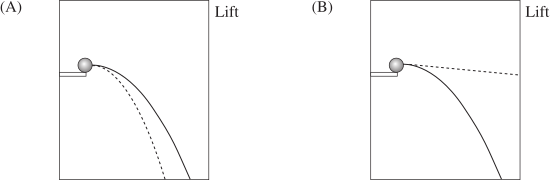
A projectile was launched horizontally inside a lift in a building. The diagram shows the path of the projectile when the lift was stationary.
 

The projectile was launched again with the same velocity. At this time, the lift was slowing down as it approached the top floor of the building.

Which diagram correctly shows the new path of the projectile (dotted line) relative to the path created in the stationary lift (solid line)?


Show Answers Only

`C`

Show Worked Solution
  • Due to the motion of the elevator, the downwards acceleration of the ball is less than when the elevator is stationary.
  • The new path that the ball takes will appear wider relative to its path in the stationary elevator.

`=>C`


♦ Mean mark 46%.

Filed Under: Projectile Motion Tagged With: Band 5, smc-3690-10-Projectile Motion Models

PHYSICS, M5 2018 HSC 27

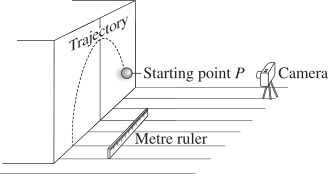
  1. The diagram shows a camera and a ruler set up to obtain data about a projectile's motion along the trajectory shown. The entire trajectory is visible through the camera.


    Identify ONE of the errors in this set-up and describe the effect of this error on the results.   (3 marks)

--- 6 WORK AREA LINES (style=lined) ---

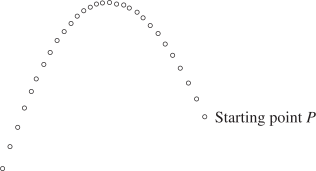
  1. An experiment was set up based on the method described in part (a), but conducted so that the data obtained were valid.
     
    The image shows the trajectory of the ball.


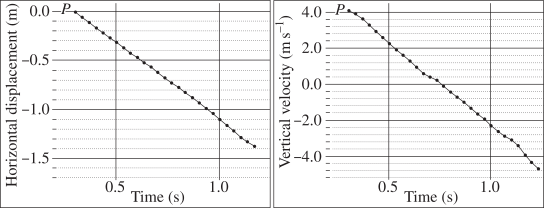
    The graphs show data from this experiment.


    Using the graphs, describe the velocity and acceleration of the ball quantitatively and qualitatively.   (3 marks)

--- 6 WORK AREA LINES (style=lined) ---

Show Answers Only

a.   Experimental error:

  • The distance between the ruler and the camera is less than the distance between the trajectory and the camera.
  • The effect of this is that the distance measured on the ruler will be greater than the true distance the projectile travels. So, the calculated velocity will be inaccurate as it will be greater than the true velocity.

Other errors include:

  • The camera and the ruler are off centre.
  • The effect of this is also that the distance measured on the ruler will be inaccurate.

b.   Velocity and acceleration of ball:

  • Ball is moving horizontally at a constant velocity (1st graph).
  • Quantitatively: `v=(-1.1-(-0.3))/(1-0.5)=-1.6\ text{m s}^(-1).` So, the ball’s speed is `1.6\ text{m s}^(-1)`
  • The second graph shows that the ball is accelerating at a constant rate vertically downwards.
  • Quantitatively: `a=(-2.4-2.4)/(0.5)=-9.6\ text{m s}^(-2)`
Show Worked Solution

a.   Experimental error:

  • The distance between the ruler and the camera is less than the distance between the trajectory and the camera.
  • The effect of this is that the distance measured on the ruler will be greater than the true distance the projectile travels. So, the calculated velocity will be inaccurate as it will be greater than the true velocity.

Other errors include:

  • The camera and the ruler are off centre.
  • The effect of this is also that the distance measured on the ruler will be inaccurate.

♦ Mean mark (a) 45%.

b.   Velocity and acceleration of ball:

  • Ball is moving horizontally at a constant velocity (1st graph).
  • Quantitatively: `v=(-1.1-(-0.3))/(1-0.5)=-1.6\ text{m s}^(-1).` So, the ball’s speed is `1.6\ text{m s}^(-1)`
  • The second graph shows that the ball is accelerating at a constant rate vertically downwards.
  • Quantitatively: `a=(-2.4-2.4)/(0.5)=-9.6\ text{m s}^(-2)`

♦ Mean mark (b) 42%.

Filed Under: Projectile Motion Tagged With: Band 5, smc-3690-10-Projectile Motion Models, smc-3690-60-Graphs

PHYSICS, M5 2018 HSC 11 MC

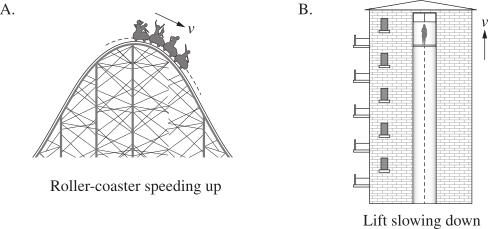
During the launch of a space vehicle from Earth, an astronaut feels an increased downward `g` force.

In which of the following situations would a person also feel an increased downward `g` force?


Show Answers Only

`D`

Show Worked Solution
  • A feeling of increased downwards `g` force is a result of upwards acceleration.
  • Options A, B and C all involve zero or downwards acceleration.

`=>D`

Filed Under: Forces, Acceleration and Energy, Projectile Motion Tagged With: Band 4, smc-3690-10-Projectile Motion Models, smc-4276-30-Gravity

PHYSICS M5 2022 HSC 29

An apple was thrown horizontally to the east from the window of a car which was moving with a uniform velocity to the north.

Explain the horizontal and vertical components of the apple's motion during its flight.   (4 marks)

--- 10 WORK AREA LINES (style=lined) ---

Show Answers Only

Horizontal component:

  • Initially, the horizontal component of the apple’s velocity is the vector sum of the car’s velocity to the north, and the velocity to the east at which the apple was thrown. 
  • There is no horizontal force, and consequently no horizontal acceleration of the apple. So, its horizontal velocity remains constant throughout its flight.

Vertical component:

  • The apple has zero initial vertical velocity.
  • There is a downwards force acting on the apple due to gravity. So, the apple accelerates vertically downwards causing its downwards velocity to increase at a constant rate until it hits the floor.
Show Worked Solution

Horizontal component:

  • Initially, the horizontal component of the apple’s velocity is the vector sum of the car’s velocity to the north, and the velocity to the east at which the apple was thrown. 
  • There is no horizontal force, and consequently no horizontal acceleration of the apple. So, its horizontal velocity remains constant throughout its flight.

Vertical component:

  • The apple has zero initial vertical velocity.
  • There is a downwards force acting on the apple due to gravity. So, the apple accelerates vertically downwards causing its downwards velocity to increase at a constant rate until it hits the floor.

Mean mark 51%.

Filed Under: Projectile Motion Tagged With: Band 5, smc-3690-10-Projectile Motion Models, smc-3690-90-Velocity and Acceleration

PHYSICS, M5 2020 HSC 15 MC

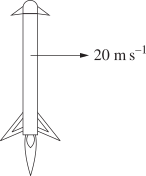
A rocket returns to Earth for reuse after launching satellites, using its engines to make a controlled landing.

The rocket having a mass of 7800 kg is on approach to the ground, travelling horizontally at 20 m s ¯1 as shown in the diagram, when the engine thrust is changed to 90 000 newtons.
 

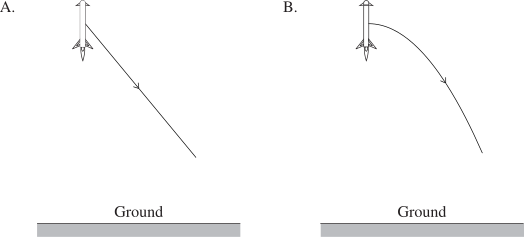
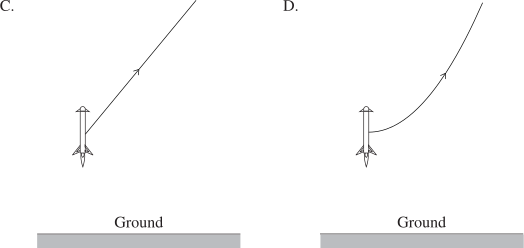
Which diagram shows the trajectory of the rocket following this change of thrust?
 

Show Answers Only

`D`

Show Worked Solution
  • Initial horizontal direction → net zero force
  • `W=mg=7800 xx 9.8=76\ 440\ text{N}`
  • Since  `90\ 000\ text{N} > 76\ 440` → net upwards force → net upwards acceleration.
  • Net upwards acceleration with constant horizontal velocity results in an upwards parabolic trajectory.

`=>D`

Filed Under: Projectile Motion Tagged With: Band 4, smc-3690-10-Projectile Motion Models, smc-3690-90-Velocity and Acceleration

PHYSICS, M5 2020 HSC 5 MC

A student throws a ball that follows a parabolic trajectory.

What change to the initial velocity would make the ball's time of flight shorter?

  1. Increasing only the vertical component
  2. Decreasing only the vertical component
  3. Increasing only the horizontal component
  4. Decreasing only the horizontal component
Show Answers Only

`B`

Show Worked Solution
  • Only the vertical component of the ball’s velocity impacts its time of flight.
  • Decreasing this decreases the time of flight.

`=> B`

Filed Under: Projectile Motion Tagged With: Band 4, smc-3690-10-Projectile Motion Models, smc-3690-45-Time of Flight

PHYSICS, M5 2021 HSC 1 MC

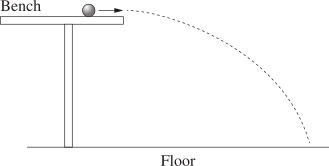
A marble is rolled off a horizontal bench and falls to the floor.


Rolling the marble at a slower speed would

  1. increase the range.
  2. decrease the range.
  3. increase the time of flight.
  4. decrease the time of flight.
Show Answers Only

`B`

Show Worked Solution

Vertical distance from floor to bench is constant → time of flight stays the same

Slower horizontal velocity → range decreases

`=>B`

Filed Under: Projectile Motion Tagged With: Band 2, smc-3690-10-Projectile Motion Models

Copyright © 2014–2025 SmarterEd.com.au · Log in