SmarterEd

Aussie Maths & Science Teachers: Save your time with SmarterEd

  • Login
  • Get Help
  • About

PHYSICS, M5 2019 VCE 10

A projectile is launched from the ground at an angle of 39° and at a speed of 25 m s\(^{-1}\), as shown in the diagram. The maximum height that the projectile reaches above the ground is labelled \(h\).
 

  1. Ignoring air resistance, show that the projectile's time of flight from the launch to the highest point is equal to 1.6 seconds. Give your answer to two significant figures. Show your working and indicate your reasoning.  (2 marks)

    --- 5 WORK AREA LINES (style=lined) ---

  2. Calculate the range, \(R\), of the projectile. Show your working.  (2 marks)

    --- 5 WORK AREA LINES (style=lined) ---

Show Answers Only

a.    \(t=1.6\ \text{s}\)

b.    \(62\ \text{m}\)

Show Worked Solution

a.    
       

\(v_v=25\,\sin39^{\circ}=15.733\ \text{ms}^{-1}\)

\(\text{At max height:}\ v_v=0\)

\(v\) \(=u+at_1\)  
\(0\) \(=15.733 -9.8t_1\)  
\(9.8t_1\) \(=15.733\)  
\(t_1\) \(=1.6\ \text{s  (2 sig.fig)}\)  


b.    \(\text{Since path is symmetrical:}\)

\(\text{Time of flight}\ (t_2) =1.6 \times 2=3.2\ \text{s}\).

\(v_h=25\,\cos39^{\circ}=19.43\ \text{ms}^{-1}\ \ \text{(see part (a) diagram)}\) 

\(\therefore R=v_ht_2=19.43 \times 3.2= 62\ \text{m}\)

Filed Under: Projectile Motion Tagged With: Band 3, Band 4, smc-3690-25-Range, smc-3690-45-Time of Flight

PHYSICS, M5 2021 VCE 9-10 MC

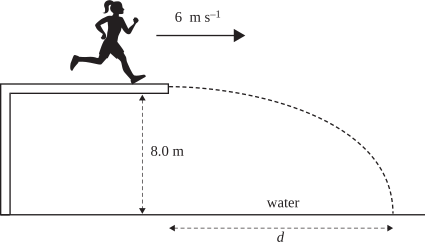
Lucy is running horizontally at a speed of 6 m s\(^{-1}\) along a diving platform that is 8.0 m vertically above the water.

Lucy runs off the end of the diving platform and reaches the water below after time \(t\).

She lands feet first at a horizontal distance \(d\) from the end of the diving platform.
 

Question 9

Which one of the following expressions correctly gives the distance \(d\) ?

  1. 0.8\(t\)
  2. 6\(t\)
  3. 5\(t^2\)
  4. 6\(t\) + 5\(t^2\)


Question 10

Which one of the following is closest to the time taken, \(t\), for Lucy to reach the water below?

  1. 0.8 s
  2. 1.1 s
  3. 1.3 s
  4. 1.6 s
Show Answers Only

\(\text{Question 9:} \ B\)

\(\text{Question 10:} \ C\)

Show Worked Solution

Question 9

  • The horizontal displacement formula for projectile motion:  \(s=ut\)
  • Horizontal distance: \(d=6t\)

\(\Rightarrow B\)
 

Question 10

Find time of flight \((t):\)

\(s\) \(=ut+\dfrac{1}{2}at^2\)  
\(s\) \(=\dfrac{1}{2}at^2\ \ \ (u=0)\)  
\(t\) \(=\sqrt{\dfrac{2s}{a}}=\sqrt{\dfrac{2 \times 8}{9.8}}\approx 1.3\ \text{s}\)  


\(\Rightarrow C\)

Filed Under: Projectile Motion Tagged With: Band 3, Band 4, smc-3690-25-Range, smc-3690-45-Time of Flight

PHYSICS, M5 2023 HSC 32

A horizontal disc rotates at 3 revolutions per second around its centre, with the top of the disc at ground level.

At 2 m from the centre of the disc, a ball is held in place at ground level on the top of the disc by a spring-loaded projectile launcher. At position \(X\), the launcher fires the ball vertically upward with a velocity of 5.72 m s\(^{-1}\).
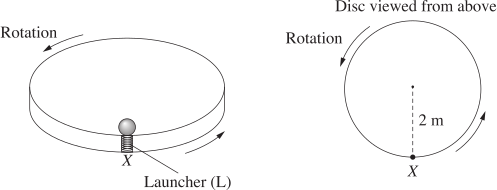


Calculate the ball's position relative to the launcher's new position, at the instant the ball hits the ground.   (7 marks)

--- 14 WORK AREA LINES (style=lined) ---

Show Answers Only

The position of the ball relative to the launcher’s new position is 44.19 m, 5.2\(^{\circ}\) below the horizontal line of the launcher.

Show Worked Solution

Find horizontal velocity of the ball, \(v_{\text{x}}\):

\(T=\dfrac{1}{3} = 0.333\ \text{seconds} \)

\(v_{\text{x}}=\dfrac{2\pi r}{T}=\dfrac{2\pi \times 2}{0.333…}=37.699\ \text{ms}^{-1}\)

♦ Mean mark 53%.

Calculating the time of flight, \(t_1\):

Let  \(t_2\) = time to max height

\(v_{\text{y}}\) \(=u_{\text{y}} + at_2\)  
\(t_2\) \(=\dfrac{v_{\text{y}}-u_{\text{y}}}{a}=\dfrac{0-5.72}{-9.8}=0.58367\ \text{sec} \)  


Time of flight (\(t_1)= 2 \times t_2= 1.167\ \text{s}\)
 

Range of the ball from launch position:

\(s_{\text{x}}=v_{\text{x}} \times t_2=37.699 \times 1.167=44.0\ \text{m}\)
 

Position of the launcher (L) when the ball hits the ground:

  • Revolutions (before ball lands) = 3 × 1.167 = 3.5 revolutions
  • The Launcher (L) is \(\frac{1}{2}\) a revolution past its starting point.
  • Thus, the positions of both the ball and the launcher at the time when the ball hits the ground can be demonstrated in the diagram below.
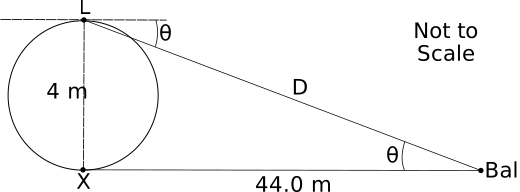


\(D\) \(=\sqrt{44.0^2+4^2}=44.18\ \text{m}\)  
\(\theta\) \(=\tan ^{-1}\left(\dfrac{4}{44.0}\right)=5.2^{\circ}\)  


  • The final position of the ball relative to \(L\) is 44.18 m, 5.2\(^{\circ}\) below the horizontal line at \(L\).

Filed Under: Circular Motion, Projectile Motion Tagged With: Band 5, Band 6, smc-3690-25-Range, smc-3690-35-Initial Velocity, smc-3690-45-Time of Flight, smc-3691-20-Applications of Circular Motion

PHYSICS, M5 2023 HSC 8 MC

A ball is launched from a platform at position \(A\) with velocity \(u\). It lands in the position shown.


The ball could be made to land at position \(B\) by increasing the

  1. velocity \(u\).
  2. launch angle.
  3. mass of the ball.
  4. height of the platform.
Show Answers Only

\(B\)

Show Worked Solution
  • As the launch angle increases, the horizontal velocity of the ball decreases.
  • At a steep launch angle, the ball will travel high into the air but have a short range, thus it could be made to land at position \(B\) as seen in the diagram below.
     

\(\Rightarrow B\)

Mean mark 56%.

Filed Under: Projectile Motion Tagged With: Band 4, smc-3690-10-Projectile Motion Models, smc-3690-25-Range

PHYSICS, M5 EQ-Bank 26

A baseball is hit with a velocity of 28 m s ¯1 at an angle of 30° to the horizontal at an initial height of 1.0 m above the plate. Ignore air resistance in your calculations.
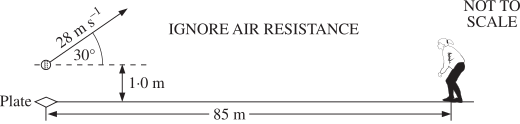
 

  1. How long does it take the ball to return to the initial height above the ground?   (3 marks)

--- 6 WORK AREA LINES (style=lined) ---

  1. The ball is hit directly towards a stationary outfielder who is 85 m from the plate. At the instant the ball is hit, the outfielder begins to run towards the plate with constant acceleration.
  2. What is the magnitude of her acceleration if she catches the ball when it is 0.50 m above the ground?   (4 marks)

--- 8 WORK AREA LINES (style=lined) ---

Show Answers Only

a.   `t=2.9\ text{seconds}`

b.   `a=3.6  text{m s}^(-2)`

Show Worked Solution

a.   At initial height: `s_y=0`

Initial vertical velocity:  `u_y=28sin30°=14\ text{m s}^(-1)`

Vertical acceleration: `-9.8\ text{m s}^(-2)`

`s_(y)` `=u_(y)t+(1)/(2)a_(y)t^2`  
`0` `=14 t+(1)/(2)xx(-9.8)xxt^(2)`  
`0` `=14 t-4.9 xxt^(2)`  
`0` `=t(14-4.9 t)`  
`t` `=(14)/(4.9)=2.9\ text{seconds},\ \ (t>0)`  


b.   At  `s_y=0.50\ text{m}`:

`v_(y)^2` `=u_(y)^2+2a_(y)s_(y)`  
`v_(y)^2` `=14^(2)+2(-9.8)(-0.50)`  
`v_(y)` `=sqrt(205.8)~~14.3457\ text{m s}^(-1)`  

 
Using  `v_y=u_(y)+a_(y)t:`

`-14.3457` `=14-9.8t`  
`t` `=(14+14.3457)/(9.8)=2.892\ text{s}`  

 
Horizontal range travelled (`s_x`):

`s_(x)=u_(x)t=28 cos 30^{\circ} xx 2.892=70.127\ text{m}`
 

COMMENT: Note `v_y` and `u_y` are in opposite directions and have opposite signs.

  Distance fielder travelled `=85-70.127 = 14.873\ text{m}`

`s` `=ut+(1)/(2)at^(2)`  
`14.873` `=0+(1)/(2)xx a xx2.892^(2)`  
`:.a` `=(2 xx 14.873)/2.892^(2)`  
  `=3.6\ text{m s}^(-2)\ \ text{(to 1 d.p.)}`  

Filed Under: Projectile Motion Tagged With: Band 4, Band 5, smc-3690-25-Range, smc-3690-45-Time of Flight

PHYSICS, M5 EQ-Bank 1 MC

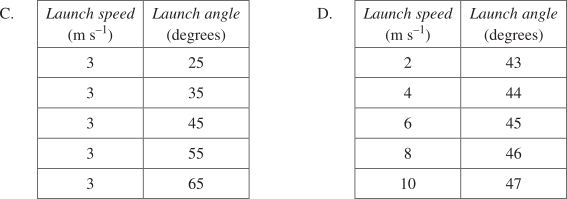
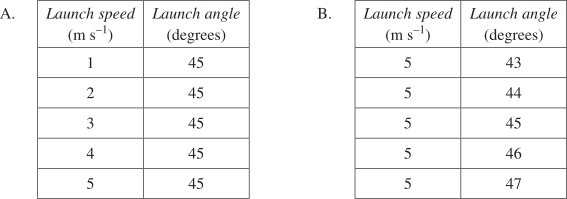
Some students were testing the hypothesis that launching a projectile at an angle of 45° will give the maximum horizontal range.

Which experimental setup will best test the hypothesis?
 

Show Answers Only

`C`

Show Worked Solution

By Elimination:

  • In this experiment horizontal range is the dependent variable and launch angle is the independent variable. So, launch angle must be varied (eliminate `A`).
  • To be a valid experiment, the independent variable, i.e. the launch angle, must be the only variable which changes (eliminate `D`).
  • Between `B` and `C`, `C` has a larger range of angles tested, whereas `B` uses too narrow a range of angles to make a valid conclusion.

`=>C`

Filed Under: Projectile Motion Tagged With: Band 3, smc-3690-10-Projectile Motion Models, smc-3690-25-Range

PHYSICS, M5 2017 HSC 29

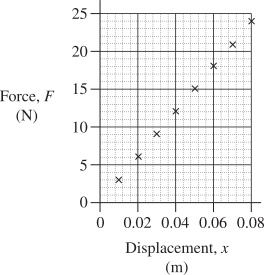
A spring is used to construct a device to launch a projectile. The force `(F)` required to compress the spring is measured as a function of the displacement `(x)` by which the spring is compressed.
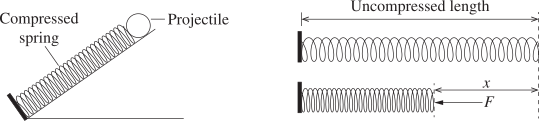
 

The potential energy stored in the compressed spring can be calculated from  `E_p=(1)/(2) kx^(2)`, where `k` is the gradient of the force-displacement graph shown.
 

  1. A projectile of mass 0.04 kg is launched using this device with the spring compressed by 0.08 m. Calculate the launch velocity.   (4 marks)

--- 11 WORK AREA LINES (style=lined) ---

  1. Calculate the range of a projectile launched by this device from ground level at an angle of 60° to the horizontal with a velocity of 10 `text{m s}^(-1)`.   (3 marks)

--- 9 WORK AREA LINES (style=lined) ---

Show Answers Only

a.   `6.9  text{m s}^(-1)`

b.   `8.8  text{m}`

Show Worked Solution

a.   `k=  text{gradient}=(24-6)/(0.08-0.02)=300`

Finding the potential energy stored in the compressed spring:

`E_(p)=(1)/(2)kx^(2)=(1)/(2)xx300 xx0.08^(2)=0.96  text{J}`

  
As this potential energy is converted into kinetic energy when the projectile is launched:

`E_(k)` `=0.96  text{J}`
 `(1)/(2)mv^(2)` `=0.96`
`v^(2)` `=(2 xx0.96)/(0.04)`
`v` `=6.9  text{m s}^(-1)`


b.   Time to reach the highest point `(v_(y)=0)`:

`v_(y)` `=u_(y)+a_(y)t`
`0` `=10xx sin 60^(@)-9.8t`
`t` `=(10xx sin 60^(@))/(9.8)=0.88  text{s}`


The time of flight is twice the time taken to reach the highest point:

`t=2 xx0.88=1.77\ text{s}`

 
Find range:

`s_(x)=u_(x)t=10xx cos 60^(@)xx 1.77=8.8\ text{m}`


Mean mark (b) 59%.

Filed Under: Projectile Motion Tagged With: Band 4, smc-3690-25-Range, smc-3690-50-Kinetic Energy

PHYSICS, M6 2020 HSC 34

A charged particle, `q_1`, is fired midway between oppositely charged plates `X` and `Y`, as shown in Figure 1. The voltage between the plates is `V` volts.

The particle strikes plate `Y` at point `P`, a horizontal distance `s` from the edge of the plate. Ignore the effect of gravity.
 

Plate `Y` is then moved to the position shown in Figure 2, with the voltage between the plates remaining the same.

An identical particle, `q_2`, is fired into the electric field at the same velocity, entering the field at the same distance from plate `X` as `q_1`.

  1. Compare the work done on `q_1` and `q_2`.   (3 marks)

    --- 8 WORK AREA LINES (style=lined) ---

  1. Compare the horizontal distances travelled by `q_1` and `q_2` in the electric field.   (3 marks)

    --- 12 WORK AREA LINES (style=lined) ---

Show Answers Only

a.   The work done on `q_2` is `(3)/(2)` times that done on `q_1`.

b.   The horizontal distance travelled by `q_2` is `sqrt(6)` times that of `q_1`.

Show Worked Solution

a.   Work done on `q_1:`

  `W=qE((d)/(2))` … (1)

Substitute  `E=(V)/(d)`  into (1)

  `W=(qV)/2`

 
Work done on `q_2:`

  `W=qE((3d)/(2))` … (1)

Substitute  `E=(V)/(2d)`  into (1)

  `W=(3qV)/4`

  `(2) -: (1):`

  `(W_(2))/(W_(1))=(((3qV)/(4)))/(((qV)/(2)))=(3)/(2)`

  • The work done on `q_2` is `3/2` times that done on `q_1`.
♦ Mean mark (a) 47%.

b.   Find the vertical acceleration of `q_1:`

`F` `=qE=(qV)/(d)`
`a` `=(F)/(m)=(qV)/(dm)` … (1)

 
Similarly for `q_2:` 

`F` `=qE=(qV)/(2d)`
`a` `=(F)/(m)=(qV)/(2dm)` … (2)
     
  • The initial horizontal velocity is the same for both `q_1` and `q_2`
  • The horizontal distance travelled by both is proportional to the time taken for them to reach the plate.
  • `s_(y)=u_(y)t+(1)/(2)a_(y)t^(2)=(1)/(2)a_(y)t^(2)`  (initial vertical velocity = 0 for both)
     

Time for `q_1` to reach plate `Y:` 

`s_(y)` `=(1)/(2)a_(y)t^(2)`  
`(d)/(2)` `=(1)/(2)((qV)/(dm))t^(2)`    from (1)
`t^(2)` `=(d^(2)m)/(qV)`  
`t` `=sqrt((d^(2)m)/(qV))` …   (3)

 
Time taken for `q_2` to reach plate `Y:` 

`s_(y)` `=(1)/(2)a_(y)t^(2)`  
`(3d)/(2)` `=(1)/(2)((qV)/(2dm))t^(2)`    from (2)
`t^(2)` `=(6d^(2)m)/(qV)`  
`t` `=sqrt((6d^(2)m)/(qV))` …   (4)

 
  `(4) -: (3):`

`(t_(2))/(t_(1))=(sqrt((6d^(2)m)/(qV)))/(sqrt((d^(2)m)/(qV)))=sqrt(6)`

  • The time taken for `q_2` to reach plate `Y` is `sqrt(6)` times that taken for `q_1`.
  • The horizontal distance travelled by `q_2` is `sqrt(6)` times that of `q_1`.
♦ Mean mark (b) 43%.

Filed Under: Charged Particles, Conductors and Electric/Magnetic Fields, Projectile Motion Tagged With: Band 5, smc-3690-25-Range, smc-3690-95-X-Topic: Charged particles, smc-3693-10-Charged Particles in EF, smc-3693-35-Kinematic/Work Calcs, smc-3693-80-X-Topic: Projectile motion

Copyright © 2014–2025 SmarterEd.com.au · Log in