SmarterEd

Aussie Maths & Science Teachers: Save your time with SmarterEd

  • Login
  • Get Help
  • About

PHYSICS, M6 2024 HSC 28

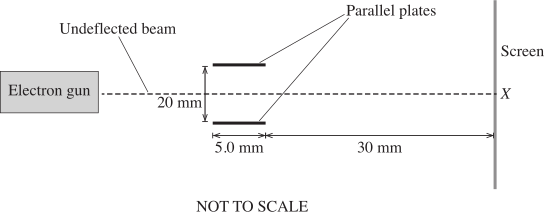
An electron gun fires a beam of electrons at 2.0 × 10\(^6\) m s\(^{-1}\) through a pair of parallel charged plates towards a screen that is 30 mm from the end of the plates as shown.

There is a uniform electric field between the plates of 1.5 × 10\(^4\) N C\(^{-1}\). The plates are 5.0 mm wide and 20 mm apart. The electron beam enters mid-way between the plates. \(X\) marks the spot on the screen where an undeflected beam would strike.

Ignore gravitational effects on the electron beam.


  1. Show that the acceleration of an electron between the parallel plates is 2.6 × 10\(^{15}\) m s\(^{-2}\).   (2 marks)

    --- 4 WORK AREA LINES (style=lined) ---

  2. Show that the vertical displacement of the electron beam at the end of the parallel plates is approximately 8.1 mm.   (2 marks)

    --- 4 WORK AREA LINES (style=lined) ---

  3. How far from point \(X\) will the electron beam strike the screen?   (3 marks)

    --- 6 WORK AREA LINES (style=lined) ---
Show Answers Only

a.   \(\text{Using}\ \ F=qE\ \ \text{and}\ \ F=ma:\)

  \(a=\dfrac{qE}{m} = \dfrac{1.5 \times 10^{4} \times 1.602 \times 10^{-19}}{9.109 \times 10^{-31}} = 2.6 \times 10^{15}\ \text{m s}^{-2} \)
 

b.  \(\text{Time of beam between the plates:}\)

\(\text{Horizontal velocity}\ (v)\ = 2 \times 10^{6}\ \text{m s}^{-1} \)

\(\text{Distance to screen}\ (s)\ = 5.0\ \text{mm}\ = \dfrac{5}{1000} = 0.005\ \text{m}\)

  \(t=\dfrac{s}{v} = \dfrac{0.005}{2 \times 10^{6}} = 2.5 \times 10^{-9}\ \text{s} \)
 

\(\text{Find vertical displacement at end of plates:}\)

  \(s=\dfrac{1}{2} at^{2} = 0.5 \times 2.6 \times 10^{15} \times (2.5 \times 10^{-9})^{2} = 0.008125\ \text{m}\ = 8.1\ \text{mm} \)
 

c.   \(\text{Find vertical velocity of beam when leaving the plates:}\)

  \(v=at=2.6 \times 10^{15} \times 2.5 \times 10^{-9} = 6.5 \times 10^{6}\ \text{m s}^{-1} \)
 

\(\text{Time for beam to hit screen:}\)

\(\text{Distance to screen}\ (s)\ = 30\ \text{mm}\ = \dfrac{30}{1000} = 0.03\ \text{m}\)

  \(t=\dfrac{s}{v} = \dfrac{0.03}{2 \times 10^{6}} = 1.5 \times 10^{-8}\ \text{s} \)
 

\(\text{Vertical displacement (from end of plates):}\)

  \(s=vt=6.5 \times 10^{6} \times 1.5 \times 10^{-8} = 0.0975\ \text{m} \)
 

\(\text{Distance from}\ X = 0.0081 + 0.0975 = 0.11\ \text{m} \)

Show Worked Solution

a.   \(\text{Using}\ \ F=qE\ \ \text{and}\ \ F=ma:\)

  \(a=\dfrac{qE}{m} = \dfrac{1.5 \times 10^{4} \times 1.602 \times 10^{-19}}{9.109 \times 10^{-31}} = 2.6 \times 10^{15}\ \text{m s}^{-2} \)
 

b.  \(\text{Time of beam between the plates:}\)

\(\text{Horizontal velocity}\ (v)\ = 2 \times 10^{6}\ \text{m s}^{-1} \)

\(\text{Distance to screen}\ (s)\ = 5.0\ \text{mm}\ = \dfrac{5}{1000} = 0.005\ \text{m}\)

  \(t=\dfrac{s}{v} = \dfrac{0.005}{2 \times 10^{6}} = 2.5 \times 10^{-9}\ \text{s} \)
 

\(\text{Find vertical displacement at end of plates:}\)

  \(s=\dfrac{1}{2} at^{2} = 0.5 \times 2.6 \times 10^{15} \times (2.5 \times 10^{-9})^{2} = 0.008125\ \text{m}\ = 8.1\ \text{mm} \)
 

c.   \(\text{Find vertical velocity of beam when leaving the plates:}\)

  \(v=at=2.6 \times 10^{15} \times 2.5 \times 10^{-9} = 6.5 \times 10^{6}\ \text{m s}^{-1} \)
 

\(\text{Time for beam to hit screen:}\)

\(\text{Distance to screen}\ (s)\ = 30\ \text{mm}\ = \dfrac{30}{1000} = 0.03\ \text{m}\)

  \(t=\dfrac{s}{v} = \dfrac{0.03}{2 \times 10^{6}} = 1.5 \times 10^{-8}\ \text{s} \)
 

\(\text{Vertical displacement (from end of plates):}\)

  \(s=vt=6.5 \times 10^{6} \times 1.5 \times 10^{-8} = 0.0975\ \text{m} \)
 

\(\text{Distance from}\ X = 0.0081 + 0.0975 = 0.11\ \text{m} \)

♦ Mean mark (c) 40%.

Filed Under: Charged Particles, Conductors and Electric/Magnetic Fields, Projectile Motion Tagged With: Band 3, Band 4, Band 5, smc-3690-40-Vertical Displacement, smc-3690-95-X-Topic: Charged particles, smc-3693-10-Charged Particles in EF, smc-3693-80-X-Topic: Projectile motion

PHYSICS, M5 2023 VCE 9

Giorgos is practising his tennis serve using a tennis ball of mass 56 g.

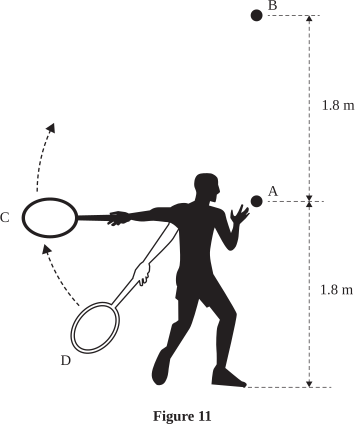
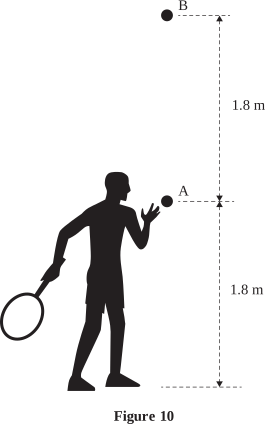
  1. Giorgos practises throwing the ball vertically upwards from point A to point B, as shown in Diagram A. His daughter Eka, a physics student, models the throw, assuming that the ball is at the level of Giorgos's shoulder, point A, both when it leaves his hand and also when he catches it again. Point A is 1.8 m from the ground. The ball reaches a maximum height, point B, 1.8 m above Giorgos's shoulder.


  1. Show that the ball is in the air for 1.2 s from the time it leaves Giorgos's hand, which is level with his shoulder, until he catches it again at the same height.   (2 marks)

--- 5 WORK AREA LINES (style=lined) ---

  1. Giorgos swings his racquet from point D through point C, which is horizontally behind him at shoulder height, as shown in Diagram B, to point B. Eka models this swing as circular motion of the racquet head. The centre of the racquet head moves with constant speed in a circular arc of radius 1.8 m from point C to point B.

  1. The racquet passes point C at the same time that the ball is released at point A and then the racquet hits the ball at point B.
  2. Calculate the speed of the racquet at point C.   (2 marks)

--- 5 WORK AREA LINES (style=lined) ---

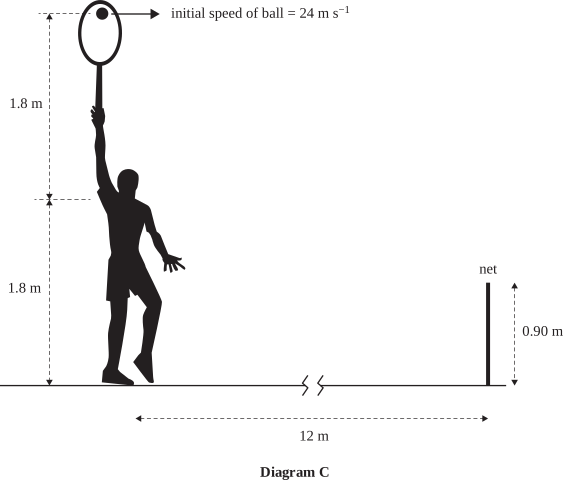
  1. The ball leaves Giorgos's racquet with an initial speed of 24 m s\(^{-1}\) in a horizontal direction, as shown in Diagram C. A tennis net is located 12 m in front of Giorgos and has a height of 0.90 m.
     

  1. How far above the net will the ball be when it passes above the net? Assume that there is no air resistance. Show your working.   (3 marks)

--- 7 WORK AREA LINES (style=lined) ---
Show Answers Only

a.    \(1.2\ \text{s}\)

b.    \(4.7\ \text{ms}^{-1}\)

c.    \(1.475\ \text{m}\)

Show Worked Solution

a.    Time to for the ball to fall from max height back to shoulder level:

\(s\) \(=ut+\dfrac{1}{2}at^2\)  
\(1.8\) \(=0 \times t + \dfrac{1}{2} \times 9.8 \times t^2\)  
\(t\) \(=\sqrt{\dfrac{1.8}{4.9}}=0.606\ \text{s}\)  


\(\text{Total time of flight}\ =0.606 \times 2=1.2\ \text{s}\)
 

b.    The racket travels a quarter of the circumference of the circle in 0.606 seconds.

\(v=\dfrac{d}{t}=\dfrac{2\pi \times 1.8 \times 0.25}{0.606}=4.7\ \text{ms}^{-1}\)
 

♦♦ Mean mark (b) 27%.

c.    Time for the ball to reach the net:

  \(t=\dfrac{d}{v}=\dfrac{12}{24}=0.5\ \text{s}\)

Vertical displacement from max height in 0.5 seconds:

  \(s=ut+\dfrac{1}{2}at^2=0 \times 0.5 + \dfrac{1}{2} \times 9.8 \times 0.5^2=1.225\ \text{m}\).

\(\text{Height (at net)}\ =3.6-1.225=2.375\ \text{m}\).

\(\therefore\ \text{Height (above net)}\ =2.375-0.9=1.475\ \text{m}\)

♦ Mean mark (c) 47%.

Filed Under: Projectile Motion Tagged With: Band 4, Band 5, smc-3690-40-Vertical Displacement, smc-3690-45-Time of Flight

PHYSICS, M5 2015 HSC 21

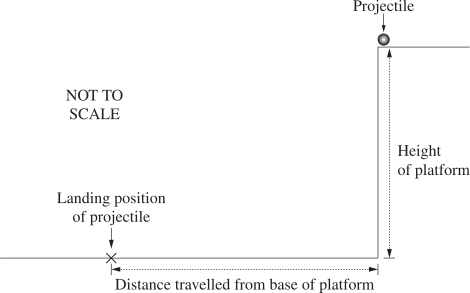
A projectile is fired horizontally from a platform.
 

Measurements of the distance travelled by the projectile from the base of the platform are made for a range of initial velocities.   

\begin{array}{|c|c|}
\hline
\rule{0pt}{2.5ex}\textit{Initial velocity}& \textit{Distance travelled from} \\
\textit{of projectile}\ \text{(ms\(^{-1}\))} \rule[-1ex]{0pt}{0pt}& \textit{base of platform}\  \text{(m)} \\
\hline
\rule{0pt}{2.5ex} 1.4 \rule[-1ex]{0pt}{0pt}&1.0\\
\hline
\rule{0pt}{2.5ex} 2.3 \rule[-1ex]{0pt}{0pt}& 1.7\\
\hline
\rule{0pt}{2.5ex} 3.1 \rule[-1ex]{0pt}{0pt}& 2.2\\
\hline
\rule{0pt}{2.5ex} 3.9 \rule[-1ex]{0pt}{0pt}& 2.3 \\
\hline
\rule{0pt}{2.5ex} 4.2 \rule[-1ex]{0pt}{0pt}& 3.0 \\
\hline
\end{array}

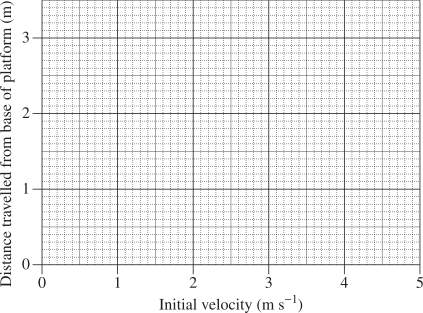
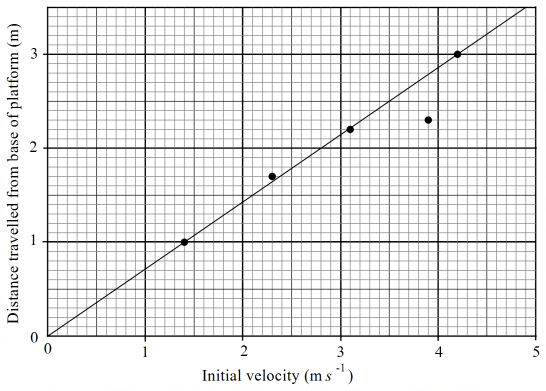
  1. Graph the data on the grid provided and draw the line of best fit.   (2 marks)


--- 0 WORK AREA LINES (style=lined) ---

  1. Calculate the height of the platform.   (2 marks)

    --- 6 WORK AREA LINES (style=lined) ---
Show Answers Only

a. 
     

b.   2.5 m

Show Worked Solution

a.   
          

b.   \(s_x=u(x) t\ \ \Rightarrow\ \ t=\dfrac{s_x}{u_x} \text{(gradient)}\)

\(\text{Using the line of best fit, gradient = 0.714.}\)

\(t = 0.714\ s\)

\(s_y\) \(=u_y t+\frac{1}{2} a_y t^2\)  
  \(=0+0.5 \times 9.8 \times(0.714)^2\)  
  \(=2.5 \ \text{m}\)  

 
\(\text{Height}\ = 2.5\ \text{m}\)

Filed Under: Projectile Motion Tagged With: Band 2, Band 4, smc-3690-40-Vertical Displacement

PHYSICS, M5 2019 HSC 30

A ball, initially at rest in position `P`, travels along a frictionless track to point `Q` and then falls to strike the floor below.
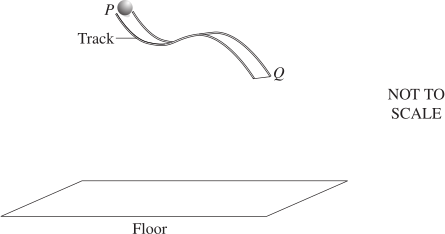
 

At the instant the ball leaves the track at `Q` it has a velocity of 1.5 `text{m s}^(-1)` at an angle of 50° to the horizontal.

  1. Calculate the difference in height between `P` and `Q`.   (3 marks)

--- 6 WORK AREA LINES (style=lined) ---

  1. The ball takes 0.5 s to reach the floor after leaving the track at `Q`.
  2. Calculate the height of `Q` above the floor.   (3 marks)

--- 6 WORK AREA LINES (style=lined) ---

Show Answers Only

a.   `h=0.11\ \text{m}`

b.   `h=1.8\ \text{m}`

Show Worked Solution

a. `Delta U` `=Delta E_(k)`
  `mgDeltah` `=(1)/(2)mv^2-(1)/(2)m u^2`
  `mgDeltah` `=(1)/(2)mv^2\ \ (u=0)`
  `Delta h` `=(v^2)/(2g)=(1.5^(2))/(2xx9.8)=0.1145\ \text{m}`


♦ Mean mark part (a) 41%.

b.   `u_(y)=u sin theta=1.50  sin 50^(@)=1.15\ text{m s}^(-1)`

  `s_(y)` `=ut+(1)/(2)at^(2)`
    `=1.15 xx0.5+(1)/(2)(9.80)xx0.5^(2)`
    `= 1.8\ text{m}`

 
`:.\ \text{Height of Q = 1.8 m}`

Filed Under: Projectile Motion Tagged With: Band 4, Band 5, smc-3690-40-Vertical Displacement, smc-3690-50-Kinetic Energy

Copyright © 2014–2025 SmarterEd.com.au · Log in