SmarterEd

Aussie Maths & Science Teachers: Save your time with SmarterEd

  • Login
  • Get Help
  • About

PHYSICS, M5 2023 HSC 23a

The James Webb Space Telescope (JWST) has a mass of 6.1 × 10³ kg and orbits the Sun at a distance of approximately 1.52 × 10\(^{11}\) m.

The Sun has a mass of 1.99 × 10\(^{30}\) kg.

Calculate the magnitude of gravitational force the Sun exerts on the JWST.  (2 marks)

--- 4 WORK AREA LINES (style=lined) ---

Show Answers Only

\(F= 35\) \( \text{N}\)

Show Worked Solution

\(F\) \(=\dfrac{GMm}{r^2}\)  
  \(=\dfrac{ 6.67 \times 10^{-11} \times 1.99 \times 10^{30} \times 6.1 \times 10^3}{(1.52 \times 10^{11} )^2}\)  
  \(=35\) \(\text{N}\)  

Filed Under: Motion in Gravitational Fields Tagged With: Band 3, smc-3692-10-Gravity between 2 objects

PHYSICS, M5 2015 HSC 19 MC

An astronaut working outside a spacecraft in orbit around Earth is not attached to it.

Why does the astronaut NOT drift away from the spacecraft?

  1. The force of gravity acting on the astronaut and spacecraft is negligible.
  2. The spacecraft and the astronaut are in orbit around the Sun with the Earth.
  3. The forces due to gravity acting on both the astronaut and the spacecraft are the same.
  4. The accelerations of the astronaut and the spacecraft are inversely proportional to their respective masses.
Show Answers Only

`D`

Show Worked Solution

By Elimination:

  • Gravity is the force keeping the spacecraft and the astronaut in orbit, so it is not negligible (eliminate A).
  • Earths rotation around the sun is not relevant to the motion of the astronaut and the spacecraft relative to Earth (eliminate B).
  • Using  `F=(GMm)/(r^2)`, the force due to gravity acting on both is proportional to their respective masses. Since the spacecraft is significantly heavier, it will experience a greater force due to gravity (eliminate C).
  • The accelerations, `g=(F)/(m)` of the spacecraft and the astronaut are inversely proportional to their respective masses. As they both experience a force, `F`, due to gravity proportional to their masses, their accelerations are the same. Therefore, the astronaut will not drift from the spacecraft.

`=>D`


♦♦♦ Mean mark 15%.

Filed Under: Motion in Gravitational Fields Tagged With: Band 6, smc-3692-10-Gravity between 2 objects, smc-3692-40-Satellites

PHYSICS, M5 2016 HSC 25

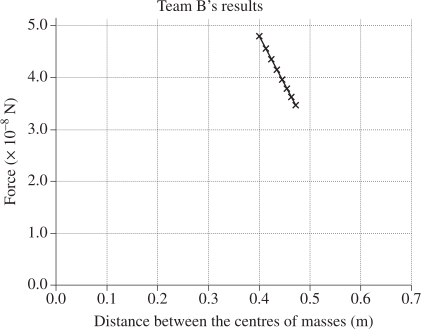
Two teams carried out independent experiments with the purpose of investigating Newton's Law of Universal Gravitation. Each team used the same procedure to accurately measure the gravitational force acting between two spherical masses over a range of distances.

The following graphs show the data collected by each team.
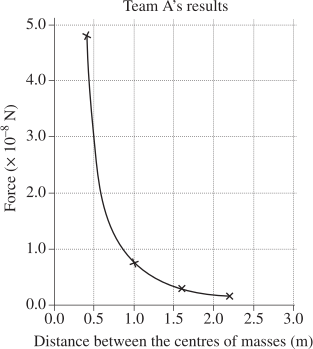


  1. Compare qualitatively the relationship between force and distance in the graphs.   (2 marks)

--- 5 WORK AREA LINES (style=lined) ---

  1. Assess the appropriateness of Team A's data and Team B's data in achieving the purpose of the experiments.   (3 marks)

--- 6 WORK AREA LINES (style=lined) ---

Show Answers Only

a.    Force vs Distance relationship:

  • Both graphs show that as distance between the centres of masses increases, force increases.
  • Team A’s data shows that the force between masses is inversely proportional to the square of the distance between them.
  • Team B’s data shows that force decreases at a constant rate.

b.   Data appropriateness:

  • Team A’s data set uses a good range of distances however it is inappropriate as it incorporates too few measurements for a valid relationship to be determined.
  • Team B’s data set is inappropriate as it does not incorporate a sufficient range of distances to determine a valid relationship although it has a sufficient number of measurements.
Show Worked Solution

a.    Force vs Distance relationship:

  • Both graphs show that as distance between the centres of masses increases, force increases.
  • Team A’s data shows that the force between masses is inversely proportional to the square of the distance between them.
  • Team B’s data shows that force decreases at a constant rate.

b.   Data appropriateness:

  • Team A’s data set uses a good range of distances however it is inappropriate as it incorporates too few measurements for a valid relationship to be determined.
  • Team B’s data set is inappropriate as it does not incorporate a sufficient range of distances to determine a valid relationship although it has a sufficient number of measurements.

Mean mark (b) 56%.

Filed Under: Motion in Gravitational Fields Tagged With: Band 4, smc-3692-10-Gravity between 2 objects, smc-3692-80-Newton's Laws

PHYSICS, M5 2016 HSC 21b

Calculate the magnitude of the gravitational force that acts on a 50 kg satellite when it is 8000 km from Earth's centre.   (3 marks)

--- 6 WORK AREA LINES (style=lined) ---

Show Answers Only

312.7 N

Show Worked Solution
  `F` `=(GMm)/(r^(2))`
    `=(6.67 xx10^(-11)xx6xx10^(24)xx50)/((8000 xx10^(3))^(2))`
    `=312.7\ text{N}`

Filed Under: Motion in Gravitational Fields Tagged With: Band 4, smc-3692-10-Gravity between 2 objects, smc-3692-40-Satellites

PHYSICS, M5 2018 HSC 21

  1. Compare the force of gravity exerted on the moon by Earth with the force of gravity exerted on Earth by the moon.    (2 marks)

--- 3 WORK AREA LINES (style=lined) ---

  1. The acceleration due to gravity on the moon is `1.6 \ text{m s}^(-2)` and on Earth it is `9.8 \ text{m s}^(-2)`. Quantitatively compare the mass and weight of a 70 kg person on the moon and on Earth.   (2 marks)

--- 4 WORK AREA LINES (style=lined) ---

Show Answers Only

a.   Using Newton’s Third Law:

  • The force of gravity of the Earth on the moon is equal in magnitude and opposite in direction to the force of gravity exerted on Earth by the moon.
     

b.   Comparison of mass:

  • The mass of the person on both Earth and the moon is 70 kg.

Comparison of weight:

  • The weight of the person on Earth is given by  `W_e=mg=70 xx9.8=686\ text{N.}`
  • The weight of the person on the moon is given by  `W_m=mg=70xx1.6=112\ text{N.}`
  • The persons weight on Earth is greater than it is on the moon.
Show Worked Solution

a.   Using Newton’s Third Law:

  • The force of gravity of the Earth on the moon is equal in magnitude and opposite in direction to the force of gravity exerted on Earth by the moon.

♦♦ Mean mark (a) 33%.

b.   Comparison of mass:

  • The mass of the person on both Earth and the moon is 70 kg.

Comparison of weight:

  • The weight of the person on Earth is given by  `W_e=mg=70 xx9.8=686\ text{N.}`
  • The weight of the person on the moon is given by  `W_m=mg=70xx1.6=112\ text{N.}`
  • The persons weight on Earth is greater than it is on the moon.

Filed Under: Forces, Motion in Gravitational Fields Tagged With: Band 3, Band 5, smc-3692-10-Gravity between 2 objects, smc-4275-10-Using Newton's laws, smc-4275-30-Newton's 2nd Law

PHYSICS M5 2022 HSC 35

A capsule travels around the International Space Station (ISS) in a circular path of radius 200 m as shown.
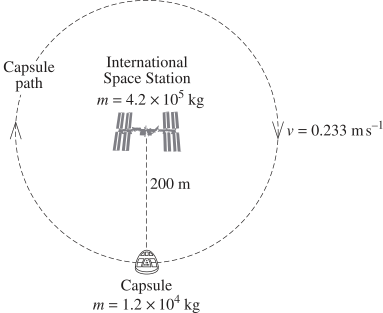


Analyse this system to test the hypothesis below.  (5 marks)

The uniform circular motion of the capsule around the ISS can be accounted for in terms of the gravitational force between the capsule and the ISS.

--- 10 WORK AREA LINES (style=lined) ---

Show Answers Only

Find the gravitational force between the capsule and the ISS:

`F` `=(GMm)/(r^2)`  
  `=(6.67 xx10^-11 xx4.2 xx10^5 xx 1.2 xx10^4)/(200^2)`  
  `=8.4 xx10^(-6)  text{N}`  

 
Find the centripetal force required to keep the capsule in its orbit:

   `F_(c)=(mv^2)/(r)=(1.2 xx10^4 xx 0.233^2)/(200)=3.26  text{N}`

  • The gravitational force is not sufficient to provide the necessary centripetal force to keep the capsule in orbit around the ISS.
  • The hypothesis is invalid.
Show Worked Solution

Find the gravitational force between the capsule and the ISS:

`F` `=(GMm)/(r^2)`  
  `=(6.67 xx10^-11 xx4.2 xx10^5 xx 1.2 xx10^4)/(200^2)`  
  `=8.4 xx10^(-6)  text{N}`  

 
Find the centripetal force required to keep the capsule in its orbit:

`F_(c)=(mv^2)/(r)=(1.2 xx10^4 xx 0.233^2)/(200)=3.26  text{N}`

  • The gravitational force is not sufficient to provide the necessary centripetal force to keep the capsule in orbit around the ISS.
  • The hypothesis is invalid.

Filed Under: Circular Motion, Motion in Gravitational Fields Tagged With: Band 4, smc-3691-10-Centripetal Forces, smc-3691-80-Satellites, smc-3692-10-Gravity between 2 objects, smc-3692-40-Satellites

PHYSICS, M5 2021 HSC 14 MC

Which of the following statements correctly describes the gravitational interaction between the Earth and the Moon?

  1. The Earth accelerates towards the Moon.
  2. The net force acting on the Earth is zero.
  3. The Moon and Earth experience equal and opposite accelerations.
  4. The force acting on the Moon is smaller than the force acting on the Earth.
Show Answers Only

`A`

Show Worked Solution
  • According to Newton’s Third Law, the earth and moon experience equal forces in opposite directions. This causes them to accelerate towards each other.

`=>A`


♦ Mean mark 19%.

Filed Under: Motion in Gravitational Fields Tagged With: Band 6, smc-3692-10-Gravity between 2 objects, smc-3692-80-Newton's Laws

Copyright © 2014–2025 SmarterEd.com.au · Log in