SmarterEd

Aussie Maths & Science Teachers: Save your time with SmarterEd

  • Login
  • Get Help
  • About

PHYSICS, M5 2024 HSC 31

In a thought experiment, a projectile is launched vertically from Earth's surface. Its initial velocity is less than the escape velocity.

The behaviour of the projectile can be analysed by using two different models, Model \(A\) and Model \(B\) as shown.
  

The effects of Earth's atmosphere and Earth's rotational and orbital motions can be ignored.

Compare the maximum height reached by the projectile, using each model. In your answer, describe the energy changes of the projectile.   (4 marks)

--- 8 WORK AREA LINES (style=lined) ---

Show Answers Only

  • Both models start with identical kinetic energy, which completely transforms into gravitational potential energy when the object reaches its highest point.
  • In Model \(A\), a consistent amount of kinetic energy converts to gravitational potential energy for each meter of upward movement.
  • In Model \(B\), the gravitational field gets weaker at higher altitudes. As a result, less kinetic energy is converted to gravitational potential energy per meter as the object goes up.
  • The object in Model \(B\) will therefore climb higher than the object in Model \(A\) before all its kinetic energy is converted to potential energy.

Show Worked Solution

  • Both models start with identical kinetic energy, which completely transforms into gravitational potential energy when the object reaches its highest point.
  • In Model \(A\), a consistent amount of kinetic energy converts to gravitational potential energy for each meter of upward movement.
  • In Model \(B\), the gravitational field gets weaker at higher altitudes. As a result, less kinetic energy is converted to gravitational potential energy per meter as the object goes up.
  • The object in Model \(B\) will therefore climb higher than the object in Model \(A\) before all its kinetic energy is converted to potential energy.
♦ Mean mark 47%.

Filed Under: Motion in Gravitational Fields Tagged With: Band 5, smc-3692-15-Gravitational field strength, smc-3692-20-Energy Changes, smc-3692-70-Escape Velocity

PHYSICS, M5 2023 HSC 14 MC

Planet \(X\) has a mass 4 times that of Earth and a radius 3 times that of Earth. The escape velocity at the surface of Earth is 11.2 km s\(^{-1}\).

What is the escape velocity at the surface of planet \(X\) ?

  1. 8.40 km s\(^{-1}\) 
  2. 9.70 km s\(^{-1}\)
  3. 12.9 km s\(^{-1}\)
  4. 14.9 km s\(^{-1}\)
Show Answers Only

\(C\)

Show Worked Solution
  • The escape velocity of Earth, \( v_\text{esc}=  \sqrt{ \dfrac{2GM}{r}} \)
  • The escape velocity of planet \(X\)
\(v_\text{esc}\) \(=\sqrt{ \dfrac{2G \times 4M}{3r}} \)  
  \(=\dfrac{2}{\sqrt{3}} \times \sqrt{ \dfrac{2GM}{r}} \)  
  \(=\dfrac{2}{\sqrt{3}} \times 11.2 \)  
  \(= 12.9\ \text{km s}^{-1}\)  


\(\Rightarrow C\)

Filed Under: Motion in Gravitational Fields Tagged With: Band 4, smc-3692-70-Escape Velocity

PHYSICS, M5 EQ-Bank 28

A bullet is fired vertically from the surface of Mars, at the escape velocity of Mars. Another bullet is fired vertically from the surface of Earth, at the escape velocity of Earth.

Neglecting air resistance, compare the energy transformations of the two bullets.   (5 marks)

Show Answers Only
  • The total energy of the bullet fired from the surface of Mars will remain constant. Its kinetic energy will transform into potential energy as it gains altitude. 
  • As the bullet fired from Mars reaches an ‘infinite’ distance away, it escapes Mars’ gravitational attraction. Here, the kinetic energy of the bullet is zero as it has expended all of its initial kinetic energy.
  • The potential energy (`U`) of the bullet has also decreased to zero as  `U=-(GMm)/(r)`.
  • A similar process occurs for the bullet fired from the surface of Earth at its escape velocity. As the mass and radius of Earth are different to that of Mars, the actual escape velocity, `v_(esc)=sqrt((2GM)/(r))` will be different.
  • The initial values of kinetic and potential energy, `U=-(GMm)/(r)` will also be different.
Show Worked Solution
  • The total energy of the bullet fired from the surface of Mars will remain constant. Its kinetic energy will transform into potential energy as it gains altitude. 
  • As the bullet fired from Mars reaches an ‘infinite’ distance away, it escapes Mars’ gravitational attraction. Here, the kinetic energy of the bullet is zero as it has expended all of its initial kinetic energy.
  • The potential energy (`U`) of the bullet has also decreased to zero as  `U=-(GMm)/(r)`.
  • A similar process occurs for the bullet fired from the surface of Earth at its escape velocity. As the mass and radius of Earth are different to that of Mars, the actual escape velocity, `v_(esc)=sqrt((2GM)/(r))` will be different.
  • The initial values of kinetic and potential energy, `U=-(GMm)/(r)` will also be different.

Filed Under: Motion in Gravitational Fields Tagged With: Band 4, Band 5, smc-3692-20-Energy Changes, smc-3692-70-Escape Velocity

PHYSICS, M5 EQ-Bank 17 MC

Two identical masses are placed at points `P` and `Q`. The escape velocity and circular orbital velocity of the mass at point `P` are `v_{P_(esc)}` and `v_{P_{o rb}}`. The escape velocity and circular orbital velocity of the mass at point `Q` are `v_{Q_(e s c)}` and `v_{Q_{o rb}}`. The diagram is drawn to scale and `X` denotes the centre of Earth.
 

The velocity for a body in circular orbit is given by  `v_{o rb} = sqrt((GM)/r`.

What is the value of `(v_{Q_(e s c)})/v_{P_{o rb}}`?

  1. `0.5`
  2. `1`
  3. `sqrt(2)`
  4. `2`
Show Answers Only

`B`

Show Worked Solution
  • The escape velocity of an object is given by `v_(esc)=sqrt((2GM)/(r))`
  • As the diagram is to scale, it can be measured that the distance from `Q` to `X` is twice that from `P` to `X`.
  • Let  `r` = distance from `P` to `X`  and  `2r` = distance from `Q` to `X`:
  • `v_(Q_(esc))=sqrt((2GM)/(2r))=sqrt((GM)/(r))`
  • `v_(p_(text{orb}))=sqrt((GM)/(r))` 
  • Hence, `v_(Q_(esc))=v_(P_(text{orb}))` → `(v_(Q_(esc)))/(v_(p_(text{orb})))=1`

`=>B`

Filed Under: Motion in Gravitational Fields Tagged With: Band 5, smc-3692-30-Orbital Velocity/Period/Radius, smc-3692-70-Escape Velocity

PHYSICS, M5 2017 HSC 24

The escape velocity from a planet is given by  `v = sqrt((2GM)/(r))`.

  1. The radius of Mars is  `3.39 xx 10^(6) \ text{m}`  and its mass is  `6.39 xx 10^(23) \ text{kg}`.
  2. Calculate the escape velocity from the surface of Mars.   (2 marks)

--- 4 WORK AREA LINES (style=lined) ---

  1. Using the law of conservation of energy, show that the escape velocity of an object is independent of its mass.   (3 marks)

--- 6 WORK AREA LINES (style=lined) ---

Show Answers Only

a.   `v=5010  text{m s}^(-1)`

b.   Applying the law of conservation of energy:

  • The object’s initial mechanical energy must equal its final mechanical energy.
  •    `KE_(i)+U_(i)=KE_(f)+U_(f)`
  • The escape velocity is the minimum velocity required for an object to escape from a central mass and never return.
  • As an object reaches an infinite distance away, `U_(f)=0`
  • When an object has just enough speed to escape, its final speed is zero, hence, `KE_(f)=0`.
  • It follows:
`KE_(i)+U_(i)` `=0`  
`(1)/(2)mv^(2)-(GMm)/(r)` `=0`  
`mv^(2)` `=(2GMm)/(r)`  
`∴ v_(esc)` `=sqrt((2GM)/(r))`  


  • Which is independent of the object’s mass.
Show Worked Solution
a.    `v` `=sqrt((2xx6.67 xx10^(-11)xx6.39 xx10^(23))/(3.39 xx10^(6)))`
    `=5014.5  text{m s}^(-1)`
    `=5015  text{m s}^(-1)\ \ text{(to 0 d.p.)}`


b.   Applying the law of conservation of energy:

  • The object’s initial mechanical energy must equal its final mechanical energy.
  •    `KE_(i)+U_(i)=KE_(f)+U_(f)`
  • The escape velocity is the minimum velocity required for an object to escape from a central mass and never return.
  • As an object reaches an infinite distance away, `U_(f)=0`
  • When an object has just enough speed to escape, its final speed is zero, hence, `KE_(f)=0`.
  • It follows:
`KE_(i)+U_(i)` `=0`  
`(1)/(2)mv^(2)-(GMm)/(r)` `=0`  
`mv^(2)` `=(2GMm)/(r)`  
`∴ v_(esc)` `=sqrt((2GM)/(r))`  


  • Which is independent of the object’s mass.

Mean mark (b) 53%.

Filed Under: Motion in Gravitational Fields Tagged With: Band 3, Band 5, smc-3692-20-Energy Changes, smc-3692-70-Escape Velocity

PHYSICS, M5 2020 HSC 12 MC

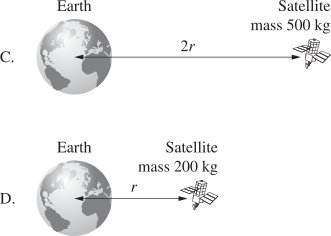
In which of the following would the satellite have the greatest escape velocity from Earth?


Show Answers Only

`D`

Show Worked Solution
  • `v_(esc)=sqrt((2GM)/(r))`
  • escape velocity is independent of the satellite’s mass
  • `v_(esc) prop (1)/(sqrt(r))`
  • the smaller the radius, the higher the required escape velocity

`=>D`

Filed Under: Motion in Gravitational Fields Tagged With: Band 4, smc-3692-70-Escape Velocity

Copyright © 2014–2025 SmarterEd.com.au · Log in