SmarterEd

Aussie Maths & Science Teachers: Save your time with SmarterEd

  • Login
  • Get Help
  • About

PHYSICS, M8 2025 HSC 30

A beam of electrons travelling at \(4 \times 10^3 \ \text{m s}^{-1}\) exits an electron gun and is directed toward two narrow slits with a separation, \(d\), of 1 \(\mu\text{m}\). The resulting interference pattern is detected on a screen 50 cm from the slits.

  1. Show that the wavelength of the electrons in this experiment is 182 nm.   (2 marks)

    --- 4 WORK AREA LINES (style=lined) ---

  2. An interference fringe occurs on the screen where constructive interference takes place.
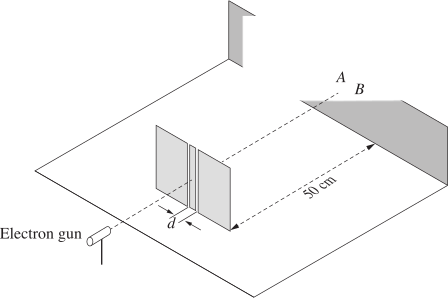
     

  1. Determine the distance between the central interference fringe \(A\) and the centre of the next bright fringe \(B\).   (2 marks)

    --- 4 WORK AREA LINES (style=lined) ---

  2. Determine the potential difference acting in the electron gun to accelerate the electrons in the beam from rest to \(4 \times 10^3 \ \text{m s}^{-1}\).   (2 marks)

    --- 4 WORK AREA LINES (style=lined) ---
Show Answers Only

a.    \(\text {Using} \ \ \lambda=\dfrac{h}{m v}:\)

\(\lambda=\dfrac{6.626 \times 10^{-34}}{9.109 \times 10^{-31} \times 4 \times 10^3}=1.82 \times 10^{-7} \ \text{m}=182 \ \text{nm}\)

b.    \(x=9.1 \ \text{cm}\)

c.    \(V=4.5 \times 10^{-5} \ \text{V}\)

Show Worked Solution

a.    \(\text {Using} \ \ \lambda=\dfrac{h}{m v}:\)

\(\lambda=\dfrac{6.626 \times 10^{-34}}{9.109 \times 10^{-31} \times 4 \times 10^3}=1.82 \times 10^{-7} \ \text{m}=182 \ \text{nm}\)
 

b.    \(\text {Using}\ \ x=\dfrac{\lambda m L}{d}\)

\(\text{where} \ \ x=\text{distance between middle of adjacent bright spots}\)

\(x=\dfrac{182 \times 10^{-9} \times 1 \times 0.5}{1 \times 10^{-6}}=0.091 \ \text{m}=9.1 \ \text{cm}\)
 

c.    \(\text{Work done by field}=\Delta K=K_f-K_i\)

\(qV\) \(=\dfrac{1}{2} m v^2-0\)
\(V\) \(=\dfrac{m v^2}{2 q}=\dfrac{9.109 \times 10^{-31} \times\left(4 \times 10^3\right)^2}{2 \times 1.602 \times 10^{-19}}=4.5 \times 10^{-5} \ \text{V}\)

Filed Under: Charged Particles, Conductors and Electric/Magnetic Fields, Light: Wave Model, Quantum Mechanical Nature of the Atom Tagged With: Band 4, Band 5, smc-3693-35-Kinematic/Work Calcs, smc-3697-30-Double Slit Calcs, smc-3702-40-De Broglie

PHYSICS, M6 2022 VCE 3

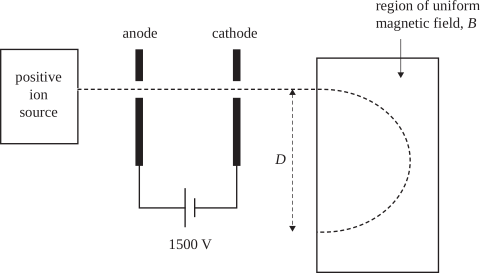
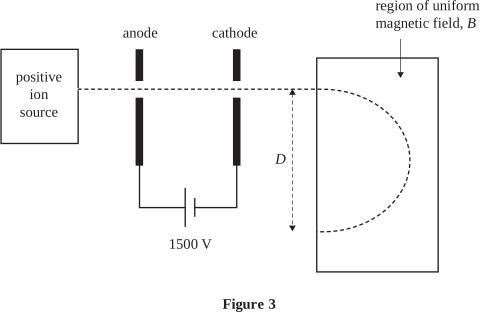
A schematic diagram of a mass spectrometer that is used to deflect charged particles to determine their mass is shown in the diagram. Positive singly charged ions (with a charge of +1.602 × 10\(^{-19}\) C) are produced at the ion source. These are accelerated between an anode and a cathode. The potential difference between the anode and the cathode is 1500 V. The ions pass into a region of uniform magnetic field, \(B\), and are directed by the field into a semicircular path of diameter \(D\).


  1. Calculate the increase in the kinetic energy of each ion as it passes between the anode and the cathode. Give your answer in joules.  (2 marks)

    --- 5 WORK AREA LINES (style=lined) ---
Each ion has a mass of 4.80 × 10\(^{-27}\) kg.

  1. Show that each ion has a speed of 3.16 × 10\(^{5}\) m s\(^{-1}\) when it exits the cathode. Assume that the ion leaves the ion source with negligible speed. Show your working.  (2 marks)

--- 6 WORK AREA LINES (style=lined) ---
  1. The region of uniform magnetic field, \(B\), in Figure 3 has a magnitude of 0.10 T.
  2. Calculate the diameter, \(D\), of the semicircular path followed by the ions within the magnetic field in Figure 3.  (3 marks)

    --- 7 WORK AREA LINES (style=lined) ---
Show Answers Only

a.    \(2.403 \times 10^{-16}\ \text{J}\)

b.     \(\Delta KE\) \(=\dfrac{1}{2}mv^2\)
  \(v\) \(=\sqrt{\dfrac{2 \Delta KE}{m}}\)
    \(=\sqrt{\dfrac{2 \times 2.403 \times 10^{-16}}{4.80 \times 10^{-27}}}\)
    \(=3.16 \times 10^5\ \text{ms}^{-1}\)

c.    \(0.19\ \text{m}\)

Show Worked Solution
a.    \(W=\Delta KE=qV=1.602 \times 10^{-19} \times 1500=2.403 \times 10^{-16}\ \text{J}\)
  
b.     \(\Delta KE\) \(=\dfrac{1}{2}mv^2\)
  \(v\) \(=\sqrt{\dfrac{2 \Delta KE}{m}}\)
    \(=\sqrt{\dfrac{2 \times 2.403 \times 10^{-16}}{4.80 \times 10^{-27}}}\)
    \(=3.16 \times 10^5\ \text{ms}^{-1}\)


c.     \(F_B\) \(=F_c\)
  \(qvB\) \(=\dfrac{mv^2}{r}\)
  \(r\) \(=\dfrac{mv}{qB}\)
    \(=\dfrac{4.80 \times 10^{-27} \times 3.16 \times 10^5}{1.602 \times 10^{-19} \times 0.10}\)
    \(=0.095\ \text{m}\)

 
\(\therefore\ D=0.19\ \text{m}\)

Filed Under: Charged Particles, Conductors and Electric/Magnetic Fields Tagged With: Band 4, smc-3693-18-Combination EF and MF, smc-3693-35-Kinematic/Work Calcs

PHYSICS, M6 2023 HSC 12 MC

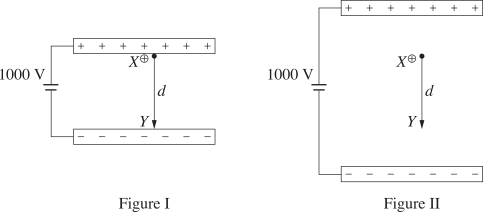
Figure \(\text{I}\) shows a positively charged particle accelerating freely from \(X\) to \(Y\), between oppositely charged plates. The change in the particle's kinetic energy is \(W\).

The distance between the plates is then doubled as shown in Figure \(\text{II}\) . The same charge accelerates from rest over the same distance from \(X\) to \(Y\).
 

What is the change in kinetic energy of the positively charged particle shown in Figure \(\text{II}\) ?

  1. \(W\)
  2. \(\dfrac{W}{2}\)
  3. \(\sqrt{W}\)
  4. \(2 W\)

Show Answers Only

\(B\)

Show Worked Solution
  • In Figure \(\text{I}\):  \( W= qEd\)  and  \( E=\dfrac{1000V}{d} \)
  •    \(W=\dfrac{1000qVd}{d}=1000qV\)
  • In Figure \(\text{II}\):  \( \Delta \text{KE} =qEd\)  and  \( E=\dfrac{1000V}{2d} \)
  •    \(\Delta \text{KE}=\dfrac{1000qVd}{2d}= \dfrac{1}{2} \times 1000qV= \dfrac{W}{2}\)

\(\Rightarrow B\)

♦ Mean mark 55%.

Filed Under: Charged Particles, Conductors and Electric/Magnetic Fields Tagged With: Band 5, smc-3693-10-Charged Particles in EF, smc-3693-35-Kinematic/Work Calcs

PHYSICS, M6 EQ-Bank 24

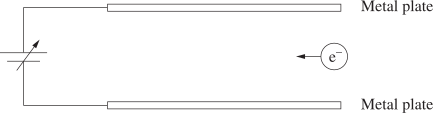
Negatively charged particles were accelerated from rest between a pair of parallel metal plates. The potential difference between the plates was varied, and the final velocity of the particles was measured for each variation.
 

The data in the table show the potential difference between the plates and the square of the corresponding final velocity of the particles.

\begin{array}{|c|c|}
\hline
\rule{0pt}{2.5ex}\textit{Potential difference}\ \text{(V)} \rule[-1ex]{0pt}{0pt}&\quad v^2\left(\times 10^9 \, \text{m}^2\, \text{s}^{-2}\right) \quad \\
\hline
\rule{0pt}{2.5ex}100\rule[-1ex]{0pt}{0pt}&0.8\\
\hline
\rule{0pt}{2.5ex}200\rule[-1ex]{0pt}{0pt}& 2.1\\
\hline
\rule{0pt}{2.5ex}300\rule[-1ex]{0pt}{0pt}& 3.1 \\
\hline
\rule{0pt}{2.5ex}400\rule[-1ex]{0pt}{0pt}& 4.1 \\
\hline
\rule{0pt}{2.5ex}500\rule[-1ex]{0pt}{0pt}& 5.2 \\
\hline
\end{array}

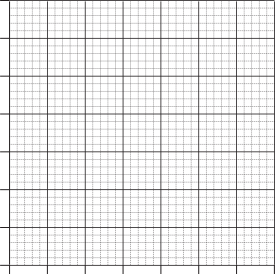
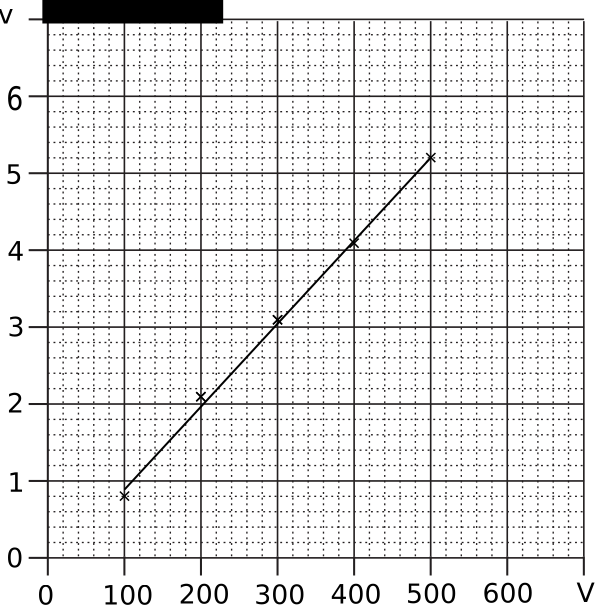
  1. Plot the data on the grid provided and draw a line of best fit.


--- 0 WORK AREA LINES (style=lined) ---
  1. A student hypothesised that the charged particles are electrons. Justify whether the student's hypothesis is correct or not. Support your answer using the data provided and relevant calculations.

    --- 10 WORK AREA LINES (style=lined) ---
Show Answers Only

a.   


b.    The gradient of the line = `(v^2)/(V)`

Calculate the gradient (choose values close to limits):

`text{gradient}` `=((5.2-0.9) xx10^(9))/(500-100)`  
  `=1.1 xx10^7  text{m}^2  text{s}^(-2)  text{V}^(-1)`  

 
The change in kinetic energy is equal to the work done by the electric field on the charged particles:

`W` `=Delta K`  
`qV` `=(1)/(2)mv^2`  
`(V^2)/(v)` `=(2q)/(m)`  

 
Charge to mass ratio of the particles:

`(q)/(m)` `=(V^2)/(2v)`  
  `=(text{gradient})/(2)`  
  `=5.4 xx10^6  text{C kg}^(-1)`  

 
 Charge to mass ratio of an electron:

`(q)/(m)` `=(1.602 xx10^(-19))/(9.109 xx10^(-31))`  
  `=1.8 xx10^(11)  text{C kg}^(-1)`  

  
Therefore, the charged particles are not electrons.

Show Worked Solution

a.   


b.    The gradient of the line = `(v^2)/(V)`

Calculate the gradient (choose values close to limits):

`text{gradient}` `=((5.2-0.9) xx10^(9))/(500-100)`  
  `=1.1 xx10^7  text{m}^2  text{s}^(-2)  text{V}^(-1)`  

 
The change in kinetic energy is equal to the work done by the electric field on the charged particles:

`W` `=Delta K`  
`qV` `=(1)/(2)mv^2`  
`(V^2)/(v)` `=(2q)/(m)`  

 
Charge to mass ratio of the particles:

`(q)/(m)` `=(V^2)/(2v)`  
  `=(text{gradient})/(2)`  
  `=5.4 xx10^6  text{C kg}^(-1)`  

 
 Charge to mass ratio of an electron:

`(q)/(m)` `=(1.602 xx10^(-19))/(9.109 xx10^(-31))`  
  `=1.8 xx10^(11)  text{C kg}^(-1)`  

  
Therefore, the charged particles are not electrons.

Filed Under: Charged Particles, Conductors and Electric/Magnetic Fields Tagged With: Band 3, Band 5, smc-3693-20-EF Strength, smc-3693-35-Kinematic/Work Calcs

PHYSICS, M6 2015 HSC 24

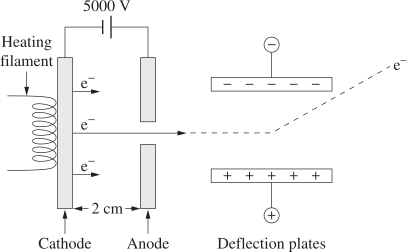
A part of a cathode ray oscilloscope was represented on a website as shown.
 

Electrons leave the cathode and are accelerated towards the anode.

  1. Explain why the representation of the path of the electron between the deflection plates is inaccurate.   (3 marks)

    --- 7 WORK AREA LINES (style=lined) ---
  1. Calculate the force on an electron due to the electric field between the cathode and the anode.   (2 marks)

    --- 6 WORK AREA LINES (style=lined) ---

  1. Calculate the velocity of an electron as it reaches the anode.   (2 marks)

    --- 6 WORK AREA LINES (style=lined) ---

Show Answers Only

a.    Inaccuracies include:

  • The electron is shown to travel towards the negative plate. This is inaccurate as the electron is a negatively charged particle so will be attracted towards the positive plate.
  • The electron is shown to only deflect once it has travelled halfway through the plates. This is inaccurate as the plate will deflect the electron immediately after it enters the uniform electric field. 
  • The electron is shown to follow a straight path. This is inaccurate as the electron has a constant acceleration towards the positive plate and a constant horizontal velocity, it will follow a parabolic path.

b.   `F=4xx10^(-14)  text{N}`

c.   `v=4.19 xx10^(7)  text{ms}^(-1)`

Show Worked Solution

a.    Inaccuracies include:

  • The electron is shown to travel towards the negative plate. This is inaccurate as the electron is a negatively charged particle so will be attracted towards the positive plate.
  • The electron is shown to only deflect once it has travelled halfway through the plates. This is inaccurate as the plate will deflect the electron immediately after it enters the uniform electric field. 
  • The electron is shown to follow a straight path. This is inaccurate as the electron has a constant acceleration towards the positive plate and a constant horizontal velocity, it will follow a parabolic path. 

b.    Using  `E=(F)/(q)`  and  `E=(V)/(d):`

`(F)/(q)` `=(V)/(d)`  
`F` `=(Vq)/(d)`  
  `=(5000 xx1.6 xx10^(-19))/(0.02)`  
  `=4xx10^(-14)  text{N}`  

 
c.
    `a=(F)/(m)=(4xx10^(-14))/(9.1 xx10^(-31))=4.4 xx10^(16)  text{ms}^(-1)`
 

`v^(2)` `=u^(2)+2as`  
`:.v` `=sqrt(2xx4.4 xx10^(16)xx0.02)`  
  `=4.19 xx10^(7)  text{ms}^(-1)`  

♦♦♦ Mean mark (c) 20%.

Filed Under: Charged Particles, Conductors and Electric/Magnetic Fields Tagged With: Band 4, Band 6, smc-3693-10-Charged Particles in EF, smc-3693-35-Kinematic/Work Calcs, smc-3693-80-X-Topic: Projectile motion

PHYSICS, M6 2020 HSC 34

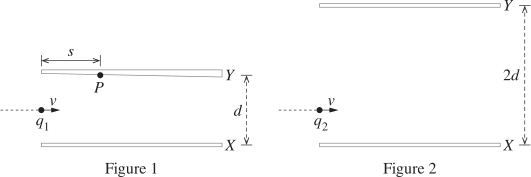
A charged particle, `q_1`, is fired midway between oppositely charged plates `X` and `Y`, as shown in Figure 1. The voltage between the plates is `V` volts.

The particle strikes plate `Y` at point `P`, a horizontal distance `s` from the edge of the plate. Ignore the effect of gravity.
 

Plate `Y` is then moved to the position shown in Figure 2, with the voltage between the plates remaining the same.

An identical particle, `q_2`, is fired into the electric field at the same velocity, entering the field at the same distance from plate `X` as `q_1`.

  1. Compare the work done on `q_1` and `q_2`.   (3 marks)

    --- 8 WORK AREA LINES (style=lined) ---

  1. Compare the horizontal distances travelled by `q_1` and `q_2` in the electric field.   (3 marks)

    --- 12 WORK AREA LINES (style=lined) ---

Show Answers Only

a.   The work done on `q_2` is `(3)/(2)` times that done on `q_1`.

b.   The horizontal distance travelled by `q_2` is `sqrt(6)` times that of `q_1`.

Show Worked Solution

a.   Work done on `q_1:`

  `W=qE((d)/(2))` … (1)

Substitute  `E=(V)/(d)`  into (1)

  `W=(qV)/2`

 
Work done on `q_2:`

  `W=qE((3d)/(2))` … (1)

Substitute  `E=(V)/(2d)`  into (1)

  `W=(3qV)/4`

  `(2) -: (1):`

  `(W_(2))/(W_(1))=(((3qV)/(4)))/(((qV)/(2)))=(3)/(2)`

  • The work done on `q_2` is `3/2` times that done on `q_1`.
♦ Mean mark (a) 47%.

b.   Find the vertical acceleration of `q_1:`

`F` `=qE=(qV)/(d)`
`a` `=(F)/(m)=(qV)/(dm)` … (1)

 
Similarly for `q_2:` 

`F` `=qE=(qV)/(2d)`
`a` `=(F)/(m)=(qV)/(2dm)` … (2)
     
  • The initial horizontal velocity is the same for both `q_1` and `q_2`
  • The horizontal distance travelled by both is proportional to the time taken for them to reach the plate.
  • `s_(y)=u_(y)t+(1)/(2)a_(y)t^(2)=(1)/(2)a_(y)t^(2)`  (initial vertical velocity = 0 for both)
     

Time for `q_1` to reach plate `Y:` 

`s_(y)` `=(1)/(2)a_(y)t^(2)`  
`(d)/(2)` `=(1)/(2)((qV)/(dm))t^(2)`    from (1)
`t^(2)` `=(d^(2)m)/(qV)`  
`t` `=sqrt((d^(2)m)/(qV))` …   (3)

 
Time taken for `q_2` to reach plate `Y:` 

`s_(y)` `=(1)/(2)a_(y)t^(2)`  
`(3d)/(2)` `=(1)/(2)((qV)/(2dm))t^(2)`    from (2)
`t^(2)` `=(6d^(2)m)/(qV)`  
`t` `=sqrt((6d^(2)m)/(qV))` …   (4)

 
  `(4) -: (3):`

`(t_(2))/(t_(1))=(sqrt((6d^(2)m)/(qV)))/(sqrt((d^(2)m)/(qV)))=sqrt(6)`

  • The time taken for `q_2` to reach plate `Y` is `sqrt(6)` times that taken for `q_1`.
  • The horizontal distance travelled by `q_2` is `sqrt(6)` times that of `q_1`.
♦ Mean mark (b) 43%.

Filed Under: Charged Particles, Conductors and Electric/Magnetic Fields, Projectile Motion Tagged With: Band 5, smc-3690-25-Range, smc-3690-95-X-Topic: Charged particles, smc-3693-10-Charged Particles in EF, smc-3693-35-Kinematic/Work Calcs, smc-3693-80-X-Topic: Projectile motion

PHYSICS, M6 2019 HSC 29

A particle having mass `m` and charge `q` is accelerated from rest through a potential difference `V`. Assume that the only force acting on the particle is due to the electric field associated with this potential difference.

Show that the final velocity of the particle is given by  `v = sqrt((2qV)/m)`.   (3 marks)

--- 5 WORK AREA LINES (style=lined) ---

Show Answers Only
`W` `=Delta E_(k)`  
  `=(1)/(2)mv^2-(1)/(2)m u^2`  
  `=(1)/(2)mv^2` `(u=0)`
`qV` `=(1)/(2)mv^2` `(W=qV)`
`v^2` `=(2qV)/m`  
`∴v` `=sqrt((2qV)/(m))`  
Show Worked Solution

The work done on the particle is equal to its change in its kinetic energy:

`W` `=Delta E_(k)`  
  `=(1)/(2)mv^2-(1)/(2)m u^2`  
  `=(1)/(2)mv^2` `(u=0)`
`qV` `=(1)/(2)mv^2` `(W=qV)`
`v^2` `=(2qV)/m`  
`∴v` `=sqrt((2qV)/(m))`  

Filed Under: Charged Particles, Conductors and Electric/Magnetic Fields Tagged With: Band 4, smc-3693-35-Kinematic/Work Calcs

PHYSICS, M6 2021 HSC 30

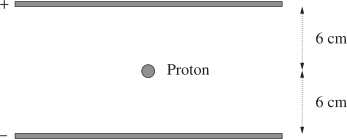
In an experiment, a proton accelerates from rest between parallel charged plates. The spacing of the plates is 12 cm and the proton is initially positioned at an equal distance from both plates, as shown. Ignore the effect of gravity.
 

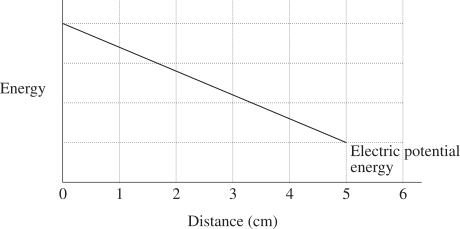
  1. The electrical potential energy of the proton is recorded in the following graph for the first 5 cm of its motion.
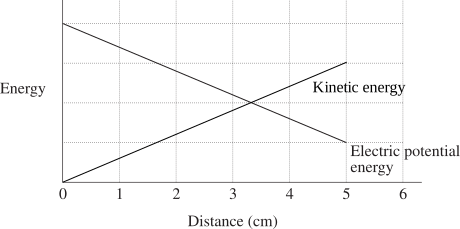
  2. On the graph, sketch the corresponding kinetic energy of the proton over the same distance.   (2 marks)


--- 0 WORK AREA LINES (style=lined) ---

  1. The experiment is repeated using an electron in the place of the proton.
  2. Explain how the motion of the electron would differ from that of the proton.    (3 marks)

    --- 6 WORK AREA LINES (style=lined) ---

Show Answers Only

a.   
           
        
b.   Motions differs from proton motion:

  • The electron will move in the opposite direction to the proton as the sign of its charge is opposite.
  • The electron will experience a force equal in magnitude to the proton as its charge has the same magnitude.
  • Since the mass of the electron is significantly smaller, it will experience a much greater acceleration compared to the proton.
Show Worked Solution

a.   


b.   Motions differs from proton motion:

  • The electron will move in the opposite direction to the proton as the sign of its charge is opposite.
  • The electron will experience a force equal in magnitude to the proton as its charge has the same magnitude.
  • Since the mass of the electron is significantly smaller, it will experience a much greater acceleration compared to the proton.

Filed Under: Charged Particles, Conductors and Electric/Magnetic Fields Tagged With: Band 4, smc-3693-10-Charged Particles in EF, smc-3693-35-Kinematic/Work Calcs

Copyright © 2014–2025 SmarterEd.com.au · Log in