SmarterEd

Aussie Maths & Science Teachers: Save your time with SmarterEd

  • Login
  • Get Help
  • About

PHYSICS, M6 2024 HSC 28

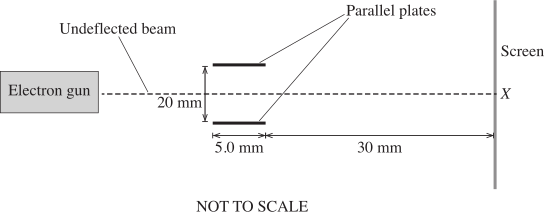
An electron gun fires a beam of electrons at 2.0 × 10\(^6\) m s\(^{-1}\) through a pair of parallel charged plates towards a screen that is 30 mm from the end of the plates as shown.

There is a uniform electric field between the plates of 1.5 × 10\(^4\) N C\(^{-1}\). The plates are 5.0 mm wide and 20 mm apart. The electron beam enters mid-way between the plates. \(X\) marks the spot on the screen where an undeflected beam would strike.

Ignore gravitational effects on the electron beam.


  1. Show that the acceleration of an electron between the parallel plates is 2.6 × 10\(^{15}\) m s\(^{-2}\).   (2 marks)

    --- 4 WORK AREA LINES (style=lined) ---

  2. Show that the vertical displacement of the electron beam at the end of the parallel plates is approximately 8.1 mm.   (2 marks)

    --- 4 WORK AREA LINES (style=lined) ---

  3. How far from point \(X\) will the electron beam strike the screen?   (3 marks)

    --- 6 WORK AREA LINES (style=lined) ---
Show Answers Only

a.   \(\text{Using}\ \ F=qE\ \ \text{and}\ \ F=ma:\)

  \(a=\dfrac{qE}{m} = \dfrac{1.5 \times 10^{4} \times 1.602 \times 10^{-19}}{9.109 \times 10^{-31}} = 2.6 \times 10^{15}\ \text{m s}^{-2} \)
 

b.  \(\text{Time of beam between the plates:}\)

\(\text{Horizontal velocity}\ (v)\ = 2 \times 10^{6}\ \text{m s}^{-1} \)

\(\text{Distance to screen}\ (s)\ = 5.0\ \text{mm}\ = \dfrac{5}{1000} = 0.005\ \text{m}\)

  \(t=\dfrac{s}{v} = \dfrac{0.005}{2 \times 10^{6}} = 2.5 \times 10^{-9}\ \text{s} \)
 

\(\text{Find vertical displacement at end of plates:}\)

  \(s=\dfrac{1}{2} at^{2} = 0.5 \times 2.6 \times 10^{15} \times (2.5 \times 10^{-9})^{2} = 0.008125\ \text{m}\ = 8.1\ \text{mm} \)
 

c.   \(\text{Find vertical velocity of beam when leaving the plates:}\)

  \(v=at=2.6 \times 10^{15} \times 2.5 \times 10^{-9} = 6.5 \times 10^{6}\ \text{m s}^{-1} \)
 

\(\text{Time for beam to hit screen:}\)

\(\text{Distance to screen}\ (s)\ = 30\ \text{mm}\ = \dfrac{30}{1000} = 0.03\ \text{m}\)

  \(t=\dfrac{s}{v} = \dfrac{0.03}{2 \times 10^{6}} = 1.5 \times 10^{-8}\ \text{s} \)
 

\(\text{Vertical displacement (from end of plates):}\)

  \(s=vt=6.5 \times 10^{6} \times 1.5 \times 10^{-8} = 0.0975\ \text{m} \)
 

\(\text{Distance from}\ X = 0.0081 + 0.0975 = 0.11\ \text{m} \)

Show Worked Solution

a.   \(\text{Using}\ \ F=qE\ \ \text{and}\ \ F=ma:\)

  \(a=\dfrac{qE}{m} = \dfrac{1.5 \times 10^{4} \times 1.602 \times 10^{-19}}{9.109 \times 10^{-31}} = 2.6 \times 10^{15}\ \text{m s}^{-2} \)
 

b.  \(\text{Time of beam between the plates:}\)

\(\text{Horizontal velocity}\ (v)\ = 2 \times 10^{6}\ \text{m s}^{-1} \)

\(\text{Distance to screen}\ (s)\ = 5.0\ \text{mm}\ = \dfrac{5}{1000} = 0.005\ \text{m}\)

  \(t=\dfrac{s}{v} = \dfrac{0.005}{2 \times 10^{6}} = 2.5 \times 10^{-9}\ \text{s} \)
 

\(\text{Find vertical displacement at end of plates:}\)

  \(s=\dfrac{1}{2} at^{2} = 0.5 \times 2.6 \times 10^{15} \times (2.5 \times 10^{-9})^{2} = 0.008125\ \text{m}\ = 8.1\ \text{mm} \)
 

c.   \(\text{Find vertical velocity of beam when leaving the plates:}\)

  \(v=at=2.6 \times 10^{15} \times 2.5 \times 10^{-9} = 6.5 \times 10^{6}\ \text{m s}^{-1} \)
 

\(\text{Time for beam to hit screen:}\)

\(\text{Distance to screen}\ (s)\ = 30\ \text{mm}\ = \dfrac{30}{1000} = 0.03\ \text{m}\)

  \(t=\dfrac{s}{v} = \dfrac{0.03}{2 \times 10^{6}} = 1.5 \times 10^{-8}\ \text{s} \)
 

\(\text{Vertical displacement (from end of plates):}\)

  \(s=vt=6.5 \times 10^{6} \times 1.5 \times 10^{-8} = 0.0975\ \text{m} \)
 

\(\text{Distance from}\ X = 0.0081 + 0.0975 = 0.11\ \text{m} \)

♦ Mean mark (c) 40%.

Filed Under: Charged Particles, Conductors and Electric/Magnetic Fields, Projectile Motion Tagged With: Band 3, Band 4, Band 5, smc-3690-40-Vertical Displacement, smc-3690-95-X-Topic: Charged particles, smc-3693-10-Charged Particles in EF, smc-3693-80-X-Topic: Projectile motion

PHYSICS, M6 2015 HSC 24

A part of a cathode ray oscilloscope was represented on a website as shown.
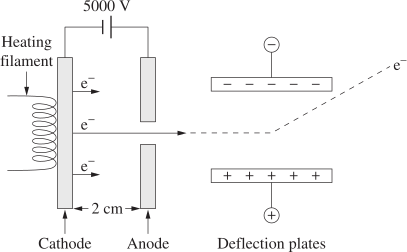
 

Electrons leave the cathode and are accelerated towards the anode.

  1. Explain why the representation of the path of the electron between the deflection plates is inaccurate.   (3 marks)

    --- 7 WORK AREA LINES (style=lined) ---

  1. Calculate the force on an electron due to the electric field between the cathode and the anode.   (2 marks)

    --- 6 WORK AREA LINES (style=lined) ---

  1. Calculate the velocity of an electron as it reaches the anode.   (2 marks)

    --- 6 WORK AREA LINES (style=lined) ---

Show Answers Only

a.    Inaccuracies include:

  • The electron is shown to travel towards the negative plate. This is inaccurate as the electron is a negatively charged particle so will be attracted towards the positive plate.
  • The electron is shown to only deflect once it has travelled halfway through the plates. This is inaccurate as the plate will deflect the electron immediately after it enters the uniform electric field. 
  • The electron is shown to follow a straight path. This is inaccurate as the electron has a constant acceleration towards the positive plate and a constant horizontal velocity, it will follow a parabolic path.

b.   `F=4xx10^(-14)  text{N}`

c.   `v=4.19 xx10^(7)  text{ms}^(-1)`

Show Worked Solution

a.    Inaccuracies include:

  • The electron is shown to travel towards the negative plate. This is inaccurate as the electron is a negatively charged particle so will be attracted towards the positive plate.
  • The electron is shown to only deflect once it has travelled halfway through the plates. This is inaccurate as the plate will deflect the electron immediately after it enters the uniform electric field. 
  • The electron is shown to follow a straight path. This is inaccurate as the electron has a constant acceleration towards the positive plate and a constant horizontal velocity, it will follow a parabolic path. 

b.    Using  `E=(F)/(q)`  and  `E=(V)/(d):`

`(F)/(q)` `=(V)/(d)`  
`F` `=(Vq)/(d)`  
  `=(5000 xx1.6 xx10^(-19))/(0.02)`  
  `=4xx10^(-14)  text{N}`  

 
c.
    `a=(F)/(m)=(4xx10^(-14))/(9.1 xx10^(-31))=4.4 xx10^(16)  text{ms}^(-1)`
 

`v^(2)` `=u^(2)+2as`  
`:.v` `=sqrt(2xx4.4 xx10^(16)xx0.02)`  
  `=4.19 xx10^(7)  text{ms}^(-1)`  

♦♦♦ Mean mark (c) 20%.

Filed Under: Charged Particles, Conductors and Electric/Magnetic Fields Tagged With: Band 4, Band 6, smc-3693-10-Charged Particles in EF, smc-3693-35-Kinematic/Work Calcs, smc-3693-80-X-Topic: Projectile motion

PHYSICS, M6 2020 HSC 34

A charged particle, `q_1`, is fired midway between oppositely charged plates `X` and `Y`, as shown in Figure 1. The voltage between the plates is `V` volts.

The particle strikes plate `Y` at point `P`, a horizontal distance `s` from the edge of the plate. Ignore the effect of gravity.
 

Plate `Y` is then moved to the position shown in Figure 2, with the voltage between the plates remaining the same.

An identical particle, `q_2`, is fired into the electric field at the same velocity, entering the field at the same distance from plate `X` as `q_1`.

  1. Compare the work done on `q_1` and `q_2`.   (3 marks)

    --- 8 WORK AREA LINES (style=lined) ---

  1. Compare the horizontal distances travelled by `q_1` and `q_2` in the electric field.   (3 marks)

    --- 12 WORK AREA LINES (style=lined) ---

Show Answers Only

a.   The work done on `q_2` is `(3)/(2)` times that done on `q_1`.

b.   The horizontal distance travelled by `q_2` is `sqrt(6)` times that of `q_1`.

Show Worked Solution

a.   Work done on `q_1:`

  `W=qE((d)/(2))` … (1)

Substitute  `E=(V)/(d)`  into (1)

  `W=(qV)/2`

 
Work done on `q_2:`

  `W=qE((3d)/(2))` … (1)

Substitute  `E=(V)/(2d)`  into (1)

  `W=(3qV)/4`

  `(2) -: (1):`

  `(W_(2))/(W_(1))=(((3qV)/(4)))/(((qV)/(2)))=(3)/(2)`

  • The work done on `q_2` is `3/2` times that done on `q_1`.
♦ Mean mark (a) 47%.

b.   Find the vertical acceleration of `q_1:`

`F` `=qE=(qV)/(d)`
`a` `=(F)/(m)=(qV)/(dm)` … (1)

 
Similarly for `q_2:` 

`F` `=qE=(qV)/(2d)`
`a` `=(F)/(m)=(qV)/(2dm)` … (2)
     
  • The initial horizontal velocity is the same for both `q_1` and `q_2`
  • The horizontal distance travelled by both is proportional to the time taken for them to reach the plate.
  • `s_(y)=u_(y)t+(1)/(2)a_(y)t^(2)=(1)/(2)a_(y)t^(2)`  (initial vertical velocity = 0 for both)
     

Time for `q_1` to reach plate `Y:` 

`s_(y)` `=(1)/(2)a_(y)t^(2)`  
`(d)/(2)` `=(1)/(2)((qV)/(dm))t^(2)`    from (1)
`t^(2)` `=(d^(2)m)/(qV)`  
`t` `=sqrt((d^(2)m)/(qV))` …   (3)

 
Time taken for `q_2` to reach plate `Y:` 

`s_(y)` `=(1)/(2)a_(y)t^(2)`  
`(3d)/(2)` `=(1)/(2)((qV)/(2dm))t^(2)`    from (2)
`t^(2)` `=(6d^(2)m)/(qV)`  
`t` `=sqrt((6d^(2)m)/(qV))` …   (4)

 
  `(4) -: (3):`

`(t_(2))/(t_(1))=(sqrt((6d^(2)m)/(qV)))/(sqrt((d^(2)m)/(qV)))=sqrt(6)`

  • The time taken for `q_2` to reach plate `Y` is `sqrt(6)` times that taken for `q_1`.
  • The horizontal distance travelled by `q_2` is `sqrt(6)` times that of `q_1`.
♦ Mean mark (b) 43%.

Filed Under: Charged Particles, Conductors and Electric/Magnetic Fields, Projectile Motion Tagged With: Band 5, smc-3690-25-Range, smc-3690-95-X-Topic: Charged particles, smc-3693-10-Charged Particles in EF, smc-3693-35-Kinematic/Work Calcs, smc-3693-80-X-Topic: Projectile motion

Copyright © 2014–2025 SmarterEd.com.au · Log in