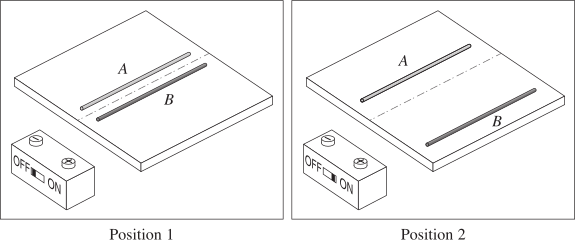
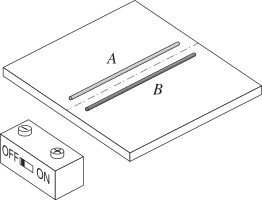
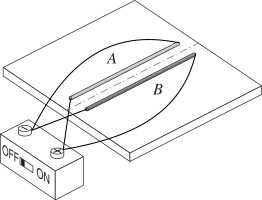
Two horizontal metal rods, \(A\) and \(B\), of different materials are resting on a frictionless table. Initially they are at rest in position 1. Both rods are then connected to a battery using wires. After the switch is turned on, currents of different magnitude flow in each rod. The rods move to position 2 after time, \(t\). In position 2, \(B\) has a larger displacement than \(A\) from position 1. The masses of the wires are negligible. --- 0 WORK AREA LINES (style=lined) --- --- 8 WORK AREA LINES (style=lined) --- a. b. Evaluate statement: Position 2 results from the larger current in rod \(A\), causing a larger force to act on rod \(B\). b. Evaluate statement: Position 2 results from the larger current in rod \(A\), causing a larger force to act on rod \(B\).
PHYSICS, M6 2023 HSC 16 MC
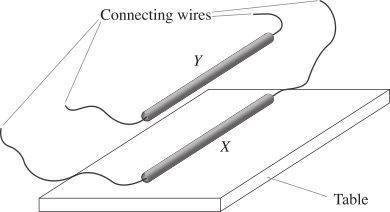
In a thought experiment, two identical parallel aluminium rods, \(X\) and \(Y\), are carrying electric currents of equal magnitude. Rod \(X\) rests on a table. Rod \(Y\) remains stationary, vertically above \(X\), as a result of the magnetic interaction. The masses of the connecting wires are negligible.
Which statement must be correct if rod \( Y\) is stationary?
- The magnetic force acting on \(X\) is upward.
- The currents through \(X\) and \(Y\) are in the same direction.
- The force the table exerts on \(X\) is equal and opposite to the total weight of \(X\) and \(Y\).
- The force the table exerts on \(X\) is equal and opposite to the force of gravity acting on \(Y\).
PHYSICS, M6 EQ-Bank 9 MC
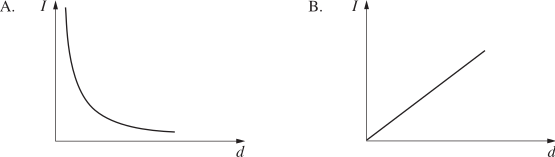
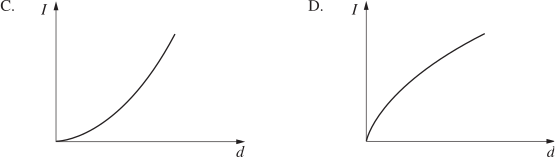
Two parallel conducting rods are connected by a wire as shown and carry current `I`. They are separated by distance `d` and repel each other with a force `F`.

Which graph best shows how the current `I` would need to be varied with distance `d` to keep the force `F` constant?
PHYSICS, M6 EQ-Bank 2 MC
A student performed an experiment using two identical, current-carrying metal rods connected to a power supply. Rod `A` was placed at different distances from Rod `B`, and the measurements on the electronic balance were recorded.

What is the dependent variable in this experiment?
- The current in `A`
- The length of the rods
- The mass recorded on the balance
- The distance between the two rods
PHYSICS, M6 2015 HSC 9 MC
`P`, `Q` and `R` are straight, current-carrying conductors. They all carry currents of the same magnitude `(I)`. Conductors `P` and `Q` are fixed in place. The magnitude of the force between conductors `Q` and `R` is `F` newtons.

What is the net force on conductor `R` when it is in the position shown?
- `(F)/2` newtons to the left
- `(F)/2` newtons to the right
- `(3F)/2` newtons to the left
- `(3F)/2` newtons to the right
PHYSICS, M6 2017 HSC 16 MC
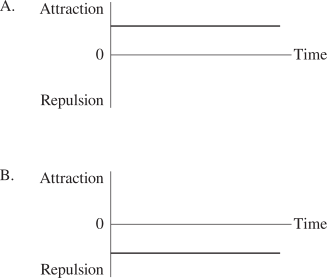
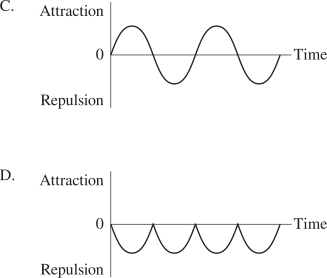
An AC supply is connected to a light bulb by two long parallel conductors as shown.

Which graph shows the variation over time of the magnetic force between the two conductors?
PHYSICS, M6 2018 HSC 24b
Three parallel wires `X`, `Y` and `Z` all carry electric currents. A force of attraction is produced between `Y` and `Z`. There is zero net force on `Y`.
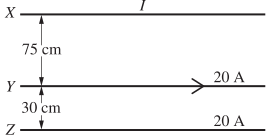
What is the magnitude and direction of the current in `X` ? (3 marks)
--- 9 WORK AREA LINES (style=lined) ---
PHYSICS M6 2022 HSC 15 MC
Two wires separated by a distance, `d`, carry equal electric currents producing a magnetic force between them.
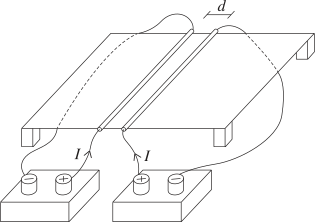
The separation between the wires is increased to `4 d` and the current in each wire is doubled.
What happens to the magnetic force between the wires, compared to the original force?
- It does not change.
- It increases by a factor of 4 .
- It decreases by a factor of 4 .
- It decreases by a factor of 8 .
PHYSICS, M6 2020 HSC 14 MC
Two parallel wires, `X` and `Y`, each carry a current `I`.

The magnitude and direction of the force on wire `Y` are represented by the vector `F`.
The current in wire `Y` is then doubled and its direction is reversed. The current in wire `X` remains unchanged.
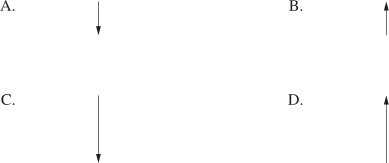
Which vector arrow represents the force on wire `X` after the change to the current in wire `Y`?
PHYSICS, M6 2021 HSC 17 MC
Two long, parallel conductors `X` and `Y` are connected to a light bulb and an AC power supply. The conductors are suspended horizontally from fixed points using sensitive spring balances. `X` is positioned directly below `Y`.

Which statement correctly compares the forces measured by the spring balances?
- The forces measured on `X` and `Y` will always be equal.
- The force measured on `Y` will be greater than or equal to that on `X`.
- The force measured on `X` will be greater than or equal to that on `Y`.
- There will be a continuous reversal of which measured force is greater.