SmarterEd

Aussie Maths & Science Teachers: Save your time with SmarterEd

  • Login
  • Get Help
  • About

PHYSICS, M6 2024 HSC 21

To tighten a nut, a force of 75 N is applied to a spanner at an angle, as shown.
 

  1. Calculate the magnitude of the torque produced by the applied force.   (2 marks)

    --- 4 WORK AREA LINES (style=lined) ---

  2. Explain TWO ways in which torque can be increased in a simple DC motor.   (4 marks)

    --- 10 WORK AREA LINES (style=lined) ---

Show Answers Only

a.    \(8.7\ \text{Nm  (2 sig.fig)}\)  

b.    Torque \((\tau=nIAB)\) in a simple DC motor can be increased as follows:

  • Increasing the current through the motor by increasing the voltage of the power source. This will increase the force on each arm of the motor due to the motor effect and increase the overall torque of the motor.
  • Increasing the number of coils in the DC motor. This will increase the torque as each individual coil will experience a force due to the motor effect. The forces on each coil will add together to increase the overall force on each arm of the motor increasing the torque of the motor.
  • Other answers could have included: increasing the area of the coil, increasing the strength of the external magnetic field by using electromagnets or adding a radial magnetic field as it increases the average torque applied to the motor.

Show Worked Solution

a.     \(\tau\) \(=Fr\sin\theta\)
    \(=75 \times 0.18 \times \sin 40\)
    \(=8.7\ \text{Nm  (2 sig.fig)}\)  


b.    Torque \((\tau=nIAB)\) in a simple DC motor can be increased as follows:

  • Increasing the current through the motor by increasing the voltage of the power source. This will increase the force on each arm of the motor due to the motor effect and increase the overall torque of the motor.
  • Increasing the number of coils in the DC motor. This will increase the torque as each individual coil will experience a force due to the motor effect. The forces on each coil will add together to increase the overall force on each arm of the motor increasing the torque of the motor.
  • Other answers could have included: increasing the area of the coil, increasing the strength of the external magnetic field by using electromagnets or adding a radial magnetic field as it increases the average torque applied to the motor.

Filed Under: Applications of the Motor Effect, Circular Motion Tagged With: Band 3, smc-3691-60-Torque, smc-3695-10-Torque

PHYSICS, M6 2024 HSC 4 MC

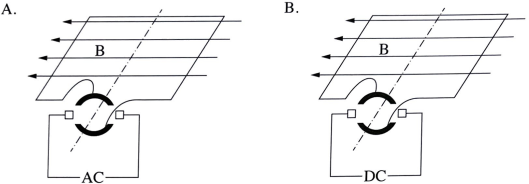
A conducting coil is mounted on an axle and placed in a uniform magnetic field. The diagram shows different ways of connecting the coil to a power source.

Which setup allows the conducting coil to rotate continuously?


Show Answers Only

\(D\)

Show Worked Solution
  • The split ring commutator is used in a DC motor to reverse the current in the arms every 180\(^{\circ}\) to ensure unidirectional torque.
  • Initially, the split ring commutator must be in contact with the carbon brushes to produce an electric current through the coil and the coil must lie in the horizontal plane so torque in produced.
  • Additionally, the split ring commutator should disconnect with the carbon brushes as the coil is vertically oriented. 

\(\Rightarrow D\)

Filed Under: Applications of the Motor Effect Tagged With: Band 4, smc-3695-10-Torque, smc-3695-30-DC motor components

PHYSICS, M6 2021 VCE 5 MC

The diagram below shows a small DC electric motor, powered by a battery that is connected via a split-ring commutator. The rectangular coil has sides KJ and LM. The magnetic field between the poles of the magnet is uniform and constant.
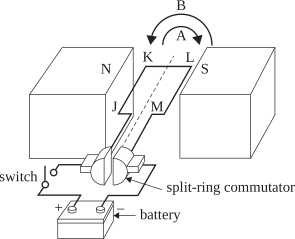
 

The switch is now closed, and the coil is stationary and in the position shown in the diagram.

Which one of the following statements best describes the motion of the coil when the switch is closed?

  1. The coil will remain stationary.
  2. The coil will rotate in direction A, as shown in the diagram.
  3. The coil will rotate in direction B, as shown in the diagram.
  4. The coil will oscillate regularly between directions A and B, as shown in the diagram.
Show Answers Only

\(C\)

Show Worked Solution
  • When the switch is closed, the current through the side \(JK\) will run from \(J\) to \(K\) and the direction magnetic field is to the right.
  • Using the Right hand rule, the force on side JK will be down and the coil will rotate in direction B (anti-clockwise).

\(\Rightarrow C\)

♦ Mean mark 51%.

Filed Under: Applications of the Motor Effect Tagged With: Band 5, smc-3695-10-Torque, smc-3695-30-DC motor components

PHYSICS, M6 2023 HSC 25b

Explain why the torque of a DC motor decreases as its rotational speed increases.   (2 marks)

--- 5 WORK AREA LINES (style=lined) ---

Show Answers Only

  • Torque in a simple DC motor can be calculated using  \(\tau=nIAB \sin\theta\).
  • Initially, the current through the coil of the motor is a maximum as the motor is stationary.
  • As the rotational speed of the motor begins to increase, there is a change of flux experienced through the coil of the motor which will induce an EMF in the coil (Faraday’s Law).
  • This induced back EMF will act to oppose the original EMF that produced it (Lenz’s Law).
  • Thus, the voltage through the coil will decrease which will decrease the current through the coil and the torque (\(\tau \propto I \)). 

Show Worked Solution

  • Torque in a simple DC motor can be calculated using  \(\tau=nIAB \sin\theta\).
  • Initially, the current through the coil of the motor is a maximum as the motor is stationary.
  • As the rotational speed of the motor begins to increase, there is a change of flux experienced through the coil of the motor which will induce an EMF in the coil (Faraday’s Law).
  • This induced back EMF will act to oppose the original EMF that produced it (Lenz’s Law).
  • Thus, the voltage through the coil will decrease which will decrease the current through the coil and the torque (\(\tau \propto I \)). 
♦ Mean mark 49%.

Filed Under: Applications of the Motor Effect Tagged With: Band 5, smc-3695-10-Torque, smc-3695-20-Back emf

PHYSICS, M6 2023 HSC 10 MC

Figure \(\text{I}\) shows a current flowing through a loop of wire that is in a uniform magnetic field.
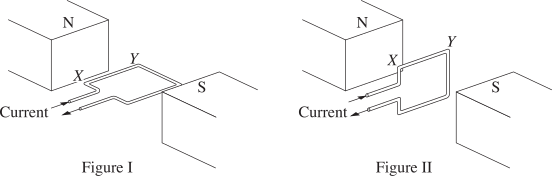


The loop is then rotated to the position shown in Figure \(\text{II}\).

The magnitude of the force on the side \(X Y\) and the magnitude of the torque on the loop in Figure \(\text{II}\) are compared to those in Figure \(\text{I}\).

Which row of the table correctly describes the comparison?

\begin{align*}
\begin{array}{l}
\rule{0pt}{2.5ex} \ \rule[-1ex]{0pt}{0pt}& \\
\rule{0pt}{2.5ex}\textbf{A.}\rule[-1ex]{0pt}{0pt}\\
\rule{0pt}{2.5ex}\textbf{B.}\rule[-1ex]{0pt}{0pt}\\
\rule{0pt}{2.5ex}\textbf{C.}\rule[-1ex]{0pt}{0pt}\\
\rule{0pt}{2.5ex}\textbf{D.}\rule[-1ex]{0pt}{0pt}\\
\end{array}
\begin{array}{|c|c|}
\hline
\rule{0pt}{2.5ex}\quad \textit{Force}\quad \rule[-1ex]{0pt}{0pt}&\quad \textit{Torque}\quad  \\
\hline
\rule{0pt}{2.5ex}\text{I > II}\rule[-1ex]{0pt}{0pt}&\text{I = II}\\
\hline
\rule{0pt}{2.5ex}\text{I > II}\rule[-1ex]{0pt}{0pt}& \text{I > II}\\
\hline
\rule{0pt}{2.5ex}\text{I = II}\rule[-1ex]{0pt}{0pt}& \text{I = II} \\
\hline
\rule{0pt}{2.5ex}\text{I = II}\rule[-1ex]{0pt}{0pt}& \text{I > II} \\
\hline
\end{array}
\end{align*} 

Show Answers Only

\(D\)

Show Worked Solution
  • The magnitude of the force on side \(XY\) can be calculated by  \( F= lIB \sin \theta\)
  • As side \( XY\) is always perpendicular to the magnetic field,  \( \theta = 90^{\circ} \) and Force \(\text{I}\) = Force \(\text{II}\)
  • The magnitude of the torque on side \(XY\) can be calculated by  \( \tau=rF\sin\theta\)
  • In Figure \(\text{I}\), \( \theta= 90^{\circ} \) and in Figure \(\text{II}\), \( \theta = 0^{\circ}  \) → Torque \(\text{I}\) > Torque \(\text{II}\)

\(\Rightarrow  D\)

♦ Mean mark 52%.

Filed Under: Applications of the Motor Effect, The Motor Effect Tagged With: Band 5, smc-3694-20-Force on Current-Carrying Conductor, smc-3695-10-Torque

PHYSICS, M6 EQ-Bank 25

The diagram shows a DC motor with a constant current flowing to the rotor.
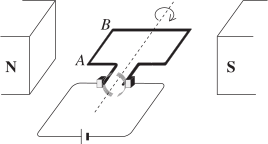
 

Sketch graphs to compare the behaviour of the force `F` on wire `AB` and the torque `tau` on the rotor, as functions of time `t`.  (4 marks)

--- 8 WORK AREA LINES (style=lined) ---

Show Answers Only
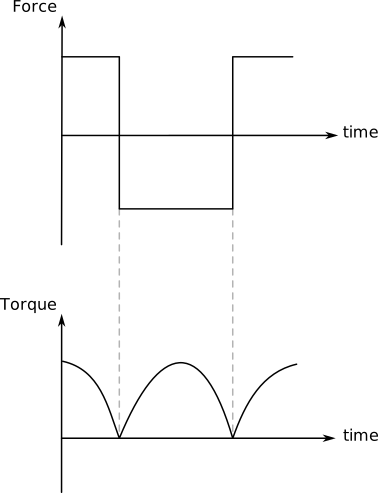
Show Worked Solution

Filed Under: Applications of the Motor Effect, The Motor Effect Tagged With: Band 4, smc-3694-20-Force on Current-Carrying Conductor, smc-3695-10-Torque

PHYSICS, M6 EQ-Bank 16 MC

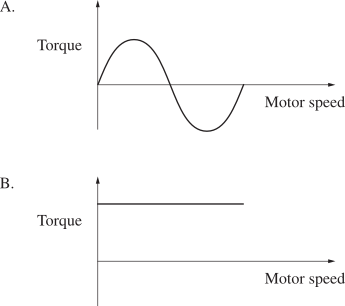
An experiment was carried out to investigate the change in torque for a DC motor with a radial magnetic field. The data from start up to operating speed were graphed.

Which graph is most likely to represent this set of data?
 

Show Answers Only

`D`

Show Worked Solution
  • The DC motor has a radial magnetic field, so the coil is always perpendicular to the magnetic field. This means the torque for the motor does not depend on the angle of the coil.
  • The torque for this DC motor is therefore given by  `tau=NIAB`.
  • As the speed of the motor increases from start to operating speed, the rate of change of magnetic flux through its coil increases, increasing the induced emf in the motor (Faraday’s Law).
  • This induced back emf acts to oppose the rotation of the motor (Lenz’s Law). 
  • The back emf opposes the current supplied to the motor, decreasing the net current through the motor.
  • Therefore, the torque produced by the motor decreases as motor speed increases.

`=>D`

Filed Under: Applications of the Motor Effect Tagged With: Band 5, smc-3695-10-Torque, smc-3695-20-Back emf

PHYSICS, M6 EQ-Bank 3 MC

A rectangular loop of wire passes between two magnets as shown and is free to rotate about `X Y`. The loop has a current flowing through it.
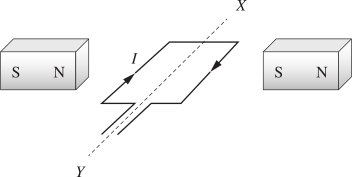
 

Without changing the current, which of the following would result in the greatest increase in torque?

  1. Increase the thickness of the wire in the loop.
  2. Decrease the thickness of the wire in the loop.
  3. Extend the length of the loop in the `X Y` direction.
  4. Extend the width of the loop towards the magnets.
Show Answers Only

`D`

Show Worked Solution

Consider  `tau=rFsin theta`:

  • Extending the width of the loop towards the magnets increases the distance between the point of application of force to the coil and the axis of rotation (i.e. `r`).
  • By increasing `r`, the torque will increase.

`=>D`

Filed Under: Applications of the Motor Effect Tagged With: Band 4, smc-3695-10-Torque

PHYSICS, M6 2015 HSC 22

The diagram represents a simple DC motor. A current of 1.0 A flows through a square loop `ABCD` with 5 cm sides in a magnetic field of 0.01 T.
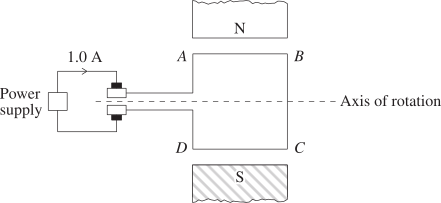
 

  1. Determine the force acting on section `AB` and the force acting on section `BC` due to the magnetic field, when the loop is in the position shown.   (3 marks)

--- 4 WORK AREA LINES (style=lined) ---

  1. How is the direction of the torque maintained as the loop rotates 360° from the position shown?   (2 marks)

--- 4 WORK AREA LINES (style=lined) ---

Show Answers Only

a.    `F_(AB)=5xx10^(-4)  text{N into the page.}`

`F_(BC)=0  text{N}`

b.   The split ring conductor reverses the direction of current.

  • This switches the direction of force on sides `AB` and `CD` of the coil every half turn, ensuring torque remains in the same direction.
Show Worked Solution
a.    `F_(AB)` `=BIℓsin theta`
    `=0.01 xx1.0 xx0.05 xx sin 90^(@)`
    `=5xx10^(-4)  text{N into the page.}`
     
  `F_(BC)` `=0.01 xx1.0 xx0.05 xx sin 0^(@)=0\ text{N}`


b.   The split ring conductor reverses the direction of current.

  • This switches the direction of force on sides `AB` and `CD` of the coil every half turn, ensuring torque remains in the same direction.

Mean mark (b) 57%.

Filed Under: Applications of the Motor Effect, The Motor Effect Tagged With: Band 4, smc-3694-20-Force on Current-Carrying Conductor, smc-3695-10-Torque

PHYSICS, M6 2016 HSC 20 MC

In the motor shown, the rotor spins clockwise, as viewed from point `P`, when connected to a DC supply.
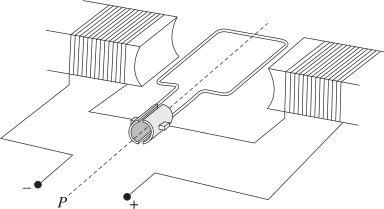
 

What happens when the motor is connected to an AC supply?

  1. There is no movement of the rotor.
  2. The rotor produces clockwise movement only.
  3. The rotor vibrates at the frequency of the AC supply.
  4. The rotor continuously turns half a rotation clockwise, then half a rotation anticlockwise.
Show Answers Only

`B`

Show Worked Solution
  • Initially, the electromagnet on the left has a magnetic south pole on its side closest to the coil, the electromagnet on the right has a north pole on its side closest to the coil and the current through the coil is anticlockwise as viewed from above.
  • Using the right hand palm rule, the rotor will rotate clockwise.
  • When the direction of AC current changes, the direction of current through the coil swaps, and the polarity of the electromagnets swaps.
  • This means that the direction of torque is maintained and the rotor continues to rotate clockwise.
  • The split-ring commutator functions as normal to maintain the direction of torque once the rotor has rotated through half a turn preventing the rotor from continuously turning half a rotation clockwise, then half a rotation anticlockwise.
  • The rotor produces clockwise movement only.

`=>B`


♦♦♦ Mean mark 17%.

Filed Under: Applications of the Motor Effect Tagged With: Band 6, smc-3695-10-Torque, smc-3695-30-DC motor components

PHYSICS, M6 2018 HSC 10 MC

The diagram shows some parts of a simple DC motor.
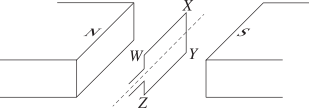
 

Which row of the table correctly describes the direction of force acting on side \(WX\) and the direction of torque this produces on the coil?
 

\begin{align*}
\begin{array}{l}
\rule{0pt}{1.5ex}\textit{} & \textit{} \\
\textit{}\rule[.5ex]{0pt}{0pt}& \textit{} \\
\rule{0pt}{2.5ex}\textbf{A.}\rule[-1ex]{0pt}{0pt}\\
\rule{0pt}{2.5ex}\textbf{B.}\rule[-1ex]{0pt}{0pt}\\
\rule{0pt}{2.5ex}\textbf{C.}\rule[-1ex]{0pt}{0pt}\\
\rule{0pt}{2.5ex}\textbf{D.}\rule[-1ex]{0pt}{0pt}\\
\end{array}
\begin{array}{|l|l|}
\hline
\rule{0pt}{1.5ex}\textit{Direction of force acting} & \textit{Direction of torque produced on the} \\
\quad \quad \quad \quad \textit{on WX}\rule[.5ex]{0pt}{0pt}& \quad \textit{coil by the force acting on WX} \\
\hline
\rule{0pt}{2.5ex}\text{Remains constant}\rule[-1ex]{0pt}{0pt}&\text{Remains constant}\\
\hline
\rule{0pt}{2.5ex}\text{Remains constant}\rule[-1ex]{0pt}{0pt}& \text{Reverses every 180°}\\
\hline
\rule{0pt}{2.5ex}\text{Reverses every 180°}\rule[-1ex]{0pt}{0pt}& \text{Remains constant} \\
\hline
\rule{0pt}{2.5ex}\text{Reverses every 180°}\rule[-1ex]{0pt}{0pt}& \text{Reverses every 180°} \\
\hline
\end{array}
\end{align*}

Show Answers Only

\(C\)

Show Worked Solution
  • To ensure the motor rotates continuously in one direction, the direction of torque must remain constant.
  • So, the split ring commutator switches the direction of the current through the coil every 180°, reversing the direction of the force on \(WX\) every 180°.

\(\Rightarrow C\)


Mean mark 52%.

Filed Under: Applications of the Motor Effect Tagged With: Band 5, smc-3695-10-Torque, smc-3695-30-DC motor components

PHYSICS, M6 2022 HSC 32

One type of stationary exercise bike uses a pair of strong, movable magnets placed on opposite sides of a thick, aluminium flywheel to provide a torque to make it harder to pedal.
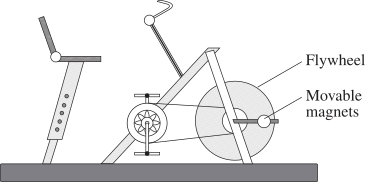


  1. Explain the principle by which these magnets make it harder to pedal.  (3 marks)

    --- 6 WORK AREA LINES (style=lined) ---

  1. The bike rider wants to increase the opposing torque on the flywheel. Justify an adjustment that could be made to the magnets to achieve this.  (3 marks)

    --- 6 WORK AREA LINES (style=lined) ---

Show Answers Only

a.    Magnetic breaking is a consequence of Lenz’s Law.

  • The changing magnetic flux through the wheel, as a result of its rotation, causes eddy currents to be induced (Faraday’s Law).
  • According to Lenz’s Law, these eddy currents produce a force which opposes the rotation of the wheel, making it more difficult to pedal.

b.    Adjustment to increase opposing torque:

  • Moving the magnets closer to the outer edge of the flywheel will increase the opposing torque on it. As the linear speed of the wheel is greater near the edge, the rate of change of flux passing through it will increase.
  • This increases the magnitude of induced emf as  `epsilon=-N(Delta theta)/(Delta t).`
  • Consequently, the opposing force and torque will increase.
  • Moving the magnets closer to the edge of the flywheel also increases the distance between the point of application of the opposing force and the axis of rotation of the wheel. As  `tau=rF`  this further increases opposing torque.
Show Worked Solution

a.    Magnetic breaking is a consequence of Lenz’s Law.

  • The changing magnetic flux through the wheel, as a result of its rotation, causes eddy currents to be induced (Faraday’s Law).
  • According to Lenz’s Law, these eddy currents produce a force which opposes the rotation of the wheel, making it more difficult to pedal.

b.    Adjustment to increase opposing torque:

  • Moving the magnets closer to the outer edge of the flywheel will increase the opposing torque on it. As the linear speed of the wheel is greater near the edge, the rate of change of flux passing through it will increase.
  • This increases the magnitude of induced emf as  `epsilon=-N(Delta theta)/(Delta t).`
  • Consequently, the opposing force and torque will increase.
  • Moving the magnets closer to the edge of the flywheel also increases the distance between the point of application of the opposing force and the axis of rotation of the wheel. As  `tau=rF`  this further increases opposing torque.

Filed Under: Applications of the Motor Effect, Electromagnetic Induction Tagged With: Band 4, smc-3695-10-Torque, smc-3695-70-Magnetic Breaking, smc-3705-40-Lenz and Faraday

PHYSICS, M6 2020 HSC 32

A rope connects a mass on a horizontal surface to a pulley attached to an electric motor as shown.
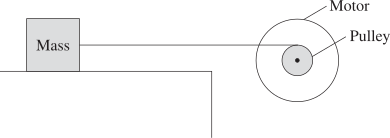
 

Explain the factors that limit the speed at which the mass can be pulled along the horizontal surface. Use mathematical models to support your answer.   (7 marks)

--- 20 WORK AREA LINES (style=lined) ---

Show Answers Only
  • The factors limiting the speed of the mass along horizontal surface can be divided into two main parts; 1-Factors involving friction between the mass and the table and 2-Factors involving the force output of the motor and pulley.

Friction between the mass and table

  • The mass will experience a friction force of  `F_(f)=mu N`. Since the mass has no vertical acceleration,  `N=mg\ \ =>\ \ F_(f)=mu mg.`
  • The speed at which the mass can be pulled is limited by the coefficient of kinetic friction between the mass and the table `mu` and the magnitude of the mass `m`.

 Force output of the motor and pulley

  • The power of the motor depends on its torque and the pulley radius `(tau=rF sin theta).`
  • The torque produced by the motor is given by  `tau=NIAB sin theta`
  • The force of the motor and hence maximum speed at which the mass can be pulled is also limited by the number of turns of the coil in the motor, the current passing through the coils, the area of the coils and the magnetic field strength of the stator magnets.

Answers could also contain:

  • Back emf in the motor limiting its maximum speed.
  • The efficiency of the motor.
Show Worked Solution
  • The factors limiting the speed of the mass along horizontal surface can be divided into two main parts; 1-Factors involving friction between the mass and the table and 2-Factors involving the force output of the motor and pulley.

Friction between the mass and table

  • The mass will experience a friction force of  `F_(f)=mu N`. Since the mass has no vertical acceleration,  `N=mg\ \ =>\ \ F_(f)=mu mg.`
  • The speed at which the mass can be pulled is limited by the coefficient of kinetic friction between the mass and the table `mu` and the magnitude of the mass `m`.

 Force output of the motor and pulley

  • The power of the motor depends on its torque and the pulley radius `(tau=rF sin theta).`
  • The torque produced by the motor is given by  `tau=NIAB sin theta`
  • The force of the motor and hence maximum speed at which the mass can be pulled is also limited by the number of turns of the coil in the motor, the current passing through the coils, the area of the coils and the magnetic field strength of the stator magnets.

Answers could also contain:

  • Back emf in the motor limiting its maximum speed.
  • The efficiency of the motor.
Mean mark 58%.

Filed Under: Applications of the Motor Effect Tagged With: Band 4, Band 5, smc-3695-10-Torque, smc-3695-20-Back emf

PHYSICS, M6 2020 HSC 23

The graph shows data for a motor connected to a 240 V power supply.
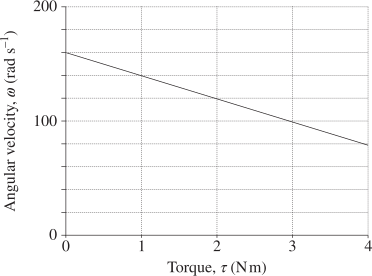
 

The equation for the torque, `tau`, produced by the motor is  `tau=frac{V I \eta}{\omega}`

where    `tau\ ` `=` torque (N m)
  `V \` `=`  voltage (V)
  `I\ ` `=` current (A)
  `eta\ ` `=` efficiency `=` 0.3
  `omega\ ` `=` angular velocity (rad `text{s}^(-1)`)

 
A circuit breaker cuts the current to the motor if the current exceeds 5  A.

Determine what will happen when the motor produces a torque of 2.95 N m. Show relevant calculations.   (3 marks)

--- 5 WORK AREA LINES (style=lined) ---

Show Answers Only

`I` = 4.1 A

Current is below 5 A, so the circuit breaker will not cut the current and the motor will continue to run.

Show Worked Solution

From the graph, when `tau =` 2.95, `omega ~~ 100`:

`tau` `=(VI eta)/(omega)`  
`I` `=tau(omega)/(Veta)=2.95 xx(100)/(240 xx0.3)=4.1\ \text{A}`  


  • Current is below 5 A, so the circuit breaker will not cut the current and the motor will continue to run.

Filed Under: Applications of the Motor Effect Tagged With: Band 3, smc-3695-10-Torque

PHYSICS, M6 2021 HSC 21

A DC motor is constructed from a single loop of wire with dimensions 0.10 m × 0.07 m. The magnetic field strength is 0.40 T and a current of 14 A flows through the loop.
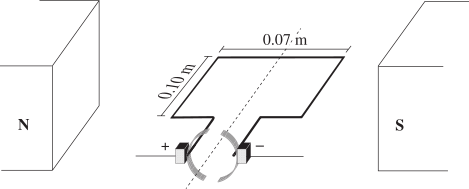
 

  1. Calculate the magnitude of the maximum torque produced by the motor.   (2 marks)

--- 4 WORK AREA LINES (style=lined) ---

  1. Describe how the magnitude of the torque changes as the loop moves through half a rotation from the position shown.   (2 marks)

--- 4 WORK AREA LINES (style=lined) ---

Show Answers Only

a.   0.04  Nm

b.    Magnitude of torque changes:

  • The torque is initially at a maximum and decreases to zero after a 90º rotation.
  • The torque then increases to a maximum at 180º from the coil’s original position.
Show Worked Solution
a.    `tau_max` `=nIAB sin theta`
    `=1xx14 xx0.1 xx0.07 xx0.40 xx sin(90^(@))`
    `=0.04`  Nm


b.    Magnitude of torque changes:

  • The torque is initially at a maximum and decreases to zero after a 90º rotation.
  • The torque then increases to a maximum at 180º from the coil’s original position.

Filed Under: Applications of the Motor Effect Tagged With: Band 3, Band 4, smc-3695-10-Torque

Copyright © 2014–2025 SmarterEd.com.au · Log in