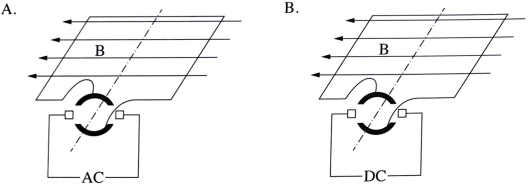
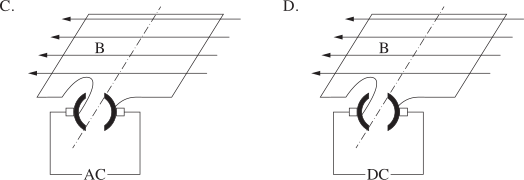
A conducting coil is mounted on an axle and placed in a uniform magnetic field. The diagram shows different ways of connecting the coil to a power source.
Which setup allows the conducting coil to rotate continuously?
Aussie Maths & Science Teachers: Save your time with SmarterEd
A conducting coil is mounted on an axle and placed in a uniform magnetic field. The diagram shows different ways of connecting the coil to a power source.
Which setup allows the conducting coil to rotate continuously?
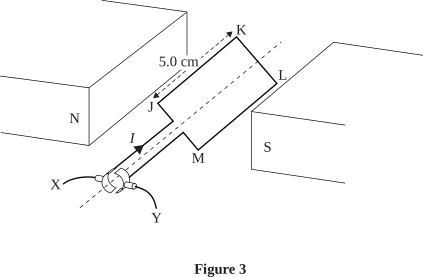
The diagram below shows a schematic diagram of a DC motor. The motor has a coil, \(JKLM\), consisting of 100 turns. The permanent magnets provide a uniform magnetic field of 0.45 T.
The commutator connectors, \(X\) and \(Y\), provide a constant DC current, \(I\), to the coil. The length of the side \(JK\) is 5.0 cm.
The current \(I\) flows in the direction shown in the diagram.
--- 1 WORK AREA LINES (style=lined) ---
--- 0 WORK AREA LINES (style=lined) ---
--- 4 WORK AREA LINES (style=lined) ---
--- 4 WORK AREA LINES (style=lined) ---
a. Current runs from the positive terminal to the negative terminal.
\(X\) is connected to the positive terminal of the current supply.
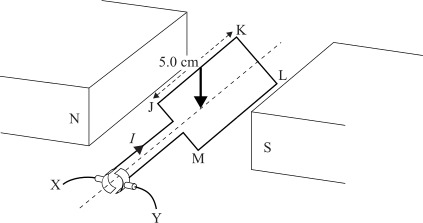
b. Using the right-hand rule: force on \(JK\) is down the page.
c. Role of the split-ring commutator:
d. \(F=nlIB=100 \times 0.05 \times 6 \times 0.45 = 13.5\ \text{N}\)
a. Current runs from the positive terminal to the negative terminal.
\(X\) is connected to the positive terminal of the current supply.
b. Using the right-hand rule: force on \(JK\) is down the page.
c. Role of the split-ring commutator:
d. \(F=nlIB=100 \times 0.05 \times 6 \times 0.45 = 13.5\ \text{N}\)
The diagram below shows a small DC electric motor, powered by a battery that is connected via a split-ring commutator. The rectangular coil has sides KJ and LM. The magnetic field between the poles of the magnet is uniform and constant.
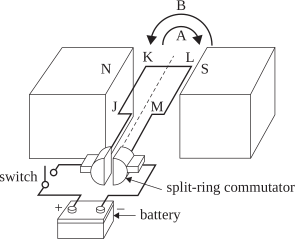
The switch is now closed, and the coil is stationary and in the position shown in the diagram.
Which one of the following statements best describes the motion of the coil when the switch is closed?
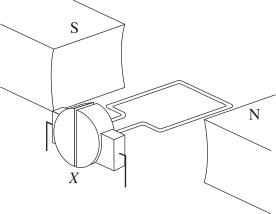
The diagram represents one type of electric motor. Describe the function of part \( X \). (2 marks) --- 5 WORK AREA LINES (style=lined) ---
In the motor shown, the rotor spins clockwise, as viewed from point `P`, when connected to a DC supply.
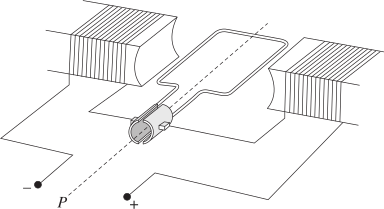
What happens when the motor is connected to an AC supply?
The diagram shows some parts of a simple DC motor.
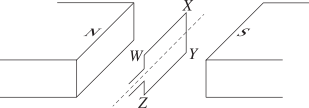
Which row of the table correctly describes the direction of force acting on side \(WX\) and the direction of torque this produces on the coil?
\begin{align*}
\begin{array}{l}
\rule{0pt}{1.5ex}\textit{} & \textit{} \\
\textit{}\rule[.5ex]{0pt}{0pt}& \textit{} \\
\rule{0pt}{2.5ex}\textbf{A.}\rule[-1ex]{0pt}{0pt}\\
\rule{0pt}{2.5ex}\textbf{B.}\rule[-1ex]{0pt}{0pt}\\
\rule{0pt}{2.5ex}\textbf{C.}\rule[-1ex]{0pt}{0pt}\\
\rule{0pt}{2.5ex}\textbf{D.}\rule[-1ex]{0pt}{0pt}\\
\end{array}
\begin{array}{|l|l|}
\hline
\rule{0pt}{1.5ex}\textit{Direction of force acting} & \textit{Direction of torque produced on the} \\
\quad \quad \quad \quad \textit{on WX}\rule[.5ex]{0pt}{0pt}& \quad \textit{coil by the force acting on WX} \\
\hline
\rule{0pt}{2.5ex}\text{Remains constant}\rule[-1ex]{0pt}{0pt}&\text{Remains constant}\\
\hline
\rule{0pt}{2.5ex}\text{Remains constant}\rule[-1ex]{0pt}{0pt}& \text{Reverses every 180°}\\
\hline
\rule{0pt}{2.5ex}\text{Reverses every 180°}\rule[-1ex]{0pt}{0pt}& \text{Remains constant} \\
\hline
\rule{0pt}{2.5ex}\text{Reverses every 180°}\rule[-1ex]{0pt}{0pt}& \text{Reverses every 180°} \\
\hline
\end{array}
\end{align*}