SmarterEd

Aussie Maths & Science Teachers: Save your time with SmarterEd

  • Login
  • Get Help
  • About

PHYSICS, M8 2025 HSC 30

A beam of electrons travelling at \(4 \times 10^3 \ \text{m s}^{-1}\) exits an electron gun and is directed toward two narrow slits with a separation, \(d\), of 1 \(\mu\text{m}\). The resulting interference pattern is detected on a screen 50 cm from the slits.

  1. Show that the wavelength of the electrons in this experiment is 182 nm.   (2 marks)

    --- 4 WORK AREA LINES (style=lined) ---

  2. An interference fringe occurs on the screen where constructive interference takes place.
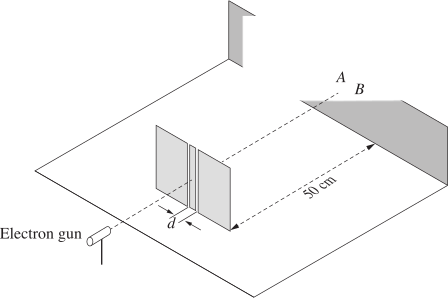
     

  1. Determine the distance between the central interference fringe \(A\) and the centre of the next bright fringe \(B\).   (2 marks)

    --- 4 WORK AREA LINES (style=lined) ---

  2. Determine the potential difference acting in the electron gun to accelerate the electrons in the beam from rest to \(4 \times 10^3 \ \text{m s}^{-1}\).   (2 marks)

    --- 4 WORK AREA LINES (style=lined) ---
Show Answers Only

a.    \(\text {Using} \ \ \lambda=\dfrac{h}{m v}:\)

\(\lambda=\dfrac{6.626 \times 10^{-34}}{9.109 \times 10^{-31} \times 4 \times 10^3}=1.82 \times 10^{-7} \ \text{m}=182 \ \text{nm}\)

b.    \(x=9.1 \ \text{cm}\)

c.    \(V=4.5 \times 10^{-5} \ \text{V}\)

Show Worked Solution

a.    \(\text {Using} \ \ \lambda=\dfrac{h}{m v}:\)

\(\lambda=\dfrac{6.626 \times 10^{-34}}{9.109 \times 10^{-31} \times 4 \times 10^3}=1.82 \times 10^{-7} \ \text{m}=182 \ \text{nm}\)
 

b.    \(\text {Using}\ \ x=\dfrac{\lambda m L}{d}\)

\(\text{where} \ \ x=\text{distance between middle of adjacent bright spots}\)

\(x=\dfrac{182 \times 10^{-9} \times 1 \times 0.5}{1 \times 10^{-6}}=0.091 \ \text{m}=9.1 \ \text{cm}\)
 

c.    \(\text{Work done by field}=\Delta K=K_f-K_i\)

\(qV\) \(=\dfrac{1}{2} m v^2-0\)
\(V\) \(=\dfrac{m v^2}{2 q}=\dfrac{9.109 \times 10^{-31} \times\left(4 \times 10^3\right)^2}{2 \times 1.602 \times 10^{-19}}=4.5 \times 10^{-5} \ \text{V}\)

Filed Under: Charged Particles, Conductors and Electric/Magnetic Fields, Light: Wave Model, Quantum Mechanical Nature of the Atom Tagged With: Band 4, Band 5, smc-3693-35-Kinematic/Work Calcs, smc-3697-30-Double Slit Calcs, smc-3702-40-De Broglie

PHYSICS, M7 2019 VCE 14*

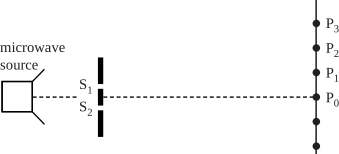
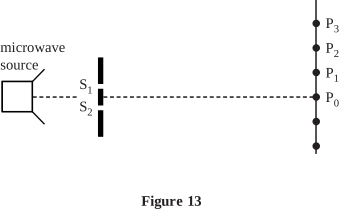
Students have set up a double-slit experiment using microwaves. The beam of microwaves passes through a metal barrier with two slits, shown as \(\text{S}_1\) and \(\text{S}_2\) in the diagram. The students measure the intensity of the resulting beam at points along the line shown. They determine the positions of maximum intensity to be at the points labelled \(\text{P}_0,\) \(\text{P}_1\), \(\text{P}_2\) and \(\text{P}_3\). 
 

The distance from \(\text{S}_1\) to \(\text{P}_3\) is 72.3 cm and the distance from \(\text{S}_2\) to \(\text{P}_3\) is 80.6 cm.

  1. What is the frequency of the microwaves transmitted through the slits? Show your working.   (2 marks)
  2. The signal strength is at a minimum approximately midway between points \(\text{P}_0\) and \(\text{P}_1\).
  3. Explain the reason why the signal strength would be a minimum at this location.   (2 marks)

    --- 4 WORK AREA LINES (style=lined) ---
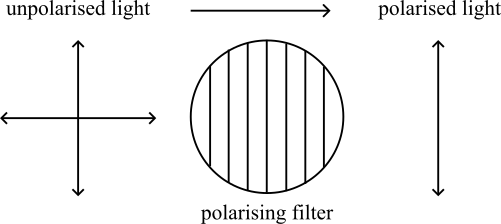
  4. The microwaves from the source are polarised.
  5. Explain what is meant by the term 'polarised'. You may use a diagram in your answer.   (2 marks)

    --- 4 WORK AREA LINES (style=lined) ---
Show Answers Only

a.    \(1.08 \times 10^{10}\ \text{Hz}\)

b.    Signal strength at midpoints:

  • Halfway between \(\text{P}_0\) and \(\text{P}_1\ \ \Rightarrow\)  path difference = \(\frac{\lambda}{2}\).
  • Therefore, destructive interference will occur and the signal strength will be a minimum.

c.    Polarised:

  • Light is a transverse wave that can oscillate in any direction.
  • Light becomes polarised when its plane of oscillation is only in a single direction, as seen in the diagram below.
      

Show Worked Solution

a.    The path difference to \(P_3\) is equal to 3 wavelengths of the microwaves.

\(3\lambda\) \(=0.806-0.723\)  
\(\lambda\) \(=\dfrac{0.083}{3}=0.0277\ \text{m}\)  

 
\(f=\dfrac{c}{\lambda}=\dfrac{3 \times 10^8}{0.0277}=1.08 \times 10^{10}\ \text{Hz}\)
 

♦♦ Mean mark (a) 35%.
COMMENT: Common error was not converting cm to m.

b.    Signal strength at midpoints:

  • Halfway between \(\text{P}_0\) and \(\text{P}_1\ \ \Rightarrow\)  path difference = \(\frac{\lambda}{2}\).
  • Therefore, destructive interference will occur and the signal strength will be a minimum.
♦♦ Mean mark (b) 42%.

c.    Polarised:

  • Light is a transverse wave that can oscillate in any direction.
  • Light becomes polarised when its plane of oscillation is only in a single direction, as seen in the diagram below.


♦ Mean mark (c) 50%.
Comment: Students are encouraged to use diagrams when possible.

Filed Under: Light: Wave Model Tagged With: Band 5, smc-3697-30-Double Slit Calcs, smc-3697-40-Polarisation

PHYSICS, M7 2020 VCE 12

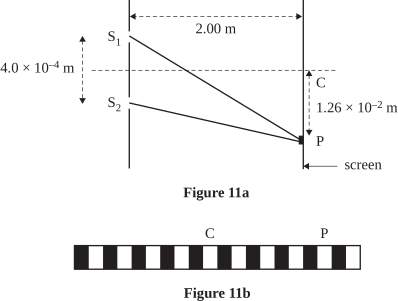
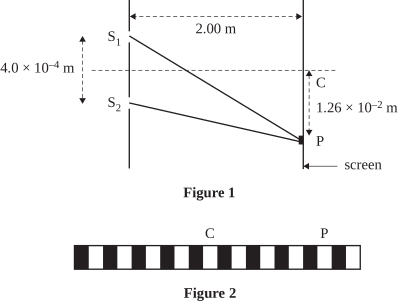
In a Young's double-slit interference experiment, laser light is incident on two slits, \(\text{S}_1\) and \(\text{S}_2\), that are 4.0 × 10\(^{-4}\) m apart, as shown in Figure 1.

Rays from the slits meet on a screen 2.00 m from the slits to produce an interference pattern. Point \(\text{C}\) is at the centre of the pattern. Figure 2 shows the pattern obtained on the screen.
 

  1. There is a bright fringe at point \(\text{P}\) on the screen.
  2. Explain how this bright fringe is formed.   (2 marks)

    --- 4 WORK AREA LINES (style=lined) ---
  1. The distance from the central bright fringe at point \(\text{C}\) to the bright fringe at point P is 1.26 × 10\(^{-2}\) m.
  2. Calculate the wavelength of the laser light. Show your working.   (3 marks

    --- 4 WORK AREA LINES (style=lined) ---
Show Answers Only

a.    Bright fringe at point \(\text{P}\):

  • Young’s double slit experiment demonstrates that light can produce an interference pattern, from both constructive and destructive interference.
  • Point \(\text{P}\) is the 4th bright fringe and it follows that the path difference between the two light beams is 4 wavelengths.
  • At this point, the peaks of the twos wave constructively interfere and a bright band is formed.

b.    \(630\ \text{nm}\)

Show Worked Solution

a.    Bright fringe at point \(\text{P}\):

  • Young’s double slit experiment demonstrates that light can produce an interference pattern, from both constructive and destructive interference.
  • Point \(\text{P}\) is the 4th bright fringe and it follows that the path difference between the two light beams is 4 wavelengths.
  • At this point, the peaks of the twos wave constructively interfere and a bright band is formed.
♦ Mean mark (a) 45%.

b.    Using  \(d\,\sin \theta=m \lambda\)  and  \(\sin \theta=\dfrac{\Delta x}{D}\)

  • \(\Delta x\) is the distance between two bright bands and \(D\) is the distance from the slits to the screen.
  • Using  \(\dfrac{d\Delta x}{D}=m\lambda\):
  •   \(\lambda=\dfrac{d\Delta x}{Dm}=\dfrac{4 \times 10^{-4} \times 1.26 \times 10^{-2}}{2 \times 4}=630\ \text{nm}\)
♦ Mean mark (b) 40%.

Filed Under: Light: Wave Model Tagged With: Band 5, smc-3697-20-Young, smc-3697-30-Double Slit Calcs

PHYSICS, M7 2021 VCE 13

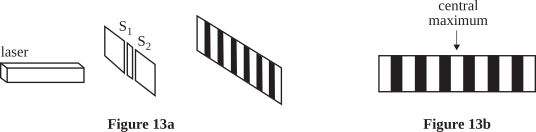
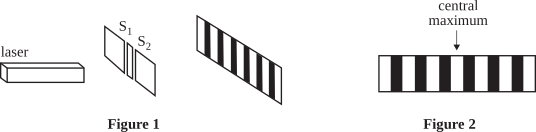
In Young's double-slit experiment, the distance between two slits, S\(_1\) and S\(_2\), is 2.0 mm. The slits are 1.0 m from a screen on which an interference pattern is observed, as shown in Figure 1. Figure 2 shows the central maximum of the observed interference pattern.
 

  1. If a laser with a wavelength of 620 nm is used to illuminate the two slits, what would be the distance between two successive dark bands? Show your working.   (2 marks)

--- 5 WORK AREA LINES (style=lined) ---
  1. Explain how this experiment supports the wave model of light.   (2 marks)

--- 5 WORK AREA LINES (style=lined) ---
Show Answers Only

a.    \(3.1 \times 10^{-4}\ \text{m}\)

b.    The experiment supports the wave theory as follows:

  • Young’s double slit experiment demonstrates how light will refract and form an interference pattern against a screen.
  • Since interference is a wave phenomenon, the experiment supports the wave model of light.

Show Worked Solution

a.    \(d\,\sin \theta=m \lambda\ \ \text{and}\ \ \sin \theta=\dfrac{\Delta x}{D}\)

  • \(\Delta x\) is the distance between two successive dark bands and \(D\) is the distance from the slits to the screen.
  •    \( \dfrac{d \Delta x}{D}\) \(=m \lambda \)
  •         \( \Delta x-\dfrac{D \lambda}{d} \)
  •              \(=\dfrac{1 \times 620 \times 10^{-9}}{2 \times 10^{-3}}\)
  •              \(=3.1 \times 10^{-4}\ \text{m}\)
♦ Mean mark (a) 51%.

b.    The experiment supports the wave theory as follows:

  • Young’s double slit experiment demonstrates how light will refract and form an interference pattern against a screen.
  • Since interference is a wave phenomenon, the experiment supports the wave model of light.

Filed Under: Light: Wave Model Tagged With: Band 4, Band 5, smc-3697-20-Young, smc-3697-30-Double Slit Calcs

PHYSICS, M7 2023 VCE 13

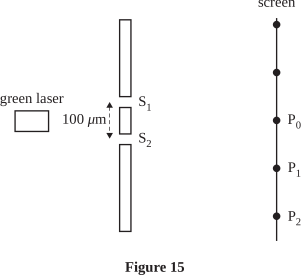
A group of physics students undertake a Young's double-slit experiment using the apparatus shown in the diagram. They use a green laser that produces light with a wavelength of 510 nm. The light is incident on two narrow slits, S\(_1\) and S\(_2\). The distance between the two slits is 100 \( \mu \)m.
 

An interference pattern is observed on a screen with points P\(_{0}\), P\(_{1}\) and P\(_2\) being the locations of adjacent bright bands, as shown. Point  P\(_0\) is the central bright band.

  1. Calculate the path difference between S\(_{1}\)P\(_{2}\) and S\(_{2}\)P\(_{2}\). Give your answer in metres. Show your working.   (2 marks)

--- 3 WORK AREA LINES (style=lined) ---
  1. The green laser is replaced by a red laser.
  2. Describe the effect of this change on the spacing between adjacent bright bands.   (1 mark)

--- 2 WORK AREA LINES (style=lined) ---
  1. Explain how Young's double-slit experiment provides evidence for the wave-like nature of light and not the particle-like nature of light.   (3 marks)

--- 6 WORK AREA LINES (style=lined) ---

Show Answers Only

a.    \(1.02 \times 10^{-6}\ \text{m}\)

b.    The spacing between adjacent bright bands will increase.

c.    Evidence for the wave-like nature of light:

  • Young’s double slit experiment was used to show that light can produce an interference pattern as it diffracts when it passes through the slits.
  • As this is a wave phenomenon, the experiment provided valuable evidence to support the wave-like nature of light.
  • Using the particle-like nature of light as a model, two bright bands would have been expected behind the two slits as the particles would have passed through the slits in a straight line which was not observed.
Show Worked Solution

a.    \(\text{Difference in distance}\ = 2 \lambda\)

\(\text{Path difference}\ =2 \times 510 \times 10^{-9} = 1.02 \times 10^{-6}\ \text{m}\).

♦ Mean mark (a) 45%.

b.    The spacing will increase.

  • \( x=\dfrac{m\lambda D}{d}\), where \(D\) is the length between the screen and the slits and \(x\) is the distance between adjacent bright bands.
  • Since \(x \propto \lambda\), as the wavelength of light increases from green to red, so will the spacing between adjacent bright bands.
     

c.    Evidence for the wave-like nature of light:

  • Young’s double slit experiment was used to show that light can produce an interference pattern as it diffracts when it passes through the slits.
  • As this is a wave phenomenon, the experiment provided valuable evidence to support the wave-like nature of light.
  • Using the particle-like nature of light as a model, two bright bands would have been expected behind the two slits as the particles would have passed through the slits in a straight line which was not observed.

Filed Under: Light: Wave Model Tagged With: Band 4, Band 5, smc-3697-20-Young, smc-3697-30-Double Slit Calcs

PHYSICS, M7 EQ-Bank 26

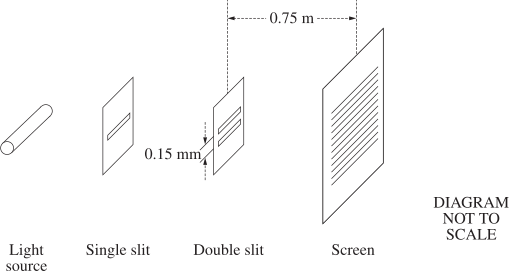
The diagram shows a light source, slits and a translucent screen arranged for an experiment on light. Light and dark bands form on the screen. The light has a wavelength of 590 nm. The diagram is not to scale.
 

  1. Explain how any one of the dark bands forms on the screen.  (3 marks)

--- 6 WORK AREA LINES (style=lined) ---
  1. The distance between the centres of the double slit is 0.15 mm, and the distance between the double slit and the screen is 0.75 m.
  2. Calculate the distance on the screen from the centre of the central maximum to the centre of a second-order bright band.  (3 marks)

--- 6 WORK AREA LINES (style=lined) ---
Show Answers Only

a.   Dark band formation:

  • When light arrives at the double slit, it undergoes diffraction.
  • The two slits act as sources of secondary wavefronts and light travels from both slits to the screen.
  • When light from one slit travels any odd multiple of `(lambda)/(2)` more than light from the other slit to the screen, it is out of phase and destructive interference occurs. Here waves superimpose and cancel each other out, creating dark bands.
  • For example, the dark bands either side of the central maximum form where light from one slit travels `(lambda)/(2)` further than light from the other slit.

b.   `0.0059  text{m}`

Show Worked Solution

a.  Dark band formation:

  • When light arrives at the double slit, it undergoes diffraction.
  • The two slits act as sources of secondary wavefronts and light travels from both slits to the screen.
  • When light from one slit travels any odd multiple of `(lambda)/(2)` more than light from the other slit to the screen, it is out of phase and destructive interference occurs. Here waves superimpose and cancel each other out, creating dark bands.
  • For example, the dark bands either side of the central maximum form where light from one slit travels `(lambda)/(2)` further than light from the other slit.

b.    Using  `d  sin theta=m lambda`

  `0.15 xx10^(-3)  sin theta` `=2xx590 xx10^(-9)`
  `sin theta` `=0.007867`


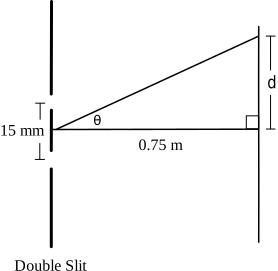
  • Using trigonometry, `tan theta=(d)/(0.75)`, where `theta` is the angular separation of the second order bright band from the central maximum and `d` is the distance between the centre of the central maximum and the centre of the second order bright band.
  • As the angle, `theta` is small, the approximation  `sin theta=tan theta`  is valid:
  •    \( \tan \theta \approx \dfrac{d}{0.75} \ \ \Rightarrow \ \ d=0.007867 \times 0.75 \approx 0.0059 \mathrm{~m} \)

Filed Under: Light: Wave Model Tagged With: Band 4, Band 5, smc-3697-10-Diffraction, smc-3697-30-Double Slit Calcs

PHYSICS, M7 EQ-Bank 27

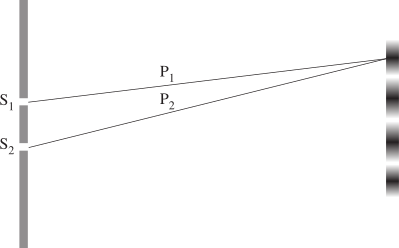
Monochromatic light of wavelength `lambda` strikes a double slit and produces bright and dark fringes on a screen. Light from slit `S_1` travels along path `P_1` and light from slit `S_2` travels along `P_2` to produce the dark fringe shown.
 

Calculate the difference in length between `P_1` and `P_2` ?  (2 marks)

Show Answers Only

`(3lambda)/2`

Show Worked Solution
  • Dark fringes occur when the path difference is an odd multiple of `(lambda)/2`. i.e at `(lambda)/2`, `(3lambda)/2`, `(5lambda)/2` etc.
  • This is the second dark fringe from the central maximum.
  • So, the difference in length between `P_1` and `P_2` is `(3lambda)/2`

Filed Under: Light: Wave Model Tagged With: Band 4, smc-3697-30-Double Slit Calcs

PHYSICS M7 2022 HSC 27

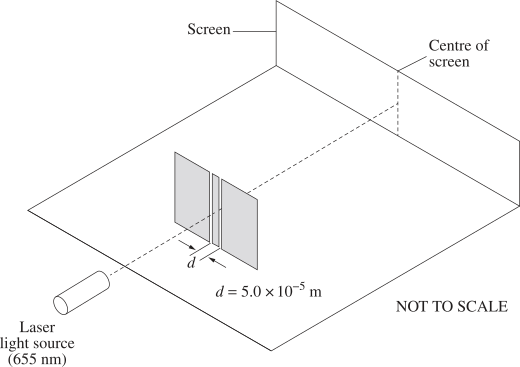
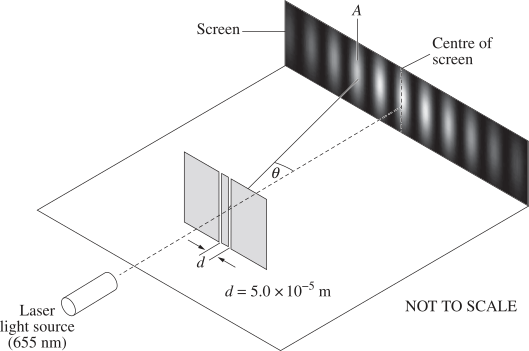
A laser producing red light of wavelength 655 nm is directed onto double slits separated by a distance, `d=5.0 xx 10^{-5} \ text{m}`. A screen is placed behind the double slits.


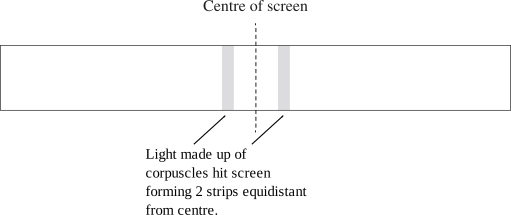
  1. Newton proposed a model of light. Use a labelled sketch to show the pattern on the screen that would be expected from Newton's proposed model.   (2 marks)


  2. When the laser light is turned on, a series of vertical bright lines are seen on the screen.
     

--- 0 WORK AREA LINES (style=lined) ---
 
  1. Calculate the angle, `\theta`, between the centre line and the bright line at `A`.   (3 marks)

--- 6 WORK AREA LINES (style=lined) ---
  1. The laser is replaced with one producing green light of wavelength 520 nm.
  2. Explain the difference in the pattern that would be produced.   (2 marks)

--- 4 WORK AREA LINES (style=lined) ---
Show Answers Only

a.   


b.
   `theta=1.50^@`

c.   Consider  `d sin theta = m lambda :`

  • `sin theta prop lambda`
  • Using light with a shorter wavelength decreases the angular separation of bright fringes.
  •  The bright lines will appear closer together.
Show Worked Solution
a.   
     

Mean mark part (a) 53%.

b.   Using  `d  sin  theta=mlambda:`

`5.0 xx10^(-5)  sin  theta` `=2 xx6.55xx10^(-7)`
   `sin  theta` `=(2 xx6.55xx10^(-7))/(5.0 xx10^(-5))`
   `theta` `=1.50^@`


c.   Consider  `d sin theta = m lambda :`

  • `sin theta prop lambda`
  • Using light with a shorter wavelength decreases the angular separation of bright fringes.
  • The bright lines will appear closer together.

Filed Under: Light: Wave Model Tagged With: Band 4, Band 5, smc-3697-10-Diffraction, smc-3697-20-Young, smc-3697-30-Double Slit Calcs, smc-3697-50-Newton vs Huygens

PHYSICS, M7 2019 HSC 15 MC

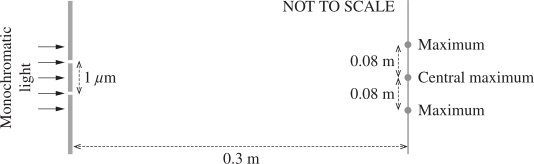
Monochromatic light passes through two slits 1 \(\mu \text{m}\) apart. The resulting diffraction pattern is measured at a distance of 0.3 m.


This diffraction pattern can be analysed using the equation  \(d \sin \theta=\lambda\).

What values of \(d\) and \(theta\) should be used in the equation?

\begin{align*}
\begin{array}{l}
\rule{0pt}{2.5ex} \ \rule[-2.5ex]{0pt}{0pt}& \\
\rule{0pt}{3ex}\textbf{A.}\rule[-2.5ex]{0pt}{0pt}\\
\rule{0pt}{3ex}\textbf{B.}\rule[-3ex]{0pt}{0pt}\\
\rule{0pt}{3ex}\textbf{C.}\rule[-3ex]{0pt}{0pt}\\
\rule{0pt}{3ex}\textbf{D.}\rule[-3ex]{0pt}{0pt}\\
\end{array}
\begin{array}{|c|c|}
\hline
\rule{0pt}{2.5ex}\quad d \quad \rule[-1ex]{0pt}{0pt}& \theta \\
\hline
\rule{0pt}{2.5ex}0.3 \ \text{m}\rule[-1ex]{0pt}{0pt}&\tan ^{-1}\left(\dfrac{0.08}{0.3}\right)\\
\hline
\rule{0pt}{2.5ex}0.3 \ \text{m}\rule[-1ex]{0pt}{0pt}& \sin ^{-1}\left(\dfrac{0.08}{0.3}\right) \\
\hline
\rule{0pt}{2.5ex}1 \ \mu \text{m}\rule[-1ex]{0pt}{0pt}& \tan ^{-1}\left(\dfrac{0.08}{0.3}\right)\\
\hline
\rule{0pt}{2.5ex}1 \ \mu \text{m} \rule[-1ex]{0pt}{0pt}&\sin ^{-1}\left(\dfrac{0.08}{0.3}\right) \\
\hline
\end{array}
\end{align*}

Show Answers Only

\(C\)

Show Worked Solution
  • \(d\) is the distance between the slits, in this case,  \(d=1 \mu \text{m}\).
  • \(\theta\) is the angular deviation of a maximum, measured from the centre of the slits .
  •    \(\theta=\tan ^{-1}\left(\dfrac{0.08}{0.3}\right)\)

\(\Rightarrow C\)

Filed Under: Light: Wave Model Tagged With: Band 4, smc-3697-30-Double Slit Calcs

PHYSICS, M7 2021 HSC 33

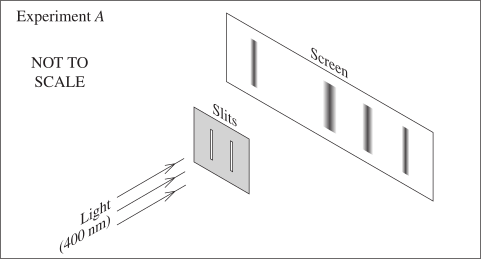
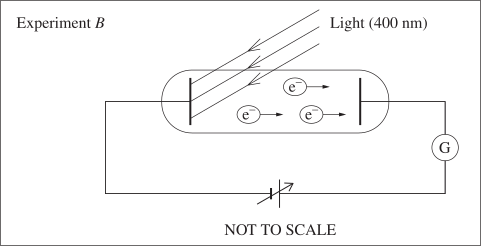
Two experiments are performed with identical light sources having a wavelength of 400 nm.

In experiment \(A\), the light is incident on a pair of narrow slits  5.0 × 10\(^{-5}\) m  apart, producing a pattern on a screen located 3.0 m behind the slits.
 

In experiment \(B\), the light is incident on different metal samples inside an evacuated tube as shown. The kinetic energy of any emitted photoelectrons can be measured.
 

Some results from experiment \(B\) are shown.
 

\begin{array}{|l|l|c|}
\hline
\rule{0pt}{1.5ex}\textit{Metal sample}\rule[-0.5ex]{0pt}{0pt}& \textit{Work function} \ \text{(J)} & \textit{Photoelectrons observed?} \\
\hline
\rule{0pt}{2.5ex}\text{Nickel}\rule[-1ex]{0pt}{0pt}&8.25 \times 10^{-19}&\text{No}\\
\hline
\rule{0pt}{2.5ex}\text{Calcium}\rule[-1ex]{0pt}{0pt}& 4.60 \times 10^{-19}&\text{Yes}\\
\hline
\end{array}

How do the results from Experiment \(A\) and Experiment \(B\) support TWO different models of light? In your answer, include a quantitative analysis of each experiment.   (9 marks)

--- 22 WORK AREA LINES (style=lined) ---
Show Answers Only
  • Experiment A supports the wave model of light as it demonstrates light undergoing diffraction as well as constructive and destructive interference, which are wave properties.
  • When light is incident upon the slits, it diffracts and causes the slit to act as a source of wavefronts. When light from the slits arrives at the screen, bright bands are produced when light waves arrive in phase and undergo constructive interference.
  • Dark bands are produced when light waves arrive at the screen out of phase and undergo destructive interference.
  • The spacing between adjacent bright bands can be calculated using  \(d \sin \theta=m \lambda\):
  •    \(5 \times 10^{-5} \sin \theta=1 \times 400 \times 10^{-9}\ \ \Rightarrow\ \ \theta=0.46^{\circ}\)
  •    \(s=3 \times \tan (0.46^{\circ})=0.024 \ \text{m}\)
  •  Experiment B supports Einstein’s particle, or photon model of light. This model can calculate the photon energy of incident light and explain why photons are emitted from calcium but not nickel:
  •    \(f=\dfrac{c}{\lambda}=\dfrac{3.00 \times 10^8}{400 \times 10^{-9}}=7.50 \times 10^{14} Hz\)
  •    \(E=h f=6.626 \times 10^{-34} \times 7.50 \times 10^{14}=4.97 \times 10^{-19} J\)
  • This energy is greater than the work function of calcium, explaining why one photon has enough energy to liberate a photoelectron from the calcium sample. However, this energy is less than the work function of nickel, explaining why no photoelectrons were observed from the nickel sample.
  • These observations support the particle model of light. Applying the particle model, the kinetic energy of photoelectrons emitted from calcium can be calculated:
  •    \(K_{\max }=h f-\phi=4.97 \times 10^{-19}-4.60 \times 10^{-19}=3.70 \times 10^{-20} \ \text{J}\)
Show Worked Solution
  • Experiment A supports the wave model of light as it demonstrates light undergoing diffraction as well as constructive and destructive interference, which are wave properties.
  • When light is incident upon the slits, it diffracts and causes the slit to act as a source of wavefronts. When light from the slits arrives at the screen, bright bands are produced when light waves arrive in phase and undergo constructive interference.
  • Dark bands are produced when light waves arrive at the screen out of phase and undergo destructive interference.
  • The spacing between adjacent bright bands can be calculated using  \(d \sin \theta=m \lambda\):
  •    \(5 \times 10^{-5} \sin \theta=1 \times 400 \times 10^{-9}\ \ \Rightarrow\ \ \theta=0.46^{\circ}\)
  •    \(s=3 \times \tan (0.46^{\circ})=0.024 \ \text{m}\)
  •  Experiment B supports Einstein’s particle, or photon model of light. This model can calculate the photon energy of incident light and explain why photons are emitted from calcium but not nickel:
  •    \(f=\dfrac{c}{\lambda}=\dfrac{3.00 \times 10^8}{400 \times 10^{-9}}=7.50 \times 10^{14} Hz\)
  •    \(E=h f=6.626 \times 10^{-34} \times 7.50 \times 10^{14}=4.97 \times 10^{-19} J\)
  • This energy is greater than the work function of calcium, explaining why one photon has enough energy to liberate a photoelectron from the calcium sample. However, this energy is less than the work function of nickel, explaining why no photoelectrons were observed from the nickel sample.
  • These observations support the particle model of light. Applying the particle model, the kinetic energy of photoelectrons emitted from calcium can be calculated:
  •    \(K_{\max }=h f-\phi=4.97 \times 10^{-19}-4.60 \times 10^{-19}=3.70 \times 10^{-20} \ \text{J}\)

♦ Mean mark 52%.

Filed Under: Light: Quantum Model, Light: Wave Model Tagged With: Band 4, Band 5, Band 6, smc-3697-20-Young, smc-3697-30-Double Slit Calcs, smc-3698-60-Experiments, smc-3698-80-Wave/Particle models

Copyright © 2014–2025 SmarterEd.com.au · Log in