SmarterEd

Aussie Maths & Science Teachers: Save your time with SmarterEd

  • Login
  • Get Help
  • About

PHYSICS, M7 2024 HSC 6 MC

The photoelectric effect is mathematically modelled by the following relationship:

\(K_{\max }=h f-\phi\)

In this model, the symbol \(\phi\) represents the amount of energy

  1. supplied by a photon to an electron.
  2. retained by an electron after being hit.
  3. required to release an electron from a material.
  4. left over after a collision of a photon with an electron.
Show Answers Only

\(C\)

Show Worked Solution
  • \(\phi\) is the symbol for the work function of the metal. 
  • The work function of a metal is defined as the minimum energy require for an electron to break free from the metal.

\(\Rightarrow C\)

Filed Under: Light: Quantum Model Tagged With: Band 3, smc-3698-10-Photoelectric Effect, smc-3698-20-Kinetic energy calcs

PHYSICS, M7 2021 VCE 16 MC

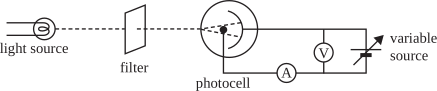
The diagram below shows a circuit that is used to study the photoelectric effect.
 

Which one of the following is essential to the measurement of the maximum kinetic energy of the emitted photoelectrons?

  1. the level of brightness of the light source
  2. the wavelengths that pass through the filter
  3. the reading on the voltmeter when the current is at a minimum value
  4. the reading on the ammeter when the voltage is at a maximum value
Show Answers Only

\(C\)

Show Worked Solution
  • The maximum kinetic energy of the photoelectrons is determined by the stopping voltage. The stopping voltage can be determined by reading the voltmeter when the current is at zero.
  • \(B\) is incorrect because although knowing the wavelengths of the light passing through will help you determine the total energy of the photons, this is different to the maximum kinetic energy of the photoelectrons (where the work function needs to be taken into account).
♦♦ Mean mark 35%.

Filed Under: Light: Quantum Model Tagged With: Band 5, smc-3698-10-Photoelectric Effect, smc-3698-20-Kinetic energy calcs

PHYSICS, M7 EQ-Bank 32

Applying the law of conservation of energy, explain why  `K_max = h f-phi`.   (3 marks)

--- 6 WORK AREA LINES (style=lined) ---

Show Answers Only
  • The law of conservation of energy states that energy cannot be created or destroyed, only transferred or transformed into different forms. 
  • The initial energy of a photon is equal to `hf`.
  • If this photon strikes a metal surface, a photoelectron may be released. Some energy is required to remove the electron from the metal surface which is equal to the work function (`phi`) of the metal.
  • The electron will also possess kinetic energy, `K_(max)`.
  • Applying the law of conservation of energy, the energy before equals the energy after, or  `hf=K_(max)+phi`.
  • Rearranging this gives  `K_(max)=hf-phi`.
Show Worked Solution
  • The law of conservation of energy states that energy cannot be created or destroyed, only transferred or transformed into different forms. 
  • The initial energy of a photon is equal to `hf`.
  • If this photon strikes a metal surface, a photoelectron may be released. Some energy is required to remove the electron from the metal surface which is equal to the work function (`phi`) of the metal.
  • The electron will also possess kinetic energy, `K_(max)`.
  • Applying the law of conservation of energy, the energy before equals the energy after, or  `hf=K_(max)+phi`.
  • Rearranging this gives  `K_(max)=hf-phi`.

Filed Under: Light: Quantum Model Tagged With: Band 4, smc-3698-20-Kinetic energy calcs, smc-3698-30-E=hf calcs

PHYSICS M7 2022 HSC 26

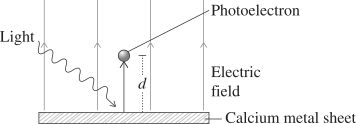
Light of frequency  `7.5 xx10^(14) \ text{Hz}`  is incident on a calcium metal sheet which has a work function of  `2.9 \ text{eV}`. Photoelectrons are emitted.

The metal is in a uniform electric field of `5.2 \ text{NC}^{-1}`, perpendicular to the surface of the metal, as shown.


  1. Show that the maximum kinetic energy of an emitted photoelectron is  `3.2 xx10^(-20) \ text{J}`.  (3 marks)

--- 6 WORK AREA LINES (style=lined) ---

  1. Calculate the maximum distance, `d`, an emitted photoelectron can travel from the surface of the metal.  (3 marks)

--- 6 WORK AREA LINES (style=lined) ---

Show Answers Only
  1. Proof (See Worked Solution)
  2. `0.038  text{m.}`
Show Worked Solution
a.    `K_(max)` `=hf-Phi`
    `=6.626 xx10^(-34)xx7.5 xx10^(14)-2.9xx 1.602 xx10^(-19)`
    `=3.2 xx10^(-20)  text{J}`


b.   Maximum Distance:

  • The electric field will do `3.2 xx10^(-20)\ text{J}` of work to stop the electron.
`W` `=qEd`     
`3.2 xx10^(-20)` `=1.602 xx10^(-19) xx 5.2 xx d_max`  
`:.d_max` `=(3.2 xx10^(-20))/(1.602 xx10^(-19)xx 5.2)`  
  `=0.038  text{m.}`  

♦ Mean mark (b) 51%.

Filed Under: Light: Quantum Model Tagged With: Band 4, Band 5, smc-3698-10-Photoelectric Effect, smc-3698-20-Kinetic energy calcs

PHYSICS, M7 2021 HSC 20 MC

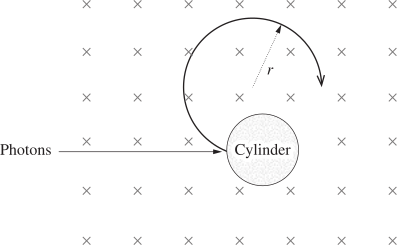
A metal cylinder is located in a uniform magnetic field. The work function of the metal is `phi`.

Photons having an energy of 2`phi` strike the side of the cylinder, liberating photoelectrons which travel perpendicular to the magnetic field in a circular path. The maximum radius of the path is `r`.
 

If the photon energy is doubled, what will the maximum radius of the path become?

  1. `2r`
  2. `3r`
  3. `sqrt2r`
  4. `sqrt3r`
Show Answers Only

`D`

Show Worked Solution
`K_max` `=(1)/(2)mv_(max)^2`  
`v_(max)` `=sqrt((2K_(max))/(m))\ \ `… (1)  

  
Substitute (1) into  `r=(mv)/(qB)`:

    `r=(m)/(qB)sqrt((2K_(max))/(m))`

    `r prop sqrt(K_(max))`
 

  • When the photon energy is `2phi, K_max=phi.`
  • When the photon energy is doubled to `4phi, K_max=3phi.`
  • ∴ Since  `r prop sqrt(K_(max)) ` the radius increases by a factor of `sqrt(3).`

`=>D`


♦ Mean mark 24%.

Filed Under: Charged Particles, Conductors and Electric/Magnetic Fields, Light: Quantum Model Tagged With: Band 6, smc-3693-65-Uniform Circular Motion, smc-3698-10-Photoelectric Effect, smc-3698-20-Kinetic energy calcs

Copyright © 2014–2025 SmarterEd.com.au · Log in